
To add a group to Britain’s list of proscribed organizations, first the Home Secretary has to declare it a terrorist organization–”one that engages in or promotes terrorism,” according to a government website–and then Parliament has to approve the addition.
If you aspire to get your local birdwatchers group added to the list, those are the hoops you’ll have to jump through. As soon as those two things are done, it becomes illegal to belong to it or promote it. Or invite support for it. Or arrange or assist with a meeting that supports it. Or address a meeting that etc., presumably even if you stand up at the meeting and say, “Everybody stop this and go home.” Or publicly wear clothes that “arouse suspicion of membership or support.” Or display anything that arouses suspicion of etc.
If this is starting to sound abusably wide-ranging, stay with me. We’ll get to that.
The maximum sentence for any of those things can be as high as 14 years. Plus a fine.
Palestine Action
Not long ago, the British government added a group called Palestine Action to the list, so now anyone who’s a member or who “recklessly expresses” support for the group (I’m quoting from yet another government website there) is dicing with the possibility of a prison sentence. Two other organizations were added at the same time: the Maniacs Murder Cult and the Russian Imperial Movement.
Palestine Action describes itself as disruptive but nonviolent and targets companies involved in arms sales to Israel. They’ve occupied premises, destroyed property, gotten themselves arrested, and used spray paint. They’ve probably even gotten spray paint on their clothes. They haven’t killed, tried to kill, or threatened to kill anyone.
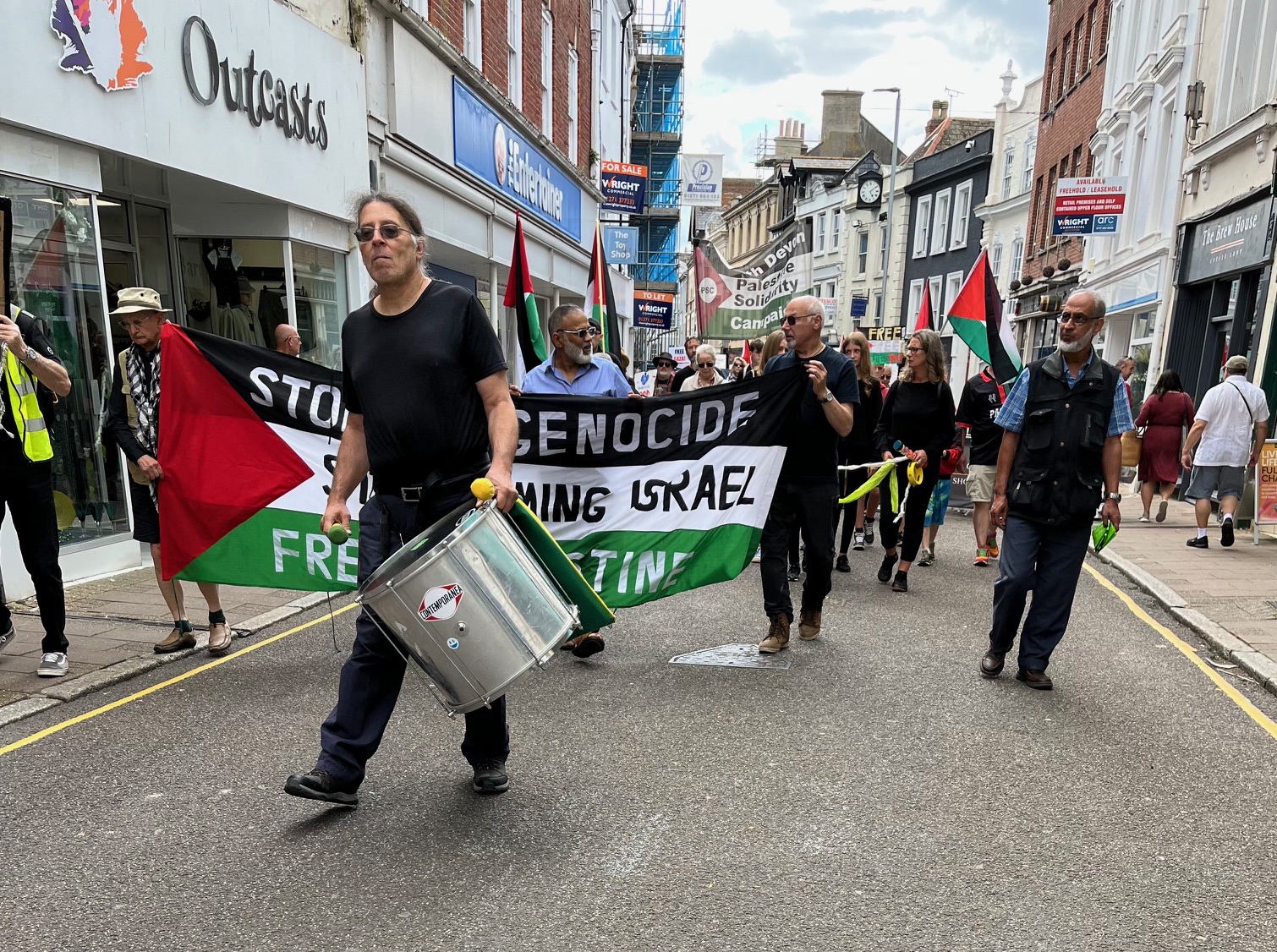
A demonstration in Barnstaple, Devon, against the genocide in Gaza.
The Russian Imperial movement is a white supremacist and monarchist organization that promotes a Russian imperial state and has been linked to a series of letter bombs and has a paramilitary training wing based in Russia.
The Maniac Murder Cult is an international white supremacist, neo-Nazi organization that exists mostly online. It encourages acts of violence against homeless people, drug addicts and migrants. Its leader’s known as Commander Butcher and is facing charges in the US for allegedly telling an undercover federal agent to dress up as Santa Claus and hand out poisoned candy to non-white kids and students at Jewish schools. The disconnect between Jews and Christmas seems to have gone over his head. A fair number of non-religious Jews do celebrate it–my family did, although without the poison candy–but families who send their kids to specifically Jewish schools? They’re really not Santa’s target audience.
What I’m saying here is that in addition to being allegedly homicidal, this guy needs career counseling. And jail time.
That leaves Palestine Action as the odd one out on the list.
Meanwhile, in what passes for the real world
Banning Palestine Action has led to more than 700 arrests, and here’s where we get to that business about the law being abusably wide-ranging. In Kent, a woman was arrested for holding a Palestinian flag and signs saying “Free Gaza” and “Israel is committing genocide.” She filmed the police telling her that the words free Gaza supported Palestine Action and that it was illegal “to express an opinion or belief supportive of a proscribed organization.”
In Leeds, a man was arrested for carrying a cartoon from the magazine Private Eye. The text read:
PALESTINE ACTION EXPLAINED
Unacceptable Palestine Action
Spraying military planes with paint
Acceptable Palestine Action
Shooting Palestinians queuing for food
“It’s a cartoon from Private Eye,” he told his arresting officer. “ I can show you. I’ve got the magazine in my bag,”
By that time, they were putting him in handcuffs. He was released on bail six hours later, but on the condition that he not attend any more Palestine Action rallies.
The rally where he was arrested hadn’t been organized by Palestine Action.
A few days later, charges were dropped.
“If I go on another demo,” he asked the anti-terrorism officer who called to tell him that, “and I hold up that cartoon again, does that mean I will be arrested or not?”
“I can’t tell you,” she said. “It’s done on a case-by-case basis.”
As indeed it is. The magazine’s editor hasn’t been arrested. Neither has the cartoonist.
An 80-year-old woman was arrested at a rally in Wales and the police searched her house, removing a Palestinian flag, books on Palestine and on the climate crisis, iPads, drumsticks, and the belt for a samba drum. They brought in a geiger counter–or what a friend who walked in to feed the cats in the middle of the search thought was a geiger counter–and poked long cotton buds into jars of dry food.
The phrase Palestine Action gets loose in the world
All that is why there was a demonstration in Parliament Square, in London, on August 9, where people showed up with blank signs and markers. Once more than 500 who were willing to be arrested had gathered, they made signs saying, “I support Palestine Action.” All 532 were duly arrested. Half of them were over 60.
One of them, though, wasn’t holding a sign but wearing a tee shirt that read “Plasticine Action” and was designed to mimic the Palestine Action logo. I’m not sure if that makes it 531 arrests there or 533. Or if we stay with 532.
As he waited to be booked, his arresting officer reappeared and told him, “I’ve got good news and I’ve got bad news.”
Plasticine Man–his name is Pickering–asked for the good news.
“I’m de-arresting you.”
“What’s the bad news?”
“It’s going to be really embarrassing for me.”
Pickering is now selling the tee shirts to raise money for Medical Aid for Palestine. It comes in your choice of 26 colors.
As far as I know, I’m not risking arrest by linking to that.
Palestine Action has won the right to appeal its ban, but until the case is heard it’s still officially a terrorist organization. When I went to a local demonstration against the starvation of Gaza, I picked my way carefully through the English language before making a sign asking, “Are we allowed to say Gaza?”
As a naturalized citizen, I’m not in a position to risk arrest.
There have been no demonstrations asking to free the words Maniacs Murder Cult or Russian Imperial Movement.
The starvation of Gaza continues. And the next planned demonstration against the ban on Palestine Action is asking people who get arrested to refuse to be processed on the street and released. If they’re taken to the police station, they’re entitled to a lawyer and can clog the jails.
*
Meanwhile, in the Protestant section of Belfast, Northern Ireland, vigilantes calling themselves Belfast Nightwatch First Division are patrolling the evening streets, challenging dark-skinned people to produce identity documents and explain what they’re doing in the eastern part of the city, threatening anyone whose responses don’t satisfy them.
One member was quoted as telling a Black man sitting on a bench, “Hey boy, I don’t want to catch you around our parks any more.”
Nightwatch First Division is not on the list of terrorist organizations, although to be fair to a government that pisses me off with amazing regularity, it’s new and may or may not have any structure behind the name.
A neo-Nazi group called Blood and Honour (the phrase comes from the Hitler Youth) is also not on the list, although the government says it has “reasonable grounds to suspect” it’s involved in “terrorist activities through promoting and encouraging terrorism, seeking to recruit people for that purpose and making funds available for the purposes of its terrorist activities.”
It has frozen its assets.
 Notes from the U.K.
Try living in an area where “Palestine Action” have vandalised buildings in residential suburbs, and their actions have been classified by Greater Manchester police as “racially aggravated hate crime”. Round the corner from schools, frightening young families.
LikeLiked by 1 person
I appreciate your comment, and I won’t argue that their tactics are wise or well judged. But it’s a big leap, I think, from there to listing them as a terrorist organization. I’m also skeptical about calling their actions racially motivated or hate crimes. I suspect that comes from a definition of antisemitism that calls any criticism of Israel antisemitic–a definition that would sweep me into the category.
LikeLiked by 2 people
The term was used by the police. These weren’t buildings connected with Israel: they were in a residential area of Manchester. If people want to protest outside an embassy, or in a city centre, then that’s one thing; but this caused a lot of upset and fear in a local community. But the real issue is that they vandalised Royal Air Force equipment – although why Brize Norton’s security was so weak that people were able to break in is another question.
LikeLiked by 1 person
I don’t doubt that the police used the term, but I’m pretty sure it was based on the definition I challenge. It was widely circulated and pushed very hard–and it’s a politically useful way to shut down any criticism of government policy.
LikeLike
Well, I could go and rob a bank, and then say that I challenge the definition of bank robbery. It doesn’t really work like that! They vandalised an office block in a residential area, and caused a lot of distress. These people are so entitled that they think it’s OK to go around damaging anything they please, but how does damaging a suburban office block help anyone?
LikeLiked by 1 person
They made a choice to break, enter, and do damage. They expected to be arrested and I doubt anyone’s arguing that they shouldn’t be. The problem comes in escalating that to terrorism.
LikeLike
Statistically, I suppose I must be the one who’s crazy, it can’t really be true that the majority have lost the plot… Is feeling sane in a mad world a symptom of insanity?
Jeannie
PS. I never expected it might be wise to discuss a subject without mentioning it in this country but things have been sliding in that direction for a while. You’re never too old to learn… but maybe I’m old enough not to care? (Though it doesn’t do to compromise others).
LikeLiked by 1 person
I can’t pretend to know what the majority think, or even if they’re paying attention. We can only do and say what we think is right and hope it makes a difference.
LikeLiked by 1 person
Thank you for laying the machinery bare – the gears and pulleys that make a law look tidy while it reaches for the throat of language itself. What chills here is not merely the statute’s reach but its ease, the way a phrase like “recklessly expresses support” lets authority choose its prey after the fact, and call that prudence. A government will always tell itself it is saving lives; the question is whose lives, and at what cost to the living tongue. When a slogan, a cartoon, a blank placard becomes contraband, the state is no longer policing danger – it is policing doubt.
The examples you gather – the woman in Kent, the man with the Private Eye cartoon, the 80-year-old whose pantry became a crime scene – show the law working exactly as designed: wide enough to catch the timid and the bold alike, vague enough to reassure itself that justice is being done while confusion does the rest. “Case by case” is not guidance; it is a shrug dressed in epaulettes. And so speech is chilled, gatherings are cordoned by uncertainty, and an ordinary citizen learns that innocence is not a refuge but a wager.
As for the company Palestine Action keeps on that list – the murderer’s fantasy club beside the tsarist fever dream – it is not only incoherent; it is instructive. Fold a non-lethal, property-focused campaign into the same ledger as groups that school men in hatred and weapons, and the ledger begins to teach its own lesson: that harm to things can be made to weigh more than harm to people, if the people are far enough away, or the things profitable enough here at home. Meanwhile, those who menace strangers on Belfast streets move as if history were a local custom, not a warning. Freeze an account, unfreeze a principle; the arithmetic is always convenient to the bookkeeper.
The oldest trick of power is to make language do its killing early. Call a sentiment support, call a doubt sedition, call a poem a plan. Then let the night fill with sirens, each one insisting it is the sound of safety. What you have recorded is the sound of something else: a country teaching itself to fear its own citizens, and citizens learning to fear their own mouths. The law claims to be a cure; the symptoms suggest a hunger.
There is, nevertheless, a stubborn mercy in the public square – the 532 who chose to be counted, the silly grace of Plasticine Action making the badge ridiculous, the quiet insistence that words are not weapons unless the state decides to fire them. If there is an answer worthy of a government, it is not the prison door; it is the courage to hear dissent without demanding it kneel. Until then, people will go on speaking, softly if they must, and the language will continue its dangerous work: saying what is there to be seen, and refusing the comfort of sanctioned silence.
LikeLiked by 3 people
I was surprised, given Keir Starmer’s background as a human rights lawyer, that he’s thrown his weight behind a campaign that I assume he’d have opposed as a lawyer in private practice. But here we are.
LikeLiked by 3 people
It is the old British drama: the barrister who once argued for the perimeter of liberty becomes the statesman who redraws the fence, and calls it prudence. Backgrounds make fine biographies; they do not bind a government’s hand when fear is made into policy and policy into theatre. What surprises is not that a former human rights lawyer lends his name to this net, but how quickly the language of rights learns to speak in the register of order once power changes the room.
LikeLiked by 1 person
Sigh.
LikeLiked by 1 person
“Speaking, softly”? They vandalised Royal Air Force military aircraft, potentially endangering the country in the event of an attack by, say, Russia, and leaving the taxpayer with a £7.5 million repair bill. That’s not really “speaking”!
LikeLiked by 1 person
The word is not a hammer, but it can unmask one. What happened on the tarmac was not a sermon; it was sabotage – and no one called it otherwise. Yet hysteria thrives on embroidery: “endangering the country” is a flourish, not a fact, and the arithmetic is doing more shouting than the deed. A £7.5 million bill is a price; it is not a prophecy of invasion, and it does not convert civil disobedience into treason on the runway. The law already has names for criminal damage; the leap to existential peril is theatre, and poor theatre at that.
What must be kept clear is this: equating the non-lethal wrecking of property with an assault on the nation is a convenient confusion. It collapses proportion, erases intent, and turns a political objection – however abrasive -into a folk tale about open gates and marching armies. If the state cannot tell the difference between a can of paint and a bomb, then it is not security that is weak, but judgment. And judgment, unlike an aircraft, cannot be repaired with a cheque.
LikeLiked by 2 people
£7.5 million of damage is £7.5 million of damage, whether it was caused by paint, a bomb or anything else. And attacking Royal Air Force property is certainly an assault on the nation. Did Gandhi go around smashing up military aircraft? Did Martin Luther King? No. But “Palestine Action” will do anything to get their names in the papers. It’s nothing to do with Palestine. How does damaging a plane or a painting affect anything that happens in the Middle East? If you want folk tales, there are the folk tales!
LikeLiked by 1 person
Let’s keep our heads. Damage to property is unlawful; that’s clear. But collapsing every unlawful act into an “assault on the nation” is how a society swaps proportion for panic, and judgment for a headline. A sum on a repair invoice – £7.5 million – tells us something about costs; it tells us nothing about treason, intent, or public safety. Law already has tools for criminal damage. What it doesn’t need is the drumbeat that turns a can of paint into an invading army.
Gandhi and King practised nonviolence with discipline and moral clarity – and they also faced a state eager to label dissent as danger. Their legacy isn’t a museum of perfect tactics; it’s a standard: keep faith with life, confront injustice openly, accept legal consequences, and force a conversation the powerful would rather avoid. That standard doesn’t require agreeing with every tactic. It does require resisting the reflex that brands protest – the noisy, disruptive kind that interrupts comfort – as an attack on the country itself. A democracy confident in its skin can tell the difference.
And the question “what does this do for Palestine?” has an answer, whether one likes it or not: it targets suppliers, interrupts normal business, and drags the moral costs of those links into public view. That is why museums, factories, and forecourts become stages; not because a painting or a plane bleeds, but because attention does, and policy follows attention. One can condemn the methods and still admit the point: to make distant suffering legible where decisions are made. That’s politics – untidy, sometimes infuriating – but it isn’t the fairytale here. The fairytale is that freedom can be preserved by cuffing dissent until it behaves.
LikeLiked by 2 people
You’ve said it more eloquently than I could have.
LikeLiked by 1 person
I think we’ll have to agree to disagree on this one. Many people see many things as being injustice. If we all used our interpretation of events to justify vandalism as a way of trying to get attention, every vehicle and building in the country would be smashed up regularly.
LikeLiked by 1 person
Totally in agreement with all of the comments above. I agree that a protest group shouldn’t cause fear in anyone else, but if we don’t have a right to peacefully state or show our opinion, where does that leave us?
LikeLiked by 1 person
Indeed.
LikeLike
Not sure I can add anything constructive to this, especially after Bob’s excellent summation. I’m just horrified that the Labour Party would go down this route after their criticisms of the excesses of the previous administration. It does seem we’re being, let’s say, actively discouraged from voicing any criticism of Israel and their genocidal actions – whoops!
LikeLiked by 1 person
They seem to be trying to out-Farage Farage. Never a good plan, but at this point I doubt they can back away from it, even if they had the sense to want to.
LikeLiked by 1 person
“Voicing”? They vandalised Royal Air Force military aircraft, potentially endangering the country in the event of an attack by, say, Russia, and leaving the taxpayer with a £7.5 million repair bill.
LikeLiked by 1 person
We are building detention camps as fast as we can for high school honor students and athletes, and factories full of Korean Hyundai workers. And we have the FBI looking for Texas legislators. What could go wrong ? ! ? We are only deporting the worst of the worst. Oh wait he is still in Washington…
LikeLiked by 1 person
These are terrifying times, truly.
LikeLiked by 1 person
Over here, you are anti-Semitic if you say anything even remotely connected to suggesting people are struggling in Gaza. At one point, Palestinians were considered a Semitic race.
LikeLiked by 1 person
Israel gave antisemitism a real boost by pretending that criticizing Israel is antisemitic. I hear you about the definition of semitic but that’s kind of a side issue, don’t you think?
LikeLiked by 1 person
Absolutely. Someone needs to stop the genocide
LikeLiked by 1 person
And the folks who have the power to aren’t doing it. All the rest of us can do is make as much noise as we can and hope it helps.
LikeLiked by 1 person
Rivalling the US arrest of the guy who threw a hero sandwich (one of those in a long loaf of bread – six inches to a foot or so – filled with cold cuts, veggies, meatballs etc etc) The sandwich was still fully wrapped up and the gummint agent he hit with it was in full uniform including body armor. After several days of hurly-burly the judge threw the case out. Had there been hot peppers in the sandwich the charges of assaulting an officer might have tuck.
LikeLiked by 1 person
I suppose it’d be tacky to say he’s my hero, wouldn’t it?
LikeLiked by 1 person
What a world we’re living in right now. I can’t find the words…
LikeLiked by 1 person
I know the feeling. And yet words are our weapons. We need to find and use them.
LikeLiked by 1 person
So long as Palestine allows itself to be represented by Hamas I’m not surprised that any pro-Palestine statement can be classified as pro-terrorist. And yes, the confused reports about who’s keeping whom from delivering food to Gazans do show that Americans cannot in practice tell one lot of Semites from another.
It’s strictly a load of irrational aging-female hormones that make us want to feed babies. However I’m not sure that the male hormones that make others feel that nits make lice, and starving a Hamas goon’s infant son now saves the trouble of having to shoot him later, are all that much more rational. At the same time I was watching a kitten with genetic defects demonstrate that some babies starve to death even when enough food to nourish their relatives is spread out before them, and even though the story of the NYT poster child suggests that something other than lack of food killed him too, I still felt bad about the babies.
Are Brits allowed to say “As a woman I want to feed babies”?
Pris cilla King
LikeLiked by 1 person
First off, Israel boosted Hamas way back when they thought it’d be clever to have a religious group topple the PLO–the Palestine Liberation Organization. They’re hardly in a position now to blame the Palestinians, who could no more hold an election in the midst of the destruction that’s been unleashed on them than I could fly. And if a country sets out to kill children because they’ll grow into adults and enemies, that, my friend, is genocide. And this is genocide. Children and adults, both, are being starved, deliberately, and shot at food distribution points. They’re not dying in the presence of plenty but from deliberate policy.
But yes, saying you want to feed babies doesn’t break the law. Yet.
LikeLiked by 1 person
A while ago, I read an article by someone who met the person who had been trolling her for “commie, feminist, anti-men, etc” views. She said he was a personable, normal seeming man who had become convinced of ideas totally opposed to hers. In some ways, no problem, we all disagree over something. Where the issue lay was his belief that, not only was she a representative of wrongness, even wickedness, and not entitled to express, or even hold, her beliefs, but that he was entitled to condemn and abuse her in the most revolting terms and anonymously. Her conclusion was, that the meeting had educated her, and (possibly) him, but that there was no way that either could find common ground or persuade each other to modify their views.
I simply don’t know how to address that kind of thing, except by persistently expressing my own beliefs and feelings in a moderate way, even when I feel like screaming my disagreement. Is there a tipping point?
Jeannie
LikeLiked by 1 person
A tipping point for an individual or a society? Probably yes for either, come to think of it. That’s an interesting tale. Mary Beard entered into an extended conversation with someone who was trolling her, and I think she did end up convincing him that she was human and worthy of some different kind of communication. Not many of us, though, have the time, patience, or strength for that.
LikeLike
This is a non-comment. I refuse to walk into that mire.
You will not find me on a “Pro Palestine” demonstration, or in a Roger Waters concert.
LikeLiked by 1 person
I’ve never gotten a non-comment before. I’ve not gotten a fair few actual comments, but a non-comment is a first. Congratulations.
LikeLike
Your piece hits hard — clear, biting, and at times darkly hilarious without ever softening the seriousness. Really strong work; it stays with you after reading.
LikeLiked by 1 person
Thanks for that. I appreciate it.
LikeLike
Nonviolent, huh? Perhaps we should change the rhetoric. I think Nepal did a great job.
LikeLiked by 1 person
Interesting reading, Ellen and rather “mixed” reaction frm your followers. I live in the Bogside in Derry. The support for Gaza is steadfast here. All visitors whether people of colour, American, French, Spanish tourists are all welcome in Derry. Indeed so are English women, like me. My husband was told to go back to Northern Ireland in Swansea way back after the Brexit vote in 2016. Intolerance is ugly in all its forms.
LikeLiked by 1 person
Sounds like a good place to live, and one where I’d feel at home. As this self-destructive tide of hate rises, it’s good to know they still exist. Thanks for writing.
I haven’t seen your blog posts in an age. Did I somehow unsubscribe or have you gone quiet?
LikeLiked by 1 person
My father was taken ill and died over the summer, which is why everything has gone “quiet”. I am taking my time finding my feet again in Derry. It’s a lively and friendly city. It has problems but like it here.
LikeLiked by 1 person
Oh, hell, I’m sorry. I know how hard that can hit. Sending love.
LikeLike
The emphasis on mythical white supremacists completely discredits what you have written. Maniacs Murder Cult are primarily an anarchist and anti-working class fanatic group.
The anti-white attitude of the text is a symptom of a greater hierarchy of prejudice that favours rich over poor; women over men; non-white over white and Moslem privilege. Kier Starmer is an example of effectively all modern day white racists; those who hate their own race in the name of the Woke sickness and the social disease of political correctness. All aimed to make the rich richer and the poor poorer.
All forms of prejudice should be treated the same instead of the endemic demonisation of white people as seen in the institutionally classist (anti-working class) and racist (anti-white) BBC.
LikeLiked by 1 person
White supremacists are mythical, eh? Let’s not go into the ones I’ve known, let’s just look at what’s been happening in Minnesota, where being brown- or black-skinned in public can be enough to get you swept off the street–no warrant, no nothing–and thrown into an immigration detention center, with way to contact your family or a lawyer, and only the barest minimum of food. They’ve taken citizens and non-citizens; legal immigrants and undocumented ones; people with no criminal record whatsoever; native-born citizens and naturalized citizens. Gee, it’s a good thing that’s not racism, because I’d hate to think what it’d be like if genuine racism was on the loose.
Listen, my friend, I think you drank the kool-aid the billionaires are passing out. While they hand billions to the big corporations and protect the billionaires, they tell you the problems in your life are the result of brown people, black people, Muslims, immigrants, women–. Have I left anyone out? They’re not. Until we can tax the rich, we don’t stand a chance of putting this country back together after the damage years of austerity did.
LikeLike