Folks, I’m recovering from Covid and am taking a week off. Possibly even two. I’m not at death’s door–no fretting, please–but I do need a break. I’ll be back when I’m vaguely competent again.



Folks, I’m recovering from Covid and am taking a week off. Possibly even two. I’m not at death’s door–no fretting, please–but I do need a break. I’ll be back when I’m vaguely competent again.
Crime is down in Britain compared to what it was in 2010, and the headline news is that this wasn’t headline news. It slid past while we were dozing, or worrying about why the cat had been gone for over a week. Was it trapped in someone’s shed?
How do I know what we were doing when it slid past? My research methods involve following (a) what goes on around our house and (b) what I see on the village Facebook page.
The cat did come home, but considerably later, and it didn’t say where it had been or what it got up to, but I do have information on crime. According to the Crime Survey for England and Wales:
Sexual offences are up, but as the survey says, “Police recorded sexual offences are not a good indicator of trends over time. Improvements in police recording practices, the introduction of new offences, and increased reporting by victims have contributed to the level of offences in recent years.” I’d love to give you a neat, round number for how much they’ve gone up but what I found wasn’t neat and wasn’t round. It was complicated and I fled. But that does tell you something about the survey: where it doesn’t think the numbers are a fair reflection of the real world, it says so.

A marginally relevant illustration, from The chronicles of crime; or, The new Newgate calendar, being a series of memoirs and anecdotes of notorious characters who have outraged the laws of Great Britain from the earliest period to 1841. Courtesy of Wikimedia Commons.
What we believe
As interesting as the results themselves–maybe more interesting–is the mismatch between what we think we know about crime and what the statistics tell us. Eight in ten people in the country are convinced crime’s rising. That’s what (depending on where we get our news) we read. It’s what we tell each other. It’s in the air. It’s in the salt shakers down at the pub. It walks down the street waving banners. It’s what we just know.
And we’re wrong. Two out of three people are sure the murder rate’s gone up or at best stayed the same. Eight out of ten think mobile phone thefts have gone up and six in ten believe the same about burglary and vehicle-related thefts.
Where immigration and sexual offenses meet, belief and reality move so far apart they can barely yell insults at each other. Or more accurately, they can yell but they can barely hear each other. The average guess is that 30% of the people cautioned or convicted of sexual offenses are foreign nationals. Supporters of Reform UK (an anti-immigrant populist party) guess it’s 50%. In fact, it’s 15%.
I’d love to explain what average means there and how anyone arrived at it, but that’s how the numbers were presented and I don’t want to cross the line between quoting and making stuff up.
So what can any sane politician (or the local know-it-all, for that matter) do when the numbers don’t support his or her conclusions? Attack the source, of course. Nigel Farage, the personality Reform coalesces around, has said the crime survey isn’t fit for purpose. The Office for Statistics Regulation, though, calls it a robust source.
I’m struggling to keep my fingers from turning that into the Office for Regular Strangulation, but in spite of that I’ll put my faith in them before I put it in Nigel Farage.
Translations and explanations
For the sake of non-British readers, let me give you a few definitions and a comment on statistics:
You will, of course, do whatever you like with the numbers. Just don’t tell me about it.
But we were talking about crime statistics.
Fraud
The number of bank and credit card scams went up 19% in–if I’m reading this correctly, which isn’t guaranteed–the previous year. To balance that out, the total number of frauds stayed pretty much the same and the “other fraud” category was down 40%. All told, there were 3.1 million incidents and 2.3 million of the victims were fully reimbursed.
But since we base our beliefs about the world at least in part on our experience of it, I was convinced the number of frauds had gone through the roof, taking part of our insulation with it. I’ve got scamsters on my phone. I’ve got them in my inbox. Come December they’ll be coming down the chimney claiming to be Santa Claus.
I can’t be the only person thinking they’ve torn have a hole in their roof, because when the government sent a group of people a letter saying something along the lines of, “You’re entitled to a refund,” it launched a full-scale PR campaign explaining that the letter wasn’t a scam and that recipients did need to respond but should only respond through official channels. Because someone out there is surely sharpening their talons and setting up copycat websites so they can move that money to their own bank accounts.
So no, statistically speaking fraud hasn’t gone up, it only feels like it has.
Booking.com rentals
The weirdly named consumer group Which? considers Booking.com so scam-ridden that it tested its security by listing 10 Downing Street, the prime minister’s residence, on it. “‘1 bedroom apartment in the heart of London. . . .’” the listing said. “‘10 Downing Street, London,’ alongside a photo of the most famous front door in Britain. Just four minutes on foot to the Houses of Parliament, it promised.”
It was such an obvious fake that they didn’t expect to get away with it, but the site took bookings.
“Creating the listing took about 15 minutes,” Which? wrote. “At no point were we asked to prove that we owned the property, or indeed that I was a real person. . . . It took a full 18 months until Booking.com asked us for photo ID and a valid National Insurance number to prove our identity. When we didn’t provide this, the listing was finally blocked – 20 months after it was first set up”–and that was in response to a new law.
“Immediately, it was a big hit. We ensured nobody could book without being approved, but a startling 14 people asked about its availability in the first 20 minutes. If you live abroad, you may have no clue this is the Prime Minister’s home – it’s just a bargain in central London.
“Worse, Booking.com made no attempt to prevent us paying for a week’s stay at 10 Downing Street. We’re still not sure if we will get all our money back. Despite us telling Booking.com that the listing is fraudulent, it wasn’t until 31 August that it cancelled the stay and we received an email about a refund. It’s not clear from the email whether we will receive a full refund, or if Booking.com will retain a fee or commission for the booking.
“Even if it pays us back in full, it’s happily held on to the money for two months – and presumably earned interest on it. Some of its multi-billion-dollar revenue this year will – unbelievably – come from the money we paid it for a phoney week’s stay at the home of the Prime Minister. . . .
“Bizarrely, Booking.com didn’t take the listing down – even when we told it what we’d done. We then went one step further and wrote a fake review of our fake stay. ‘It was unbelievable that Booking.com let us stay at 10 Downing Street – the home of the UK PM!’ we enthused in a 10/10 review.
“To make sure Booking.com’s review moderators knew it was a joke, we added that our favourite part of the stay was ‘Hanging out with Larry The Cat’.
“But although the platform said that the review would be ‘checked by our moderation team’ before being posted, it was published within minutes. Our 10/10 score meant that 10 Downing Street was now officially rated by Booking.com as ‘exceptional’. Booking.com finally deleted the account on 27 August – around two months after it was set up.”
There’s more but I’ll leave you to follow the link if you want to enjoy the full tale.
That’s not really related to crime statistics but I couldn’t resist throwing it in.
Immigration
In September, in response to immigrants who’d tried to cross the Channel in a small boat, been rescued by the RNLI–the Royal National Lifeboat Institution–and brought ashore at Dover, anti-immigrant demonstrators blocked roads for several hours. They dressed in black, wore balaclavas, chanted “Christ is king,” and called themselves Christian patriots. They were well organized, disciplined, and militaristic.They’d been called together by something called Patriot Platform.
Not long afterward, the Portsmouth Patriots held a rally in–you guessed it–Portsmouth, describing immigration as a “national emergency of migrant-driven crime, particularly against women and children.” (I’m quoting from the Observer there, not the group itself. If the article’s behind a paywall, I apologize but I swear I’m not the one who put it there.)
The article quotes one participant as saying, “None of the crime figures really are truly being broadcast. The police don’t let the data out. So consequently–this is the trouble, isn’t it?–nobody knows.”
In other words, if the figures aren’t the ones I believe in, they either don’t exist or have been fiddled with.
In Poole, demonstrators handed women rape alarms as protection against those hoards of immigrant men.
Somehow these guys just love thinking about women being raped.
If you’re looking for protection, the head of the Patriot Platform, Daniel Thomas, called Danny Tommo, might not be your obvious choice. He served time for an attempted kidnap. Apparently, he and some other men claimed someone had stolen £10,000 worth of drugs from them, so they tried to kidnap him at knifepoint, as any sane, rational adult would.
The judge described the attempt as both “extraordinarily frightening” and “stupid.” According to Wikipedia, the claim that the man had stolen the drugs was false.
The organization doesn’t have seem to have much in the way of a program but has been good at mobilizing people and managing its social media. So far. Having raised a fair bit of money for Patriot Platform, Thomas shifted to raising money for his mother, who he claimed had to move because the Daily Mail had–
Okay, he doesn’t say they printed her address but that based on what they had printed people would be able to figure out where she lived. So he showed up at the Mail’s office with a dozen masked men wearing black shorts and hoodies and livestreamed himself “threatening that unless the newspaper organised his mother a new home within 48 hours, he would be back again with a larger contingent of men.”
On a Wednesday, he went online asking for donations to help his mother move. She was living “a state of absolute fear. . . . It would be right for the country to rally together and help her in this time of need.” By Friday afternoon, he had more than £62,000.
How well that’ll play with the wider public is anyone’s guess.
So who are they angry at?
It took no time at all for the definition of bad guys to widen. This seems to be driven by some previously unknown law of physics. Think of Trump’s anti-immigrant drive. He starting out saying that he was going to deport not all immigrants but “the worst of the worst,” then before you had time to sneeze and throw away your kleenex he had got masked men (also dressed in black; they have a thing about black) pulling random brown people out of cars and off the street when they walk their kids to the shool bus.
How many of the people who’ve been snatched even have criminal records, never mind being the worst of the worst? According to the Cato Institute, a conservative thinktank, 5% have convictions for violent crimes; 73% have no criminal record at all.
Some entered the country legally and were arrested at routine immigration hearings. The occasional citizen gets picked up, shouting “But I’m a citizen” and is–I believe although I can’t swear to that–eventually realized.
That sounds like it’s off the subject, but it’s not. Once anti-immigrant rhetoric dominates the national conversation, its target expands.
So who else did Britain’s anti-immigrant crew decide were the bad guys back in September? The RNLI for one. For some time, it had been under pressure not to rescue migrants, and it stood its ground, saying its lifeboats would rescue anyone at sea whose life was in danger. Following the Dover incident, volunteers (the RNLI isn’t a government body and relies heavily on volunteers) reported being harassed and threatened online and in person.
The Portsmouth RNLI station is temporarily closed. On the positive side, the RNLI reported a “significant” rise in donations since they came under attack. On the other hand, money’s also said to be rolling into Patriot Platform.
Mission creep
Who else became a target? Well, someone in Portsmouth saw a busload of young brown guys arriving in a bus and being dropped off at a hotel. Some 40 demonstrators gathered outside, some wearing masks or balaclavas (there’s a run on balaclavas lately; you might want to stock up). One or two of them got into the hotel and ran through, knocking on doors, trying, I assume, to roust out the good-for-nothing asylum seekers.
Who’d been on the bus? Pakistan’s under-19 cricket team.
The incident was defused, but I make no promises about the next one.
British migrants
Meanwhile, in the wake of Brexit, Sweden’s been ejecting hundreds of British immigrants –Britons who’d moved to Sweden. Some of them lived in Sweden for decades and have families there. Some of them are old and ill. Some are demented. All of them are guaranteed to spark compassion.
Since I started this post by talking about the gap between perception and what’s measurable, I should say that it’s beyond me to compare the way this story’s been covered with the way migration to Britain and deportations from Britain have been. But I am left with an impression: that the stories humanize British deportees from Sweden. They’re presented as people with stories and losses and lives they’ve had to leave behind. The people coming to Britain or being deported from it? With rare exceptions, they’re at best a blur and at worst a threat.
If you want to rub elbows with the mystique of British history, you’ll want to explore either a castle or a stately home, also known as a great house. But castles are battered old things these days–they’ve had a rough few centuries–and what’s worse they were never any match for Walt Disney’s imagining of a castle, so for this post let’s stick with stately homes.
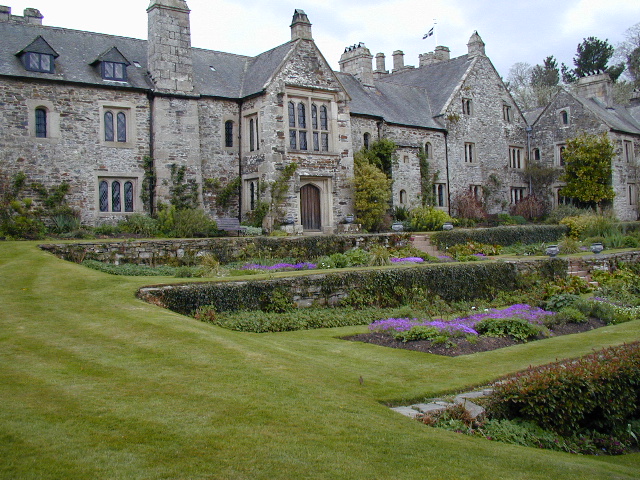
Cotehele House, Cornwall. Compliments of Wikimedia, Attribution-ShareAlike 2.0 license., whatever that means.
The rise
What we’re really talking about when we talk about a great house is an unfortified home fit for a feudal lord. This dates back to the Tudor era, when it became safe for lords to plant themselves and their families in the kind of house where the neighbors could walk up and ring the doorbell. No moats, no battlements. In fact, no doorbells. They hadn’t been invented yet. And I’m not sure about the neighbors, at least not the kind who could knock on the door. That kind of familiarity would’ve been reserved for equals, who wouldn’t have lived next door. Feudal lords had land–estates, thank you very much–surrounding their houses, or formerly their castles. You couldn’t pack them in side by each. The system demanded that they be spread around the country.
Living in an unfortified house was new, even daring, and no doubt more comfortable. But the country looked stable, so out from behind their battlements the lords crept. Which should serve as a reminder that stability is relative and that no one can see what’s coming next.
More great houses were added to England’s collection when Henry VIII confiscated the monasteries. Ever wonder about the word abbey in Jane Austen’s Northanger Abbey? It would’ve once been–yes indeed, folks–an abbey. Ditto Downton Abbey. Fictional ones, admittedly, but still.
By the time we get to Elizabeth I, it was no longer enough just to have a grand unfortified house. If you had the land and the money and a need to play with the big kids, you had to have an architect design you a house so grand it would make both your name and his own (and yes, it would’ve been a his). They were called prodigy homes, and apparently they still are, although I never ran into the phrase until just now.
These were about luxury, style, expense.
Skip to Charles I and we find the high and mighty throwing around words like neo-classical, Palladian, baroque, English baroque. Don’t worry about what they mean. Throw them into a sentence and you’ll sound like you know something.
The ultra-rich aren’t the only people trying to impress.
After Charles I, England stumbled, all unprepared, into the Civil War and discovered that those fortified homes still had a use. Some of them were still occupied, or occupiable, and some of them, even today, have bullet holes in the outer walls to demonstrate the uses they were put to.
The country house
By the late 18th and early 19th centuries, a new class was lusting after stately homes–or country houses if you like. Fortunes were being made in trade, in banking, in industry, in slavery. They needed houses to match their money.
Yes, dears, all those slave-related businesses–tobacco, sugar, cotton, the slave trade itself–were the basis of many a British fortune and of many a mansion that modern visitors pay to admire. (We’ll get to that.) In some of them, the captions telling the house’s history will acknowledge those origins, but boy was there ever shouting and finger-wagging when it was first done.
History was so much nicer when we didn’t talk about that stuff.
At the time, though, slavery and the money it produced were respectable. The monarchy itself invested. You can’t get more respectable than that. The non-respectable ways to make money were in industry and trade. They weren’t quite the equivalent of today’s drug money, but they were a reason for the old money to look down on the new.
So what would you do if you were one of the newly rich? You’d buy land, because land is what old money has. Land is respectable. And you build some huge country house or renovate one, and you try to outdo everybody else who has a country house. The old money will still look down at you but if you’re rich enough and your house is grand enough–and in good enough taste–it won’t turn down your invitations.
Probably.
Before long, it may even marry one or two of its kids to one or two of yours, trading a title for some cash, because new money’s raking in the cash and the aristocracy is struggling. It might even marry off a kid or two to the offspring of some no-name American tycoon.
I’m not sure which was more desperate, marrying an American or marrying the offspring of an industrialist, but it doesn’t matter. They were both signs of the times and ways the economy was shifting.
Ideally, whether you’re old money or new, you’ll have a place in London as well as one in the country. The country one–the great house–will be for hunting, fishing, shooting (which isn’t the same as hunting but something ends up dead all the same); it’ll be for hosting parties and escaping the noise and grit of London. When the family’s in residence, the great and the grand can spend their time visiting each other’s houses and either envying them or thinking how much better theirs is.
The economics of the great house
Ah, but all those grand homes were expensive, not just to design and build and expand and furnish but to run. You needed a staff to go with the house–a big staff: people to cook and clean and garden and serve, to buttle and to maid and to shine the shoes and groom the horses. You needed people to stand around in expensive uniforms looking necessary. And if Historic UK’s to be believed (the link’s above), those big staffs tied a great house into the area’s economy, because when times were hard (and that would’ve been often, or possibly always) great houses provided relatively good jobs–jobs that kept a roof over a servant’s head and food on the table, which was (again, according to Historic UK) the definition of a good job. That tells us a more about how hard times were than about how good the jobs were. English Heritage is less rosy about working in the great houses, and that’s a better match for what I’ve read elsewhere.
Either way, a great house could easily need an indoor staff of 20 and an outdoor staff to match. Those lawns don’t mow themselves, you know.
But a country estate wasn’t just for show. Even as late as the Victorian age (1837-1901; you’re welcome), it could bring its owner a good income, which added considerably to its appeal. It might be mortgaged up to the windowsills to provide dowries, pay off debts, or fund the ludicrous lifestyle that went with it, but if farm prices stayed steady and money kept coming in, the dance could go on.
Until, of course, it didn’t.
From 1815 to 1846 the Corn Laws kept the price of grain high. (Of course you want to know all about the Corn Laws, and for that I refer you to that non-expert, myself. In the meantime, though, let’s settle for a sentence: imported grain would’ve been cheaper than domestic if the Corn Laws hadn’t added a big whackin’ tariff to the imported stuff. That worked well for the people who were selling grain, in this case the owners of those grand estates. But it left the poor hungry–literally–and sometimes starving. Since–you won’t have noticed this, I’m sure–things that benefit the rich are hard to overturn, it took decades of rioting, lobbying, advocating, and assorted other forms of political action to get rid of them.
Prices didn’t do an immediate nosedive after the Corn Laws were repealed, but by the 1870s and ‘80s, with railroads in the Americas carrying wheat to ports, where it could be shipped, they did fall, and between 1870 and 1900, British food prices dropped by half. For the vast majority of people, and especially for anyone overly familiar with hunger, this was great news. For the owners of those vast estates, it was disastrous. Yes, they were rich, but not so rich that they could lose part of their income.
And to make it worse, when the estates’ income went down, so did the value of the land.
If an owner had mortgaged the place, if he was careless about his bookkeeping or his spending, if any one of several other things had happened, he’d find himself selling, say, his art collection to fund his estate. Or his first editions. Or his whole damn property, and someone richer and less indebted would buy it up. Or some public (which, of course means private) school would. Or possibly no one would and the place would end up being torn down, because the land was worth more than the building.
C’mon folks, let’s have a bit of feeling here for the hardships of the formerly immensely rich.
To complete the picture, estate and property taxes started going up in the 1880s.
The twentieth century
Then World War I began and those wonderful jobs in country houses (if indeed they ever were wonderful) were no longer the only jobs on offer. Young young men left for the war, some willingly and some because they were drafted. Women left for factory jobs, which were not only better paid but had predictable hours and allowed for a less restrictive, more independent life.
After the war, not many people came knocking on the (back) door asking if their old jobs were still open. The upper class had to make do with a reduced staff and had to (gasp) offer better pay to those who remained. They talked about “the servant problem.” Even now, “Just can’t get the staff these days” is a standing joke. It gets a sour sort of laugh–or at least that’s how I hear it, foreigner that I am.
In the 1920s and ‘30s, more country houses were sold off or demolished.
During World War II, some were requisitioned to be used as hospitals, military headquarters, supply depots, you name it. At the end of the war, they were handed back, not necessarily in good shape.
In 1945, a Labour government was elected and got to work crafting a welfare state in a country that the war had pretty well bankrupted. Taxes went up on country estates.The coal industry was nationalized, cutting off the income some owners had gotten from coal rents. Even where an estate was still making a profit, its owners didn’t necessarily want to pour money into the house itself–or live there, for that matter.
It’s at this point that the nation began to see the great houses as a bit (a large and expensive bit) of its history, which should be preserved, so heirs who couldn’t pay the inheritance tax could hand over land and houses to the treasury instead, ridding them of an expensive and now useless inheritance. Assorted nonprofit organizations were set up to restore and maintain them and open them to the (paying) public.
Stately homes have turned out to be profitable. Visitors pay to wander through to gawp (I’ve done it myself), to disapprove, or to wish themselves back to that era, forgetting how few of us would be playing billiards instead of shining shoes. Then they (that’s the visitors in case you’ve lost track) move on to buy sandwiches, tea, cakes, maybe scones, sitting at tables in the courtyard and hoping it doesn’t rain. They stop at the gift shop and buy china teacups, nicely packaged candies, walking sticks. It all adds up to a successful enough business model that privately owned houses have followed the pattern.
To round out the picture, some great houses have been turned into hotels, schools, wedding venues, and before this all sounds like too much fun, nursing homes.
There’s nothing like a sprinkling of aristocratic fairy dust to make a spy’s target forget all caution. Or so I’ve read. I have no first-hand knowledge of either spies or aristocrats. Sorry if I’ve wrecked your image of me.
During World War II, the British government used three great houses to hold high-ranking German captives and put them too much at ease for their own good. One of them, Trent Park, has been in the news lately because it’s been turned into a museum. Let’s focus on it.
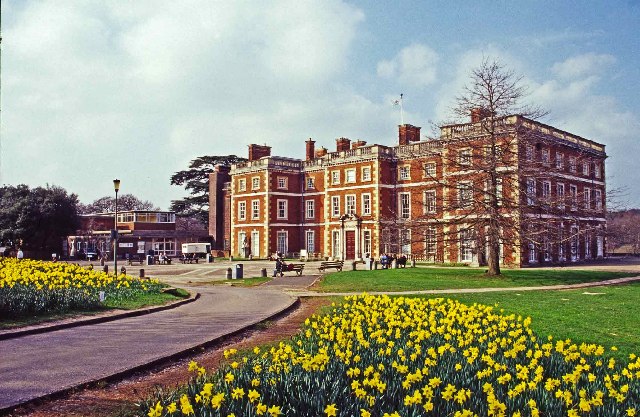
Trent Park, courtesy of Wikimedia Commons
Trent Park
Trent Park was built because in 1779 George III gave the royal doctor a 99-year lease on 250 acres of land, and when you get a gift like that, what can you do but build a great house?
As great houses go, the original version of Trent Park was small, but over the years, as house and land were passed from one family to another and one fortune to another, it got larger and grander and then even grander than that until by the 1930s the owner, Phillip Sassoon, was using it to entertain royalty, high society, and any other elite you care to add to the list. He also entertained penguins, black swans, and flamingos, but they stayed outdoors and weren’t offered champagne.
Then came the war (and coincidentally Sassoon’s death) and the government kitted the place out to hold high-ranking German prisoners, including 59 generals. There was barbed wire. There were guard towers and interrogation rooms, but there was also this mansion, complete with billiard room, a radio, ancient woodlands, and a German-language library lifted wholesale from the embassy Germany had abandoned at the start of the war. A tailor visited to maintain the officers’ uniforms.
And there was alcohol. Let’s not forget the alcohol. It does put people at ease. As one high-ranking officer put it, “We read, we played, we wrote, we meditated day after day as if there were nothing more natural in the world.” It was, they assumed, a fitting acknowledgement of their rank.
The place was also kitted out with microphones. They were in the walls, under the billiard table, in the light fixtures, on trees and plant pots and in rose bushes, and from all of them wires led to the basement, where some hundred people, mostly German-speaking Jewish refugees, wrote down every word the prisoners said.
I’m still trying to figure out how those listeners got in and out without being noticed, but they did. Maybe in surroundings like that, a person stops seeing the minions who keep the place running. A hundred or so unexplained people trudging in and out, working two shifts a day? Nyeh. What can they matter?
Still, you’d think someone would’ve wondered.
The translators
The amount of work involved was staggering. First they cut records of every conversation, with each record holding seven minutes of whatever was going on. That was transcribed, then checked by a second person, then checked by interrogators combing through for useful information. Then the draft was translated into English and typed up in both German and English, checked for errors, and sent to various government departments and agencies.
Think carbon copies. Probably lots of them.
Have you ever typed carbon copies? I was a lousy typist (I took the advice that women on the left gave each other in the sixties, “Never let ‘em know you can type,” to extremes), but I know enough to tell you that they were awkward, horrible things.
Initially, the listeners were Brits fluent in German, some of them from the Auxiliary Territorial Service–the women’s branch of the army. Or maybe all of them were. Decoding explanations that seem clear involves an absurd amount of guesswork.
But however fluent the listeners were, they hit their limit when faced with German dialects and technical vocabulary. And the number of prisoners increased, adding to the pressure. So they recruited native speakers, Jewish refugees serving in the Army’s Pioneer Corps.
Many Jewish refugees were interned during the war. They were from Germany, right? So Jewish or not, they might be enemies and Nazi sympathizers. How anyone decided who to recruit and who to lock up is beyond me.
The prisoners
It’s not that the prisoners didn’t worry about surveillance. They did, but they had no idea how completely Trent Park was bugged. At one point, two prisoners leaned out a window so they could speak freely and were picked up by a microphone on an outside wall.
The prisoners were also being politically choreographed. Prisoners from opposing Nazi factions roomed together to see what would emerge. And decoys were planted among them, guiding conversations in useful directions. A former bank clerk passed himself off as a Nazi-sympathizing Scottish peer, Lord Aberfeldy, complete with kilt, pictures of his castle, and a small bag of aristocratic fairy dust.
He entered into the role so deeply that he refused to drop it when he was off duty.
Other decoys included German-Jewish refugees, who mingled with the Nazis undetected.
A fake news report was planted to elicit information about German weapons capabilities. One response allowed the allies to find and bomb the factory that made V2 rockets, the first long-range ballistic missiles.
All told, 3,000 conversations were recorded, some of which helped Bletchly Park unravel the Enigma code. The first information about the Holocaust came from Trent Park and was taken down by Jews who had left families behind in Germany. In one conversation, a Nazi officer said, “The worst job I carried out was the liquidation of the Jews.”
What was done with that information? Not a damn thing. Not only at the time but later, during the Nuremberg trials. It would’ve exposed the secret of Trent Park, although the secret doesn’t seem to have mattered anymore.
A footnote about Jews and Quakers
At one point, Trent Park Museum’s website notes, the house was owned by “a local Quaker who was a successful banker,” and later by “Sir Edward Sassoon . . . [who] was the head of a Jewish merchant dynasty.” George III’s favorite doctor? He might as well not have had either a religion or an ethnicity. Neither one gets a mention, and if the place had other owners along the way they don’t come into the story at all.
Have you ever noticed that when some absurdly rich person wanders into the conversation, their religion or ethnicity is 79.6% more likely to get mentioned if they’re a Quaker or a Jew than if they’re some run-of-the-mill Christian?
That percentage, by the way, is entirely imaginary but the rest of the sentence is not. This leaves people with the impression that (a) rich people are likely to be Jews or Quakers and that (b) Jews and Quakers are likely to be rich.
The same thing may happen to people from other backgrounds without me having noticed. If you have noticed, leave me a comment.
The Quaker owner of Trent Park is pretty much irrelevant to the story and I haven’t bothered to name him although the museum’s article does. Sassoon (he was Jewish, by the way) is worth a few relevant paragraphs. His visitors included Winston Churchill, Edward VIII and Wallis Simpson, the future George VI, Queen Elizabeth, Charlie Chaplin, George Bernard Shaw, Rex Whistler and T.E. Lawrence. That’s Lawrence as in of Arabia, not Lawrence as in Sons and Lovers, which was written by D.H.
Edward VIII was a Nazi sympathizer, but he wasn’t so antisemitic that he’d turn down an invitation from a Jew if he was well enough connected and had a glamorous country house.
I don’t know, maybe the black swans and flamingoes helped.
Let’s take a break from English history and catch up with life, politics, and any random thing that comes our way.
Why we call the emergency services number
Britain has an emergency services number, 999, that lets callers reach the police, fire, ambulance, and Coast Guard services. Lots of countries have something along these lines, and it’s great. It keeps people from having to think too hard when they’re too frantic to think straight.
So what sort of emergencies drive us to call?
Funny you should ask. In August, a man called and asked for the police because he’d bought a four-pack of non-alcoholic gin and tonic. He’d asked the store for a refund but they refused because he’d already poured the contents of one can down his throat.

I can’t swear that this is non-alcoholic, but we’ve got gin, we’ve got tonic, we’ve can a can. Close enough. Compliments of Wikimedia.
The caller explained that he’d offered to pay for that one but the answer was still no. That’s why he called the cops.
“I’m really angry,” he told the emergency operator, “so I’ll get arrested… because I’m not having it. I’ve just paid them six quid for non-alcoholic gin and tonic…. Is it possible to send a police car or something?”
Well, no, the operator said. It wasn’t the kind of thing the police handled, and no again, the operator said he couldn’t endorse the idea of shoplifting a four-pack of alcoholic gin and tonic.
End of story, except that the emergency services released a recording of the call. Officially it’s to convince the public to be more sensible about calling 999, but I suspect it’s really because they couldn’t resist.
Making Britain Great Again
It’s been a year of anti-immigrant sentiment here in Britain. Hating immigrants is getting as respectable as antisemitism was before World War II took some of the fun out of it. The major political parties are all wrestling to see who can sound toughest on immigration and immigrants.
I started out saying “a year of anti-immigrant sentiment,” but I chose the time period at random. It fit the sentence. The time period isn’t the point. The attitude is, along with what grows out of it. To take one lone example, in Northern Ireland all hell broke loose after an immigrant attacked a non-immigrant with a knife. The immigrant’s been charged with attempted murder.
The footage went viral, though, and Elon Musk multiplied the outrage on the platform formerly known as Twitter. Anti-immigrant groups also used social media, encouraging people to target the homes of refugees and asylum seekers. Crowds gathered and shouted, “Foreigners out.” Houses were burned. Doors and windows were broken. People fled their homes, carrying nothing but the clothes they wore. Anyone with brown skin–immigrant or native-born–was a target.
At least 76 families were left homeless. Others were afraid to go out while mobs were rampaging through the streets.
You’d think no British-born white guy ever tried to murder anyone. Or succeeded, for that matter.
I could cite example after example of an immigrant doing something despicable–or allegedly doing it–and the right wing mobilizing, making noises about protecting women, protecting children, protecting society. Social media goes into high gear as if no native-born white guy ever threatened women, children, or society. Various levels of violence and intimidation follow.
For two of the riots, Belfast and Southampton, guess where the largest X accounts stirring up that unrest were based: 55% of them were based outside the UK, many of them in the US.
You might’ve already figured this out, but if your feet are planted on British soil, the US is abroad, and abroad is where foreigners come from.
I’m a foreigner myself. I know these things.
So the Foreigners Out campaign is being stirred up by–yes, folks–foreigners. The ultra right in the US is reaching out to Britain. So far no one’s proposed making it the 52nd state or renaming the English Channel, but don’t rule either one out.
According to Dr. Julia Ebner, a researcher at the Institute for Strategic Dialogue and the University of Oxford, “They are using the UK as a negative example, smearing the UK to promote their own narratives of western civilisational decay or social collapse. But the other purpose is to influence UK politics, and European politics more widely,” to “promote a strong, strengthened far-right wave across the world.”
Okay, that was depressing. Got any good news?
A bit, yes. In Belfast, groups that normally work with immigrant communities, including food banks and interpreter support groups, used WhatsApp to organize help for people under attack. More than 200 people were involved, and many of them walked into riot zones to help people to safety.
As someone who was involved put it, messages were “coming in as fast as people could pick them up. And even then, when we were downtown collecting people, we were then also being asked to go somewhere else, you know, to pick somebody else up.
“There’s a lift needed to take somebody to work, lift needed to take somebody into the hospital for a shift. There’s somebody coeliac, no food in the house, pick up such and such at an address.”
Meanwhile, forgive me if I gloat
Reform UK, one of Britain’s anti-immigrant parties, took control of a number of local governments in the last elections and it’s struggling to survive its success. In May, a councillor was elected to the Newcastle-under-Lyme Borough Council and in August she sent in a letter of resignation, saying she’d gotten “very little or no training for this role.”
Proving her point, she sent her letter to the wrong town council.
By the time the letter found its way to the right hands, she’d decided not to resign.
There’s no mechanism for councillors to withdraw their resignations once they’ve been received, but since her resignation came after its withdrawal, she continues to serve.
I’m sure her constituents are grateful.
Helping out the old folks
Elderly Aids, a company that sold (and may still sell–I’m not sure) gizmos to protect the elderly, doddering, and vulnerable from nuisance calls, has been fined £190,000 for–yes–making nuisance calls. But it gets better. They were calling people who signed up to a government list saying they didn’t want to receive nuisance calls. Probably on the theory that it was a list of the elderly, doddering, and vulnerable. Who would have more need of their product?
Apologies if I’ve offended anyone with that elderly, doddering business. I turned 367last week, so I’ve earned the right to make fun of the elderly. I say “doddering and vulnerable” with the greatest of respect. Some of my best friends . . .
Let’s move on.
What the company sold (and presumably still sells) was a piece of equipment that cost £139 upfront, and for the privilege of using it customers paid (or still pay) £6.99 a month. Or at least that’s what one elderly and possibly befuddled man was convinced to part with.
The company has been accused of making almost 800,000 cold calls to sell its equipment and services. Some of the complaints say the callers were aggressive and misleading.
Given my age and experience, I’m able to offer advice, free, on how to handle aging: get a guard dog and teach it to answer the phone.
If you see human history as a story of unending progress, leading from ignorance to enlightenment, you might at the very least want to admit that progress hasn’t gone in a straight line. Take, for example, Britain and the right to vote. The number of people who could vote did gradually expand, but boy did the country find some interesting ways to go a-wandering on its path toward universal suffrage.
I’m picking up here on an earlier post about the 1832 voting reforms. This one isn’t specifically about that set of changes, although it is connected. If you haven’t read the older one, I’ll never know, but if you want to go back and fill in the blank, here’s your link. Meanwhile, the rest of us will waddle on, never knowing whether you’re with us or not.

Irrelevant photo: Mallow
Women, men, and freedom of the city
In many nineteenth-century boroughs–that pretty much translates to towns and cities–men with the freedom of the city had the right to vote.
The freedom of the what?
The phrase goes back to feudal times, when a freeman was someone who wasn’t the property of a feudal lord and when living in a city for more than a year and not getting hauled back to the land could free you.
Were there free women? Yes, but they don’t seem to have gone into the language in the same way. Funny how that works.
Even while feudalism was turning to dust, echoes of the system were burrowing their way into the language, and the freedom of the city is one of the echoes. In those nineteenth-century boroughs (didn’t think I’d get back to that, did you?), having the freedom of the city gave you more than the right to vote. Depending on what city you lived in, it might also give you the right to trade or own property in the city; it would connect you to a network of people with money and power; it might allow you to graze your cattle on the town square, but only if you actually owned cattle. But let’s focus on that one benefit, the right to vote.
How could you get the freedom of the city?
You could get it by being apprenticed to a freeman or you could inherit it from your father. Or grandfather. Or–well, how many generations back you could go would depend on what city’s freedom you were claiming.
In some towns, only one son could inherit it; in others multiple sons could. And in some, a daughter could inherit, only she couldn’t use it to cast a vote herself. What she could do was enfranchise her husband so he could vote. The widow of a freeman (again, only in some boroughs) could do the same, enfranchising a second husband, and if he died, possibly a third.
After the 1832 electoral reforms, the number of boroughs where women could enfranchise a husband shrank from 90 to 15 (did I mention that progress doesn’t know what a straight line is?), but at a time when women’s power in the public sphere was somewhere between minuscule and not noticeable at all, this bit of compromised power is worth noticing.
Like everything else connected to this story, terms and conditions applied and they varied from place to place. As did the proportion of voters who were enfranchised by their wives rather than voting in their own right: it might’ve been a third here, a sixth someplace else. Pull a number out of a hat and you can convince me that it applied somewhere.
In some boroughs, marriage wasn’t enough to enfranchise a man. The wife’s consent was required as well.
Why the right to vote mattered
I’ve always taken it for granted that having the vote was about political power, so expanding it was about spreading the power outward and giving new groups of people a voice. I’ve lived around universal suffrage all my life, which is long enough to know that it hasn’t even come close to spreading power out universally, but that didn’t completely knock the rose-colored glasses off my face.
The belief that having the vote meant you had a voice isn’t entirely wrong–people fought for it and some died for it, and it has made a difference–but it isn’t the whole story either. In the nineteenth century, having the vote gave you some immediate benefits many people would’ve found more useful than that abstraction about having a voice.
Political wheelers and dealers might’ve offered them free food, drink, and until polling places moved closer to the voters, (generous) travel expenses on polling day. Outright bribes weren’t uncommon. In 1774, in Hindon, Wiltshire, householders (a group who were eligible to vote after the 1832 reforms expanded the electorate) were given as much as 20 guineas each. That would be something along the lines of £2,000 in today’s money.
It wasn’t legal but it also wasn’t uncommon.
People’s votes were public, so they couldn’t just pocket the money and vote for the candidate they liked. Not only did they have to declare their vote publicly, it would be written down, along with their name, occupation, and address, becoming part of the public record.
A candidate might also get an opponent’s supporters too drunk to vote. If you’re the opponent, that’s dirty pool, but if you’re a voter and don’t much care who wins, a drink is a drink and a chance to get so drunk you land on the floor? Let’s drink to that.
So forget about using their vote, these voters were without question being used, but for a lot of people the material advantages of being voters would’ve outweighed any abstraction. And I’ll bet a ham sandwich that it was a rare election when the outcome made a difference to the voters’ circumstances after the food and drink were gone and the bribes had been spent.
As the 18th century limped to its end, leading British Catholics were paying court to King George III, assuring him and whoever else would listen that they were loyal subjects and could be trusted around gunpowder and sparklers. There’d been centuries of official hostility toward Catholics, but surely it was time to move on. And it seemed to be working. In 1778, Parliament passed the Papists Act, “Relieving his Majesty’s Subjects professing the Popish Religion from certain Penalties and Disabilities imposed on them by an Act, made in the eleventh and twelfth Years of the Reign of King William the Third, intituled, An Act for the further preventing the Growth of Popery .”
It didn’t grant them freedom of religion and it didn’t bother to call their religion by its proper name, but it allowed Catholics to serve in the military if they swore their loyalty, allowed them to buy property, and reversed some bits of anti-Catholic legislation that dated back to 1698. It looked like everyone would come out ahead: the Catholics would have more freedom and the country would have more soldiers, which would be no bad thing, what with a growing empire and a war or three on its hands (France, Spain, the newly formed United States).
What a deal.

Irrelevant photo: St. John’s Wort, or rose of sharon
Not everyone was convinced, though. Catholics with political foresight saw trouble brewing. You know what it’s like: when a group of people have been discriminated against for long enough, a certain number of them become delicately tuned to the scent of brewing trouble. They also saw that the old law had pretty well fallen out of use and Catholics from Ireland and the Scottish highlands were already serving in the army. Wouldn’t it be smarter to leave well enough alone? The hatred of Catholics might have died down a bit but the embers were still burning.
They had a point. Lord Gordon–a Member of Parliament–and the Protestant Association grabbed hold of the new law and used it to fan the aforesaid embers, and at this point I’ll sneak away from that metaphor before I burn down any forests. We’re in a drought here and it wasn’t an original image anyway.
Gordon et al claimed that the minute Catholics were in the army they’d plot rebellion. They’d foment treason. They’d join forces with European Catholics to attack Britain. They’d use the blood of Christian children to make their–
Nope, sorry, wrong conspiracy theory. I do struggle to keep them all straight. They’d jump into small boats and–
Nope, not that one either. Never mind. Bad things would happen. Overwhelmingly bad things, and to stop them a petition was circulated, calling for repeal of the new law, and for anyone who’s too young to remember the world before the internet, this was back when petitions were pieces of paper that had to be circulated by hand and signed with– Do you remember pens? They were signed with pens that had to be dipped in ink because they didn’t even carry their own supply.
It was all difficult enough that a huge petition was a measure not only of public sentiment but of the political will behind it. This one accumulated some 45,000 signatures.
The riots
To deliver it, Gordon led some 50,000 followers to Parliament, and some of them broke into the building, intimidating enough MPs that they agreed to debate the issue at a later date. Which didn’t settle anyone down and a week of rioting followed, targeting Catholic chapels, Catholics’ property, the embassies of a couple of Catholic countries, and Catholics themselves, mostly working class Irish Londoners–people working class English Protestants saw as competition for jobs.
The rioters also turned against authorities in general, burning down Newgate Prison (it had just been rebuilt) and releasing rioters held inside. They attacked the Bank of England, burned the tollbooth on Blackfriars Bridge, and harassed both onlookers and politicians. Shops, pubs, and other prisons were attacked. Bonfires burned across the city. Respectable observers–or some of them anyway–thought they were watching the beginning of a revolution.
When the Bank of England was attacked, the City authorities woke up, said some era-appropriate version of “Oh, my ears and whiskers how late it’s getting,” and sent armed troops and the City’s volunteer militia. By the time the riots ended, the troops had killed hundreds of people and arrested an additional 450. Afterwards, 26 were hanged.
So what was all that about?
I’m tempted to write that political change had run ahead of public opinion, but I’m not convinced anyone knows whether the riots reflected majority opinion. This was before polling, and we could have an interesting argument about how well polls reflect public opinion anyway.
What’s certain is that Gordon had tapped into a longstanding current of anti-Catholicicism and also that other channels of anger flowed into the riots. Exactly what those channels were, though, is hindsight. One article lists anger at poverty, at inequality, and at the justice and political systems. A good Wikipedia article quotes multiple conflicting interpretations of the riots, some of them overlapping:
Maybe we can settle for saying that people had a mix of reasons for rioting and that many of them could’ve been contradictory. What seems fairly certain is that they were angry and Gordon cranked them up and presented them with a handy target, Catholics. And it always helps to have a respectable leader saying that rioting’s good idea.
The aftermath
After it all died down, Geroge Gordon was arrested and charged with high treason and he sat in jail for eight months, then he was found not guilty. Compared to being hanged, that looks pretty good.
The riots convinced the rest of Europe that constitutional monarchy was an inherently unstable form of government. That was lousy timing for Britain, which needed allies in its fight against the newly formed United States and wanted to undercut the support the US was getting from Spain–which was, awkwardly, Catholic and even more awkwardly now pulled out of some secret negotiations the two countries had been engaged in.
The riots also drew attention to Britain’s lack of a professional police force, which the people who decided these things had considered foreign and absolutist but which now looked less foreign and less absolutist.
Catholic emancipation
In 1791, the Catholic Relief Act pushed Catholic emancipation further, allowing Catholics the freedom to worship, run their own schools, hold junior public offices, and live inside of London. After that, Catholic rights got tangled up in Irish politics, where colonialism met nationalism met religion, resulting in some bitter history, many deaths, and some damn good songs. For fear of losing control of Ireland completely, Parliament passed the 1829 Catholic Emancipation Act, allowing Catholics to vote, to become Members of Parliament, and to hold (most) senior government offices, although they still had to pay tithes to the Anglican Church.
Most of the last restrictions were lifted in 1926. One had been left in place to this day: a Catholic still can’t inherit the throne.
On August 13, the town of Clacton returned Reform UK’s poster boy Nigel Farage to Parliament, allowing him to declare victory over Coun Binface, who the Guardian describes as “a parody candidate dressed as an intergalactic rubbish bin.”
If you don’t follow British politics, that paragraph will have sounded odd. Just nod as if it made sense and stay with me. In another few seconds, you’ll have forgotten all about it.
Farage won 63% of the vote and Count Binface won 26%, which is impressive for a guy with a trash can on his head. Whatever’s left over was divided among the other 32 candidates.
Breaking with tradition, Farage stayed away from the high-point event where the candidates line up on stage and the winner is announced, along with the number of votes each candidate got. He said the police had advised him that “a plot was under way to embarrass him [in some tellings, this becomes a threat to his safety] when the result was declared. The Guardian understands that the force did not advise Farage not to attend.”
The BBC understood the same thing but I’ve lost the link. Would you settle for the Huffington Post? Same understanding. Same police force, plus a quote from the Reform UK chair calling the election a “great victory.”
In a separate explanation for his absence, Farage said, “Damned if I’m going to stand on a stage having won a resounding victory , , , to be demeaned and humiliated by nobodies.”
Admittedly, appearing with Count Binface might have been embarrassing, but no one needed a plot to make that happen, and it was Farage who set up the by-election by resigning from Parliament so he could run for the seat he’d just vacated, all of which is what opened the door to a contest with Binface.
The theory goes–and it’s convincing–that he resigned to derail a parliamentary investigation into a £5 million gift he didn’t declare. And a report–sorry, the article I’m relying on doesn’t name it–says Farage’s team told him that resigning would end the investigation. In which case, he might want to think twice about relying on his team next time.
The investigation restarted almost immediately and will have, I’m sure, taken in several other financially iffy actions by the time you read this, making the by-election as pointless and as expensive (£250,000) as it was entertaining, but I’m not writing about financial scandals today, kidlets, I’m writing about alcohol. More specifically, about alcohol and Parliament, because Farage–who’s often photographed holding a pint as if it’s his best and only friend–will waddle back to the booziest workplace in this beer-loving land.
What am I talking about? It turns out that drinking during working hours is not only not frowned upon in Parliament, it’s subsidized. In 2014, Parliament’s bars and restaurants cost the taxpayer £6 million.
It’s a funny thing, but when the Conservatives were on their everybody-has-to-make-do-with-less rampages, they don’t seem to have cast an eye on that line in the budget.

Beer. Compliments of Wikimedia, photo by Len Rizzi, cut by Jan Kameníček. What does “cut by” mean? Haven’t a clue.
Did I just make all that up?
No. By one count, the Houses of Parliament have nine bars on site, along with nineteen restaurants and cafeterias and one lone coffee bar. Included in that count is the Members’ Smoking Room. Members’ means it’s not open to the public. Smoking means nothing. It’s now non-smoking. But it does serve booze, as do, I believe, the restaurants and cafeterias.
Some of them are open to the public, assuming they’ve gotten passes allowing them to be there. Others are for MPs and staffers, and at least one bar and one restaurant are for members of the House of Lords only, protecting them from rubbing elbows with mere elected officials. Some eleven years ago, the Lords refused to save taxpayer money by sharing a catering service with the Commons. It would have forced them to drink an inferior brand of that over-priced fizz known as champagne.
I mean, honestly. The insult.
The booziness of the Westminster work culture landed in the news recently (not for the first time–it’s hardly a secret) because of a study by the Institute of Alcohol Studies. Among other things, the study mentions wine at breakfast meetings and alcohol flowing throughout the day. Soft drinks are so rare at events that MPs and staff members struggle to find them.
The non-financial costs
The impact of all that drinking includes sexual harassment, insults, shouting, swearing, theatening situations (or possibly situations that feel threatening, which aren’t exactly the same thing but never mind, I didn’t design the survey), and hungover or still-woozy colleagues. As one MP put it, “If I wouldn’t operate heavy machinery or drive a car, why should I legislate the laws of the land?”
Younger staff members–particularly women–feel pressured to drink so they’ll fit in.
Either pulling from some part of the report that I didn’t find or drawing on its extensive archive of bad ministerial behavior, the Guardian also mentions allegations of drink spiking and of one MP downing 200 units of alcohol per week. To pour that much down your throat, you’d need to drink ten pints per night. Or per day. Or in the name of moderation, you can divide them evenly between the two.
One MP talked about colleagues drinking so much they ended up in the hospital having their stomachs pumped, then returned to work the next day.
A newly elected Green MP said, “You can smell the alcohol when people are in between votes.”
Atmosphere
Going to a different source, a BBC journalist reporting on what the restaurants, cafes, and boozers are really like spoke to an anonymous someone on the catering staff, who said, “I’ve never seen anyone throw up. I’ve seen four or five pass out.”
Irrelevantly (but interestingly), the source said MPs are polite to the staff for the most part, but when they’re not their arrogance divides along party lines. A Conservative MP will say, “Do you know who I am?” A Labour MP will say, “Do you know how important I am?”
Maybe you have to have lived in Britain for a while to get the joke.
So what are the pubs etc. like? If you want to know about the ambience, follow the link above. This blog is ambience-free. What’s worth repeating is that the Sports and Social club got such a reputation for drunken brawls and general mayhem that in 2018 it was put under new management and its name was changed to the Woolsack.** I’ll go out on a limb and say it’s now suitably boring but I’d love to hear that I’m wrong. I don’t approve of the way they carrying on in Westminster, but I love disapproving.
When Parliament held late night sittings more often than it (apparently) does now, the Strangers bar was the place to find drunken MPs and party whips trying to keep them in line. (The article I’m working from says they were inebriated. If there’s a difference between that and drunk, other than that one crawled out of Latin and the other out of Old English, the mistake is mine and without the least hint of sarcasm I hereby apologize.)
If an MP is still capable of walking, he or she can leave the Strangers and wobble down a corridor to find function rooms, where receptions and events are held most evenings and where–this will surprise you, I know–the booze flows freely. And is free.
So will anything change?
I’m skeptical, although the younger generation is said to drink less. But a spokesperson for Parliament said, “Any changes . . . would ultimately be a matter for members to decide on.” The spokesperson also said everyone’s expected to drink responsibly and behave well, which of course they do. They’re also expected to vote with the country’s best interests at heart, not their own or those of the lobbyist who most recently poured them a drink.
And this is, without a doubt, the best of all possible worlds.
Footnotes
* Thirty-four candidates ran in Clacton, making the ballot the longest in British history. Printing it cost four times more than a normal ballot and left the council wrestling with the logistics of how to fold it into an envelope so it could be sent to postal voters. The major parties–Labour, Conservatives, Liberal Democrats, and Greens–didn’t bother to run candidates. Neither did Restore UK.
** The bar is named after a real woolsack in the House of Lords. I’ll quote Parliament’s website to explain that: “The Woolsack is where the Lord Speaker in the House of Lords sits and resembles*** a large square cushion covered in red cloth. In 1938 it was re-stuffed with a blend of wool from Britain and the other wool producing nations of the Commonwealth. The woolsack is thought to have been introduced in the 14th century to reflect the economic importance of the wool trade in England.” And here we are, seven centuries later, with someone called the Lord Speaker still sitting on a sack of wool.
*** In case it’s not clear, it’s the woolsack that resembles a large square cushion, not the speakers. Although I can’t swear that none of them have.
Who says politics have to be grim and boring? When Reform UK took control of the Kent County Council earlier this year, it decided to make the national anthem great again. Or maybe it decided to make patriotism pay. Or–
Oh, never mind the motivations. Let’s stick with what it did. It amended the constitution to make sure full council meetings would open with the Lord’s Prayer and end with the national anthem. This would, admittedly, take time away from debating things like potholes and the county’s recurring water crises, but they’d thought of that: The council would make up the time by giving opposition parties less time to talk. They didn’t have enough votes to accomplish anything, so why make the majority listen to them?
Would the council’s leader cut the amount of time he’d been allotted?
Well, no. That would be unreasonable.

Irrelevant photo: mallow
But wasn’t all this divisive?
Of course not. The Lord’s Prayer, the council’s leader said, is a “profound unifier.”
“We are Christians at the end of the day,” another Reform councillor said after rambling a bit about whether he was or wasn’t a Christian since he didn’t go to church but did pray to win the lottery.
The underlying assumption in all this is that Britain is Christian country, and technically it is. It has its own church. You can’t get much more Christian than that. If you want to measure by what people believe, though, the argument gets weaker. In the 2021 census, less than half the population of England and Wales called itself Christian. Christian did lead the list at 46%, followed by No Religion at 37%, Muslim at 6%, and Hindu at 1%. Jewish? That gets messier, since people could be Jewish on the religion question, on the ethnicity question, or on both, but for whatever the number means, .5% of the population is Jewish.
The second underlying assumption is that everyone at the meetings is Christian or willing to pretend in the face of social and political pressure. If I’d been on the council, I’d have felt called upon to stand up and recite the Shema, one of the Jewish prayers, while they were reciting the Lord’s Prayer. I don’t speak Hebrew, I don’t pray, and I’d have to learn the words syllable by syllable, so this wouldn’t come to me easily (or well), but some things are worth the effort. I have a loud voice, which might make up for my lack of Hebrew and piousness.
Sadly, I don’t live in Kent and I’ve run for office exactly as often as I’ve prayed, so the prayer passed off with no events odd enough to make the news.
The anthem
Eventually the meeting ended, as all good meetings must. And all bad ones. The council members sang “God Save the King” and the Reform councillors began packing up their toys to go home but the Greens and some members of other opposition parties kept singing. It turns out the song has six verses and no one knows the last five. No one even knew they existed until the Greens handed song sheets out to opposition councillors.
On they sang. They were admirably awful, and since the meetings are livestreamed, their performance went out to–oh, I don’t know, an audience of five or six, surely, and it was accompanied by subtitles from an automated system that make the meetings accessible to the deaf, the hard of hearing, and anyone with a Mute button.
The Reform councillors shuffled feet and papers but couldn’t bring themselves to walk out because this was, after all, the national anthem, even if they no longer recognized it. The chair interrupted several times, trying to get control of the meeting, which either was or wasn’t over, but on they sang, while the automatic caption gizmo, for reasons no one will ever understand, switched from the words they were singing to the lyrics of the “Star Spangled Banner.”
Politics don’t get any better than that.
And now the bad news: The link to the meeting’s end has disappeared into the morass we know as the internet. I did see it, I can testify that it’s real, but all I can find now is an official version that cuts off before the fun starts. If anyone stumbles over it, send me a link, will you? I’ll insert it for the benefit of any latecomers.
All six bloody verses
People who are serious about what they sing in public have been known to stand visibly silent when the song’s sung. They’re not royalists, they’re not religious, or maybe they just like a bit of poetry with their music. Surely at least some of the people belting out the extra five verses in Kent would normally have stayed silent. But when you know that someone you dislike will be deeply annoyed if you do exactly what they told you to do, wouldn’t you make an exception?
Let’s look at all six verses. It’ll help us understand why the last five have fallen into hard-earned obscurity. Even if you can forgive the lyricist for trying to rhyne arise with enemies (or ene-myes) and laws and cause with voice, it still thumps through its stanzas on lead-weighted boots. Its shift from bloodthirsty to let’s-all-be-brothers and then back again is enough to cause whiplash. And then there’s that business about Marshal Wade and the rebellious Scots.
Marshal who? The Scots? Aren’t they British these days?
Stay with me. It’ll all be explained.
Verse 1: God save our gracious King, long live our noble King, God save the King! Send him victorious, happy and glorious, long to reign over us, God save the King.
Verse 2: O Lord our God arise, scatter our* enemies, and make them fall! Confound their politics, frustrate their knavish tricks, on Thee our hopes we fix, God save us all.
Verse 3: Not in this land alone, but be God’s mercies known, from shore to shore. Lord make the nations see, that men should brothers be, and form one family, the wide world over.
Verse 4: From every latent foe, from the assassins blow, God save the King. O’er his thine arm extend, For Britain’s sake defend, our Father, prince, and friend, God save the King.
Verse 5: Thy choicest gifts in store, on him be pleased to pour, long may he reign. May he defend our laws, and ever give us cause, to sing with heart and voice, God save the King.
Verse 6: Lord grant that Marshal Wade, may by thy mighty aid, victory bring. May he sedition hush, and like a torrent rush, rebellious Scots to crush. God save the King!
My London, which kindly dragged me through all six verses, notes that “Verse 6 is often omitted. It was added as a prayer for the success of Field Marshal George Wade’s army, which was assembling at Newcastle in 1745 to defend against the Scottish Uprising, led by Bonnie Prince Charlie.”
Nope, sorry. You have to respect tradition. Once in the national anthem, always in the national anthem.
A quick note from the Research Department
Since we’re doing absurdity today, I can’t leave you without noting that when I asked Lord Google for the lyrics, AI elbowed its way to the top of the page, as it always does these days, and gave me a version of “God Save the King” that started out with “God save our gracious Queen.” It went on merrily from there, saving the now-dead queen, not noticing that she never had been a king, and missing several of those unmissable verses.
On the other hand, since it didn’t hack any neighboring countries’ anthems, no real harm was done, and I was able to move on to a more reliable version.
*
* Finally, I have no idea what the asterisk in verse two is about. It didn’t lead to any footnote, explanation, or alternative text that I could find. Let’s call it a typo. I’ve left it in because it fits so well with today’s theme. And in verse four, “O’er his thine arm extend” is probably another typo. My best guess is that it’s supposed to be “O’er him.” I could check it against some other version if I dug deep enough but how many of us really need to know?
And since absurdity isn’t limited to the UK . . .
. . . the United States Department of Agriculture’s online tariff tracking site listed the fictional nation of Wakanda as one of the US’s free trade partners. It seems to have been added sometime after June 10 and was taken down after software engineer Francis Tseng noticed it and and went public.
You know how sometimes you fix a thing and end up making it so complicated that the only solution is crawling back to bed for a week or two, by which time no one will remember your part in it? Well, in 1832 Parliament rewrote the rules on who could vote. The bill’s usually told as a tale of progress, one step in the inexorable march toward democracy.
Forgive me if I sound cynical. People died for the right to vote, and they had good reason to think it mattered. They couldn’t have guessed how many ways universal suffrage could be turned into a sham. Still, the progress story’s not wrong, it’s just more complicated than it looks. As usual.
What Parliament did was layer the new system over the old one and the result was messy enough to drive a Methodist to drink. Before I try to explain it, though, this might be a good time to pop an aspirin. Even Methodists allow themselves an aspirin when faced with something this headache inducing.
I’m indebted to The History of Parliament website for most of what you’ll find here. I’ve linked to them before but never thought to acknowledge them directly. Thanks, folks.

Irrelevant photo: zantedeschia
A few people lost the vote under the new system
Overall, the 1832 reform increased the number of people who could vote, but some people were disenfranchised. Most of them don’t sound like people we’d waste sympathy on: they’d once had the right to vote in places where they didn’t live. I’m oversimplifying here but I’m telling you as much as I can untangle. Any more than that and I’ll be making it up, so don’t complain. Just take another aspirin. You’re supposed to take them in twos anyway.
Another group who lost out were women. Not many managed to vote under the pre-1832 rules, but there were a few, because the old system hadn’t specifically limited the vote to men. (That link refers you to myself–sorry–and an older post about women who did vote.) Tradition did the work of keeping most of them away from the polls, but the old system left loopholes and a few women wriggled through, for all that they had huge sleeves and tiny waists, or so the 1830 fashion drawings swear.
Fashion drawings wouldn’t lie.
The new rules closed the loophole and left the tiny waists. And no doubt the sleeves.
Definitions
When you see the word borough, you won’t go too far wrong if you substitute town or city. When you see county, try not-borough. It’ll work well enough. This matters because the rules are different for counties and boroughs. In both places, your right to vote rested on how much property you had, but having a single rule for both places would’ve been way too simple.
Let’s tackle them separately.
Borough voters
Who could vote in the boroughs? Ooh, call on me, teacher, I can answer that: Any adult male who met the property qualifications and who lived within seven miles of the borough. Unless they were ancient-right voters–people who were claiming their right under the pre-1832 rules, in which case they had to live seven miles from the borough’s former main voting place.
For new £10 households, though, the distance was measured by a straight horizontal line from the borough’s new boundaries.
If you’re still with me at this point, that’s good, because I’m not sure I am. Especially when it comes to the line being horizontal.
If a voter met all those qualifications but had gotten alms or poor relief from the parish in the past year–even a free vaccination (smallpox vaccines date back to the previous century)–he lost his right to vote.
If his borough was recognized before 1832, the £10 freehold was the only qualification he had to meet. If it wasn’t, then his borough carried over its ancient-right qualifications as well, no matter how much it complicated the picture.
You didn’t follow that? Good. Your mind’s still functioning.
Quick quiz: What’s a £10 household? It meant someone–let’s say you for the sake of simplicity–rented, leased, or owned a property that would bring in a rent of at least £10 a year. It could be a house, a shop, a warehouse, a whatever. Except that you had to have had it for at least a year and to have lived in the borough for at least six months.
Only that’s too simple. You had to have paid up any parish poor rate and local taxes. And you had to pay a shilling to register.
But what about freemen, who were also known as burgesses or liverymen? If they didn’t live in the borough, they were disqualified. (There’s that business about people losing their vote.) Unless they were resident freemen who could vote on or before 1 March 1831 and could, therefore, keep right on voting during their lifetimes, as could their sons, but again I’m simplifying. I’m worried about that aspirin bottle, which is running low. And the Methodist is eyeing the gin.
Local customs determined how many sons could inherit a father’s freeman status, so that would vary from borough to borough.
If a freeman’s name dropped off the electoral register for two years running, he wasn’t sent back to Go, he was tossed out of the game entirely.
But we’ve left out a few ancient-right voters.
Ancient what? We did that before, or I think we did. Those were voters under the old law who could still vote as long as they still met their original qualifications and hadn’t dropped off the register for two years running.
First come the scot and lot voters–residents who paid local taxes. Scot came from the Anglo-Saxon silver coins called sceats. Lot? That meant a portion or part.
Don’t ask me.
Next come potwallopers, also called potwallers. They were residents who boiled their own pots. No, I don’t make this stuff up. I wish I could. It meant they had someplace to cook. I’m not going to tell you anything more about either category. I only mention them so you’ll understand what I’m sparing you, and I’ll bail out before we get to inhabitant householders, inhabitants-at-large, burgage holders or tenants, and freeholders (who are not to be confused with freeloaders).
If your disappointed at the simplicity of all that, remember that boroughs would each have had their own layers of complexity to stretch over the basic system.
Counties
Think it’s easier to live in the country? Well, again the basic qualification was that you had to be male and own property–legally, mind you, and for six months before the election if it was freehold or twelve if you were a leaseholder or occupier. Unless a few other conditions applied, in which case you got to roll the dice an extra time and throw popcorn at the other players.
What you didn’t have to do (mostly) was live in your property (the “mostly” is there because you did have to occupy some kinds of property). Living outside the country where you voted would make you an outvoter, as a lot of county voters were.
Except that some people who could vote in the counties did have to live there.
Squint a little and that’ll all make sense. After that, don’t worry about it.
You could be a county voter even if you didn’t pay local taxes.
Of course, if you were a freeholder, copyholder, or leaseholder, terms and conditions applied. Just check the box. Don’t bother to read the small print. No one does.
The property that gave you the right to vote didn’t have to be land or buildings. It could be shares in mines, canals, gasworks, cemeteries, sewers, steam engines, or burial plots. It could have been the right to collect tolls or tithes, and I’m not sure how or why, but church pews is on the list.
Could someone amass enough church pews to gain the right to vote? Did the pews have to be in a church or could they just pile them up in a barn? I’ve read that the lord works in mysterious ways but what with being an atheist and all I had no idea how mysterious–not to mention strange–that could be.
If you had freehold property, it had to be worth £2 a year in income or rent.
After that it gets into leasehold property and you had to balance the value of the property against the length of the lease, not to mention the sub-leases or assignees of the above but only if they were resident and in actual occupation.
Have you ever wondered why lawyers were invented? And that’s before we mention fifty-pounders, occupiers, or £50 tenants-at-will. Those were tenants, who are lowly creatures, but if they paid a high enough rent, what the hell, they could vote. So could some of the people who lost their right to vote in a borough–they could use the property that wasn’t eligible in the borough to vote in the county that the borough that snubbed them was in. If, of course, they met the county’s qualifications.
And I haven’t even mentioned universities, which weren’t boroughs or counties and used a third system to decide who could vote.
Every year counties, boroughs, and universities had to find their way through all of this and put together an electoral register.
In 1867, Parliament revised the system again.

