
If you like a good rebellion–and who doesn’t, from the comfort of a couch–the English Parliamentarians are a reminder of how murky history gets and why it’s not always wise to take sides.
Let’s talk about the Parliamentarians, King Charles, and, gulp, Ireland.
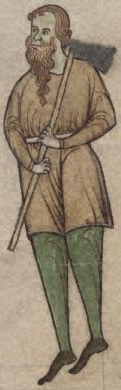
A rare relevant graphic: Diarmait mac Murchada, King of Leinster and the beginning of a lot of trouble. He may look like he has a broom over his shoulder but it’s sure to be something highly symbolic.
A bit of Irish history
We’ll keep this to a minimum or I’ll never find my way back to our alleged topic.
After the Normans conquered England, they looked across the water and noticed one more island sitting off to the west. And did nothing. Then in the twelfth century, Ireland’s high king deposed one of its local kings, Diarmait, and Diarmait turned to England’s Henry II for backing.
Many a colonial conquest has started out that way.
Henry encouraged him to hire some of the Norman knights who’d been kicking around after being on the losing end of fighting in Wales. (Unemployed knights could be a hazard, so I expect this suited everybody.) Diarmait offered to pay them not in cash but in Irish land, which is how the first of the English lords sank their roots into Irish soil. By 1175 they were powerful enough that the Irish kings had recognized the English king as an overlord, hoping he’d stop the Norman lords from taking any more Irish land.
It didn’t work. Before long–measuring that in historical time–the Normans had imposed feudalism on eastern Ireland, the part they controlled. The lords had parceled out land to their knights and a country of clans and herding became a country of manors and peasants. They’d swept away Irish law in favor of Norman, and ditto the Irish version of Catholicism in favor of Roman–the flavor that suited the Normans’ tastes.
Over time, they integrated to some extent, intermarrying and adopting the language, but they continued to be a group of their own. As one of them, Maurice fitzGerald, complained, “Just as we are English as far as the Irish are concerned, likewise to the English we are Irish and the inhabitants of this island and of the other assail us with an equal degree of hatred.”
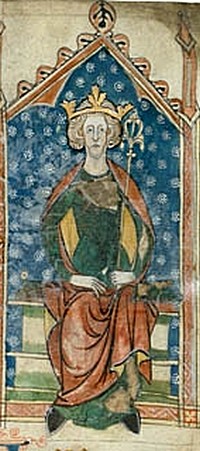
Another relevant graphic: Henry II, King of England, so it’s a fair bet that he’s not holding a mop to balance Diarmait’s broom but something else highly symbolic.
In “Controversy: Oliver Cromwell in Ireland,” Micheál Ó Siochrú says there were three different ethnic groups in Ireland during the 1640s: the native Irish, who were between 80 and 90 percent of the population; the “old English”–the descendants of the those Norman colonists; and a new wave of Protestant English settlers (plus some Scottish soldiers, administrators, etc.), who’d been coming over since early in the seventeenth century.
The first two groups were Catholic and the Protestants–obviously–weren’t, so we’re looking at ethnic divisions with religious and class overlays.
And if that didn’t produce enough tension, since the 1550s Irish land had been handed to English-born Protestant officials and by the seventeenth century Protestant settlers were displacing native Catholics in large parts of the country. All the situation needed was for someone to light a cigarette and toss the still-lit match over their shoulder.
The Irish Rebellion
With that in place, we’ll skip a few years. In 1641, a rebellion (I should probably say “another rebellion”) broke out. The rebels weren’t hoping to break with England or the crown, only to end religious and political discrimination against Catholics. The plan was for the rebellion to put them in a strong negotiating position. England, though, read it as an uprising that needed to be crushed.
The rebellion started with a small, not particularly well organized group of Catholic gentry and military officers, who tried to occupy Dublin Castle–and failed. It was the match I was talking about, though. Around the country, Catholics attacked Protestants. Protestants attacked Catholics. The colonial government attacked Catholics. Thousands of people died on both sides–by one estimate somewhere between 4,000 and 12,000, which is another way of saying that no one was counting.
As the uprising grew, the Catholic elite, who’d hoped for a polite, apartment-size rebellion, were horrified, and in an effort to take control they set up a government, which for a while held part of the country, while the royalists another held part, the Scots held a third bit, and the Parliamentarians (a.k.a. the English Protestants) held a fourth.
Eleven years of war followed.
Meanwhile, in England . . .
. . . news of Catholics slaughtering innocent Protestants circulated. In some tellings, more Protestants were slaughtered in Ireland than actually lived there. But you know how these things go: Popular news sheets featured the stories. Preachers thundered. Tables were thumped. Money was raised. The stories flew on the wings of outrage and people believed the most lurid of them. Why wouldn’t they? They fit so neatly with the English image of the Irish. And the waves of fIrish Protestants taking refuge in England added credibility to the stories.
To be fair, there does seem to have been slaughter and I believe the first killings were of Protestants, but it didn’t match the lurid stories and soon the killing was on both sides.
As a side point, since I’ve mentioned the English image of the Irish, I’ve read an argument that it was during its occupation of Ireland that England first learned to portray a colonized people as ignorant, lazy, dumb, brutish, and any other negative adjective you want to tack onto the list. Ugly? You bet. Smelly? I haven’t seen it but I’m sure someone said so.
Take the argument for what it’s worth. To me it has a convincing ring. You’ll find one colonized group after another portrayed that way.
But back to our story: All this was happening in 1641, which matters because it was when the king (Charles I; you’re welcome) and Parliament were arm wrestling over who was going to run the country and who was going to be merely decorative. One of the few things they’d have agreed on was that someone had to do something about those pesky Irish Catholics. They’d even have agreed that doing something involved sending an army. Where all that love and harmony broke down, though, was over who’d be in charge of the army, because whoever controlled that army–
Yeah. They were bright enough to know the army equaled power.
By 1642, king and Parliament were openly at war with each other, giving the Catholic forces in Ireland a bit of breathing space, which they used to form a united movement. Or at least a government that was more united than England’s. And than England’s armed forces in Ireland, which were split between king and Parliament, with some Scottish forces and a settler army thrown in just to complicate the picture.
Financing the army
Where the story gets interesting–as in, I hadn’t known even a hint of this before–is when they got to the question of how to pay for the conquest of Ireland, because armies are expensive. Keep that in mind if someone offers you one. What Parliament did was basically to create a public-private partnership that parallelled Diarmait’s agreement with the knights he hired: People would lend money to the state and be paid in Irish land once it was conquered. Some 18% of the country’s profitable land, or 2.5 million acres, was promised.
Whose land was it? Catholic land. Rebel land. That way Parliament could break the power of the Catholic landowners and pay off their investors all at once.
The investors were called the Irish Adventurers.
A parallel bill to finance ships offered the reward of “all Ships, Goods, Monies, Plate, Pillage,and Spoil, which shall be seized or taken by any of the Persons by them employed by Force of Virtue of this ordinance.”
Basically, it was piracy.
The adventurers included radicals from the Parliamentary party, rich City merchants who could invest £1,000, smaller investors who’d put in £25–a year’s pay for a tradesman. The investors also included a handful of men who went on to become Levellers–campaigners for equality, near-universal suffrage, and religious tolerance. I’d love to explain that but I can’t.
And then?
And then for a while nothing happened. There was this little business of the English Civil Wars going on and Ireland was off on the other side of the water. It was only once Charles was reliably dead and guaranteed not to cause any more trouble that Parliament picked up its quarrel with Ireland, sending its New Model Army, with Oliver Cromwell in command. His orders were to bring Ireland “to the obedience of the Parliament of England.”
Yes, it’s an odd thing how easily people who start out saying, We demand freedom, can turn around and say, You have to obey us, but turn around they did, using the 1641 Rebellion as a rallying cry: Those bloodthirsty Irish had, as Cromwell put it, had “imbrued their hands in so much innocent blood.”
There was more to it than that, though. It was also an economic necessity. The merchant adventurers had to be paid back. And Parliament’s army–the New Model Army–hadn’t been paid, in some cases in years. They had to be paid, and Parliament already had a model of how to use Irish land to pay English debts.
The war dragged on into 1651 and 1652, with the Catholic armies turning to guerrilla warfare and the New Model Army killing civilians, destroying food, and setting bubonic plague loose, although to be fair that last part wasn’t deliberate.
Ó Siochrú talks about it as a genocidal conflict “in which the people of Ireland–the civilian population–were deliberately targeted. People were driven out of their homes and killed, crops were destroyed, infrastructure was wrecked, and it really had an absolutely disastrous impact on the population of Ireland.”
In Ireland, he says, the English “saw themselves as outside of the realms of civilised society and therefore the behaviour that could be justified in Ireland would never have been accepted in England, or indeed even in Scotland, and certainly not on the Continent.” Who won the war? You already know, right? The English eventually, and they reshaped Irish society to their own benefit, confiscating almost all Catholic-owned land and using it to pay off the investors (at least those who hadn’t sold their shares) as well as military veterans and Protestant supporters of Parliament.
Catholic landowners who hadn’t supported the rebellion were compensated with some land west of the Shannon river but Catholic religious practices were banned in public, and priests executed. The Anglican Church was also forbidden, although for some reason the Quakers were tolerated.
 Notes from the U.K.
Hmm. Maybe the Quakers were tolerable because they didn’t try to demand that everyone join their church? In fact they would probably have advised people to spend a lot of time in meditation before considering such a step.
Pris cilla King
LikeLiked by 1 person
Not impossible but I’m not ready to put any heavy bets on it. The Quakers changed a lot over the years. In their early years, they not only weren’t pacifists, they fought in the Civil Wars (on Parliament’s side). My impression is that their transition to pacifism was pragmatic at first, not principled, but don’t trust me too far on that. I’m not sure what stage they were at during the period we’re talking about.
Fascinating group, though.
LikeLike
About Diarmait/Dermot-with-the broom…I think that might be a whopping great axe.
Yes, I was being a bit flip about a time when even looking sideways could land you in trouble.
LikeLiked by 1 person
I often have trouble telling axes and brooms apart. I don’t know if it’s a personal problem or a failure of the American educational system.
LikeLiked by 1 person
“Clean sweep” can be applied with use of either tool…
LikeLiked by 2 people
Indeed. Although I expect there’s a little cleanup needed if you use the axe.That’s guesswork, mind you. I haven’t experimented.
LikeLiked by 1 person
You’ve done this so well! I think you should turn it into a series on Ireland up to the present time!
Mollie
LikeLiked by 1 person
That’s so tempting, and Irish and English history intertwine so much (much to Ireland’s distress). The problem is that it means getting at least a vague grasp of the throughline of Irish history, which boils down to time. That’s why I’ve steered clear of Scottish and Welsh history, and for the most part the history of the empire (although I did a bit with that). It gets overwhelming pretty quickly.
On the other hand, if I were to just drop in at some of the high and low points…. Thanks for suggesting it.
LikeLike
Well, with a name like mollie you can probably understand why i have such an interest in it. Then, when I worked at my family history, I knew about my irish ancestory and my mom’s side… And I was raised catholic. But it was a big surprise to find out that on my dad’s side, that his scottish family (there was even a photo of my grandpa dressed up in a kilt as about a two year old child… apparently, that was really popular back in the day) part of his Scottish family.
Were not just scottish, they were scots irish. Another branch in Scotland had a son who was in a tussle with some catholics. It turned into a mob, and there was a death and they fled to the united states. As you can imagine, this was a lot to take in for someone that grew up in an irish catholic town in the middle of iowa, who in their courthouse square has a statue of robert emmet, irish revolutionist. Ohh, and there’s a piece of the barney stone embedded in the statue as well. So I know quite a bit of history, but i’ve never really gone from the beginning to the end.I’ve just learned as i’ve got along bits and pieces from different eras. :)
LikeLiked by 1 person
In some times and places, an Irish/Scots Irish relationship would’ve been the Montagus and the Capulets played out all over again. That it wasn’t is a marker of how far your parents’ generation was from that history, I’d guess. What a fascinating thing to find out, though.
My partner’s family is partially Scots Irish and I notice she tends to talk about them as simply Scottish, detaching herself from the history of the Scots Irish. I can understand the impulse, but then none of us are responsible for our ancestors.
LikeLiked by 1 person
So true, but it felt like a betrayal at the time. It took me a while to wrap my head around it.I know a lot of the older generation donated regularly to the ira during the troubles. I guess that’s a case to see what indoctrination as a child can do to oneself. Always nice to chat with you again. Mollie
LikeLiked by 1 person
Likewise. I’m always glad to find comments that make me think, that show me parts of the world I didn’t know. Yours did both.
LikeLike
Are you sure this illumination shows King Diarit, and not just another disoriented Irish farmhand searching for spuds ?
But what do I know. I’ll just sit over there and work on my review for the Single Malt Monitor, thanks.
LikeLiked by 1 person
Leaning kind of hard on the national stereotypes this afternoon, aren’t we? But do I know who the picture’s really of? Haven’t a clue. I can only take other people’s word for it and help spread disinformation on this crucial topic. Because that’s what the world needs is more disinformation.
LikeLiked by 1 person
I use only good quality sources related to all Irish, Brian Ó Nualláin, and Sally Mara.
LikeLiked by 1 person
Mm hmm.
LikeLike
Are the majority of people in Ireland today of mixed English/Irish blood or only the rich ones? England usually wasn’t much interested in the working class.
LikeLiked by 1 person
I haven’t a clue. Sorry, I’m completely useless.
LikeLiked by 1 person
Not at all. We can only keep track of just so many extraneous thoughts. :)
LikeLiked by 1 person
Very true. Right now, I’m keeping track of one thought. It involves lunch. But that’s not really extraneous, is it?
LikeLiked by 1 person
I’m a Scot living in Ireland. Most Irish would explode if you suggested they have English blood (even if it’s true!). I have been on the receiving end of anti-English sentiments from natives who don’t recognise my (admittedly not very strong) accent
LikeLiked by 2 people
Ouch. There’s such a thin line between pride in your history and re-enacting the old battles using whatever individual happens to be handy as a stand-in for the bad guys.
LikeLiked by 1 person
That is good to know. My grandparents were from Scotland. They felt the same way about the English.Thank you
LikeLiked by 1 person
The English have made themselves a lot of enemies over the centuries. The Cornish–I live in Cornwall–aren’t (as a generalization) fond of them either.
LikeLiked by 2 people