
Want to change history? You have two choices: do something that changes the future or change the way we see the past. Neither one is easy, but a group of scientists studying the Stonehenge rocks have managed to change the way historians understand late stone age Britain.
If you read much about Stonehenge, you’ll probably read about sarsen stones first–the uprights and the massive crosspieces that sit on top of them, forming the outer circle. They were hauled a mere 16 miles. On the other hand, they weigh an average of 25 tons, so however hard you worked last week I’m pretty sure you didn’t do that.
Once you’re done being impressed, you’ll read about the bluestones–the stones that form the inner circle–which came from 140 miles away, in Wales. Before the invention of smartphones, which would at least have let the people who dragged them document the challenge.
Think about doing that without a single online follower leaving a Like. Where’s your incentive?
The bluestones weigh between 1 and 3 tons.
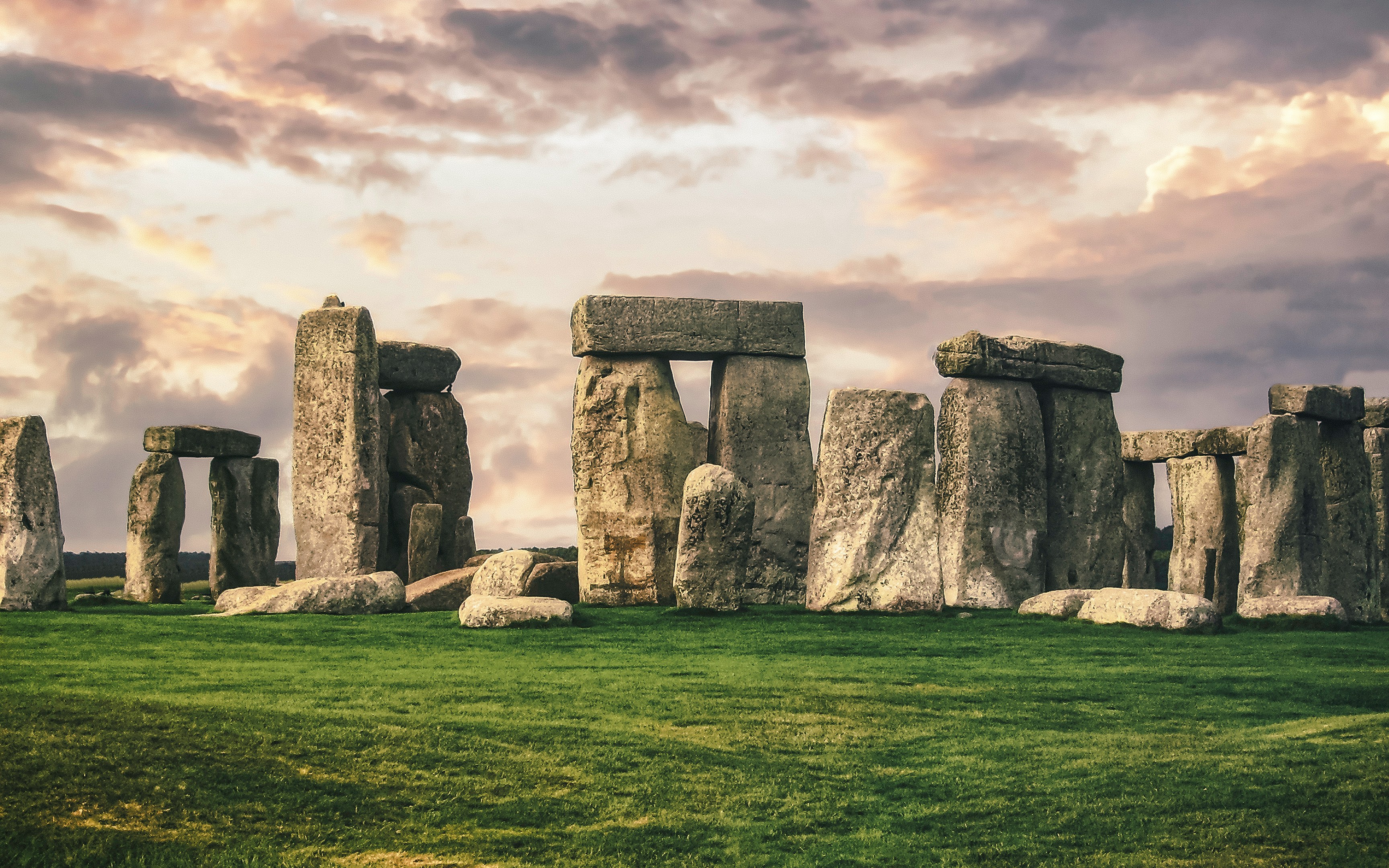
A rare relevant photo, with thanks to K. Mitch Hodge, who made it available online at Unsplash.
What most of us wouldn’t have read about is the altar stone, but it’s the one that’s making headlines and retroactively changing history.
In spite of its name, there’s no reason to believe it was ever used as an altar. It’s lying flat and it must’ve reminded someone of an altar. The name stuck, but don’t get carried away with the idea.
The new information is that the stone traveled something like 500 (or 350, or 800) miles to play its part in Stonehenge–that’s pretending it went in a straight line–from what’s now Scotland, somewhere around the neighborhood of Inverness, John O’Groats, and Orkney. It’s a big neighborhood, but someone will be out there even now working to narrow it down.
Why does that matter? Because it tells us that late stone age Britain (known to its friends as neolithic Britain) was a lot more connected than anyone knew. And it tells us that whatever function Stonehenge had, it had it for a whole lot more people than any recent residents suspected.
Moving the stones
How did they get the stone from Scotland to the Salisbury Plain? It’s tempting to think, No problem. Just plop that beast on a boat, but we’re talking about a 6-ton stone. In a boat built in the late stone age. That might not comply with health and safety guidelines. Personally, I’d think two or three times before I jumped in and started to paddle.
Information about ocean-going boats in this period seems to be pretty limited, but they’d have been small and a little sticker on the side would’ve said, “Not recommended for the transport of any stone above 1 ton in weight.”
Evidence of cross-Channel trade between Britain and Europe has been found, and that meant boats–it’s wet out there, people–but the evidence consists of lighter things like pottery, axes, and cattle.
Okay, I admit, cattle aren’t light. But compared to the stones we’re talking about? You could lift two of them before breakfast.
The experts are still arguing about how the stones were transported. One experiment tried to move the equivalent of the bluestones across the Severn on rafts. They sank.
The Severn? Most likely body of water on the way from Wales to Wiltshire, currently playing host to some large stones that future archeologists will try to explain in some marginally rational way.
That doesn’t prove it can’t be done, only that it couldn’t be done the way they tried to do it. Neolithic people would’ve had a lot more experience with neolithic boats than even the best modern-day experimental archaeologist. With so little known about late stone-age boats, it’s all guesswork. So we can’t rule out boats.
But there’s another compelling reason to take the stone overland. An archaeologist who wasn’t involved in the study explained it this way: “If you put a stone on a boat out to sea, not only do you risk losing the stone–but also nobody can see it.”
But if we spend a few years dragging it the length of Britain, people along the route will get involved. Maybe they’ll help drag it a few miles. Maybe they’ll make us a nice cup of–
No, sorry, we’re centuries too early to get a nice cup of tea. Or even instant coffee, and forget about that frothy, expensive stuff folks have fallen for. We might be offered some nettle tea, though. It’s supposed to be good for sore muscles and arthritis. The island’s rich in nettles, and after hauling that stone we’re rich in sore muscles. We’re also building up the prerequisites of future arthritic problems. So whatever it tastes like, drink that tea and look happy. These people are being hospitable.
Most settlements will lay on a feast, or share what they can if it’s been a bad year. They’ll make us feel welcome and speed us on the next leg of our journey. And with each stop, more people will feel involved with the project. They helped pull that stone. They welcomed the people who delivered it. For generations, people will talk about it.
The stone, the expert said, will become “increasingly precious . . . as it travels south.”
If dragging a 6-ton stone the length of Britain sounds impossible, I refer you to a BBC documentary–sorry, the name sank into the sludge that passes for my memory–about the bluestones. The presenters somehow got an entire class of primary school kids to pull a stone very much like the bluestones using nothing more than ropes and (if my memory isn’t playing tricks on me) a wooden sledge and logs for it to roll across. Maybe thirty ordinary kids, none of them even close to full grown. And the stone slid across the ground as if that’s what it had in mind all along.
Admittedly, the ground was flat and it wasn’t full of boulders or forests, but it does show what plain old muscle power can do.
One objection to the land route theory is that it’s hard to coordinate that many people, but teamwork would’ve been an integral part of any late stone-age community. And they wouldn’t necessarily have seen the length of time involved as a problem. They might’ve seen it as something like a pilgrimage.
Getting places in a hurry is a relatively modern obsession.
The terrain wouldn’t have been easy, but the idea that Britain was wall-to-wall forest is, apparently, a myth.
One theory holds that the stones could’ve been moved to Wiltshire by the glaciers, but finding a stone from Scotland wrecks this.
“From Orkney, I can’t see a way that the stone hikes a ride on half a dozen glaciers in the right order to end up on Salisbury Plain,” a geologist said.
But forget about moving the stones. How did they set them upright?
An archeologist who’s raised the 12-ton cap stone on neolithic tomb using wooden levers said it’s easy,
So if you buy a Stonehenge from Ikea, those are your assembly instructions.
*
If all that doesn’t sound like enough work, Stonehenge was built in several stages, each one involving a different configuration. I won’t take you through all them but it must’ve been like living with someone who insists on moving the furniture every few thousand years, only the furniture is multiple tons of rock and soil.
We’ll probably never know what went on there or why, but we’re pretty safe saying that whatever it was, it was important. To a lot of people.
 Notes from the U.K.
Pingback: Stonehenge: the story keeps changing – It's Only Words
Stonehenge is endlessly fascinating, (to me at least) thanks for the links! Have been reading stuff about it since first reading Bernard Cornwell’s wonderful novel about it. Fab post!
LikeLiked by 2 people
I not only haven’t read the novel, I didn’t know it existed. I’ll keep an eye out. What’s the title?
LikeLiked by 2 people
‘Stonehenge’. He did a cracking job with it.
LikeLiked by 2 people
Okay, I should be able to remember that without straining my brain. Thanks.
LikeLiked by 3 people
Apparently the pigs eaten at feasts near Stonehenge came from Orkney. Maybe they rode down south on the stone…..
LikeLiked by 3 people
I am so sorry all this had to happen before anyone could take selfies. That would so have gone viral.
LikeLiked by 2 people
I love that factoid and thank you for sharing it but I appreciate the wonderful image of pigs surfing on rocks even more. Thanks for the giggle.
LikeLiked by 3 people
Well, it was the stone age…
LikeLiked by 1 person
😊😎
LikeLiked by 2 people
The capstone placement is simple. The Neolithic people had the same size brains as we have. They just piled up a mound of earth where they wanted to place the stone, then dragged the capstone to the top. Then they dug out the earth on each end of the capstone and slid the support stones down into the holes underneath the capstone, then it was as simple as removing the earth around the whole thing. No need for a backhoe! I also think that the sea levels were much lower at the time making crossing water barriers much easier since water would have been much lower and the British islands were more connected by land. google Doggerland!
LikeLiked by 1 person
I’m not sure how the rising sea levels and the construction of Stonehenge line up and it’s too late in the evening for me to want to check, but none of the stones came from Europe, so it doesn’t much matter. The bluestones, Wales. The altar stone, somewhere in northwest Scotland. Everything else, relatively local, although given the weight of those beasts local would still involve a lot of heavy work.
And yes, you’re right, neolithic people were basically us minus the technology.
LikeLike
My in-laws live ten minutes from Stonehenge and obviously I am from Scotland so I was intrigued upon reading the brief blurb I saw about this latest discovery about the origins of the stone. I too remember that documentary with the reenactment of dragging and rolling the stones on logs but the topography of Scotland and Northern England must have made an endeavor like that quite an undertaking. I am confident that the neolithic variant of me would not have been that committed and would have taken no part in it. I hated anything involving ropes in gym class. I will need to keep an eye out for any developments on the learning of what was involved but it really is fascinating to think about how connected these far flung populations of Britain must have been and how they must have shared, at least to some degree, the common purpose of relocating this massive hunk of stone.
LikeLiked by 1 person
Today’s paper has an article saying they’ve ruled Orkney out as the source of the stone, so somewhere else in the neighborhood. Which still leaves them with a lot of pulling. I’ll post something about it eventually.
Ropes were the only thing in gym class that I liked.
LikeLiked by 1 person
Ah, I was about to say the likely place is Orkney, where the Ring of Brodgar and Stones of Stenness are, as that’s now thought to be a very important centre of Neolithic culture.
It’s amazing to think of that journey and what it might have represented, and the technology involved, the uphill bits in particular.
LikeLiked by 1 person
Orkney does seem like the obvious place–except for all that water. I’m still not convinced putting boulders into small boats is a good idea. But by land or sea, yes, it would’ve been amazing to haul a stone all that way. My hunch is that the forests would’ve been even harder than the hills.
LikeLiked by 1 person
Stonehenge is wonderful – a true historical puzzle ! (I am not sure about the aliens, but could be convinced that the Elder Gods actually WERE the Elder Gods.)
Egyptologists seem pretty sure (it may even be from tomb paintings) that the obelisks were transported down the Nile by boat. (I don’t understand how they stayed afloat either, but obviously boats carry heavy loads and airplanes fly.) So it seems theoretically possible to float the Stonehenge stones. But it seems the Nile is more of a straight shot than some of the UK waterways, so steering would be less of a problem in Egypt.
Explaining all the human remains they are finding at Stonehenge will be interesting too. I am glad you are interested in keeping us up to date (so to speak).
LikeLiked by 1 person
I think the burials around Stonehenge involve a later group of people, but at the point where I ran into that I decided to cut and run–the post was getting unwieldy. A 20-second google search tells me that the pyramids were built with stone tools, so boat technology might’ve been more advanced as well, although not much is known about neolithic boats. What I do know is that there are some nasty currents off the coast of Britain, not to mention storms, so I don’t know that the comparison to the Nile is much use.
LikeLiked by 2 people
I think stones for the Pyramids were carved using copper chisels (and probably stone tools as well). I can’t find anything saying what the builders of Stonehenge used. Maybe we don’t know, but stone tools would be adequate to build wooden boats anyway. 6 tons isn’t a lot – maybe 12 cows’ weight, and a boat could take it along the coast, avoiding stormy weather. As you say, forests would be quite a challenge, as would hills and bog lands, and there would be significant river crossings if they were to avoid more detours and climbs.
I don’t think there’s much to say for either method. The overland monumental project is feasible – just more people needed to slog at it over years (and how do they cross rivers?). The boat journey involves potentially a big risk of catastrophic failure, but the bulk of the journey could be done much quicker.
Hey, isn’t archeo-guesswork fun!?
LikeLiked by 1 person
Much more fun than getting out and trying to hall a 6-ton stone across a bog. I don’t know about you, but I’m getting too old for that. The guesswork that weighs heavily with me is the comment that an overland route would involve more people, which for something like this would be important. That guarantees that in my imagination they went overland. I hadn’t thought about bogs, though. The really would get nasty.
LikeLike
I’d read the news item, but your post is *way more* entertaining – thank you. I love some of the responses, too, but I’m not sure my ‘likes’ actually did anything.
LikeLiked by 2 people
The Likes do let me know someone cares enough to hit the button, so yes, it matters. The comments, though, are a lot of fun to get.
LikeLiked by 1 person
I think the Norse tenth century historian Hägar called Stonehenge an investment ruin, but don’t nail me for the source.
LikeLiked by 1 person
No footnote needed for that one. It would’ve been a very long-term investment, but starting sometime in the past century it began paying off.
LikeLike
I’ve seen Stonehenge in person. Even fenced off and surrounded by tourists, it was an incredible experience! We also went to the one at Skara Brae. Fascinating!
LikeLiked by 1 person
I understand why Stonehenge is fenced off and why tourists are channeled through it so efficiently, but for me all that made it hard to connect. Skara Brae, though, knocked me out, as do the smaller, quieter stone circles and quoits sitting quietly in fields all over Cornwall, as they’ve been doing for eons.
LikeLiked by 1 person
Perhaps thinking about it would finally convince some folks that modern people are not smarter than the ancient varieties. We’re just building on what came before us. (And we don’t even understand all of that.)
LikeLiked by 1 person
True. We’ve been handed a lot of technology we don’t understand but can (at least partially) use. Or that someone else can use. And the people who know how to use it? The world’s complicated enough that there’s something else they don’t know how to use, so no, they don’t get to be gods either. The image of stone-age people grunting and clobbering each other over the head–which is the image I was fed when I was a kid–does them a disservice, and does us one as well.
LikeLiked by 2 people
Thank you for sharing. I am always here to support a fellow blogger and read their work.
I also have a podcast where I offer people the opportunity to share their knowledge. If you would ever like to be a guest, just let me know.
Thank you
LikeLiked by 1 person
Thanks for the invite. Post a link, would you? That’ll let me get a sense of whether it’s a good fit–or whether I’m a good fit for it.
LikeLike
So interesting.
LikeLiked by 1 person
Thanks.
LikeLiked by 1 person
Alter or not, it looks sacred.
LikeLiked by 1 person
I have a hunch that when it was built the line between sacred and not-sacred was either thinner than it is in our lives or at least lay in a different place.
LikeLiked by 1 person
We need somebody to love ringing in my ears.
LikeLike
Pingback: 58,#agricultural#architectural#anthropology#historic#history#Europe#America#interesting – Val Whitewolf
Pingback: 60,#history#interesting#archeology#Europe#America#financial#global warming#nonfiction – Val Whitewolf
Pingback: A new theory about Stonehenge | Notes from the U.K.
One of my personal peccadillos is when people say that Stonehenge or the pyramids or what have you were CLEARLY made by aliens because humans could never have done such a feat.
LikeLiked by 1 person
Right. And you don’t really need evidence, all you have to do is cast doubt.
LikeLike