
Ever looked at a picture of some centuries-old house–or for that matter, at the real thing in all its hand-built glory–and gotten all misty-eyed, wondering what it was like to live there? Well, thanks to a street of 650-year-old houses and a plan to update them, we can inch a little closer to the answer. The update plan led to a newspaper article. The newspaper article led to my hunch that you might be interested in reading about it.
The houses are owned by Wells Cathedral and for all their 650 years they’ve been lived in by the singers in the cathedral choir. They’re on what’s believed to be the most complete and continuously occupied medieval street in Europe.
So what’s it like to live there? Cold. According to one resident, “The windows leak £10 notes every time you put the heating on . . . and [enough with the metaphors] the roof leaks actual water.”
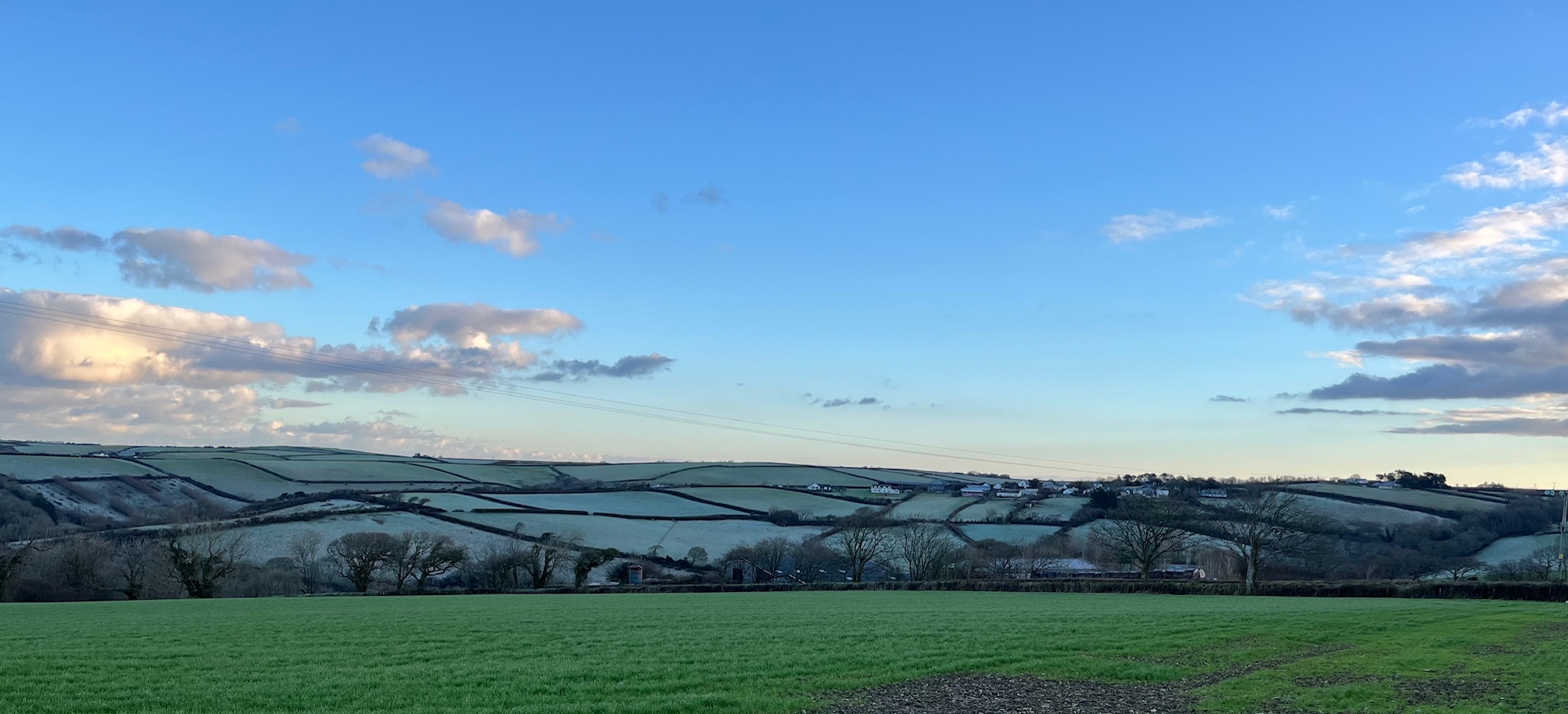
Irrelevant photo–except that it was cold enough overnight to leave frost on the fields.
The original houses
When they were first built, the roofs wouldn’t have leaked, but the windows surely would have let the cold air in. And the warm air out if any was available. Before chimneys, smoke from the hearth had to find its own way out, taking any available warmth with it, so if an airtight house had been possible it would’ve been a health hazard.
Even with the leaks, though, indoor life was smoky. That was a problem for anyone who relied on breathing, but if you wanted to preserve your–or someone else’s–voice it would be particularly problematic, which may be why Wells Cathedral was ahead of the curve. Chimneys weren’t common until the 16th or 17th centuries, but chimneys were added to the choristers’ houses in the 15th century, along with water pipes.
This meant that, cold or not, the houses would’ve been miracles of convenience. So let’s set aside our notions of comfort. They’re not a good match for the era we’re talking about.
The houses originally had two rooms each and were built for single men.
Men? Yes. The choristers were all male, with boys singing the soprano parts. The buildings housed altos, tenors, and basses. I’m not sure where the kids lived. They were small. Maybe someone stacked them in a cupboard when they weren’t in use.
It wasn’t until the Reformation that the cathedral broke through some walls to double the houses’ size and make room for families, and it wasn’t until very recent times that soprano parts have been opened up to girls and (gasp) grown women–and even now (I believe) that’s only true in some choirs.
If the houses weren’t built for families, does that mean pre-Reformation choristers were expected to be celibate? Apparently so, with the emphasis on expected.
Before the houses were built, the choristers lived in town, and the idea was that corralling them in one place would keep them from worldly temptations, by which the churchly fathers meant sex. It must not have worked (I know: that surprises you), because in 1459 (the houses were first occupied in 1348) the church added a bridge to the cathedral so that on their way to work the singers wouldn’t have to rub shoulders, even briefly, with real people and all the temptations they presented.
As the current cathedral dean explained it, “They started to get into trouble with what they termed ‘incontinence,’ which meant getting involved with women.” A BBC video tour and explanation, which is worth watching, also mentions problems with singers not showing up on time. Move them all next door to the cathedral, though, and they couldn’t say, “I’d have clocked in an hour ago but traffic was backed up halfway to Bristol.”
The singers ate in a common dining room. That lets us imagine strong community bonds among people working and eating together and living next to each other. It also lets us–or me anyway–imagine living with the constant presence of some busybody, either another singer or a church official, tracking everyone’s comings and goings, watching for the faintest hint of a sex life.
The current houses
The current residents don’t own or rent the houses, and not all the residents are singers; some are cathedral employees of various other sorts. The houses are what’s called grace and favour houses. They come with the job.
At some point kitchens were added, but residents say the sense of community remains.
The cathedral has gotten a grant of £4.4 million for repairs but needs to raise an additional £1.9 million to start the project. Which is, in case you haven’t noticed, a lot of money.
Is it worth it? The cathedral’s dean would argue that it is. “The roofs are failing,” he said. “The guttering is failing. The windows are failing. If we don’t look after this treasure, we’re going to lose it. The stakes are that high.”
 Notes from the U.K.
However picturesque and ‘characterful’ old houses may be, they are an expensive indulgence if you like your creature comforts or have regard for the environment.
LikeLiked by 1 person
I expect that’s true. They come with 700-year-old problems. Or–I’d have to look back–however long they’ve been standing.
LikeLike
Many houses were built with minimal foundations, damp proof courses didn’t exist until fairly recently, piped water and flush loos, no chance. Windows didn’t fit properly and, in mediaeval times, glass was a rare indulgence of the wealthy, anyway. Tapestries and hangings weren’t just there to look good or impress the neighbours, they were an aid to draught proofing. Even the rich lived lives we would think of as inconvenient and uncomfortable, to say the least.
LikeLiked by 1 person
Can’t argue with any of that. Giving someone a seat close to the fire was a sign of favor, love, or respect because it would’ve been the warmest seat in the house.
LikeLike
You’re right, it’s a very interesting story. I’ve never heard of a cathedral providing housing for its choir. Seems like a bit of a deterrent to auditioning. They say that some of the best sex, however, takes place in monasteries so while church officials claim they were shielding their chorus members from temptation, they might have had a different mission altogether.
LikeLiked by 1 person
I couldn’t rule that out and wouldn’t want to, but I can’t help but wonder how anybody establishes what sex is better–and for who.
LikeLiked by 1 person
I don’t think they intentionally established it. I suspect that the housing grew over time. Word got around and people were chosen because existing members suspected their new recruits were gay or because gay people self-selected to enter their ranks. I say this in part because I have a gay friend who loved the church and seriously thought about becoming a monk because it offered the best of both worlds. That’s just one data point but I think we can assume that there were approximately the same percentage of gay people in the 1400s as there are today. Some of them found ways to satisfy their desires without being ostracized by society.
LikeLiked by 1 person
Sorry, I’ve lost track of which housing we’re talking about. If it’s the choristers’ housing, it was purpose built all at the same time. Monasteries? I’m sure some involved a lot of sex. Devoting yourself to the church was a respectable way to avoid marriage, for both men and women.
LikeLiked by 1 person
Very interesting. The continuing conflict of historic preservation versus what is just plain common sense to maintain livable conditions. There is no set right/wrong to this…maybe the Cathedral can find a dedicated group of reenactors who can also sing ?
I was surprised these houses got water pipes as early as they did. Lead pipes though I suppose.
LikeLiked by 1 person
I was surprised about the water pipes too. The idea of a troupe of reenactors moving in set me off imagining a BBC special–a year in a row of medieval houses. Great TV. We all watch and are fascinated, then they all move out and–oops, what do we do with the places now? And if they can’t sing, much larger ooops.
LikeLiked by 1 person
As an ensemble this row of houses is surely worth any protection they can get. Bishop Ralph was a generous man. I am sure the singers formed a kind of sodalitas or something, they were constituted in some way. The single singer got two (!) rooms, bloody luxury you would not find in a monastery or a bursa of those days. The only comparable situation I can think of right now on the Continent, is the Fuggerei in Augsburg, but this was built notabely later.
As for the sex – I doubt that bishop Ralph and his successors had something against sex in general, what they surely did not want in their nearly monastic group are wives, then things get complicated. Regarding sex – what are public baths for, eh ? Music, merryness, life entertainment, crabs included, or worse a nymph called Syphillis.
LikeLiked by 1 person
If those medieval towns had public baths, I’ve never read about them. Washing too much was considered unhygienic, and given the state of the water probably was. According to one historian who specializes in recreating living condition–Ruth SomethingOrOther; she’s wonderful–they did use a linen cloth to rub on their skin, and when she tried it over a period of weeks it did keep her from smelling to high hell. Her fellow historian who simply didn’t wash–well, it got to the point where it was hard to be near him.
Bishop Ralph’s fear of his musicians having sex comes from a reading of the documents that are left and I expect is fairly accurate. Banning the singers from marrying would be simple. Keeping them away from the opposite sex would be difficult. Keeping them away from the same sex (never forget that as a possibility) would be impossible.
LikeLiked by 1 person
“Washing considered unhygienic” – ? By whom ?
They had bathes. That linen thing – I know it only from 18th century France’s nobility. Especially in Paris the water was terrible and poisonous, always.
But who cares for Paris – even small places like Franconian towns had at least one “Badstube”. An absolutely common institution in the Reich, and elsewhere.
LikeLiked by 1 person
That’s based on what I’ve read, although it’s not a subject I’ve researched with any real focus. But the water–a creek outside (if memory serves) Exeter was called Shit River–or maybe it was Creek–because basically it was a sewer. As so many of them were. They washed hands. They washed clothes. On rare occasions, they washed whatever was left. Or–well, like I said, I haven’t researched it with any focus. I will.
LikeLike
As I understand it, Public bathing came in with the Romans, lasted until early medieval times but had gone by the time of the Tudors when ladies of easy virtue had moved in to ply their trade in the bath houses. Linen was changed daily and people flanelled down rather than immersing themselves, which was considered unhealthy in a cold damp climate with draughts, unless you were unwell, in which case it was considered to be medicinal.
Sorry, no time to find references to support any of this – I’m off for a bath!
Regards, Chris.
LikeLiked by 1 person
Public baths came in with the Romans and I’m reasonably sure left with them. I got as far as finding reasonable sources saying bath houses were associated with licentious behavior. Wheee. Beyond that, I should go research bathing in the middle ages and see if I can’t find some reliable info.
Have fun in your bath.
LikeLiked by 1 person
The Badhaus in Volkach was built around 1450. Badgasse 4. Well restored today.
The “Bader”, the guy who runs the bath, also is a kind of medic, takes care of small wounds, sucks blood etc. He may be a public servant ; I think that is not obligatory, but possible. The authority likes to have an eye on this, and if the guy is an employee it’s easier to keep discipline.
(Sex was allowed, puellae publicae offered their services, sometimes there was a price list. Also the possibility for food, drink, and music was given – not for the common working man of course, one has to keep the riffraff out.
But bathing alone was affordable even for a humble worker and his wife.)
No clue about shit creeks, in Volkach they very likely used water from the river Main.
In general there were hefty fines for people who poisoned water, be it freely flowing or a well. One finds this in “Flurordnungen” or in “Dorfordnungen”. Guess under “Feldfrevel”.
Just because it is “medieval” it does not mean rivers of shit flowing through the nice landscape. If you are interested in rivers of shit, read what Burroughs has to say about his youth.
LikeLiked by 1 person
Rivers of shit aren’t, actually, one of my particular interests, although our privatized British water companies are doing their best to produce them–mostly, I believe, using the sea not the rivers, but hey, you do what you can. It could be that medieval Germany was cleaner than medieval England. Research needed. Thanks for the push in that direction.
LikeLike
Years ago, I moved out of my 100 year old farm house into brand new townhouse. The old house was hand built and didn’t have a plume wall or square corner – then neither did the new house.
LikeLiked by 1 person
That’s not where I expected this story to go. In other words, thanks for the laugh.
LikeLiked by 1 person
As you might expect, I spend quite a bit of time thinking about life in medieval buildings. There’s a restored 14th century house nearby that provides most of the food for my thoughts, although the ones in Wells are much prettier. Thank you for the link to the BBC video, by the way.
What I found most interesting in the video was the size of the windows. I keep forgetting how dark it would have been in houses in the Middle Ages. They would mostly have been covered by oiled fabric, so would not have let much light in and would have been useless at keeping the cold out.
LikeLiked by 1 person
Good point. Glass was a luxury. I didn’t see anything about when glass windows were added. I think it’s a fair assumption that they weren’t original but I don’t actually know that. Yes, though, dark indeed. That would’ve made cathedrals all the more awesome: all that glass; all that light.
LikeLiked by 1 person
Yes, they were definitely built to impress.
LikeLiked by 1 person
Nearly ten years ago, our daughter and her husband bought an old cottage in Cornwall, where our son-in-law still lives. They decided to rearrange the layout which was difficult as the walls are stone and several feet thick, so the new plumbing is only just complete. Drilling a soil pipe through three feet of stone is a challenge. They didn’t know how old it was when they bought, maybe 16th century, but not listed. Some of the walls are now plumb, as they decided to remove the old plaster and install plaster board on battens, so that they could insulate behind to prevent condensation. It’s going to be lovely when he’s finished but it’s taken so much longer than intended, owing to various sad and unpredictable circumstances. It would have been so much quicker and cheaper to build from scratch…
LikeLiked by 1 person
What a project! Someone up the road from us bought an old thatched house that was apparently damp because a previous owner had decided to finish the outside with (I think) concrete. I learned this from the guy who took that off and was putting a lime coating on it, which he said would take care of the dampness. The house needed to breathe. These old places are entire ecosystems, which the people who built them must’ve understood but we–or many of us anyway–no longer do.
LikeLike
I had no idea the Church was that interested in the lives of its singers. (I probably should have guessed since it had an opinion about everything else.) It would be a shame to lose that piece of living history.
LikeLiked by 1 person
For all the problems of living there, the people who do seem to agree. Mercifully, these days they can enjoy with community without the surveillance. These days, we leave that to the algorithms.
LikeLiked by 1 person
… We’ve become so enlightened.
LikeLiked by 1 person
i would still get misty eyed and want to live there…too bad they don’t rent them out!
LikeLiked by 1 person
I understand the wish and know that if they did it would undermine the community. I live in a part of Cornwall where holiday rentals are eating villages, bit by bit, until only a shell is left, beautiful but empty.
Sorry to get all serious on you.
LikeLike
yes i get it, sad.
LikeLiked by 1 person
As time goes on, I’m more and more concerned by the urge to travel. Yes, it’s wonderful to see new places, meet new people but there are many places I would love to visit and probably never shall, now. It’s not just holiday lets, it’s the sheer number of people, who have nothing to do with the place, just following a guide, taking selfies. How can you experience places, when they are so different from what they originally were, when the sheer numbers distort the experience? I’ve been lucky enough to travel, so it feels hypocritical to complain about other people doing so but I don’t intend to go far from now on.
LikeLiked by 1 person
Add to that travel’s impact on global warming…
LikeLike
shit
LikeLiked by 1 person
Oh, eloquently said.
LikeLike