
No one can give us a solid answer, but we do have some hints. A group of geneticists and archeologists have analyzed a cluster of burials in Dorset and report that they show a matrilocal society. In other words, the women stayed in the village and the men moved out when they married, being replaced by men from outside, who married in.
The tribe–the Romans called them the Durotriges; we don’t know what they called themselves–didn’t cremate their dead, which was unusual for the time and place. From around 100 BCE–more or less 150 years before the Romans invaded–they buried them in the hills around their farmsteads, leaving an important resource for archeologists.
Who cares? Pretty much everyone who was involved in the arrangement, and I can’t think why we shouldn’t as well, because it tells us a lot about the roles of the men and women. Or–hell, let’s throw out a patriarchal habit that’s so deeply ingrained it’s damn near invisible and say “the roles of the women and men.”
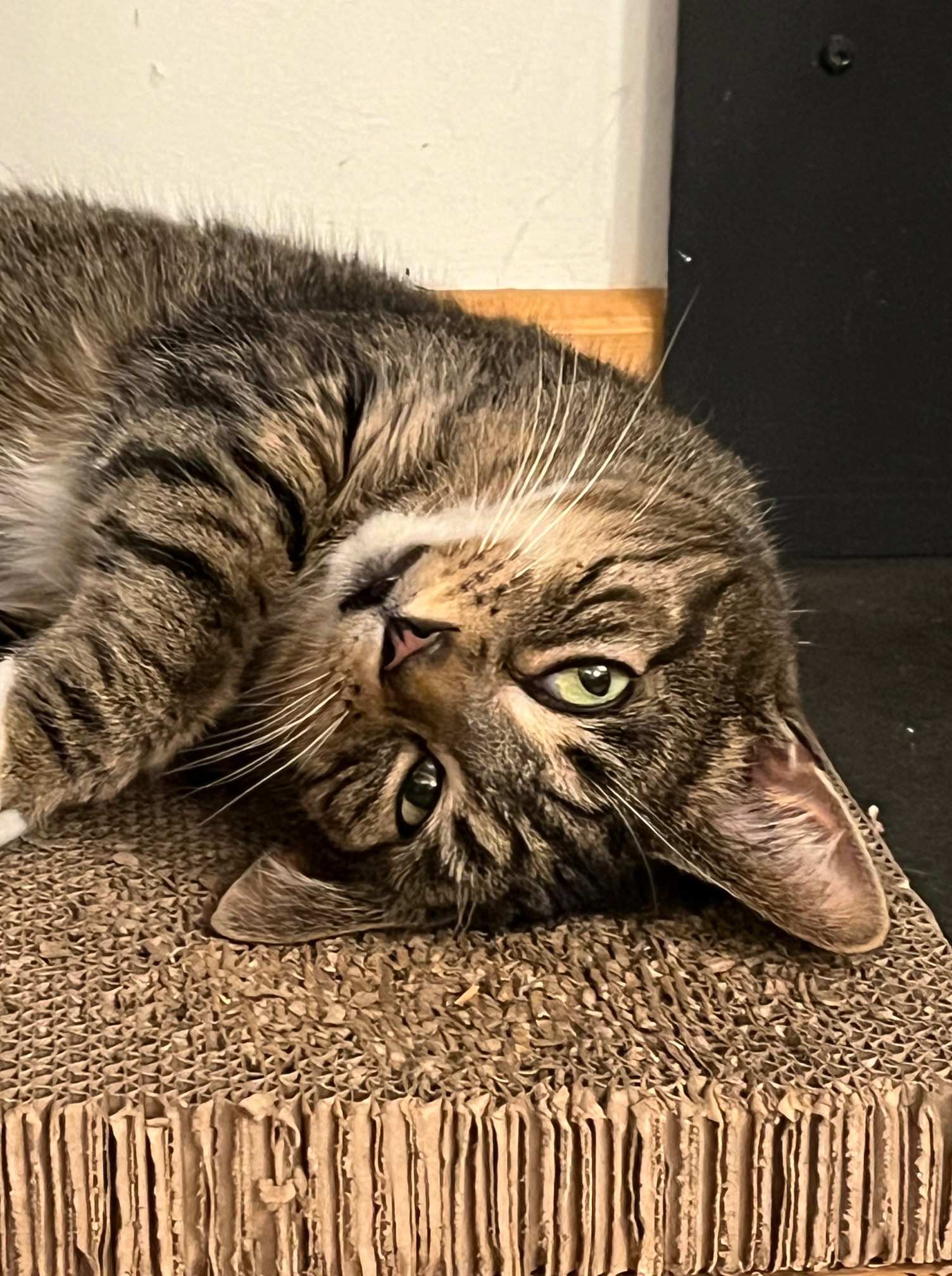
Semi-relevant photo: This is Fast Eddie, who’s relevant only because we’ve been told (sort of) that women with power become childless cat ladies.
Okay, I’m stretching it, but hey, he’s a great cat and I needed a photo to drop in here.
Does it matter who stays and who goes? Yup, it does. The partner who stays in place has the unbroken support of an extended family. The one who comes in comes as an outsider and an individual, without that built-in support. They may acquire it over time, but they may not. And if the tribe considered land as something a person could own–they were farmers, so let’s guess that they did–then land ownership is likely to have been held by the person who stayed in place. It’s awkward, taking land with you. So it would presumably have been passed down through the female line.
Matrilocality also means–or at least hints–that women would have the primary shapers of the group’s identity.
It’s kind of mind-boggling, isn’t it?
How do they know any of this?
DNA. Mitochondrial DNA is passed down from mother to daughter, making matrilocality relatively easy to trace. The Y chromosome is passed from father to son. Everything else is a grab-bag.
Geneticist Dr. Lara Cassidy, said, “This was the cemetery of a large kin group. We reconstructed a family tree with many different branches and found most members traced their maternal lineage back to a single woman, who would have lived centuries before. In contrast, relationships through the father’s line were almost absent.
“This tells us that husbands moved to join their wives’ communities upon marriage, with land potentially passed down through the female line. This is the first time this type of system has been documented in European prehistory and it predicts female social and political empowerment.”
The find casts a new light on smaller samples from other cemeteries, where the same pattern shows up: most of the individuals trace back to a small set of female ancestors. Dan Bradley, a professor of population genetics, called it “a widespread phenomenon with deep roots on the island.”
This changes the way earlier information is interpreted
The first thing it changes is the earlier discoveries of Celtic women buried with what archeologists call rich grave goods–what we might call stuff–mirrors, combs, the occasional chariot. The standard interpretation is that these were the burials of high status women. Fair enough, but that tells us nothing about why they had high status and I’d bet a chocolate cake that most people reading it will think, Right: wives of important men, just like most people would write men and women, as I started to in the second paragraph, instead of women and men. Old, nearly invisible thought patterns, underlining the importance of men, the peripheral status of women. But if the village’s continuity was in the hands of its women, it’s not unlikely that much of the power was as well. Or–let’s go out on a limb and see if we fall off–possibly all the power.
It’s a safe limb to go out on, because we can’t know. So don’t take the possibility as fact but don’t dismiss it either. We do have some facts that make it look likely. The Durotriges men were buried with a joint of meat and maybe a pot with something to drink on their way to the afterlife. Many of the women were buried with mirrors, combs, jewelry, and the occaisonal sword.
All this comes with a reminder that being buried with expensive stuff may or may not indicate that the person was a leader. To make that leap, we need to go back to those Greek and Roman texts, which takes us neatly to the next paragraph:
The second thing the new findings change is how we read what Greek and Roman writers said about pre-Roman (or Iron Age if you prefer) Britain. The Britons, inconsiderately, didn’t develop a system of writing, so yeah, they didn’t leave written records. We have to depend on what outsiders wrote.
The written sources tell us the Romans were shocked to find women in positions of power. They inherited wealth, led battles, and practiced polyandry–the flip side of polygamy, with the woman having more than one husband. Going both further back and to Celts outside of Britain, ancient Greek writers said women’s and men’s tasks “have been exchanged” and Celtic women acted as “political judiciary.” (That last quote is from an article in The Conversation, not an ancient Greek source. I’m leaving you to figure out what political judiciary means.)
For a long time that was widely dismissed on the theory that the Romans overstated British women’s freedom and power to make the country sound barbaric. Because surely we can’t take that literally? It upends too many of our assumptions. But this latest find makes it look like they were reporting accurately. It undermines the idea that pre-Roman Britain was a land where men were hairy-chested warriors and women stayed home and did what a much later culture expected them to do. You know, look in their mirrors, comb their hair, and stay the hell off those chariots.
Were all early societies matrilocal or matriarchal, then?
Nope. Early Bronze Age Orkney was patrilocal: the men stayed put and the women moved to other communities. And early iron age Hallstatt graves in Austria showed men and women equally achieving high status. Middle Iron Age British burials show men and women having equal status. Age seems to have been more important than gender in giving them status.
A rampage back through 150 British and European genome studies in light of the Dorset findings shows the diversity in mitochondrial DNA declining over a period that spans the Stone, Bronze, and Iron ages. To translate that, increasing numbers of women stayed in place as time went very slowly on.
None of this gives us a simple picture, or even a decisive one, but it does mean that patriarchy hasn’t been in place since forever and isn’t built into our DNA.


https://www.nessofbrodgar.co.uk/orkney-prehistory/bronze-age/ I am from Orkney and I’m trying to remember where I read that most of Orkney was inhabited by women, I’ve given this link as it is very interesting but I will keep on looking for the source and hopefully jog my memory.
LikeLiked by 1 person
Great link. Thanks. It makes me want to write a bit more about Orkney. (I have an earlier post buried here somewhere, but it focused on Skara Brae if I remember correctly.) But inhabited mostly by women? It would be difficult to maintain an off-balance population like that, for all the obvious reasons. On the other hand, it’d be great to work with if you write historical fiction.
If you do find a source for that, let me know, will you? I’m interested.
LikeLiked by 1 person
I certainly will Ellen, I know I’ll have it somewhere in the depths of bookmarks. Hope you do write more about Orkney, I come from Rousay which is known or was as the Egypt of the North for all the tombs we have.
LikeLiked by 1 person
Amazing place to come from. I’ve left myself a note to follow up on that. Unfortunately, notes to myself are a bit like your bookmarks, but it’s in a place where I really have been looking lately.
LikeLiked by 1 person
What a rich read!
Thank you very much, Ellen, and a lovely weekend to you!
LikeLiked by 2 people
And a good one to you as well, Luisa. A major storm just missed us, so the odds of a good weekend have improved.
LikeLiked by 1 person
🙏🤗🙏🤗🙏
LikeLiked by 1 person
Fascinating. And I love fast eddie! It makes me want to see their society in action for awhile.
LikeLiked by 1 person
It would be fascinating, but it’s so out of our reach.
LikeLike
“It’s kind of mind-boggling, isn’t it?”
I can’t make heads or tails of it. “Women and men,” you say?
“The Britons, inconsiderately, didn’t develop a system of writing,”
Well, there you go. What do you expect?
Seriously though, this is fascinating. I like prehistory much more than history. The older the better.
To be honest, when I’ve seen the rich grave-goods in women’s burials from this period, I didn’t think, “rich man’s wife,” but imagined women of high status in their own right, but I’d not really considered how prevalent that might have been in their society.
It is quite telling that archaeologists didn’t trust the Greek and Roman writings on it.
LikeLiked by 1 person
I think we’re dealing with a case of experts, no matter how knowledgeable, reaffirming their existing beliefs. Credit to you, though, for assuming a woman would have attained high status on her own. Can we clone you??
LikeLike
And I’m with you on prehistory. Maybe it’s how large the unknowns that make it so fascinating.
LikeLike
Fascinating, Ellen!
LikeLiked by 1 person
It certainly captured my imagination.
LikeLike
Very interesting ! For me it is a First – the first time I see / hear about / encounter a theory, based on scientific evidence, that supports anything “matriarchaic” in ancient Europe. I really do not think that the presented interpretation of the scientific facts is too far fetched.
Before it was just and ONLY BACHOFENs (https://de.wikipedia.org/wiki/Johann_Jakob_Bachofen ) (sorry I can’t link here) Phantasey, nothing else, not one hint of evidence. I never have heard about the “Durotriges” before, wonder where they show up in the written (hence Roman) sources. They were “Kelten” for sure.
Only slightly related, sorry.
Over the last – goodness, forty ? – years there were some exciting excavations made in Southern Germany, regarding the “Kelten”. Hochdorf, Glauberg may be the names of the most well-known places – and there is the grave of a “Keltendame” / “keltische” lady excavated some years ago in Heuneburg, another one was nearby in Bettelbühl. (There are a lot of museums presenting these things now. I would have linked some, but sorry I have no possibility to hyperlink here.)
I read only lately (what means some months ago) about a project that will use DNS/DNA to find out if, and if so, how, these people were related to each other. This could show the genealogy of a “kleinräumige” “Elite”, an “elite” living in a relatively small area of Southern Germany. Should help to establish more about the role of women in this society too.
Forget them chariots, they had sofas, ha ! And Greek wine.
There was “something” before Rome, we (me) just can not grab it I so long for an over-all presentation / over-view (“Überblicksdarstellung”) of the actual knowledge of Europe’s history from, say, 3000 before Christ to the Roman expansion and the start of the Germanic invasion. Effing barbarians from the East that they are, ta ! ( Franconians excepted, of course.)
LikeLiked by 1 person
I wouldn’t want to dig a hole big enough for a sofa, but given a choice between that and a chariot, I think I’d go with the sofa.
It would be fascinating to know whether the elite were related or whether people became the elite based on their own merit. With DNA analysis, I expect someone will get back to us on that. (If we put this to a vote, I vote for merit, but I’m ready to admit that we shouldn’t do archeology that way.)
LikeLike
I thought more of a nice tumulus than a hole in the ground, like this :
https://www.keltenwelt-glauberg.de/en/archaeologischer-park/grabhuegel/
or a number smaller :
https://www.heuneburg-pyrene.de/erlebnis-heuneburg/grabhuegel
I do not like the word “elite” very well, the whole concept that some are more worth than others, always tastes a bit like napola, but I am biased there, sorry.
But with these graves – these people, buried under these circumstances, really do stand out, regardless how they gained their position.
LikeLiked by 1 person
If you’re going to bury a chariot or a sofa, I suppose it makes more sense to mound earth over it, but either way it’s a shitload of shoveling. As for the elite, if we’re talking about inherited status, then the word’s accurate. If we’re talking about leadership positions given to people because they’re able to lead, then we might want to replace it with something else.
LikeLike
The Celts were advanced in so many ways. Love that Fast Eddie!
LikeLiked by 1 person
We could learn a lot from many tribal societies, but we don’t seem to be in the mood to do that lately. As for Fast Eddie–well, he loves Fast Eddie too. What a coincidence, eh?
LikeLiked by 1 person
It shouldn’t have been too great a shock to the Romans. They had to defeat Boudica to maintain control of the island. Although they may have seen her as proof of how barbaric the people were.
LikeLiked by 1 person
Forget the Romans. Given what they knew about Boudica, it shouldn’t have been a shock to the historians that the Romans and Greeks wrote about women having power. But then, what you don’t want to know–well, it’s almost always possible not to know.
LikeLiked by 1 person
Excellent point
LikeLiked by 1 person
They were smart to follow the women.
LikeLike
I won’t go as far as arguing that women are inherently better than men–I’ve known some people who’d upset that theory just by breathing–but a bit of equality wouldn’t go amiss.
LikeLike
I do find it interesting how much of our “automatic” thinking is coloured by our patriarchal societal norms and background. And I am generally fascinated whenever I find a culture that is built differently.
As an aside, your choice of illustration for this post is fitting as well: when common household cats live in semi-feral settings (like on farmholds), then they build matrilocal societies as well. ;)
LikeLiked by 1 person
Cats? I had no idea. I do know that a fair bit of what I was taught (I’m roughly a thousand years old, so take that into consideration) about animal behavior was colored by the same biases that couldn’t let historians see the reality of a society where women wielded power. The study of animal behavior is far from immune. So yes, I’m with you on being fascinated by what we take for granted and how invisible our biases are–at least to us.
LikeLiked by 1 person