
Orkney isn’t the first place that comes to mind if you’re looking for the center of Britain. It’s small, it’s an island, and it’s way the hell up north in a country whose political and cultural center is way the hell down south. What’s more, it’s sitting in the middle of a lot of water, which is what islands like to do, and the currents around it are fierce. But in Neolithic times, it was a center–maybe the center. It originated a type of pottery called grooved ware that spread across Britain and was the must-have thing of the late stone age. It built the first henges–those stone rings with ditches around them that dot the British landscape–and they also spread south. And yes, they did that before Stonehenge.
The Neolithic
Who were the people behind all that? They arrived, who knows why, from mainland Scotland, bringing their domesticated animals, their grain, and their knowledge of how to farm. Like any early farmers, they would’ve supplemented their diet with whatever they could gather, hunt, or fish. They replaced (or possibly absorbed; I don’t know) a small population of hunter-gatherers who’d reached the Orkneys first, and they set up a society successful enough to last through 60 or 70 generations and to build monuments that are still impressive today.
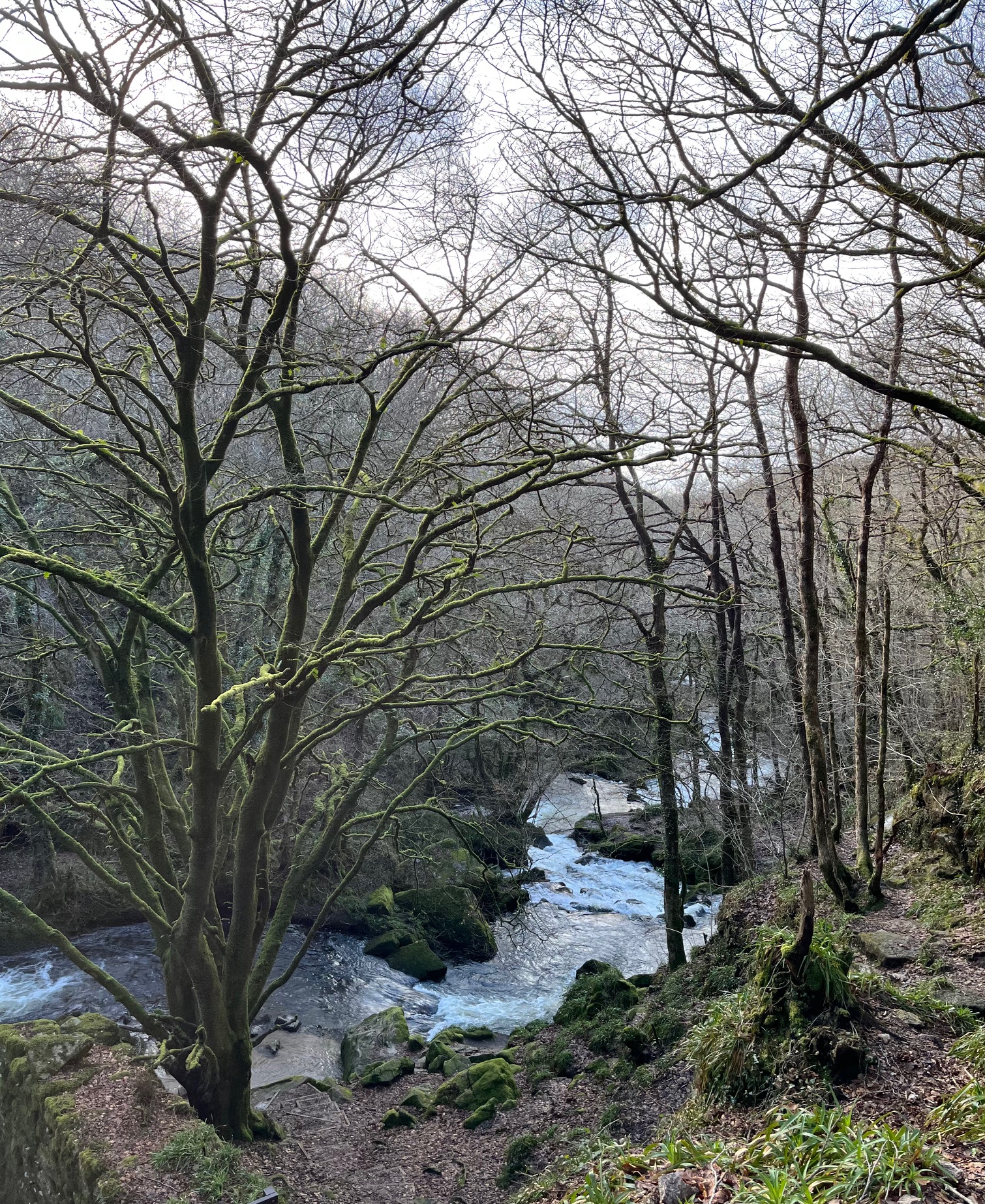
Deceptive photo: This isn’t from Orkney. It’s from Cornwall–the opposite end of the country. Sorry. I’d rather cheat than steal other people’s photos.
Their lives wouldn’t have been easy. Most people who survived childhood died in their 30s and few lived to be 50, but somehow or other this relatively small group of people found time to build massive henges and tombs as well as make that elegant pottery.
Initially they lived in isolated farmsteads but grew into a tribal society, possibly with an elite ruling class, but that implies the possibility that they might’ve lived without one. Until we hear something definite, it’s your choice. Personally, I’ve had it with ruling elites and I’m going for an egalitarian structure.
We know a lot of this because for the past 20 years archeologists have been excavating the Ness of Brodgar, an Orkney site that was used by those 60 to 70 generations of late Stone Age residents that I mentioned a paragraph or three back. Or if it makes them sound more modern, Neolithic residents. Now the archeologists are about to rebury everything they dug up so painstakingly, and eventually I’ll get around to explaining that, but first, how long does it take to get through 60 or 70 generations?
About as long as it took to get from the Norman Invasion of England to last Monday afternoon. So offhand I’d say they were more reliable than we are today.
The Ness
The Ness of Brodgar–that bit that’s been explored–covers six acres and only the top level has been excavated. It may be 5 meters deep in places, with newer structures on top of older ones. Tempting as it must be to find out what’s underneath, the only way to do it would be to destroy the top layer and the archeologists have held back. By covering it up, they’ll leave it to later generations of archeologists who, with luck, will have the tools to explore it without wrecking what’s on top.
There’s another reason to cover it up: the kind of stone it was built with erodes with long exposure to air.
In the layer they have excavated they’ve found dozens of buildings, including temples, outbuildings, and kitchens, all linked by paved paths and surrounded by a wall. It’s built on a narrow bridge of land, so you wouldn’t have been able to go around it. You either went in or you turned back.
Some of the stones, although not whole walls, were painted.
Did I mention that it rubs elbows with two impressive stone circles, the Ring of Brodgar and the Stones of Stenness? Impressive as they are, though, archeologists talk about them as peripheral. The temple complex–the Ness itself–was the most important piece of work. Or as one archeologist put it, “By comparison, everything else in the area looks like a shanty town.”
Archeologist Colin Richards describes it this way: “The walls were dead straight. Little slivers of stones had even been slipped between the main slabs to keep the facing perfect. This quality of workmanship would not be seen again on Orkney for thousands of years.”
Fans of the Ness say it rivals Hadrian’s Wall and Sutton Hoo for for both size and sophistication. Archaeologist Nick Card warns us never to “underestimate our Neolithic ancestors and what they were capable of.”
The Ness doesn’t seem to have been a settlement. It was a gathering place–a ceremonial center–for people from across the Orkneys.
How come Orkney just turned into a plural? It’s made up of some 70 islands. About 20 of them are inhabited these days. So we’re talking about a group of scattered people who would have come to the Ness to exchange ideas and objects, to hold rituals and ceremonies (no one has a clue what their belief system was), and to celebrate. Or as one article put it, to party.
And what happened next?
A lot of stuff, but since this is prehistory we don’t know most of it. Around 2,300 BCE, some thousand years after building began, the place was abandoned, apparently after a big feast–more than 600 cattle were slaughtered–and the Ness hung out a Closed sign.
Did a new religion take the old one’s place? Did power shift, drawing everyone’s attention to some other location? Can I think of a third possibility to round out the rhythm of the paragraph? Dunno, dunno, and no.
By the late Iron Age, the Orkneys had become part of the Pictish kingdom, and by the close of the Pictish era Celtic Christian missionaries began to show up. Then the Vikings came and, as WikiWhosia has it, “The nature of this transition is controversial, and theories range from peaceful integration to enslavement and genocide.” Which is one hell of a range.
Whatever happened, Norwegians–or Vikings if that’s a more familiar way to think of them–settled in the Orkneys and farmed and pretty much took over. Christianity packed its bags and left. Harald Hårfagre–Harald Fairhair–annexed both the Orkneys and Shetland, making them an earldom. We’re going to dance through this lightly and get out fast, but we can probably learn a lot about the culture from the names of a couple of rulers: Thorfinn Skull-splitter; Eric Bloodaxe.
See why we’re leaving?
According to the Orkneyinga Saga, the islands became Christian in 995, when Olaf Tryggvasson summoned the earl, Sigurd the Stout, and said, “I order you and all your subjects to be baptised. If you refuse, I’ll have you killed on the spot and I swear I will ravage every island with fire and steel.”
So Sigurd said, “Yeah, what the hell, I always wanted a bit of water sloshed on my head. What do we eat when we’re Christians?” and that was that. Or to tell the story a different way, details about the islands’ conversion to Christianity are elusive.
Fast forward to the fifteenth century, when the king of Norway, Denmark, and Sweden (we’ll call him King I) used Orkney as a guarantee that he’d pay his daughter’s dowry when she married the king of Scotland (that’s King II). So far, so good, but despite being the king of three countries and a whole raft of islands, King I was broke and he didn’t pay, so presto change-o, King II got the Orkneys, which became Scottish.
That’s feudalism for you. The rich play chess, using the land and its people as game pieces.
You see what I mean about ruling elites?
The shift brought an influx of Scottish settlers and the islands are Scottish to this day, but have retained a lot of Scandinavian influence.
 Notes from the U.K.
Fascinating, Ellen. To start with a niggle about your quote from the archeologist, gaps are filled with “slivers’ not “slithers” but it gets confused so often that I suspect it’s just me being extra picky. (No surprise there, I still say “different from” and don’t split infinitives (well, hardly ever, it sometimes flows better). The joys of being taught English grammar in the sixties! By the time our daughter was in school, it was more or less abandoned and we had to educate her in the proper use of, say, the semicolon etc. Shameful …
Anyway, back to the subject. I’ve never been to Orkney but we did visit Jarlshof in Shetland some thirty years ago and the use of stone for fitted furniture was fascinating. I imagine that straw and animal skins were used to make the seating and beds more comfortable but maybe they were just a lot tougher than we are. My fantasy is to be able to go back, strictly as an observer, to see and try to understand what went on in these ancient societies. I’m convinced that the stories we invent to account for the rise and fall of these ancient sites and their uses are just that, stories. There’s no real justification for believing that they were radically different from us, a few millennia are insignificant in evolutionary terms, but I am pleased that there’s a shift from regarding them as primitive, painted savages. How well would we do transplanted to a cold and inhospitable island with no modern luxuries such as metal tools?
LikeLiked by 1 person
Thanks for spotting that business with the slivers. That was probably my typo, not the archeologist’s mistake. It’s damn near impossible for any of us to catch our own typos. We see what we’re convinced we put there. I’ve gone back to correct it.
A thousand years ago, in those enlightened days when I was a kid, we were deluged with images of stone-age people dragging their knuckles on the ground and clubbing each other over the head. Idiocy. You’re right: in evolutionary terms, they were us but minus the technology. They knew their world better than we know ours. They had to.
If you find a way to go back and observe, can I hitch a ride? It is a return trip, isn’t it?
LikeLike
Absolutely it’s a return trip! Even though I respect their abilities, I’m far too old to start sleeping on stone slabs and relying on anything but up-to-the-minute plumbing and heating. You’d be more than welcome with your historical insights.
LikeLiked by 1 person
Sounds fabulous. I’ll wait breathlessly for you to work out the technical problems.
LikeLike
Good stuff.
LikeLiked by 1 person
Orkney is fascinating, thanks for all the links. It’s on my list to visit one day.
LikeLiked by 1 person
My partner and I were there some years back and didn’t stay long enough. I’d love to go back.
LikeLiked by 1 person
Some amazing remains on Orkney. Bearing mind their relatively small size, there were obviously some very busy residents. Scara Brae is the site that especially grabs me, though. And…“The nature of this transition is controversial, and theories range from peaceful integration to enslavement and genocide.” My money is definitely on the latter, with the Vikings’ record everywhere else they went.
LikeLiked by 1 person
Scara Brae grabbed me too. Unlike the stone circles, we can stand there and sort of know how the place was used. People ate, slept, worked, passed the time, kept the kids from falling into the fire–
I expect you’re at least partially right about the Vikings. In the north of England, they did eventually settle down and build a stable mixed community, Norse and Anglo-Saxon. We shouldn’t simplify the picture, in spite of the blood splatters there on the left.
LikeLiked by 1 person
Yes, eventually. Certainly plenty of blood spatters wherever the Great Heathen Army went, though, and lots more gore as they expanded east and south into Europe and Asia.
LikeLiked by 1 person
Okay, now you’ve got me wondering how they compare, blood-spatterwise, to other rampaging armies. The Crusaders, say. Or, come to think of it, the Belgians in the Congo. Compared to them, the Vikings should be nominated for sainthood.
It’d be interesting to know how the Viking interlude is taught to Nordic schoolkids.
LikeLiked by 1 person
I don’t think I’d want to compare them – that might suggest that some blood spattering was better than other blood spattering and I really don’t feel like going there. It’s all rather ugly.
And I’ve no idea how it’s taught in Nordic schools, but I’m currently reading a book on the Vikings by an archaeologist who studied in Oslo and is a director of the museum there, although I think she might be British, and who certainly is under no illusions about their blood spattering skills.
LikeLiked by 1 person
I tried to do a comparison between the amount of killing on the Catholic and Protestant sides of the Tudor monarchies and sank quickly. Maybe it’s enough to acknowledge that some pretty horrible stuff went on on both sides. But it is interesting that the Vikings’ reputation still stands out.
LikeLiked by 1 person
I think it has a lot to do with their ferocious We-Will-Eat-You appearance. Nothing subtle about them at all.
LikeLiked by 1 person
Not to mention the Romans! I can’t understand their reputation for having “civilised” Europe. They were good engineers but the idea that everything went to rack and ruin with the fall of their empire is ludicrous. Underfloor heating was no compensation for crucifixion etc and ask Boudicca about their attitude to the conquered. Okay, her army wasn’t a shining example but she had been sorely provoked.
LikeLiked by 2 people
I can’t justify the reputation given to the Romans, but I can understand it, I think. They brought a lot of things our era and culture understand: governmental structure and sanitation just off the top of my head. I wouldn’t want to balance that against the issues you listed, to which I’d add the little matter of a slave-based economy.
At least some recent historians are reconsidering the supposed collapse of economies and countries after the Romans left. You’ll find a quick reference to it towrad the end of this post:
https://notesfromtheuk.com/2021/07/02/who-were-the-anglo-saxons/ It’s in the section titled “But didn’t Britain collapse when the Romans left?”
LikeLike
Thanks, I’ll take a look at that.
LikeLiked by 1 person
Unorkneyish, sorry.
The Imperium Romanum was a state – the bloody rest was not.
It did not “collapse” on a nice day in August because of one orgy too much, it changed it’s face, it faded, but still lived on.
(Historiography is always historical. So it may be a good idea to check what image of “Rome” you have, where it originates from. 19th century historiograohy ?)
Many of those “germanic” leaders realised what they had met, and chose to become a part of it – a magnificent tool for rule over the known world around the sea in the middle.
Good examples are Gallia, and maybe Brittania (but I do not know enough about it), where over time (Roman rule and statelyness / statehood, administration, law, education, infrastructure, you get the idea) a mixed society evolved, and that did not end simply because “Rome” became weak. There may have been a rising self esteem. The “Romans” did not leave, the “Romans” were there : Get rid of the “national” goggles.
And btw do not forget Eastern Rome, things were different there. In the end continuity outweighs (imagined) disruption. The centrifugal forces won, yes, but that left the parts not without “everything”, no “zero hour”.
A little extreme may be to state that the Imperium Romanum ended only 1803/06, with the end of the Holy Roman Imperium Natione Germanum, dem Heiligen Römischen Reich Deutscher Nation. Nevertheless the FRANCONIAN kings took over and continued, ahem.
Do not know if someone already did it, but it could be interesting to compare the, say, last three hundred years of Western Rome (dates ?) with the last three hundred years of the Reich from 1550 to 1806. These constructions are really undestroyable in a sense – like an old battle ship, she just won’t sink !
LikeLiked by 1 person
All excellent examples of the way we carry history with us. I’m tempted to add a few but the point’s been made.
LikeLike
There is an idea that the Vikings were actually “traders not raiders”. But then we’ve also got accounts of how they destroyed things – although it’s worth bearing in mind that the writing in those days was nearly all done by monks, who were not overly keen on anyone who wasn’t a professed Christian. And it actually seems to have been later Scandinavian artists who popularised the horned helmets idea. They definitely settled down here. I went to Iceland in 2023, and the waterfalls there are all called foss – Skagafoss etc – and a lot of mountain names end in fjoll or fell … compare that with the Lake District, where waterfalls are called forces and mountains and called fells.
LikeLiked by 1 person
The fact that they farmed is also sometimes presented as–well, almost an either/or thing, but it sounds like all three are true: they raided, the traded, they farmed. As far as I know the only thing they didn’t do is, as you mentioned, wear horned helmets.
Interesting point about the monks. And the words in use in the Lake District. I wondered what fells were, although not enough that I ever bothered to look it up. Thanks.
LikeLiked by 1 person
Oh, Eric ! Didn’t he get the nickname “Bloodaxe” after he killed his twenty or so brothers ? Daddy was a ladies’ man, obviously. Wonder whether Eric used always the same trusty tool.
Must be the Orkney groove.
LikeLiked by 1 person
Nickname? No. That was his name-name, then he had to live up to it.
LikeLike
I shouldn’t kid around that particular way, should I? Someone will think I mean it.
LikeLike
Enjoyed reading your post. I love Orkney , having visited twice (so far). I have tried unsuccessfully to persuade my wife to move there (with me, I mean) and so I’m now pinning my hopes on a lottery win and a holiday home.
LikeLiked by 1 person
I have a hunch it’s a cold, windy place to live in the winter. Fingers crossed for the lottery, though.
LikeLiked by 1 person
Another cracking yarn, Ellen, thank you. The links were very interesting, and now my head is reeling with all the twists and turns and unknowns.
Archaeology is weird, don’t you think, and history? Vast amounts of time and energy and money go into finding out as many tiny details about things that happened ALREADY, and make literally zero difference to NOW, and yet they demand our attention and captivate us.
One thing struck me in particular in this, which is the tremendous attitude of the scientists, who have dug up quite sufficient finds to keep them in work in the lab for decades, and who know if they keep digging they’ll probably do more damage than good, despite the richness of what’s available, and future technologies might reveal more without disturbing as much, so we’ll be patient, cover the rest up and go home… so that in future we can find out more of those pragmatically irreleveant but irresistibly fascinating minutiae about our human heritage.
LikeLiked by 1 person
I’m going to have to argue with you about history and archeology. I think they do make a difference to us now, partly in explaining how we got here and making sense of us, but also because with no sense of history we’re even greater fools than we are with it. The stories we tell ourselves about our past (we’re heroes; we’re conquerors; we’ve been victims) shape the decisions we make as nations, as peoples. Consider Gaza: if we start the story with the Hamas attack, as Israel does, we get one story. Start the story with the expulsion of the Palestinians in 1947, as the Palestinians do, and we have a very different story.
I could go on endlessly with other examples, but I’ll spare you.
LikeLike
You are absolutely right. I have no idea what I was talking about, not for the first time. :)
LikeLiked by 1 person
Been there. Said something more or less like that–usually in public.
LikeLike
The more that is learned about ancient history, the more amazing it turns out our ancestors were. We do not need aliens; these things – mind-boggling as they are – were done by some form if humans. The challenge for us (or at least the archeaologists) is to unearth how they did it. Those of us watching this play out are in for witnessing some exciting discoveries.
LikeLiked by 1 person
Agreed: they were us minus the technology. As for how they did it, I’ve found the work of experimental archeologists fascinating. They get in there and try to recreate what they’ve found. They’re amazing.
LikeLiked by 1 person
The mention of aliens reminded me of something I was thinking about, although it’s kind of off topic given this blog is about the UK’s spidery corners. It’s not particularly difficult to explain how ancient people built things like Stonehenge (although it probably was baffling at one time – it’s just scaffolding, levers, ropes, and banks of earth) there are some really challenging bits of ancient architecture abroad, including in North and South America. I wonder if you’ve looked into those and have any ideas. I forget the names, but I’m thinking of those exquisite walls of enormous blocks of stone – Inca and others.
It would take a lot to convince me of alien intevention or pre-Homo giants, etc., and the limited human origin is given away often by the presence only of a near-perfect *facing*, while the deeper recesses are rough and ready with big gaps infilled with soil and rubble. But even so, I still haven’t found a satisfactory explanation. The only reasonable one is that people worked for stupid amounts of time grinding away at the edges of granite blocks with their – at best, copper – chisels to align a joint, but it’s hard to imagine how they’d do that without repeatedly moving enormously heavy blocks up to their neighbours, seeing where they don’t fit, moving them away again, and chiseling some more off. Maybe some very good templates might be constructed of wood or something first – hey, whaddayaknow? I’ve just solved it!
But the lesson from the Egyptian Pyramids is that we underestimated just how dedicated a population could be to their ruler (without enforced labour) and how much of their free time (seasonally) they put into building something astonishing for him/very-rarely-her to be buried under, not to mention how slow the cultural development of those monuments was. Anyway, as I say, maybe off topic for here.
LikeLiked by 2 people
Off topic’s never–okay, seldom–a problem here. Outside my area of alleged expertise (okay, I have no expertise unless finding people who do seem to know something counts as expertise–
Where was I? Outside my area of expertise is a problem. I’m going to bail out on this one–except to say that we not only shouldn’t underestimate the dedication of those ancient people, we shouldn’t underestimate their expertise either.
LikeLiked by 1 person
Rich get richer…. sad history.
LikeLiked by 1 person
Ain’t it the truth?
LikeLiked by 1 person
The Orkneys—one of my favourite places on the planet.😊
LikeLiked by 1 person
I can see why.
LikeLiked by 1 person
It’s amazing what they were able to do with stone tools. I looked up the grooved pottery. I imagine it was among the first decorated pottery that people had seen.
LikeLike
I know next to nothing about the mechanics of using stone (or antlers) to work stone. I know that fire and water can be used (not together) to split stone, but beyond that I’m lost. So yes, amazing.
LikeLiked by 1 person
It’s called Orkney, not The Orkneys
LikeLiked by 1 person
I’m sorry to say you’re right. I’ll update the title.
LikeLike