
Black people have been part of British society at least since the Tudor era. I could as easily say, “since the Roman era,” but we’re trying to keep this short so let’s skip over that.
Who’s the we in that last paragraph? That’d be me. I’m trying to make you feel included. Don’t you just love how subtle I am?
The Tudor era
The work of writing Black people back into English (or British–take your pick) history is relatively new and seems to be at the stage where historians are still popping up saying, “Found one!” and “Found another!” Information is scattered and finding it depends on digging through archives full of information that’s no help at all. Starting in the time of Henry VIII, the Church of England kept records of baptisms, marriages, and deaths, so that’s one place to look, but sometimes they record people’s ethnicity and sometimes they don’t. Nothing was standardized. Even so, they’re a rich source of information.
At this point, we have enough information to know that Black people were present as musicians, as sailors, as ambassadors, as weavers, as servants, as seamstresses, as traders. A few were the sons of African kings. One was described as an independent single woman. She lived in a village in Gloucestershire and owned a cow–a valuable possession. Just enough is known about her to be thoroughly frustrating. What is known is that all of them were free.
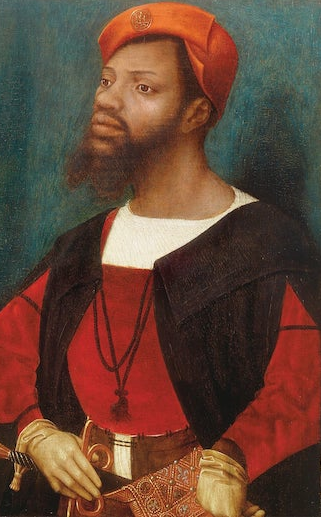
Black people were present at the Tudor courts and could be found on all levels of Tudor society. According to one source, “skin colour was less important than religion, class or talent.” Some married into the overwhelmingly white population and within a few generations their descendants’ connection to Africa was likely to have been lost.
How many of us can trace our family history any further back than our grandparents or great-grandparents?
I’m going to go ahead an repeat that Black residents in Tudor England were free, and the reason I’m honking on about it because when we think of Black people living outside of Africa at this stage of history, we tend to assume they were slaves–and you see how neatly I’ve convinced you that your mind works the same way mine does. So let’s repeat that once more, in four-part harmony: They were free.
Thank you. That was gorgeous.
England wasn’t heavily involved in the slave trade yet and although English law didn’t forbid slavery it also didn’t allow for it.
Slavery puts down roots
Once England did get involved in the transatlantic slave trade, it made, to use academic terminology, a shitload of money–not just from the slave trade itself but from slavery in its Caribbean colonies. (Let’s keep life simple by ignoring its colonies in North America.) But even then,, England itself muddled on in that strange in-between state where slavery wasn’t banned within its borders but also had no legal foundation. At some point, though–and I haven’t found a source that says when–enslaved people were brought to England, stayed, and continued to be slaves.
For the most part, they were the servants of returning planters, ships’ captains, government officials, and army and navy officers. This wasn’t a flood of people, but it was a significant trickle, and English society shaped itself to this change. Having a black servant became quite the fashion among the aristocracy and the well-to-do.
Most of the newly arrived slaves continued to work as servants. In other words, slavery didn’t become central to the economy, but they were still treated as commodities. Some were sold; some were given as gifts. And some said the era-appropriate equivalent of “screw this” and took off, which was a lot easier to do in England than in, say, Jamaica.
This part of the story is relatively easy to document: newspapers ran notices calling for the return of runaway slaves.
June 1743: a woman called Sabinah was “deluded away [from a ship bound for Jamaica] by some other Black about Whitechapel.”
February 1748: “RUN away last Thursday Morning from Mr. Gifford’s, in Brunswick-Row, Queen-Square, Great Ormond-Street, an indentur’d Negro Woman Servant, of a yellowish Cast, nam’d Christmas Bennett; she had on a dark-grey Poplin, lin’d with a grey water’d Silk … and suppos’d to be conceal’d somewhere about Whitechapel.
“Whoever harbours her after this Publication shall be severely prosecuted; and a Reward of a Guinea will be given to any Person who will give Information of her, so that she may be had again.”
Why does it say indentured? Slavery and indentured servitude weren’t identical they did overlap. Much later, it was later used as a way to abolish slavery in the colonies without abolishing slavery in the colonies. You can find that in an older post.
A University of Glasgow project has catalogued 800 runaway slave notices. Slavery had become an accepted part of British life. Anti-slavery activists chipped away at it through the courts and through Parliament, until even before slavery was abolished it became illegal to take a slave out of Britain without his or her agreement. That didn’t make it illegal to hold someone in slavery within the country, mind you, but it was a milestone.
Free Black people
Having said all that, let’s not lose sight of the free Black community, because it was still out there and it’s important to any discussion of Black British history, and of the abolition slavery in the country.
Most Black people–free or enslaved–worked in domestic service, but I’m not sure if that’s a comment on the work available to Black people. A lot of white people worked in domestic service. I tried to find out what proportion of the population worked as domestic servants and the best I could come up with was “considerable.” So let’s say a considerable proportion of the population worked as servants and some proportion of them were Black, then we’ll duck out the door before anyone notices that those aren’t numbers. (I got the “considerable” estimate from a reputable source in case that helps.)
What other jobs did Black people do? There’s no centralized set of records to consult, so we’re back to the historians saying, “I found one!” Some were agricultural workers, craftsmen, laborers, seamen. Single mentions include a fencing master, an actor, a fire-eater, a minister, a hairdresser, and a contortionist. The range of jobs open to women, Black or white, was narrower than the range open to men, and Black women enter the record as laundry maids, seamstresses, children’s nurses, prostitutes, and one actress with a particularly fine singing voice.
In 1731, London barred Black people from becoming apprentices. Since apprenticeship was the only way to learn and then practice a trade, this kept them out of skilled work, at least within London.
Did you just hear a bell ring? That was the Racism Alert Bell, marking a change in the culture. Black people could no longer integrate into the larger population as easily as they used to, and skin color was no longer less important than skill or religion or money.
If you were a legally free Black person and work was hard to find, it was that much harder if you were an escaped slave. Any time you spent in public put you at risk of being recaptured. So we shouldn’t be surprised that the historical record starts to mention Black beggars.
As a side note, my point of reference is the United States, since that’s where I spent most of my life. Compared to American racism, the British brew was mild. I don’t want to get into a my-racism-can-beat-your-racism argument, but to give a single example, Black-white marriage was unremarkable in Britain at a time when it would’ve been damn near suicidal in the US. That doesn’t let anybody off the hook. It’s just a reminder that no good comes of uprooting assumptions grown in one country and importing them into another.
Community
By the end of the 18th century, some 15,000 Black people were living in England, most of them in port cities–London, Bristol, Liverpool–but also in towns and villages around the country.
Or possibly it was more than that. Or less. It’s all guesswork–educated guesswork but still guesswork. So forget the numbers. We won’t get them right anyway. What matters is that a Black community was forming. Assorted white writers left us a record of Black people gathering for serious discussions as well as to drink and dance and to celebrate weddings and baptisms. It’s shallow evidence but it does tell us that people were coming together and a community was defining itself.
Listen, you take your historical records where you can find them. Black sources exist but they’re scarce.
The Black community played a crucial part in the movement to abolish slavery. When I asked Lord Google for the names of British abolitionists, he gave me twelve; nine of them were white. But a host of people whose names we don’t know were busy helping slaves to freedom, and somewhere between many and most of them were Black. As Peter Fryer put it somewhere in Staying Power (I’m damned if I’ll reread the whole book to find you the exact quote), for the most part the slaves within Britain freed themselves.
London’s East End–an integrated, working class neighborhood and a center of Black community–had safe havens, including the White Raven pub, where “Black patrons formed a frontline against bounty hunters, and the church of St. George-in-the-East, which in the mid-18th century committed itself to baptising escaped slaves.”
Why did baptism matter? An early legal ruling opened the possibility that holding a “heathen” as a slave was okay, but not a Christian. That escape route was closed off relatively early, but the belief lingered that becoming a Christian would free a person.
In 1773, two Black men were jailed for begging and they were “visited by upwards of 300 of their countrymen” and the community “contributed largely towards their support during their confinement.”
Sir John Fielding–brother of the novelist Henry Fielding–wrote scathingly that Black people entered “into Societies and make it their Business to corrupt and dissatisfy the Mind of every fresh black Servant that comes to England.” And if that wasn’t bad enough, they made it hazardous to recapture a runaway, because they got “the Mob on their side.” Blacks brought to England grew “restless” and conceived and executed “the blackest Conspiracies against Governors and Masters.”
And don’t we just want details of that? Sorry, we’ll have to settle for a detail or two about that mob. A few years earlier, Fielding listed among its members “an infinite number of Chairmen [those weren’t people who chaired meetings, they carried people in sedan chairs], Porters, Labourers, and drunken Mechanics.”
Drawing on the participants in the Gordon riots, Fryer (remember him? Staying Power?) lists more occupations: coal heavers, shopkeepers, sailors, apprentices, journeymen, weavers–the list goes on for another line or so but let’s stop there. What’s interesting is that he’s not talking only about Black workers. They were both white and Black and saw slavery as part of a system that degraded everyone: free and enslaved, Black and white.
This was the community into which runaway slaves disappeared. If you know the history of the Underground Railroad in the United States, you can think of the East End as an English version: a network of places and people who would take in fugitives. Predictably, that also made the East End a magnet for the people who hunted escaped slaves.
The Communities of Liberation Project
We’re coming to the end of the post and it brings us to the news item that got me started on the topic: a new project is researching the Black presence in London’s East End in roughly the period I’ve covered, and it’s inviting non-historians to get involved. They’re looking for people who live in or have a strong connection to the Tower Hamlets neighborhood–or borough if we’re being all British about this–and who have an African or African-Caribbean background. They particularly welcome “people with no specific qualifications or experience,” which wins my heart. They’ll train them in archival research.
(This is as good a place as any to answer a question that’s been annoying me for a while: why’s the place called Tower Hamlets? Because it’s near the Tower of London. And because it used to be a bunch of hamlets. But that was a long time ago. It’s now part of London’s East End.)
The project’s hoping to “identify the places, spaces and networks in which African people lived, worked or socialised during the period of the operation of the Transatlantic Slave Trade” by unearthing the”names, stories and experiences of everyday life of working Londoners” as well as “the buildings or spaces, the taverns and churches, where ‘working class’ African Londoners would gather, meet and coalesce as a community.”
Rewriting history
If you keep your ear to the ground, you’ll have noticed two things recently: one, you have dirt in your ear, and two, a lot of self-appointed defenders of the culture are complaining about wild-eyed lefties rewriting history. What particularly sets them off is people writing about aspects of history that go beyond what they learned from their grade-school textbooks.
As your official Wild-eyed Lefty Representative (see my photo at the top of the page; look at those eyes; they’d worry anyone), I’d like to remind you that every generation rewrites history. It’s commonly known as reinterpreting it, or correcting the biases of earlier generations, or incorporating new material. Otherwise we’d still be working with 1913 textbooks, when no Black history was taught because, basically, who cared? It wasn’t important.
So am I helping to rewrite history here? You bet your ass I am. That doesn’t mean I’m inventing it. It means I look for sources who’ve done the hard work of filling in the blanks. Long may they dig through the archives.
A few notes
- If you want to fill in a few blanks I’ve left, I have two earlier posts about the history of British slavery. One focuses on the legal aspects of abolition but also works as a rough outline of British slavery and slave trading. Another focuses on abolition and the substitution of indentured servitude for slavery. (Isn’t progress wonderful?) After you chase those down, I expect you’ll be sick of me and we can all ignore each other for another week.
- I don’t have a topic up my sleeve to write about next. England has plenty of history left but I feel like I’m running out of ideas. If you have any suggestions, questions, or areas you’re particularly interested in I’d love to hear about them. I can’t promise to write about them all, but if something grabs my imagination and if I can find enough material to work with (neither of those is guaranteed), I’ll do it.
- In the meantime, thanks for reading. And if you leave comments, thanks for that. If they make me laugh or think or do both, even more thanks.
 Notes from the U.K.
I don’t think anyone’s rewriting history, but I think people forget that schools have a very limited time in which to teach history. In my first three years at secondary school, we had two 40 minute history lessons a week. That’s not very much. Alison Hammond, the TV presenter, did a programme about black British history a few years back, and moaned at great length about how no-one’d told her at school that Henry VII had a black trumpeter. No-one learns about any of Henry VII’s trumpeters, black, white or purple with green spots, at school, because there isn’t time to teach any more than the main facts, and trumpeters weren’t involved in those! Schools cannot teach black history, women’s history, LGBT history and everything else. Were it up to me, kids would not have to do maths, physics, PE or art (especially PE), and would have several hours of history lessons a week :-) . Sadly, it’s not up to me!
LikeLiked by 2 people
I agree about how little time there is to cover a lot of ground (and I’d happily have sacrificed every one of my math lessons–it’s amazing how long it took for me to learn so little from them), but I think what Hammond was talking about, or at least what I’d talk about, isn’t that specifically Black and women’s history are left out than that kids come away with what’s essentially white history and male history. Everyone else has been erased. The work of writing them back in leads to what can look like a lopsided focus on the left-out groups, but it’s an important counter-balance. It should all be a natural part of the history kids are taught and adults assume, but we’re not there yet and there’s a lot of resistance to getting there. So the trumpeter may not seem to matter but he does: he stands for the news that Black people didn’t arrive suddenly on the Windrush. They’ve been here all this time.
LikeLiked by 1 person
Oh–and I’d happily have given up PE. I dodged physics. Art I’d have kept.
LikeLiked by 1 person
Excellent post! I’d have given up PE for history too!
LikeLiked by 1 person
I’d have given it up for just about anything. Except math. Math was way worse, and for a while I actually have a very nice math teacher. It was hopeless, though.
LikeLiked by 1 person
PE was a daily torture to me but although not a born mathematician, as my sister was, I always enjoyed maths. (An excellent teacher helped). History is much more interesting now it isn’t just lists of the dates when men did things (we didn’t cover any of the queens in our syllabus) but I find some of it too harrowing to read. Over imaginative, as my mother said.
On the subject of the black community in history, there was an interesting tv programme a few years ago that mentioned Dido Elizabeth Belle, the illegitimate daughter of a sea captain. Her life has been the subject of a film. Her mother was a slave but Dido was brought up in England by her father’s aristocratic family and there’s a lovely portrait of her. Although very few in number, there are some excellent portraits of non-white people to be found.
LikeLiked by 1 person
That I know her name is testament to how thoroughly Black British history is still in the found one! stage. I doubt I’ll be around long enough to find out what stage comes next (I’m a thousand years old now, so how much more can I expect?), but it would be interesting to know.
LikeLike
I’m with you there, got a U grade in Maths O level – it meant ‘ungraded’ it was that bad.
LikeLiked by 1 person
I never heard of ungraded. Maybe it was an act of mercy.
LikeLiked by 1 person
Hah!
LikeLiked by 1 person
I said that thinking of my own stunning mathematical ability, mind you.
LikeLike
Mine is of a similar ilk.
LikeLiked by 1 person
Interesting post Ellen. I hope this project unearths much more about this part of history. The United States also lacks thorough information about the lives of black people, enslaved or otherwise. Much more could be done.
I’d always thought of England as being relatively color-blind and without a shameful legacy of slavery in its past. Then I read Zadie Smith’s The Fraud and attended a talk she gave in my home town. The Fraud is fiction but she did a lot of research to portray the real life characters in the book. One of the most intriguing is a freed slave named Andrew Bogle. Smith’s book was fascinating. I generally prefer nonfiction but she really did her homework. I highly recommend.
It annoys me how the Right always complains about liberals rewriting history. We should then be in agreement on the name of the large body of water to the east and north of Mexico.
LikeLiked by 1 person
Compared to the US, England was a safe haven and drew a lot of Black musicians–and probably other people but the musicians are the ones who get the column inches. But that was setting the bar pretty low. My partner and I have been struck since we moved here by how different British and US racism are. I’ve thought about doing a blog post on it but it’s sort of like carrying a handful of water. I doubt I’ll ever manage it.
As for rewriting history, ahem, as you point out, look who’s rewriting the map.
LikeLiked by 2 people
It is fascinating and disheartening to realize how many things are left out of the history we are generally exposed to. Thank you for all the light you cast on such things !
LikeLiked by 1 person
Thanks for that.
LikeLike
Excellent article Ellen! 😀☕️👏 Really enjoyed it.
And the people from the right who complain about people rewriting history tend to ignore their own personal history, which is far more diverse than they would like to admit. It’s part of their own battle to reclaim the narrative. But the facts are the facts, and you have done an excellent(and humourous) job displaying them. Keep up the good work 👏☕️☺️
LikeLiked by 1 person
Many thanks–and you’re right (or I think you’re right, which is of course the same thing): it is all about controlling the narrative.
LikeLiked by 1 person
It is interesting to think about what would have happened if the British had left the slave trade to the Spanish and Dutch. I guess that they needed a way to finance all that Empire building. And I guess it’s difficult to empire-build without thinking that you are superior to those you are subjugating. Once you’re down that path, the documentation gets more and more skewered. (Have you written about the South Sea Bubble of 1720? Seems like an early example of the rich dragging the less wealthy into a get=rich-quick scheme.
LikeLiked by 1 person
I do have a post about it somewhere, but Lord Google’s forgotten about it so I can’t find it. I’m sure it was glorious.
The Romans, as far as I know, don’t seem to have convinced themselves that the people they enslaved were inferior. They were just, you know, losers in the game. But I don’t know very far, so don’t take me too seriously on that.
Taking a cold, hard look at it, if the British had left the slave trade to the Spanish and Portuguese, my best guess is that they’d have remained a minor power. Their wealth was built on slavery. That justifies nothing, just acknowledges the way it worked.
LikeLiked by 1 person
Just a thought about wealth and power, whatever its basis. An awful lot of people, whatever their origins, were (and still are) left out of the prosperity loop. Plenty of the British had little more access to the cash from empire and the good living it brought than the subjugated peoples. Those who are better versed in history and economics than I am can no doubt give us the story of how prosperity eventually came to the British population at large at the expense of many of the colonies but it doesn’t, in my view at least, wipe out the dreadful conditions which afflicted those at the bottom of the heap. Slavery is the ultimate insult, of course, and I wouldn’t be crass enough to equate that with the position of the destitute in this country, at any time. But once people are not bought and sold, when they are ‘free’ (to starve?), then they are inevitably positioned on a continuum, a continuum of ‘scavengers’ right at the very bottom of the heap and, at the top, the amoral exploiters who are rich at the expense of others. On International Women’s Day, it may be worth remembering that many women and girls don’t, and never did, have the choice of how to earn food and shelter. They were exploited and blamed in equal measure for something they could not avoid.
Sorry, not very humorous!
LikeLiked by 2 people
Not humorous but very true. When the nineteenth century radicals talked about wage slavery, they weren’t just being dramatic.
LikeLiked by 1 person
I believe you are correct about the Romans. It was that way in Africa too.
LikeLiked by 1 person
This is fantastic!
LikeLiked by 1 person
Thanks, Dwight.
LikeLike
“Who’s the we in that last paragraph? That’d be me. I’m trying to make you feel included.”
Oh come on, embrace the pluralis maiestatis ! We like it.
“wild-eyed lefties rewriting history” – ?
I have no idea who says that. It is the reactionary right that actually re-writes history in Amurga, and makes slavery look like white man’s gift to black people. It is Vlad the impaler who recklessly lies and lies and lies about history, and makes Stalin look like a saint. Do not start me about the German right …
I have no real knowledge about Black History, I can not even pinpoint when the first Black person is mentioned in German sources. Possibly in the 16th century, via Austria, just a guess.
The history of slavery in Europe is interesting, but as I understand, it became a topic or subject only in the last twenty years or so. I can not name the relevant book.
LikeLiked by 1 person
I heard on the radio just today that Margaret Thatcher embraced the plural so much that she announced, “We have become a grandmother.” I’ll stick to the wild-eyed lefty’s singular, thanks. Just another way no one will mix me up with Margaret Thatcher.
I agree with you about who rewrites history, but the accusation comes from the right wing, or sections of it. As for the history of Black people in Europe, I know very little. I had, cluelessly, considered it more or less a blank until I read that one of Russia’s famous writers (I’ve managed to forget which one) had Black ancestry. Russia? I thought? How’d that happen? Yeah, I expect most of us have a lot of blanks to fill in.
LikeLike
Another part of Black History.
mago, too lazy to lock in
LikeLiked by 1 person
Ah–I wondered which Anon. I was conversing with this time.
LikeLike
Excuses Ellen, obviously I am crumbling away. It is at least the second, if not the third time that I am unable to write down a lousy hyperlink correctly in the first go.
It is an article on Al Jazeera about a project of African people who search for the graves of relatives who served on British side in the worldwars.
This is the link :
https://www.aljazeera.com/features/2025/3/9/searching-for-africas-lost-world-war-soldiers-one-grave-at-a-time
The famous Russian was Pushkin. The black forefather came via the Osman Reich to Russia.
LikeLiked by 1 person
Pushkin! Of course. Thanks. And in the department of people filling in the blanks in the African diaspora, I read an article in the New Yorker about divers searching out the wrecks and the history of sunken slave ships. It included some touching moments of people finding some peace in connecting with the incredibly painful, suppressed histories of their ancestors.
Good article. Thanks.
LikeLike
They were free.
Repeating after you…
LikeLiked by 1 person
:)
LikeLiked by 1 person
At least forty, possibly nearly fifty, years ago, I read something by a black woman researcher who had statistics showing that the black population of London in the eighteenth(?) century was higher (proportionally) than it was when she was writing but they had been absorbed into the whole so that they left barely a trace. Apparently, they didn’t just die without issue. It was so long ago that I read this that I don’t remember any details but I’m not sure whether the comparison with the present day would show quite the same result. It’s possible, I suppose, that something similar might also be true of other major ports. It does show, though, that the black population is not the only historically under-represented section of society. If the aristocracy intermarried with foreigners of any origin, it went on record in more than the church registers. When the hoi polloi did the same, no-one noticed, to the extent that a whole section of the population could slip out of sight and memory of any but the most assiduous researcher.
As one who is vanishingly unlikely to appear in any history and a fully paid-up member of the nonentities club, I want to register three cheers for the hoi polloi, the vast unsung majority!
LikeLiked by 1 person
Hell yes! It’s good to know there’s something still worth cheering for.
I heard the historian Onyeka Nubia talk to a white British audience about Tudor-era Black British residents being, in large part, absorbed into the larger population. At some point he stopped himself, looked out at the audience and said, “This is not my history [he’s from Africa] but yours.”
From the time of Henry VIII, there is a record of at least the minimal events of people’s lives (assuming they’re C of E): baptism, marriage, and death. Tax rolls can give us a bit more, as can wills, although not everyone will appear in those. So we can trace the nonentities, at least a bit. The problem is that sometimes they mention a person’s place of origin and color and sometimes don’t, so we really are at sea.
That’s fascinating about Black population of London. Thanks for dropping it into the conversation. As an American who grew up in a culture where even in the relatively free northern states a mixed-race couple could shock the hell out of people (I remember being stared at in New York in the early 60s when I was half of one), I find it fascinating that what was so charged in my childhood and early adulthood was no big deal here.
LikeLike
I think the likelihood is that mixed couples would have been mainly seen in the ports or major cities, even in the relatively recent past. I grew up in the West Midlands where even in my teens, most of the population was white but that has changed considerably, to the point where I find it odd to visit areas of the country where the vast majority are still mostly white. Our daughter and her friends (born in the seventies) were effectively colour blind although some of that could be down to their background, as I know that some of her friends felt the atmosphere of exclusion that still exists. (Bouncers on the doors at clubs, using the code, “Keep things light,” not referring to a light touch with enforcing security but to limiting the proportion of ethnic minorities admitted, for instance.)
LikeLiked by 1 person
Interesting about the bouncers. Not surprising, but interesting. I did, in researching this post, run into a reference to an autobiography of a mixed couple in the–oh, ouch, 16th century, maybe, who moved around quite a bit, away from any port city. It was a hard-luck tale for many reasons, although whether any of them were racism I can’t remember. It was too specific to add to the story I was piecing together and I’m sorry to say I can’t remember where I read about it. Which makes it no use whatsoever in this discussion.
Sorry. I led us right into a wall there.
LikeLike
Pingback: Black British history: the parts that get left out – An Itinerant Scribe