
Dido Elizabeth Belle was born a slave, raised in an aristocratic English family, and given the education and many of the and-so-forths of an English aristocrat. Her story messes with pretty much any assumptions we carry in our luggage. In some tellings, she’s Britain’s first Black aristocrat. That makes a great headline but it stretches the truth.
Let’s call her Dido, since her mother comes into the story and her last name was also Belle.
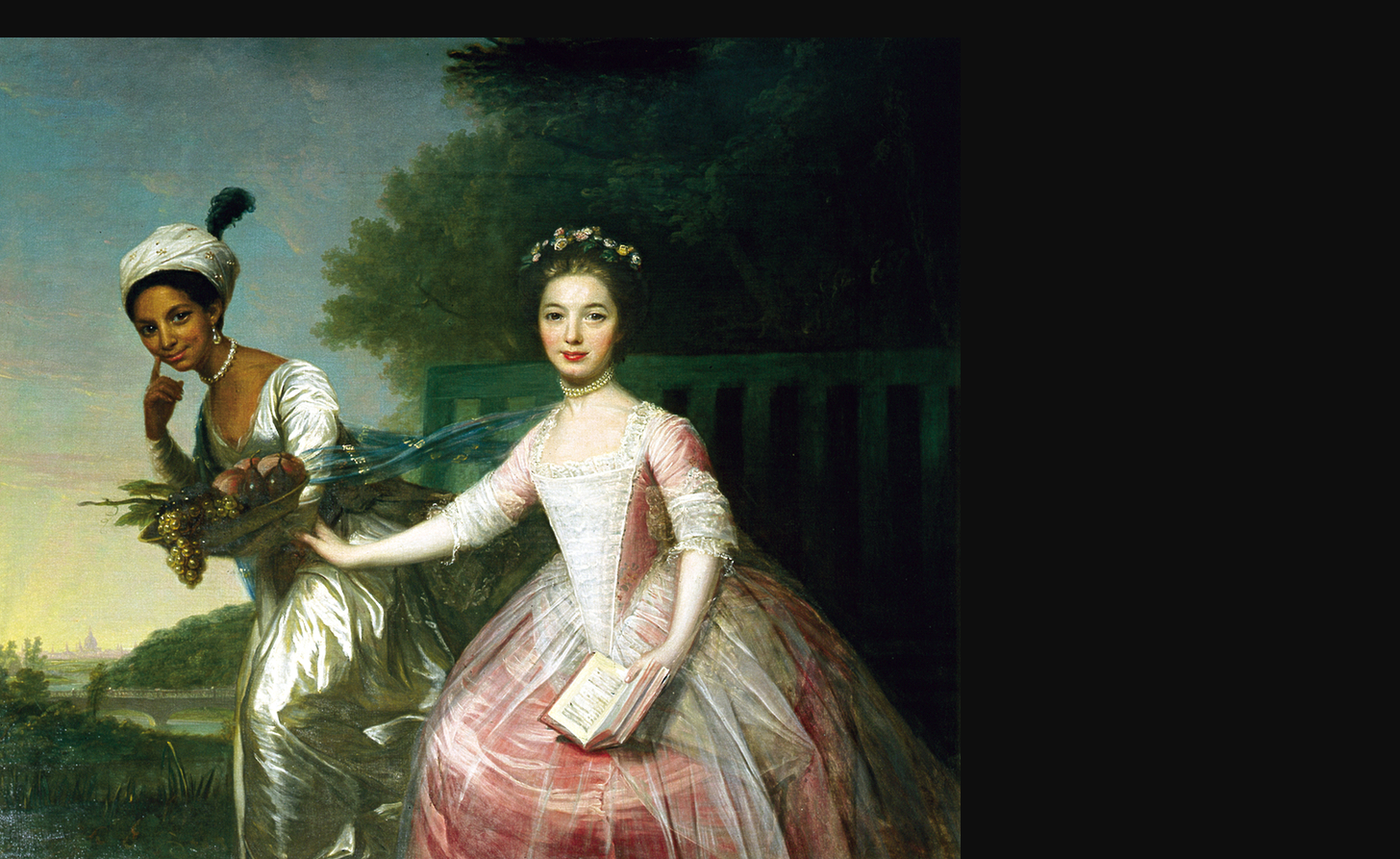
Dido Elizabeth Belle (left) and her cousin, Elizabeth Murray.
Maria, John, and Dido
Dido was born in 1761. Her mother was Maria Belle, who was then a slave, which would have made Dido a slave, and her father was John Lindsay, an officer in the Royal Navy.
Sorry, Make that Sir John Lindsay. I just love italics. They do sarcasm so well.
It’s not 600% clear how he and Maria Belle met, but Lindsay was where you’d expect a naval officer to be, on a ship, and his particular ship was protecting British trade routes and capturing the ships of countries Britain was at war with, along with the ships’ cargoes. In other situations, that’s called piracy, but when you have your government’s stamp of approval it’s called foreign policy.
Exactly how John and Maria (what the hell, let’s call them all by their first names) crossed paths isn’t clear. Maria might’ve been part of the–ahem–cargo on a ship he captured. She also might not have been.
Whatever happened, they met, Dido ensued, and John and Maria seem to have had something approaching a relationship, because in 1774 Maria built a home in Pensacola, Florida, where John had bought a plot of land for her. The property record calls her “a Negroe Woman of Pensacola in America but now of London afore and made free.” Her manumission papers are also from 1774 and acknowledge “the sum of two hundred Spanish milled dollars . . . paid by Maria Belle a Negro Woman Slave about twenty eight years of age.”
Although having said that, another source talks about John having given her her freedom, not sold it to her. Either way, working backward from those numbers, Maria would’ve been around fifteen when Dido was born.
But that business about the house, the property, and her freedom jumps ahead of the story. Somehow–again it’s not clear how–Maria and Dido show up in London when Dido’s around five, something we know because her baptism is recorded, thanks to Henry VIII having introduced the requirement that churches record baptisms, marriages, and burials. Maria’s listed as the wife of Mr. Bell, whoever he might’ve been.
John isn’t listed as the father, although she was widely acknowledged as his child and he was involved enough that Dido was placed with his brother’s family at Kenwood House.
Before you decide that Dido’s parents had the love affair of the century, defying differences of class, color, and national origin to explore their mutual passion until the end of the earth or their deaths, whichever came first, I should tell you that John made a socially acceptable marriage in 1768 and had four more children with four more women, none of whom was his wife. He doesn’t sound like lasting romance material to me.
Somewhere along the line he was knighted and in 1776 he became a part-owner of a plantation in Nevis, which was worked by slaves, as they all were at the time, so off the top of my head I’d say we can’t count him as an opponent of slavery any more than we can nominate him for faithful non-spouse of the year.
And Maria? We’re not going to find out. She drops off the historical record.
Dido
Dido went to live with the family of her father’s uncle, William Murray, First Earl of Mansfield and Lord Chief Justice–in other words, the most powerful judge in England. In the spirit of rampant inconsistency, we’re not going to call him by either his first or last name but Mansfield. Don’t ask me to justify that. It’s what most of the articles I’ve read call him. If you have a grand enough title, you get handed a whole poker hand’s worth of names to choose from.
Have you noticed that everyone in this tale has a last name that could also be a first name?
Mansfield and his wife were childless and had already taken in Dido’s cousin Elizabeth Murray, whose mother had died. The two girls were raised and educated together.
What was usual and what was unusual about this? If a family sat high enough on the class scale, society wouldn’t faint from shock if it become guardians to a relative whose parents hadn’t been married. Or–hell, I’m dancing all over the lot, trying to avoid talking about legitimate and illegitimate children. The idea that a child could be illegitimate is bizarre, but that was the way people thought at the time. Let’s use the word. It simplifies my sentences.
So, taking in an illegitimate child wasn’t shocking. What was unusual was for a mixed-race child, and the child of a slave or former slave, to be raised not as a servant but as a gentlewoman.
And yes, since we’re talking about absurd phrases that we’re more or less stuck with, let’s add mixed race to the list. Humans don’t divide into races. It just doesn’t work. The problem is that I haven’t found a phrase that slots into a sentence as well, so put a mental asterisk beside it and understand that we need some new language there.
But back to our story. We now have Dido safely ensconced in the very grand home of an earl and accepted into the heart of the family.
But . . .
. . . the family made a clear distinction between Dido and Elizabeth. Dido got an allowance of £30 a year. Elizabeth got £100. Mind you, £30 a year was good money–several times more than a domestic worker made and she didn’t work for it–but it says a lot about their ranking. When it was just the family present, she was family. When they had guests, she joined them after dinner, not during. In the portrait at the top of the page, Dido’s the secondary figure. It’s a portrait of her cousin.
Was that about color, legitimacy, or a bit of each? I don’t know that anyone can untangle those threads at this point. An illegitimate child was always ranked below a legitimate one. On the other hand, all the money that was being made from slavery guaranteed that racism had infused itself into the British belief system. In the portrait, she gets the turban and the bowl of exotic fruit; the cousin gets the chair and the more traditional headpiece.
Portrait artists were pretty heavy handed with their symbols. I’m not stretching things to mention those.
On a personal note, I was raised in the US and spent most of my life there, inevitably surrounded by the American brand of racism. I’m constantly noticing that the British brand is different. I don’t know of any story from the US that’s comparable to Dido’s. But that’s not to say that Britain’s free of racism. It’s just–you know, different wrapper, different ingredients, slightly different weight to the candy bar inside.
When Dido’s father died, his obituary described Dido–”his natural daughter”–as having an amiable disposition and accomplishments [that] have gained her the highest respect from all his Lordship’s relations and visitants.”
Accomplishments were a big thing for a lady of the period. Dido played music and had beautiful handwriting. Mansfield often dictated his letters to her–a job normally reserved for a male clerk. She also supervised the dairy and poultry yard, as genteel women of the time often did. (Come on, they had to do something or they’d have perished from boredom, every last one of ’em.)
In 1784 Mansfield’s wife died and in 1785 Dido’s cousin Elizabeth married, leaving Dido to care for Mansfield until his death in 1793. His will left her £500 (about £40,000 today) as well as £100 a year–not as much as he left Elizabeth but nothing to sneeze at. And to clear up any doubt about her status, his will stated that she was a free woman. Or in some tellings, he granted her her freedom.
Does that mean that she and the family considered her to still be enslaved? Or was he only being cautious? I can’t begin to guess, but even if it was caution, knowing that he didn’t clear that up from the beginning kind of makes your blood curdle, doesn’t it?
After Mansfield’s death, Dido married a steward. To locate him in the all-important class hierarchy, he was a senior servant, so if she’d been fully a lady that would’ve been a shocker of a marriage. No one says that he wasn’t white, so we can probably assume he was. He was from France. That gets a mention. They had three sons and lived in London. Dido died in 1804, at 43.
Dido, Mansfield, and slavery
Before we go on, let’s spend a moment remembering–or if you didn’t already know this, finding out–that Mansfield (Chief Justice, remember) presided over the 1772 Somerset case, which ruled on the legality of slavery in England. His ruling was, like so much of this story, ambiguous.
The question in front of him was whether James Somerset, an escaped slave, could be forced onto a ship and sent to the Caribbean, where he’d be sold. Mansfield ruled that he couldn’t, setting in place the precedent that no slave could be made to leave the country against his or her will.
The ruling was widely believed to have ended slavery in England, but it didn’t. Slaves continued to work as slaves, and to be bought and sold. Escapees continued to be recaptured–or at least sought, since it was far easier for an escaped slave to disappear in England than in, say, the Caribbean, and many people freed themselves instead of waiting 61 long years for the law to do it for them.
Legal scholars argue about what precedent the ruling actually set. Unfortunately, I’m no legal scholar, although I did once pass myself off–accidentally and in an email–as a lawyer, so we won’t dive into that. Instead, let’s acknowledge that although Mansfield described slavery as odious and argued that it was “of such a nature” that it couldn’t be introduced without some positive law to uphold it, which England didn’t have, he still stopped short of ruling it illegal. The economic fallout of that was more than he could face–or at least that’s the best explanation I’ve seen offered. His ruling made it clear that the case posed an important moral question, he picked up the legal bricks that could’ve built a case for abolition, and he put them down again without building it.
And he made sure in his will that his great-niece could live out her life as a free woman.
 Notes from the U.K.
Given that she was illegitimate, I think it would have been surprising if she had been treated in the same way as Elizabeth was treated. It’s more surprising that she was acknowledged as a member of the family at all, although perhaps I’m ascribing Victorian morals to an earlier, less uptight, age. On the other hand, in Jane Austen’s novels (written about 3 decades later) the middle classes do tend to look down on illegitimate children.
I think that, during his lifetime, Mansfield’s treatment of her was sufficient to make it clear that she wasn’t a slave (given his position), but he realised that things might be more difficult for her after his death, so clarified the issue in his will.
LikeLiked by 3 people
One of the sources I relied on did say that it wasn’t uncommon for aristocratic families to acknowledge illegitimate children, so I don’t think the later Victorian values apply. It’s interesting,
though, to notice that they made a point of saying ~”aristocratic,” leaving me with the impression that lower down the class ladder you couldn’t get away with that as easily. I’m inclined to think you’re right about how Mansfield considered her, but given the complexity of the human mind, I’m inclined to leave it open.
LikeLiked by 2 people
Thank you for this fascinating post. I am originally from Liverpool which made money out of slavery. Indeed many of the buildings in the city have an association with slavery, including Speke Hall, which dates back to Tudor times. The International Slavery Museum in Liverpool is well worth a visit for anyone visiting the city. I think its clear that Mansfield abhored slavery, but he was a man of his time and couldn’t (or felt he couldn’t) go as far as to make it unlawful in the UK.
LikeLiked by 1 person
Thanks for your comment. I hadn’t known about the museum and I’m too far from Liverpool to drop in casually, but if I ever get a chance I’ll go. And yes, we all live inside our times and struggle to imagine what’s beyond that horizon.
LikeLiked by 1 person
The painting is gorgeous! Dido looks both beautiful and cheeky and both look like they’re happy together. Whatever the rights and wrongs she seems to have had a good life, when so many didn’t.
LikeLiked by 2 people
Materially speaking, a good life, without doubt, but I can’t help wondering if one of those fabulous 19th century women novelists couldn’t have made the tensions and incidental slights in the household come alive for us–and have us weeping over it.
LikeLiked by 1 person
Fascinating as ever, Ellen. If I were a novelist (no chance!) I think there could be an interesting tale in an invented life of Maria Bell. Who was Mr Bell, how did she marry him? I was under the impression that slaves didn’t get to marry at will, so was she free before the payment she made? Or was she coerced? Was the payment a piece of “legal” sleight of hand to make money from former slaves? Pay up or face the consequences? What happened to give her the means to make it to London? Why did she leave Dido behind and go off to America where things, on the face of it, would be more hazardous for a former slave? There are so many questions and potential answers that could make a novel I would happily read. In a way, more interesting than the life of Dido.
Thanks, as usual.
LikeLiked by 1 person
I can answer a few questions, but they’ll still leave room for lots of invention. Or guesswork. Or whatever. I expect this will vary from place to place, depending on the laws and mores, but from what I’ve read slaves could marry, but they needed their “masters'” permission. I have the impression that Maria left Dido behind because it offered her a life Maria could never have given her, but it’s also possible that she was pushed or coerced into it. From her, unfortunately, we get only silence.
LikeLiked by 1 person
I wonder what the lives of her children were like. Also, it would be interesting to do her family tree up to now. I love the American PBS program Finding Your Roots.
LikeLiked by 1 person
I don’t know what happened to her children. And now you’ve got me wondering if she and her cousin–the one born on the right side of the bed–stayed in touch.
LikeLike
I’m don’t know whether Elizabeth stayed in touch but according to this: https://georgianera.wordpress.com/tag/lady-elizabeth-murray/
Dido and her sons were mentioned in the wills of other family members. Elizabeth outlived Dido and one of her sons, so perhaps that’s a reason why her will isn’t discussed.
LikeLiked by 1 person
Thanks for thinking to look at Elizabeth’s history. I didn’t think to follow that thread.
I’m not sure how reliable the system for keeping wills is, so it’s possible that her will drifted off to that great circular file in the sky and won’t be seen again.
LikeLike
we have her will, it’s free to download, it’s just really hard to read. Dido was never mentioned in her will, ironically she was pretty close with another illegitimate child, the Hon. Lady Murray (born Emily De Visme), her half brother’s wife
https://en.wikipedia.org/wiki/Henry_Murray_(British_Army_officer)
LikeLiked by 1 person
Again, thanks. I never thought to look for that.
LikeLike
Dido was never mentioned in Elizabeth’s will, ironically she was pretty close with another illegitimate child, the Hon. Lady Murray (born Emily De Visme), her half brother’s wife
https://en.wikipedia.org/wiki/Henry_Murray_(British_Army_officer)
But, her 2 aunts Lady Anne and Lady Margery kept in touch and left Dido something, what’s fascinating was Lady Anne outlived Dido by a lot dying at 1817 age 90, the sole executor was Lady Elizabeth’s husband, meaning her husband was the one in charge of giving the bequests to Dido’s son and husband. Dido would’ve been very aware of him since he was also Lady Mansfield’s dear nephew who will inherit the family’s title and wealth.
I read somewhere that Lady Elizabeth’s eldest half brother the next Lord Mansfield continue paying Dido’s husband money to upkeep Dido’s son, after her annuity was over when she died. Interesting because although he was young of course he remembered Dido since he was raised most of the time at Kenwood with Lady Elizabeth
LikeLiked by 1 person
Thanks for all that. If I needed to keep the family straight, I’d have to make a wall chart. They’d make a great starting point for historical fiction, don’t you think? I feel the charactrs pulling at me from the bare outlines you’ve written.
LikeLike
the movie was surprisingly good, but glad to come here read more of the real story.. thanks for sharing
LikeLiked by 1 person
Glad you dropped by.
LikeLike
This story resonates with some cases in America (including Thomas Jefferson & Sally Hemmings). It seems that in many cases the “master” was emotionally torn as to what to do…the pressures of society were enormous, but in many cases they tried to “do right” (to the extent they saw it) by the unfortunate offspring. It stands to reason that – from our distant perspective – there was no right or wrong answer to this for the people involved.
LikeLiked by 1 person
Not just the pressures of society but the pressures of business: gotta make that money.
LikeLiked by 1 person
Great story, Ellen! ❤️
LikeLiked by 1 person
Thanks.
LikeLiked by 1 person
Excellent article Ellen, a very enjoyable read😀👏. I love how you’re writing so many positive articles about prominent non-white Britons from history. This is an of the past that has long been overlooked and ties into the fact that British diversity did not start in 1948.
And great humour too😀☺️👏☕️
LikeLiked by 2 people
Thanks. I’ll confess that it’s not a plan. It’s just that one thing has been leading me to the next.
LikeLiked by 1 person
Often works that way. I was going to write about Greenland but there’s been so much drama with Trump’s tariffs I could resist. Greenland will have to wait til next week lol😀☕️
LikeLiked by 1 person
It’ll still be there. I [can almost] promise.
And it won’t be American.
LikeLiked by 1 person
Agreed Ellen. In a way it does tie in to Trump’s tariffs in the way that he says alot but what happens after everything settles is normally very little 😀
LikeLiked by 1 person
Except of course for tearing up the world economy, with the possibility of tipping us all into a depression. Not to mention kidnapping people off the street and deporting or trying to deport them. Defying a judge’s orders to bring one back. Taking an eggbeater to government agencies that were actually doing useful stuff. None of which works out as promised but still we can all admit gets [the wrong] things done.
Sorry, I seem to have misplaced my sense of humor. I’ll be back as soon as I locate it.
LikeLiked by 2 people
Whoops my bad. That’s true, there is a lot of putting Humpty Dumpty back together again😀
LikeLike
Get out the Gorilla Glue, kids. It’s going to be a long night.
LikeLiked by 1 person
I’m British and find US politics strange but I have a theory that the President is just a bored old rich man who’s been given the biggest toy to play with… and no one to stop him.
LikeLiked by 1 person
I’m both British and American and, yeah, American politics are strange. But so are most politics. I think we’re dealing with something worse than a bored old man, though. We’re dealing with someone who wouldn’t know the truth if it ran him down on Fifth Avenue, who during his first presidential campaign talked openly about grabbing women by the pussy, who has a long history of racism, of not paying the contractors his construction company used, basically of being a sleazeball on so many levels that my brain’s refused to track them all. One of his former advisers–an anti-tariff guy from Trump’s first term–tried to get Trump to explain why he favored tariffs and he basically said, look, for 30 years I’ve believed they’re good and that’s good enough for me. He lives in a reality-free zone, where his belief is enough to make it so. And he’s not going to want to give up power. This is, I think, a dangerous guy. His best quality is his stunning incompetence, and I’m hoping that’ll bring him down. That and the coalescing of (I’m indulging in a minute of optimism here) a gathering opposition.
LikeLike
It seems that most British slaves would have been the equivalent of “house” slaves over here, with all the unpleasantness that entailed. Additionally, there were all the social rankings among the “white” people. It seems like a lot of energy was spent making sure that people were kept where they belonged. I guess if the Chief Magistrate said that Dido was free, that would be enough for the rest of society. Too bad he wasn’t able to say it about the rest of the slaves.
LikeLiked by 1 person
I haven’t seen any breakdown of the work slaves within Britain did, but my hunch is that you’re right. Slavery’s role in the economy was, I think, closer to the role it had in the northern US states–a kind of add-on, not the economic base. Class differences and tensions in Britain were very sharp, and there seems to have been a real sense of solidarity between the working class (white and Black, but given the demographics of the country, primarily white) and slaves, escaped slaves, and former slaves. It’s one of lives little ironies that while the aristocracy in general profited massively from slavery, they were able to accept as free someone whom one of their own said was free, whether legally speaking she was or not.
As an aside, it wasn’t just the aristocracy who profited from slavery. At least by the time it was abolished, the ability to invest in and make money from slavery had worked its way down the class system until they’ve found ministers and respectable but hardly rich widows investing their money in ways that gave them ownership but also distance, so that they had no personal contact with any slave they owned or partially owned.
LikeLiked by 1 person
I guess it’s easier to accept slavery when you don’t actually see what it entails on the human side. Unfortunately, there were too many people willing to accept it knowing full well what it meant to the people suffering through it. I’ve read the journals of the “ladies of the house” in the Southern US who sincerely believed they were entitled to have slaves to make their lives easier.
LikeLiked by 1 person