
Today’s excursion into English history takes us to a moment in the Middle Ages when misogyny, common law, and feudalism– Well, cars hadn’t been invented yet, so let’s say they had a cart crash. High speeds hadn’t been invented either, so they all came out intact if slightly battered.
We’ll start with the law part.
Common law
English common law dates back to the Middle Ages and if you’re a fan of convoluted systems I can’t recommend it highly enough. Basically, this is a system of law that’s based not on what I think of as law–you know, a set of written rules that you transgress at your peril–but on what courts have decided in the past. It can rely on a written law if it’s in the mood, but precedent is the driving force.
The system gives judges a shitload of power in shaping the law, and I’m naive to think common law’s outside of my experience (although I still think it is), because the system’s in use today in an assortment of countries, including the US and UK, the two countries I’ve lived in.
Shows you what I know.
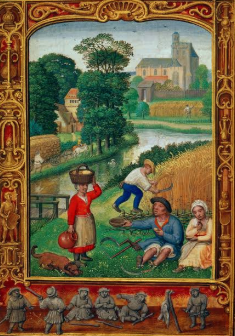
A rare relevant photo: medieval rural life–somewhere.
Other systems of law in the Middle Ages
Just to confuse things, in the Middle Ages English common law coexisted with other legal systems. Church courts applied canon law, urban and rural courts applied local customary law, Chancery and maritime courts applied Roman law.
The royal courts were for the most serious stuff and were run by a professional (in other words, paid) judge. Starting in the 13th century, those judges traveled to each county two or three times a year and held county assizes.
County sheriffs held a court in each hundred.
A hundred? It was an administrative/political division, smaller than a county but bigger than a pie. Starting in the 14th century, justices of the peace took the role over from the sheriffs. They were drawn from the local nobility and gentry, and they weren’t paid for the job but I’d bet a small pie that they got power and prestige from it.
In towns, borough courts played a similar role.
After all that, we get to manor courts. These were run by the lord of the manor or the village. They dealt with petty crimes–debt, theft, fighting. The accused would more than likely have been the lord’s own villeins.
What’s a villein? That’s medieval-speak for a serf. Sort of, and it sounds nicer, though, doesn’t it?
The sources I’ve found in a quick search contradict each other about what the difference is between a serf and a villein. One says villeins, like serfs, were tied to the land–not slaves but not free to leave either. Another says villeins were free to leave but generally couldn’t afford to. Both sources are more or less bite-size but the issue’s off to one side of the point I’m trying to make, so let’s use a word that dodges the whole issue: naif.
If you consult Lord Google, he’ll inform you that it’s also spelled neif, but I’ll stick with the more familiar spelling. It’s the root of our word naive, and you can trace it back to Old French, where it meant “native inhabitant; simpleton, natural fool.” Or to the Middle Ages, when it meant someone who was born a serf.
But we were talking about courts. Church courts could try lay people for things like adultery, homosexuality, gambling, or not showing up at church–you know, the stuff that really mattered. Priests acted as the judges and unlike the other courts they had no juries.
If you’re feeling hemmed in and starting to hyperventilate, I’d say you understand the situation fairly well. Most people probably got through their lives without appearing before any of those courts, but it can leave the modern reader feeling, um, judged.
Common law and serfdom
With all the throat-clearing out of the way, let’s move closer to that collision I promised. A whole lot of legal time and energy gets devoted, both then and now, to disputes over property, and under feudalism the most valuable properties would’ve been land and the naifs who were trapped on it.
This brings us to the blog Legal History Miscellany, and to a post, “All Bastards Are Free.” Understand, please, that the author, Sara M. Butler, isn’t talking here about people she doesn’t like. She’s using the language of the era. Being born inside or outside of marriage mattered. She saw a passing reference to the bastard children of villeins being born free, wondered if that could possibly be true, and off she went down a fascinating rabbit hole.
As it turns out, the answer to whether bastard children were born free is both yes and no, and that’s due to common law’s annoying habit of changing without having to file a written notice in triplicate. For information, Butler turned to legal treatises, which are as close as you can get to codified law at this stage.
In the 12th and early 13th centuries, the child of an unmarried, unfree woman was a naif, even if the child’s father was free.
What if the parents were married? Worrying over that seems to have kept a good number of lawyers occupied, and they went into intricate detail over it.The result? If both parents were unfree, the child was unfree, whether the parents were married or not. If the man was free and the woman not? The child was unfree. If the mother was free and the father wasn’t? Guess what! The child still wasn’t free. In fact, if that free man married the unfree woman, he lost his freedom.
Go a little further into the 13th century, though, and the rules loosen up a bit: the child follows the status of the mother, so if the mother is free, the child is free.
By the end of the 13th century, opinion was branching out in different directions, as it will when judges are essentially making the law. One treatise held that “One who is begotten of a free man but born of a bondwoman out of wedlock is a serf.” Another held that either parent could pass freedom down to their child. A third held that the father was the determining factor: the child of a free man married to a naif would be free; the child of an unfree man married to a free woman wouldn’t be.
What happened, then, when the jurors didn’t know who the father was and therefore didn’t know if he was free, unfree, or fur-bearing? According to this line of argument, the child “belongs to the lord of the manor, for his condition is determined by that of his mother, by whomsoever he may be begotten, freeman or serf.”
One of those tracts holds that when “jurors do not in truth know whether [a person] is a villein or a free man, judgement must be in favour of freedom.” Another says that the “blood of a man” should not be tried “by means of women,” which means–
Okay, I’m not entirely sure what it means. It sounds like a woman’s status shouldn’t determine a man’s. I mean, come on, it was humiliating enough that a man had to be born of a woman, but why take it further than that?
What Butler says is, “I would argue that it is in these two statements, when taken together, that we see the glimmer of the origins of the common law rule that all bastards are free. Here’s the problem: the only person who can definitively prove that a bastard child’s father is free is the mother: she knows who she slept with and when. Granted, it surely comes as no surprise to anyone who studies the Middle Ages that by the late thirteenth century authorities were not keen to rely on a woman’s word alone, especially if it meant that a man might lose his freedom, or that an elite man would lose the profits associated with a villein and his entire line.
“Did justices decide to declare all bastards free because they didn’t want to have to rely on the word of a woman?”
The implied answer is yes.
As one judge put it in 1279, “No woman should be received in proof except in a marriage case.“
Who actually went to court over this?
As long as all this child-bearing stayed on the manor, I doubt there would’ve been much cause to go to court over anyone’s status. Everyone knew everyone and everyone’s nose was undoubtedly in everyone else’s business–and the lord of the manor was the judge anyway, with the locality’s wealthier citizens acting as jury, so the manor court wouldn’t be a smart place to sue for your or your child’s freedom. But if a naif hightailed it to a town, hoping to establish a new life as a free person, and a lord appeared to reclaim him or her, it was up to the lord to prove his right to the person by establishing that he or she came from a line of naifs.
If the case Butler cites was typical, proving that was harder than it sounds. In 1280, William of Cressy tried to reclaim William son of Siward by producing a collection of (entirely male) relatives to prove that William S. came from a line of unfree men, but either William S. or his lawyer managed to undermine William C.’s claims about their status, one by one.
Not only were the courts leaning against women, they seem to have been leaning more toward freedom than unfreedom. As one judge wrote, “Free law is more predisposed to save and maintain a man in his free estate than to condemn him or lead him into servitude and so, since you say that he is your villein and he says he is free, the law acts and we ought rather to act to save him and support him in his free estate than to maintain you in this to bring him back and reduce him to servitude, for it is clear that he is free until you have proved him the reverse by his blood.”
In another case, from 1326, Thomas son of Thomas the Elder tried to claim Richard Lachebere, using three unfree relatives as proof. Richard argued that they didn’t share the same blood because “he was a bastard and thus free.” The judge ruled that because Richard was a bastard, “he had estranged himself from every blood, so that he could not be proven a villein by any blood.”
Or as Butler puts it, “Rather than rely on the word of a woman, it was simply easier to presume freedom.”
I do wonder, though, whether town courts were more inclined toward freedom since they sat outside the manorial system.
 Notes from the U.K.
Canon law does my head in. Oh, I know I’ve committed a serious offence, but I hold a very minor position in the church, so I can be tried in a church court and get a very minor sentence. And I might be a mad axe murderer, but I’ve taken sanctuary in a church so you can’t get me, ha ha. Gah!
LikeLiked by 1 person
So you’re telling me you don’t think that’s fair??
I’ve read in passing that for a while if you could cobble together any Latin you could claim to be a priest and get passed over to the church. If, I assume, you were male.
LikeLiked by 1 person
Ellen, we are talking eye-opening, here!
LikeLiked by 1 person
Isn’t history fascinating?
LikeLike
As I was to understand it, if a woman did have any Latin (which she might have picked up from some man of higher standing!) she was automatically packed off to a convent.
LikeLiked by 1 person
There’s a guideline I haven’t stumbled over before now. I wonder, though. Children, both male and female, were important pieces in the chess games played by families with money and power, and both marriage and being in a convent could be useful moves, but if marriage was a more useful move– What I’m working up to saying is that I wonder how absolute that was.
LikeLike
I don’t think that the convent was an automatic destination for women with Latin. Elizabeth I and Thomas More’s daughter, among others, come to mind. Maybe, as you say, it varied with their other perceived usefulness or rank, as both my examples were deliberately educated rather than having picked up Latin by happenstance.
LikeLiked by 1 person
If memory serves (and mine is always patchy), upper-class women were increasingly able to get an education toward the end of the medieval period and into the Tudor era. From this distance, it’s easy to think of the medieval era as uniform, but it changed a lot from the early days to the end.
LikeLike
Okay. So the rich people were tried in the Royal courts where I’m guessing who you knew and who you were related to was more important than what you’d done in some cases (both in the defendant’s favor and against the defendant.)
The clerics were tried in Church courts which were generally more lenient unless you had crossed the wrong person.
Everyone else was tried in the local court (unless they had poached the King’s deer). And being judged a free person usually meant getting paid a pittance over not being paid for the same work and the ability to earn that pittance from whomever they chose.
Am I close?
LikeLiked by 1 person
Kind of–at least as far as I know. It’s true that a free person could, in some cases, be worse off than an unfree one. Access to land and all that. The longer the feudal system went on, the messier and more unworkable the divisions got. But no one went to court to maintain a worse-off status. In a town, a person who was enterprising and lucky–and who had some useful skill–could rise through the class structure of the town, which had its own rigidities but was at least different than the class structure of the countryside. Those are the people who didn’t want to be dragged back into serfdom.
It’s also possible that someone who wasn’t rising in the town would’ve resisted being dragged back–for the hope the town had to offer; for the personal freedom; for the avoidance of the lord’s vengeance if they did get dragged back.
LikeLiked by 1 person
Excellent point. Those with drive, ambition (and luck) would be able to rise.
LikeLiked by 1 person
Our culture’s made a fetish out of social mobility–so much so that we tend to forget all the people who get left behind; who don’t get to rise. But in such a rigid, stratified society, it would’ve been incredibly important.
LikeLiked by 1 person
Sir, I found the whole article is hard to read, as a person learning the US language, an American English, I found US language is much easier, as we focus the cause itself (common law as a explained chapters) It was a law in the Heart, which is the soulish heart everybody had, so the common law itself explained itself like Jesus God the Bible, the faith it was given in the law. The law itself is a law given by authority, so the common law, should be:
Thou shall not. Jesus is great !~
LikeLiked by 3 people
My friend, I am neither a man nor a Christian. Laws that come from one religion only will never be fair to or accepted by people of other religions, or none. We must find justice that people of good will, of any background, can accept.
My language is, I’m sure, difficult for someone just learning English. I use slang, I play with the language. It’s part of who I am, but I do apologize for the difficulty.
LikeLiked by 1 person
No worries, as we all tends to know what happened in between church as its holy power who kill to satisfying the God lying pope. So I understand your perspective as a non-god-atheist-no-religion-whatsoever type of thing.
And, the good thing is, USA is also a atheist government, a government try to find the same peace the UK wants, a holy nation under GOD, but not controled by pastor/priest/pope. A evil religion who predestined evil the mark, of , the beast, 666. God is GOD.
LikeLike
Sorry, have no idea about serfs / nervs or somesuch. The old saying was “Stadtluft macht frei” – if an unfree person makes it into a town, stays there for some time, lives the life of a towns people, s/he can not be reclaimed after a certain period. The subject changes from one area of law (something rural whatever) into a new area of law, the town ; the former dominus losses his right on that subject.
The idea behind the lawful medieval anarchy is that someone can only be judged by those of his kind : A man of the Church can only be judged by other men of the Church. A member of the University – a sodalitas, a group of its own right – can only be judged by eg the Chancellor, or the professores iuris of said schola.
Of course it was a bit impractical. I think Karl V. tried to modify the whole system with his reforms (“Reichsreformen”). But these were affairs of the 1550s ; Karl was already tired, desillusioned, and finally gave up. I have a lot of sympathy for this man.
In the 17th century there was PUFENDORF, Staatsrechtler, a giant nobody knows. He tried to summarize etc., but it had no real result. I think the first real success was the Allgemeine Preußische LandRecht, SVAREZ, COCCEIJ these guys. But one can not underestimated the French Code Civil, slap bam – there is modern right / law – we are all children of the Revolution.
As far as I know, it was absolutely irrelevant whether a woman could read / write Latin or count two and to together or not – the decision to put her into a Stift / monastery was usually taken by family (surplus daughters) or husband (infidelity, instead of chopping the head off). Education of women in the Middle Ages was not that uncommon as we (like to) think.
The status of a woman, from underage virgin to elderly widow, is important for her legal status : Property, business, credit etctetcpp. This is also very important for her children, hence people had to verify that they were born legally. So I think this saying “All bastards are free” is an English speciality.Someone born from an unmarried woman would not be able to get citizen’s rights in a medieval town in the Reich.
What puzzles me always anew is the talk about the blood, the oh so pure blood. Makes me always reach for my roscoe.
LikeLike
Living in a town for a period of time made a unfree person free in England as well. I assume the business about lords trying to reclaim their serfs happened before that time had elapsed.
Blood–as I don’t suppose I need to tell you–was a stand-in for family, inheritance. It’s come down to us in endless racist theories and verbiage. I was interested to see if used, very differently, in the medieval period.
I think you’re right about women and convents. I think the earlier commenter meant either that a family wouldn’t know what to do with a woman who learned Latin other than put her in a convent or that a convent was the only place she was likely to learn it. My understanding is that as the middle ages went on, educated women became more common–in the upper classes. In the early stages, I’m less certain. But at that point, it wasn’t common for aristocratic men to be able to read either.
LikeLike
It need a certain state of mind, a kind of idea what life is, can be, should be, in order to make people want to read and write. As I understand Karl der Große (Franconian King, emperor number 1) and his wish to learn to write was seen as a kind of miracle. His successors, and most (if not all) nobility did surely not read and write for some generations to come.
Friedrich II. von Staufen on the other hand, wrote a book De Arte Venandi Cum Avibus in the 1240s, fourhundred years later. But his court was really something special in all respects.
ANd here something has changed fundamentally in the attitude (there is a better word for what I mean, I just do not find it ! Mentalität may be it, the sum of thinking and feeling within a certain collectiv within a certain time – soso, think Les Annales) towards life itself, towards art, all in all : towards what we can call “culture”.
A young woman of noble offspring in the 9th century would simply have no chance to learn to read and write Latin outside a monastery – remember Cuthswyth
(https://63mago.wordpress.com/2014/07/12/cuthswyth/)
Her chances in a Northern Italian early Renaissance town are notably greater, there she would find a teacher and books easily.
Vilains & bastards, really nice company over there.
LikeLiked by 1 person
I always keep the best company.
Karl, I suspect, is the king I was taught to call Charlemagne–learned not only to read as an adult, but to write. The two skills are inextricably linked in most minds these days but were very separate at the time. Alfred the Great did the same, but I’m damned if I can remember if he learned as an adult. If I had a memory, it would be so nice.
Thanks, as always, for your comments. WP was being strange with the Like button on your earlier comments–the Like wouldn’t register and you may have gotten repeated notices that I liked them. Or none at all. I use the thing as a kind of doorbell, to say I’ve responded, but clearly you figured that out. I’ll stop hitting that button now.
LikeLike
“But one can not overestimate the French Code Civil,”
instead of :
“But one can not underestimated the French Code Civil,”
Two mistakes in one word, ha !
LikeLike
Good thing it’s a long word.
LikeLike