
When the Normans conquered England, they didn’t just bring their language–basically French, but you can call it Norman French if it makes you happy–they also brought the castle.
Not physically. Castles are heavy and prone to sea sickness. They brought the idea of the castle, and they set about building them in strategic spots as a way to keep control of their newly conquered land.
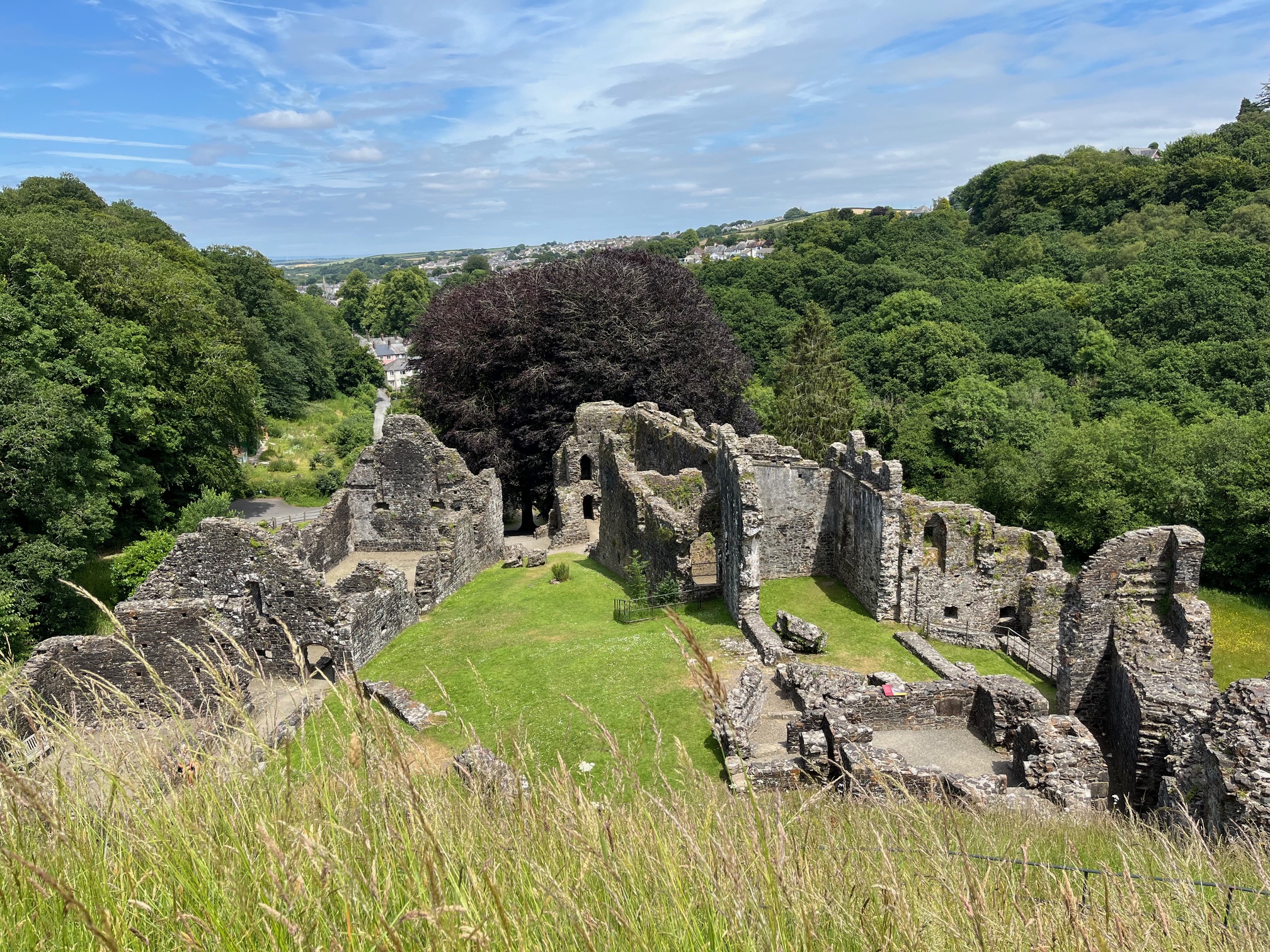
A rare relevant photo: Okehampton Castle, in Devon–or what’s left of it. In 1384, according to a nearby sign, it was owned by the Courtenays, who arrived with a household of 135 people: the family, of course, plus 61 servants, 41 esquires, 14 lawyers, 8 clergymen, and 3 damsels–young, unmarried women. I’m tempted to add six geese a-swimming and five gold rings but the sign doesn’t mention them so I won’t. When the family moved on, they left behind a small garrison, a gatekeeper, a constable, and a few men-at-arms.
The hell you say: didn’t the Anglo-Saxons have castles?
Nope. To defend the country from the Vikings, A couple of hundred years earlier, Alfred the Great–known in his own time as plain old King Alfred–had promoted the building of fortified towns, called burhs, and to attract settlers who’d defend them, he offered free plots of land inside the walls. I was about to write that it wasn’t a bad deal if you lived through an attack, but your chances of getting killed were probably just high if you were cutting hay. So, not a bad deal and I won’t add any qualifiers.
But burhs weren’t castles. They were closer to the fortified towns the Romans had built before they toddled off back to Rome (and the many other places they’d come from). In fact, some burhs used what was left of Roman fortifications as a starting point.
One theory holds that the Normans conquered England relatively easily because the country lacked castles. As Orderic Vitalis (monk; chronicler; son of an Anglo-Saxon mother and a Norman father; born in 1075, not long after the conquest) explained, “The fortifications that the Normans called castles were scarcely known in the English provinces, and so the English – in spite of their courage and love of fighting – could put up only a weak resistance to their enemies.”
So okay, castles were something new
The Normans built their first castles quickly, cheaply, and Ikea style. William the Conqueror–chief Norman and the new king–divided the land up among his newly be-lorded followers, and that land came well stocked with forests and dirt, which they used to assemble motte and bailey castles.
Motte and what? A motte was a big mound of earth (and inevitably, yes, some stone) and a bailey was the ditch and bank surrounding it. At the top was a wooden tower.
The problem with a wooden castle, though, was that if the Big Bad Anglo-Saxon Wolf came bearing a torch and followed by a bunch of pissed-off Anglo-Saxon wolflets, it would burn. What’s more, it would burn just as cheerily if instead of an Anglo-Saxon some invader set it alight. And if none of that happened, give it thirty or so years and the timbers would rot.
So William sent out a memo: rebuild the castles in stone.
More work, yes, but more durable, and as it happened Ikea had a kit for this too: the land held stone as well as wood and dirt. And lo, the lords followed the pictures on the instruction sheet and assembled more durable castles. Some kept the motte and bailey style; others went for a newer pattern that relied on massive stone walls to repel attackers.
But we’re not going to talk about architecture. I get bored easily. Let’s talk about . . .
. . . Why castles mattered
Have you ever wondered why an invading medieval army couldn’t just bypass the castles and rampage through the countryside while the lords and knights who were supposed to defend the land sat behind their walls eating, drinking, and acting lordly and knightly? Did the invading army really have to come to the door and challenge them to a fight?
As you may have figured out by now, military strategy isn’t one of my strengths, but here’s what I know: First, castles had a habit of getting themselves built where they could control a stretch of land: near roads, navigable rivers, ports, that sort of place. Helicopters hadn’t been invented, so the castles wouldn’t have been easy for an army to bypass.
Second, an invading army stomping around anywhere near a castle would’ve set the lines of communication buzzing. Word moved more slowly than it does today, but move it did, and it would’ve reached the castle and been a cue for the lord to gather up as many fighters as he could and get out into the field.
Third, if you were an invading army and the defending soldiers didn’t come out to meet you, you might have wanted to stop and dig them out while you knew where they were. Even if it did slow you down by a few weeks. Or in rarer cases, a few years.
And fourth, it was how things were done. How many of us think to question that?
But castles weren’t just forts. They were also administrative centers and homes to the lord, his family, his servants, his knights, and whatever other soldiers he had on hand–more in times of war; not so many in times of peace.
You notice that bass note thumping away there? His, his, his, his. Especially in the early part of the medieval period, this was a heavily masculine world, and a militarized one. The whole point of the aristocracy was to fight, but that job belonged only to the species.
Militarization was baked into the social structure: peasants toiled, priests and their churchly associates prayed, and lords fought. Warfare justified the aristocratic male’s existence and his dominance over the, ahem, lower orders. In Medieval Horizons, Ian Mortimer argues that not only were their lives centered around fighting, they–or many of them anyway–enjoyed the sheer brutality of it.
Why castles stopped mattering as much
Cannons took a lot of the fun out of castles. It’s true that cannons were big and heavy and not easy to lug around the countryside, and it’s also true that Ikea didn’t stock them, so they couldn’t be assembled on site, but from around 1400 on, they could wreck a castle wall. So they were well worth dragging around.
Forget waiting out a siege inside your thick stone walls. Warfare had changed.
Why were castles still used, then?
A castle was still good for what Ian Mortimer (Medieval Horizons; remember?) calls “regional control.” If you want to substitute “oppressing the peasantry,” be my guest. I wouldn’t sink to such a biased way of putting it but I can’t find an argument against you using it.
They also still served as residences, administrative centers (not unrelated to that oppressing business), and big honkin’ status symbols. The largest lords had multiple castles, and moved from one to the next, along with their households–lady, children, servants, hangers-on (secular and clerical)–taking their belongings with them, from beds to wall hangings to candlesticks and no doubt the candles as well. In times of peace, there would’ve been fewer soldiers and knights; in times of war, more. For an example, see the note under the photo. Breaking with all my traditions, the photo’s relevant to the post this week.
In the early century or three after the Norman invasion, traveling from castle to castle was about keeping that retinue fed. I can’t help thinking of them as a horde of locusts, needing to move on before they’d stripped the land clean. Move further into the middle ages, though, and that becomes less of an issue. One explanation I’ve seen is that the medieval warm period (800 – 1250 or 950 – 1250, depending on who you ask) came along and more food was grown. Another is that trade expanded. Between 1100 and 1300, more than 1,600 markets were established–something that can be traced because they needed permission. You can add a thousand fairs, so food could now follow the aristocrats and the aristocrats didn’t have to follow the food. And that’s as far as I can take that discussion. Sorry. I’m sure there’s more to be dug out.
As the castle’s military value decreased, the ratio of men to women evened out, and as the middle ages wore on, trekking from castle to castle became less of a thing. Lords tended to settle into a primary residence and make it more comfortable.
 Notes from the U.K.
I wonder what the 14 lawyers were doing at Okehampton. The 14th century was very litigious, but how could one man keep 14 lawyers busy? Even if you say that a couple of them were really scriveners, that’s still 12.
LikeLiked by 1 person
That stopped me in my tracks as well. The sign English Heritage posted did (if memory serves) talk about the size of his entourage being partly a matter of prestige, so maybe we can chalk 10 or 11 of them up to that. Which leaves me wondering what they did all day.
LikeLiked by 1 person
Perhaps they kept the accounts and collected the rents and harassed the peasants. I suppose they would have been dealing with applications to the king to do things that needed his approval at the various properties that the Courtenays had, but I suspect that a lot of thumb-twiddling went on.
LikeLiked by 1 person
Thumb-twiddling, yes, but in Latin. It takes more time that way and is far more impressive.
LikeLike
They probably spoke, wrote and read Latin like natives. It was almost the entire purpose of the education system to enable them to do that.
LikeLiked by 1 person
Good point. I was thinking of my own Latinless self and how much it would slow me down.
LikeLiked by 1 person
Perhaps the lawyers also (ahem) contributed the Courtney lineage…
LikeLiked by 1 person
We’ll never know, will we?
LikeLiked by 1 person
There will always be the influence of the earliest human being, with a complete different civilization than the one that’s currently active where we live, and sometimes, we still forget, that because we live on the land we live, we don’t, actually, OWN it…
LikeLiked by 1 person
Yeah, funny how easy it is to forget that. Especially when you have papers (and fourteen lawyers traveling with you) that all say you do own it.
LikeLike
IKEA didn’t offer a helicopter kit? Glaring omission.
LikeLiked by 1 person
It’s difficult coming up with kits for things that haven’t been invented. Sure, you can put all the parts in, but who’s going to write the assembly instructions?
LikeLiked by 1 person
Judging by my experience of assembly instructions it doesn’t matter much if there aren’t any… Not to mention the times when parts are left out or doubled up. It’s worrisome to be left with a pile of bits and nowhere to put them. Should I trust the assembly (fairly important with a helicopter)? Should I try to start again? Or, as I do, put the bits in a safe place and use the thing regardless? This has the consequence that a few years down the line, said bits are found and no-one has a clue what they’re for. Bin, and risk remembering too late? Keep, and find there’s no room to keep properly important stuff in the end? The dilemmas of flatpack. Of course, I could label the bag of bits but that would be far too sensible and takes the fun out of trying to guess what this collection of nuts, bolts and nameless gubbins is for.
Jeannie
LikeLiked by 1 person
I won’t try to pass this off as universal wisdom, but my approach is to save them on the assumption that some future version of me will know far more than the current version does. To date, that hasn’t happened but that’s not to say it won’t. So yes, absolutely, put them in a safe place–the one place guaranteed to be unfindable should you ever understand what they were meant for.
Of course, the cautious approach is probably to bag them up and load them onto the helicopter in the hope that they can be added in midair, when it becomes obvious what they were meant to do.
You don’t suppose the two of us should go into business together, do you? We could make flat-pack kits for all sorts of things that haven’t been invented.
LikeLike
Well, I do have tins and bags and boxes in drawers and cupboards, full of the aforesaid nameless gubbins which should give us a serious supply of raw material to start with.
My daughter actually had a designated drawer known as ‘A Safe Place’ where she kept such stuff but then, she was a scientist, far more sensible and organised than I am. And she only kept Allen keys if they were a different size from ones she already had.
LikeLiked by 1 person
Your daughter’s (a) a genius and (b) frightening. I keep allen keys in various places where I’m guaranteed not to find them. They’re probably all the same size but since I only see them when I put them away I don’t get to compare them. Yes, I’m very well organized. The envy of the village, in fact.
I love the idea of having a single drawer that’s officially the safe place where you’ll find all those things you put someplace safe. Think of the time it would save. I wonder what I’d do with it.
LikeLike
Pingback: The English castle: a quick history
Lower the draw bridge!
LikeLiked by 1 person
If you say so, but are you sure those aren’t the vandal hordes hiding behind the hedge?
LikeLiked by 1 person
Love your history lesson – as usual. I like your funny presentation ever so much.
LikeLiked by 1 person
Thanks, Pit. You be careful over there in the land of current madness.
LikeLike
Interesting to know the difference between burhs and castles. I’m lacking a moat during the dry season which is why the perimeter has been fortified with the prolific bramble of native Nootka rose. The birds love it, the solicitors (aka door-to-door salesmen in the US) are a bit more intimidated. The young people are so soft nowadays that even the gravel driveway scares them because they don’t know how to behave on a road that isn’t made of asphalt. I can tell a person is over the age of 35 if they haven’t mistaken the driveway for a long slough of quicksand outside of February, when the chances rise to 50/50 possibility of sturdy gravel or over-moisturized slog.
LikeLiked by 1 person
Sounds to me like you don’t need a moat. After the most recent visit by over-sweetened evangelists, I just might dig us one. We don’t have space for a long gravel driveway.
LikeLiked by 1 person
We don’t have a moat but a very steep drive with a corner. Delivery drivers fall into camps: macho, reverse up. Optimist, drive up forwards, perform a 23 point turn to avoid reversing down. Disappointed, drive up forwards and find visitors at the top so they have to reverse down. Pedestrian, park on the road, walk (or stagger) up. One actually jogged up and back. There should be a law against being so young and fit… All can be very helpful in telling me how steep the drive is, in case we hadn’t noticed, although it’s surprising how quickly we got used to it, in spite of age and general lack of fitness.
Jeannie
LikeLiked by 1 person
You introduce the law and I’ll back it. I love the categories–and how everyone has to tell you how steep it is. What would you do without their help?
LikeLike
I have to admit to a self satisfied smugness when people (usually youngish men) stand gasping and red faced at the door, when we, at 76, can walk up the drive, talking, and not be out of breath, though to be fair, it took a while to achieve.
LikeLiked by 1 person
There’s nothing like necessity to keep a person in shape.
LikeLike
Thanks for sharing!! I love to read about history, especially those on other continents. 🥰
LikeLiked by 2 people
I’m an immigrant to Britain and one of the things that knocks me out is how many small, strange pockets of history I find here.
LikeLike
That looks interesting, hope to visit that place in the future.
LikeLiked by 1 person
The castle in the photo? It’s Okehampton Castle, in Devon–not too far from the train station.
LikeLike
These “Motten” are found in many areas of Europe. One of the most Romantic writers was de la Motte Fouque, poor sod after all.
I think it was not only the militarian “advances” (cannons throwing stones at walls) but in the end the social change of the society . the “class” (the word is wrong, it is ordo, and this should be translated with “Stand”, but I am not familiar enough with the English terminology, so I say “class”) of the knights simply became obsolete. In the late middle ages there was no more place for these kind of rambos, latest with the invention and use of the fork this had to change. This idea of the tres ordines is so 10th century – it’s okay for an agrarian illiterate society without money. It does not work in a more specified society with “Geldwirtschaft”, towns/cities, and a bloody Landfriede – there go the days when a knight could be a knight.
Assembly instructions are for the weak, all a bloke needs is a nail gun, the rest is history.
LikeLiked by 1 person
To hell with your cannons and your wimpy instruction manuals, all I need is my nail gun?
Cause and effect are messy, and it’s tempting–not to mention easy–to pin an effect to a single cause and run out of the room, slamming the door behind you. Especially when the cause happens to be one you’re writing a thousand or so words about. Can we agree to multiple causes, many too intertwined to fit here? Although I’ll admit that I don’t understand what any of this has to do with the fork.
LikeLike
In this connection the fork in question is a mere symbol standing for “Zivilisierung” o better “Ent-Barbarisierung”. I specially refer to Elias’ Prozess der Zivilisation.
I agree on multiple causes, surely, I do.
And a nail gun is the accessoire to have these days, just don’t mix it with gin, just sayin’ …
LikeLiked by 1 person
Note on shed door: Do not mix nail gun with gin. I appreciate your good advice, and I took the fork reference too literally. Silver spoons (and not taking them home with you after a meal) comes into the post I’m working on now, so the part of my brain that’s dedicated to tableware in set to literal, not metaphorical, mode.
LikeLike
Okay, it has to be mentioned : In October 1518 Ulrich von Hutten, a FRanconian knight, wrote a letter to Pirckheimer, a NUrembergian burgher, complaining about the life on a “Burg” – the usual place for a Franconian knight in those days. It may be a bit exaggerated, because Ulli wrote for the public, and was in the process of securing a position at a court.
German Text here. No idea whether a translation exists, sorry.
it is, in short, a lousy life.
LikeLiked by 1 person
Oh, it did have to be mentioned. But by 1518 he wouldn’t have been writing about the burhs that Alfred founded–they were long gone. Probably a town, but that’s a guess.
LikeLike
No town, the German “Burg”, your “castle” (arx, castellum), sorry my fault.
Ulrich and me do not speak about Alfred’s fortified places, but about Burg Steckelberg (a href=”https://de.wikipedia.org/wiki/Burg_Steckelberg”>Ger.” / a href=”https://en.wikipedia.org/wiki/Steckelberg_Castle”Eng.), or Steckelberg Castle – sounds much more posh.
LikeLiked by 1 person
Much more impressive.
LikeLike
Most of my early exposure to castles came from old movies, like Robin Hood. They seemed very large and poorly lit, with a lot of staircases to climb. Since then I have also learned that they were extremely drafty. I imagine the safety they provided led people to overlook the inconveniences, but it must have been extremely expensive to maintain a group of them.
LikeLiked by 1 person
Drafty and inconvenient, yes, but this wasn’t a time that set high standards for what we consider convenience. If they kept out the rain and whatever marauding hordes their owners expected, that would’ve made them desirable. And think of the status they conveyed. As for expense, this was an economically unequal time (geez, just imagine that!), and a lord had plenty of, as I imagine it, unwilling or at least resentful labor close at hand. In the early days, they weren’t measuring these things in money but in food, land, and serfs.
okay, i have a cat on the keyboard. time to quit.
LikeLiked by 1 person
Cats are great editors. I’ve had them delete entire paragraphs for me. :)
LikeLiked by 1 person
And I’m sure the work was better for it. Fast Eddie isn’t a fan of capital letters for some reason.
LikeLiked by 1 person
Forks…ah, yes. But my understanding of their importance in European society, came later than baileys and castles.
I’m sure you know (but maybe some readers don’t) that forks, as in tableware, as opposed to farming implements, arrived when Venetian traders brought some beautiful tableware back from Turkey.
LikeLiked by 1 person
Somewhere in this mess is a post about England adopting the fork. If I had a functioning memory, I’d be able to spit out a nicely condensed little history about that. Unfortunately, I don’t. All that stays with me without looking it up (and it’s 7 a.m., not researching-forks time) is that England came to the table late as far as the forks were concerned.
LikeLiked by 1 person
I’m all for baileys, anytime.
LikeLiked by 1 person
In liquid form, no doubt.
LikeLike
One of my favourite things to do when we travel is to tour castles. I find them fascinating. We have a couple here but nowhere near as old as the ones in the UK!
LikeLiked by 1 person
They fascinate me too, but my imagination doesn’t do a great job of filling them with living, working people. I wish it did.
LikeLiked by 1 person
A couple of my favorite English castles are Lincoln and Conwy. Lincoln because the walls incorporate not one but two motte towers into them. Conwy because Edward didn’t just build a castle but an entire fortified town around it. And you can still walk the walls. I visited in 2023 and saw quite a few but there are many still to go when I come back, particularly as, other than Dover, I didn’t visit anywhere south of London. Thanks for a great post.
LikeLiked by 2 people
I haven’t seen either of them, but from your descriptions I’d love to. Thanks.
LikeLike
Very cool!
LikeLiked by 1 person
Thanks.
LikeLike