
The feudal world–generalization alert here–glorified warfare. Or at least the folks at the top did. Why wouldn’t they? They got to the top and they stayed there because they were armed and dangerous. If we want to explain their role nicely, it was to protect the country from invaders. If we’re not in a mood to be nice, the English aristocracy was there because they’d been the invaders, killing people and taking over what had once been theirs. And because they were too big and scary to get rid of–not that some of the Anglo-Saxons didn’t try.
But they were happy to fight any new invaders. And sometimes each other. And occasionally to be the invaders in other people’s lands.
Yes, if you didn’t mind a bit of bloodshed and you were born on the winning team, it was a fine old time to be alive.
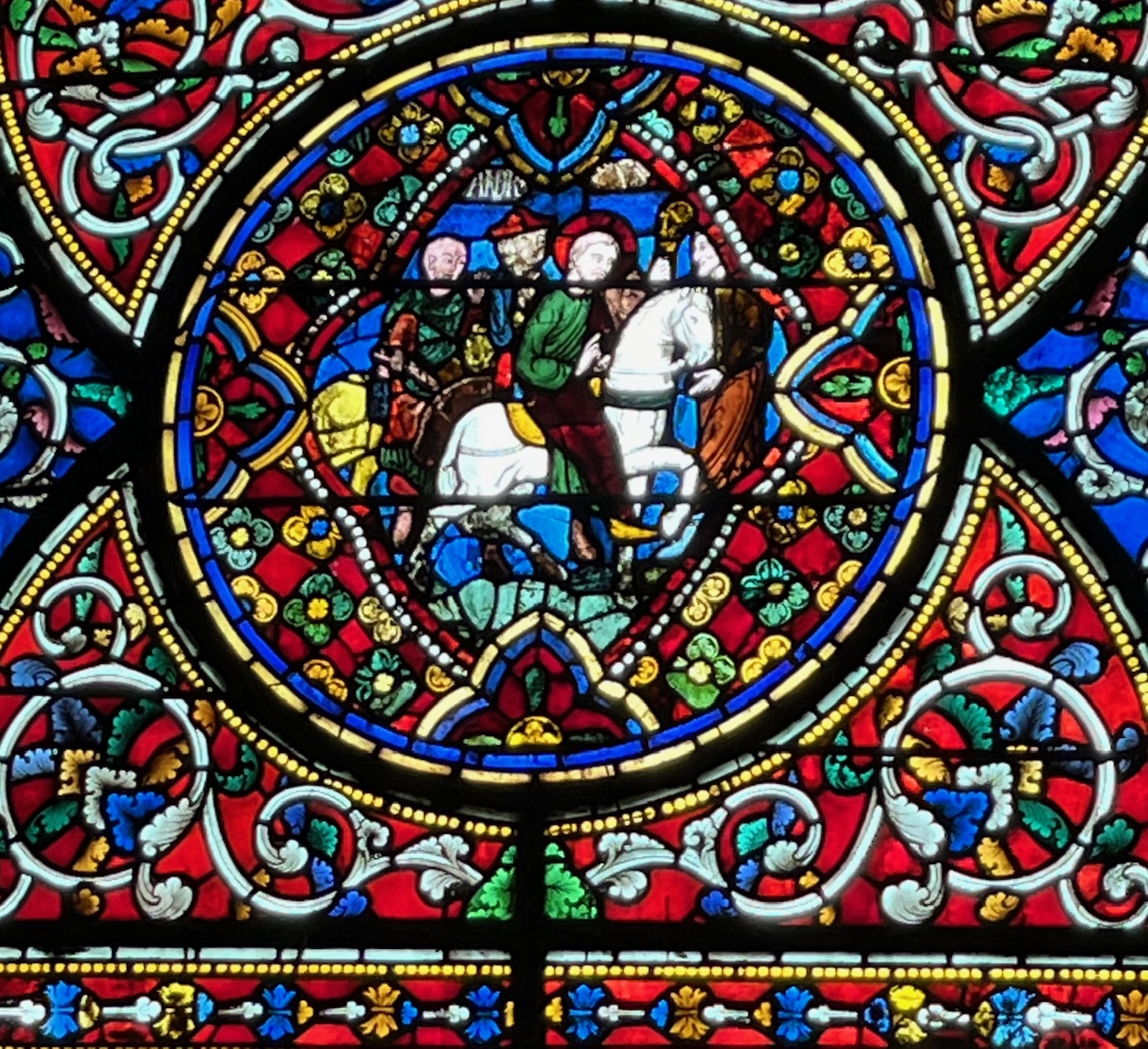
Yet another relevant photo: Stained glass window with what I assume to be a knight in the centerfold. And if it’s not a knight (is that a halo behind him?), what the hell, he’s on a horse. Close enough. From Canterbury Cathedral.
The cult of knighthood
To be part of a class defined by warfare meant training from childhood. I’m leaning heavily here on Ian Mortimer’s book (remember books?) Medieval Horizons, and he writes about the aristocracy “deriving satisfaction” from war and “committing acts that caused enormous suffering but which they regarded as their right.”
They were enthusiastic enough about fighting that when they didn’t have a war at hand,they needed to be kept occupied, and raids were a good training ground for warfare–not to mention a good way to keep a restless set of knights amused. The English raided Wales and Scotland repeatedly, although the raids on Scotland seem to have been written up as invasions and the Scottish invasions as raids. That may be about numbers and it may be about nationalism, but the line between war and raid looks a bit blurry to me.
I’m less certain about Wales. Sorry.
When raids were out of season, restless aristocrats could always recreate war in the form of a joust, and in the earlier medieval period we’re not talking about the kind of fancified, one-on-one, controlled jousts we see in movies. Those came later. In 1341, Sir William Douglass (whoever he may have been) challenged the earl of Derby (he was the earl of Derby, that’s who he was) to a joust. The conditions were that no one wear armor and that they all fight with sharpened lances.
You’d do the same on a rainy Saturday when you’d gotten tired of listening to some damn minstrel plunk away on the lute. You know you would.
Twelve men fought on each side. Three were killed and there’s no record of how many were injured. The survivors agreed it was a great party and wrote very nice thank-you letters, saying, “Let’s do it again soon.”
The culture of chivalry, with its tales and songs and myths, glorified it all. It was all about personal courage, personal honor, personal strength.
From what I’ve found, serfs and associated non-nobles did get drafted into the wars the aristocrats started and commanded. They were foot soldiers, archers, and whatever else was needed. But they were the backup band, not the lead singers. The aristocracy hogged the spotlight.
Not to diminish that business of personal honor or anything, but real warfare, as opposed to jousts, could also be profitable. If you captured a knight (or–jackpot!–the king), you could hold him for ransom. It sounds like a board game, doesn’t it? I’ve seen references to ransoming archers as well, so commoners may have been ransomable, but the emphasis is pretty clearly on aristocrats, and the higher up the food chain the captive was, the bigger the ransom.
Historians argue about when and why that business of ransom began. It’s an interesting rabbit hole and we’re not going down it but you’re welcome to. Let me know when you get back and I’ll put the kettle on.
Another source of wartime profit was looting, and I’m not sure what more I can say about that. Soldiers took stuff, but to be fair, only when they could.
Attempts to rein in the brutality
A few winds blew in the direction of toning down the brutality of war. In the tenth century, the Peace of God movement–
Well, okay, not a lot is known about the Peace of God movement, but it started in southern France and popped up at assorted Church councils.
Back to the Peace of God movement, though. It was a response to the inability of, specifically, France’s Carolingian dynasty to impose anything like order, but more widely it was an effort to tone down the violence of the period. It urged combatants to make a distinction between soldiers (legitimate targets) and non-combatants. Warriors were not to commit rape and not to kill women, children, churchmen, or merchants.
A bit later, the Truce of God movement tried to ban fighting from sunset on a Wednesday until dawn on a Monday as well as during Lent and Advent, and if that strikes you as bizarre, think of it as a reminder of how different the medieval mindset was from the modern one. The ban parallels the restrictions on when a person could have sex or eat meat.
No, I didn’t make that up.
The Truce of God movement would’ve made perfect sense at the time, even to people who disagreed with it.
Two English kings, Edward III and Henry V, also tried setting some limits. Edward ordered that “no town or manor was to be burnt, no church or holy place sacked, and no old people, children, or women in his kingdom of France [France and England were hopelessly tangled at the time] were to be harmed or molested.” Henry’s ordinances instructed his soldiers to protect churches and religious buildings–not to steal from them; not to harm or capture clergymen and -women (or maybe that’s women and clergymen; Medieval Horizons’ wording leaves it open); not to take clergymen hostage unless they were armed and hostile; and not to rape any women.
The instructions are more interesting as an indication of what was happening than as a list of what they managed to stop. Still, warfare was changing, although not in the ways either movement hoped for.
The decline of the knight
Knights’ effectiveness depended on the massed charge, which could overwhelm a defense, but in the fourteenth century the knight started to lose his status as hero of the battlefield. In 1314, Robert the Bruce (Scotland; real person; also a movie that I remember as endless) scattered sharp metal gizmos–caltrops in case you care–across the ground English knights would have to charge across. He also had pits dug and planted them with sharpened stakes. He organized his men so that knights who got past the gizmos and the stakes charged their horses into a wall of pikes.
This sounds harder on the horses, who didn’t choose to be there, than on the knights–although to be fair a knight on his way to the ground wasn’t in an enviable position. But when the alternative is letting the knights kill you, you know how it is: a person’s ruthless side can come to the surface.
For our purposes, what matters is that knights charged foot soldiers and lost.
The English had longbowmen and might have won if they’d used them first, but they sent in the knights, in their full heroic cluelessness, and lost the battle.
Like the Scottish wall of pikes (and those sharp little gizmos, which would upset the balance of the sentence so let’s leave them out), the English longbow tipped battlefield power away from knights and toward ordinary soldiers. Longbowmen–commoners, remember, and beneath a knight’s notice–fought from a distance, in relative safety, and a wise commander let them decimate the enemy before turning the heroes on horses loose, even if doing so upset the social order.
By the end of the fifteenth century, armies had grown larger and knights no longer trained for a massed charge. Now it wasn’t just longbows and pikemen they’d be coming up against, but cannons. You couldn’t charge a cannonball and there was no heroism in getting splattered by one.
Regulating warfare
As the middle ages became middle aged and the structure of society changed, warfare needed a bit more justification. The papacy had become more powerful, so if one Christian king was going to fight another, he needed to justify it–if not to god at least to the Pope. That didn’t put an end to wars between Christian kings but it did boost everyone’s creativity by a factor of twelve.
But what really tamped things down was that war had become expensive, even with the countervailing lure of loot and ransoms. The side with more cannons and more soldiers was likely to win, and both cost money.
Money? In the early middle ages, it was around but it wasn’t central. In the 1150s, if you’d spread England’s supply of money evenly, everyone would’ve had 6 pence. By 1320 it would’ve been 10 shillings. (Twelve pence to the shilling. You’re welcome, and I had to look it up.) The shift to a money economy was underway. By the time we reach the later medieval period, warfare was measured in money–for arms, for soldiers, for all those little incidentals you forget to factor in at your peril. All that meant taxes, and in England it meant the king going to that ever-annoying Parliament, which had the power to approve or not approve some new tax to finance a new war.
That took some of the fun out of going to war.
And in the sixteenth century, after the War of the Roses went further and ruined the reputation of internecine warfare, Henry VII got rid of private armies by making it illegal for lords to keep supporters who wore their livery.
Translation? Every lord had his colors and symbols and assorted rigamarole. They dressed their followers to match. Think of it all as a uniform.
Building an army was now the prerogative of the king. Warfare had been nationalized.
Numbers
Wars in the early middle ages were likely to involve a few thousand men. Battle of Hastings, where the Normans took England? Seven thousand to eight thousand men on each side. Before 1300, most battles were much smaller. Sure, chroniclers wrote about armies of up to 80,000, but then I regularly claim to be a thousand years old. Don’t believe everything you read. Historians–those clever devils–look at the financial record to dig out more realistic numbers, and they say (or at least one says) it was rare to find more than 10,000 on a side.
By the sixteenth century–and by this time the middle ages isn’t just middle aged, it’s bald and has bad knees, if it’s still the middle ages at all–the English army had 30,000 men (do you really care where?). The Spanish had 200,000 and the French 80,000. And you can tell from the numbers that these weren’t drawn from the top of society. The top layer wasn’t big enough and didn’t see any glory in getting killed by cannonballs anyway. The percentage of noblemen dying of violence went from 25% in 1400 to 2.5% in 1750. Kings no longer risked their lives leading their troops. They delegated.
No two people agree on exactly when the middle ages ended, but for the sake of convenience let’s say it ends here.
 Notes from the U.K.
It might not surprise you to know that I’ve got and have read that book by Remy Ambuhl. It’s fascinating.
I don’t think the mounted man in your picture is a knight; he doesn’t have any of the kit on. From the way his hand is raised, I’d say that he’s blessing or preaching, possibly both. I can’t make out whether he’s the one holding the bishop’s crook, but it’s either him or the man by the horse’s head.
LikeLiked by 1 person
It doesn’t surprise me and I’m pretty sure you’re right about the guy on the horse. This is why I so seldom use–or try to use–relevant pictures. Unless I steal them from someone else online, they’re hard to find. But we were in Canterbury last summer and I have a few photos, and hey, guy on a horse, nice colors, let’s just slip this in and pretend. Squint a bit and it’ll work.
LikeLiked by 1 person
I wish there was a bit more context, because it might be really obvious who he is.
LikeLiked by 1 person
I just got a comment arguing convincingly for Thomas a Becket.
LikeLiked by 1 person
Given the location, it crossed my mind. I’ll have a look at the comment.
LikeLiked by 1 person
Becket is usually shown being murdered in images, so probably not him. If the image is him, it must be part of a kind of biography in a group of pictures.
LikeLiked by 1 person
I don’t remember what other windows, if any, were nearby. I was drawn to it strictly for the colors–and for the fact that I could get close enough to get a half-decent photo, so I’m not much help here.
LikeLike
I don’t know why I’m shown as anonymous when I reply to my own reply, but it’s definitely me.
LikeLiked by 1 person
To make that even stranger, you’re appearing as yourself now.
LikeLiked by 1 person
The wonders of WordPress.
LikeLiked by 1 person
Indeed.
LikeLiked by 1 person
At a guess, your horseman is Thomas à Becket. Horse, so high rank, crozier, so at least a bishop, halo, saint and the window’s in Canterbury where he was archbishop and also killed (martyred). Very striking image, whoever it is. It must be frustrating for historians that so few images can be definitely identified.
Jeannie
LikeLike
Sounds convincing to me, but all that Christian symbolism goes right over my head. It’s not usually a problem, but from time to time it’d be nice to know what they’re signalling.
LikeLike
Religious and other symbolism isn’t only a problem for historians like you, Ellen. It’s also one in art history, where many old portraits show objects which are related to the standing and reputation of the subject and also are comments on our ultimate fate. Flowers, birds, instruments, ornaments, even colours, had a significance at the time, some now known only to experts or lost altogether.
Jeannie
LikeLiked by 1 person
Interesting that some would have been lost altogether. I’m sure at the time they were as clear as, um, emojis are today (says someone who doesn’t read emoji fluently but understands that she’s in a minority).
LikeLike
Jesus rides on a white horse somewhere in the Offenbarung, not sure whether this can be applied here.
LikeLiked by 1 person
So far, I think the prize should go to the comment that argues for Thomas a Becket.
LikeLike
Heroes generally rode white horses. Presumably this had to do with white symbolizing purity, because white animals are not generally prized for any other reason.
Pris cilla King
LikeLiked by 1 person
I’m with you on the white horse symbolism, Patricia and I came across this, courtesy of google:
“Christian iconography attributed red to martyrs, white to virgins and pure people, green to confessors, purple to penitents, gold or blue to saints and angels. The devil or Jude(sic) Iscariot are sometimes represented with a black halo around their head.” It seems to support the Thomas à Becket idea.
Thanks again to Ellen, it’s all added to my store of odd bits of things I didn’t known I didn’t know…
Jeannie
LikeLiked by 1 person
And the discussion kicked off by the window has added to mine. Thanks to all of you.
LikeLike
And an apology for my daftness, I should have addressed ‘Priscilla”. Sorry!
LikeLiked by 1 person
I think you did, actually, but let’s not lose any sleep over it. Apology (a) unnecessary and (b) if it was to me, accepted. And (c) if it wasn’t to me, accepted on behalf of whoever it was for, who didn’t give me permission to accept it on their behalf.
Have I confused the situation sufficiently yet?
LikeLike
More fascinating information, Ellen, and in easy chunks for the interested but lazy, like me. Thanks!
A personal observation, as one with working class roots, and therefore most likely links with the conquered rather than the conquerors, I have lurking at the back of my mind a resentment of the Normans and, by extension, the aristocracy. By education, income and occupation, I’m certainly middle class now, so rationally, identifying with the downtrodden Saxons makes no sense, especially at this remove in time.
I also find this fashion for researching family trees a bit odd. If we could trace our ancestry sufficiently far back, we’re all umpteenth cousins, umpteen times removed of everybody who’s ever lived, so proving that one of them was a highwayman or a swineherd or a queen surely doesn’t matter that much? Detail of how people lived is fascinating but I don’t find a remote personal connection makes it more so. Maybe I’m the one out of step…
Thanks again,
Jeannie
LikeLiked by 1 person
I’m always in favor of identifying with the conquered. I’m not convinced we need a genetic or even an economic connection. Vaguely related to that, years ago I saw a study that claimed British people with French-derived last names had, in general, higher incomes than people with–well, I’m not sure how they defined it so let’s say other-derived last names. All these centuries laabouter, the legacy of the conquest lingers.
I’m with you on family trees but had an interesting experience contradicting everything I believe about them. A relative I never heard of popped up a few years back and had traced one branch of the family, and I learned that a relative or two died in the Holocaust. I’d always assumed none of my family had because all the family I knew about were either in the US or were in the Soviet Union and had, more or less miraculously, lived. The ties to all the others who stayed behind had long since snapped. Somehow this new information–. Let’s start that again: Knowing that I was related to someone who’d been killed by the Nazis was different than simply knowing that the Nazis killed people. Or that the Nazis killed Jews specifically and would’ve killed me if I’d been born in a different time and place. History hadn’t changed but–in spite of what I believe and how I think about these things–my relationship to it had.
For whatever that’s worth. I don’t want to draw large conclusions from it, but it is interesting.
LikeLike
I think the martyred Thomas-a-Becket wins the stained glass prize. It would be nice to give a nod to old Geoff Chaucer, but Becket’s more likely and I’m pretty sure I’ve seen Chaucer in glass somewhere…
LikeLiked by 1 person
Chaucer has a statue in the town center. No beautiful colors, but he can’t complain of having been forgotten.
LikeLiked by 1 person
JFC, could men please find better hobbies?
LikeLiked by 1 person
This is one of those moments When I kind of regret my emoji illiteracy, because pasting in a laughing face would be really nice right about now.
LikeLiked by 1 person
It seems like people have been always finding new ways to kill each other, which is a sad state of affairs. However, it is good to remember the past thank you.
LikeLiked by 1 person
It does seem to be one of the things our species is good at.
LikeLiked by 1 person
Yet another history lesson that would have served Charles I well
LikeLiked by 1 person
You know how it is. It’s hard to learn anything when god’s chosen you and, you know, you’re supposed to have absolute power.
LikeLiked by 1 person
To chip in my two cents about the topic, knights.
As I read somewhere the last English (or was he already a British king, sorry, I’m not firm with this) King who rode with his men into battle was George II., but I am not sure about this – and forgot where I read it.
Weapons : The Swiss / Schweizer peasants killed a lot of knights, peasants by foot – as I vaguely remember the Armbrust was the weapon of choice.
A good bolt could penetrate an armour plate – and forget the horses. Some volleys of Armbrust “fire” would down even the most impressive knightly charge, a bit of shooting at cans, the rest is just bloody finishing.
I disagree – of course, what do you expect from me ? – with the last sentence before “Numbers” : “Warfare had been nationalized.”
Still no nations. Still a long way to the standing armies of, say Prussia, or ffs France, forget revolutionised France. The Knights were replaced with “Söldner”, soldiers of fortune – war is a business after all, has ever been.
The capitalist early areas of Northern Italy, Papal State included, showed the “new” way. Frundsberg and Co. were no “knights” of any way, and surely did not want to be like this, surely not their role model, they were hard core business people. The Scots were for rent in the Thirty years War, Gustav Adolf’s successes in the 1630s were not possible without his soldiers of fortune.
LikeLiked by 1 person
1. Yes, George II.
2. Yup, the crossbow. Very powerful. Slower than the longbow but not to be sneezed at.
3. Of course I expect you to disagree. Where’s the fun if we all say the same thing? But you’re making my point for me. The power to make war or refuse to make war wasn’t in the hands of the lords anymore. The king (and remember, my focus here is on English history; if I widen it my head will spin) could hire himself an army if he needed one–and if he could pay for it, which is where he usually ran into trouble. No, it wasn’t a sudden or complete shift, more like the beginning of a long process, but it was a distinct change.
LikeLike
At 3. : This ability (to make war, and other regales, former rights of the King) here in Middle Europe / The Reich (later Germany and Italy) shifted towards the powerlevel under the King, the Lords or domini terrae, mostly Herzöge, dukes. Here lies the source for the German & Italian particularism, for these two nations being late in joining the “concert of nations” called Europe (1871).
In any way I think of “Nationalismus” as a modern pest.
LikeLiked by 1 person
The drive to centralize power is a fascinating one. As for nationalization being a modern pest, I’m more inclined to think privatization is. Since Thatcher privatized the water services, we’re paying more, getting sewage in our rivers and seas, and the companies are going broke and borrowing huge sums (I can’t imagine who’s willing to lend them money, but that’s a separate issue) while paying huge sums to their execs and shareholders. Hooray for private enterprise.
LikeLike
I wish I could find it, there’s a quote I ran across a while back about how the only good thing that came out of ww1 was people finally decided there was no more reason to take horses into combat.
LikeLiked by 1 person
I haven’t seen that but yes, it makes sense.
LikeLike