
Any coastal community sees storms deliver shipwrecks to its shores, and if times are hard no community lets those deliveries go to waste.
Okay, even when times aren’t hard. As far as I can figure out, humans are wired to accept a free lunch. Or a free shipping container of slightly salted whatever.
Before we go on, though, I need to build a wall between two words: Wreckers are people who scavenge what they can from wrecked ships or from the cargo that floats ashore. Wrecking is an activity that probably never happened. The Cornish are said (although not by the Cornish themselves, in my experience) to have used lights to lure ships ashore where they’d wreck. There’s not only no evidence that anyone actually did that, it’s questionable that it would even work. But it still means I can’t use the word wrecking here, since I’m talking about what did actually happen.
With that out of the way, let’s talk about the right to wreck–wreck here meaning to scavenge a wrecked ship. And lets watch me jump through linguistic hoops to avoid the word wrecking.
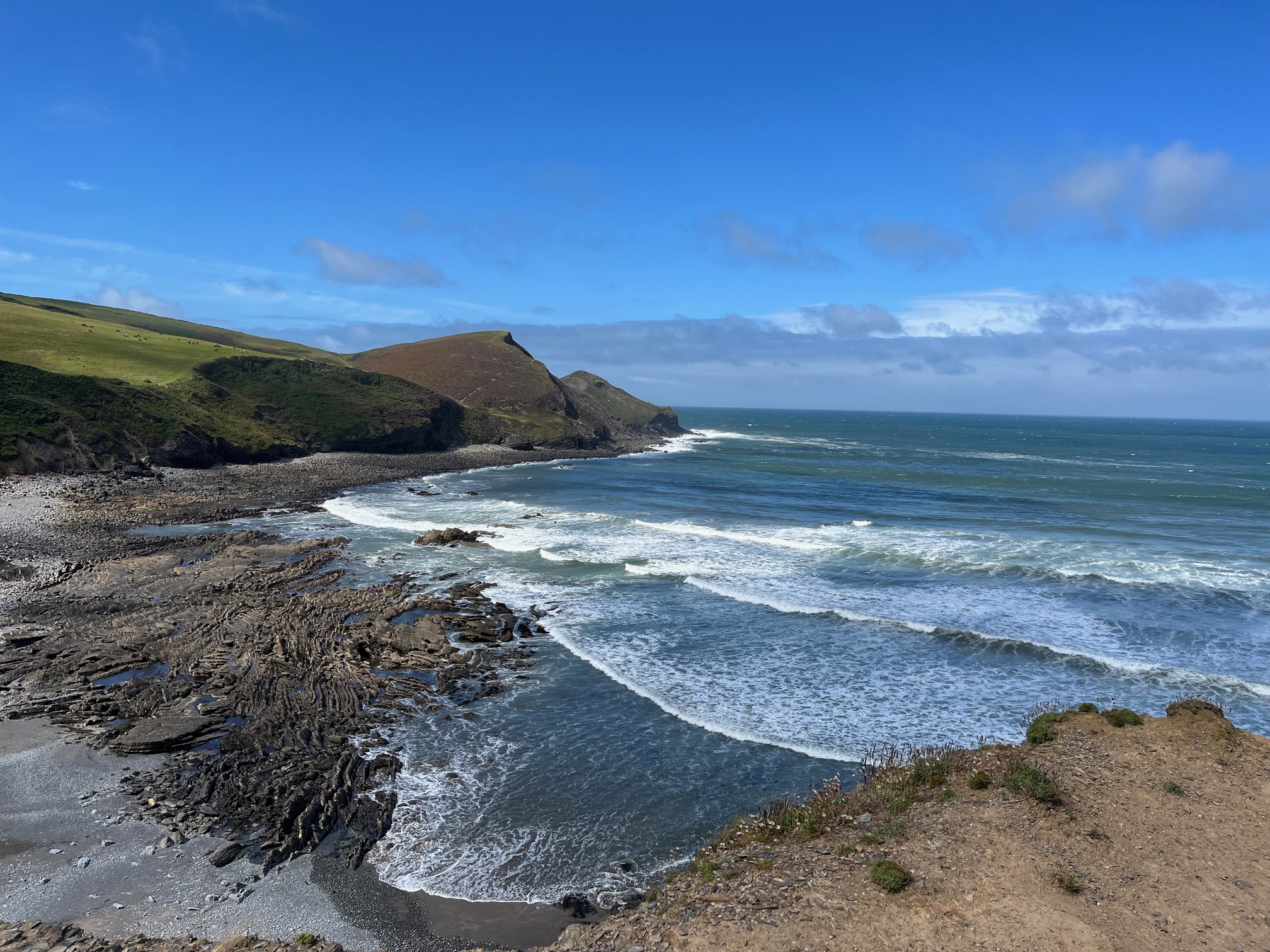
The rocks where the L’Adaldise wrecked. (See below. It’ll all make sense.)
The right of wreck
If Wikipedia’s right on this (it has a good overall record even if it’s subject to the occasional fit of madness), the right of wreck, or jus naufragii if we’re going to pretend we know Latin, is a medieval European custom rather than an actual law.
It was based on the idea that if a ship wrecked it was because god got mad at the crew for–well, something, clearly, so he drove their ship ashore. That made the ship, its contents, and in the early days its crew the property of the finders. Because god had set it all up that way.
Gradually that business about enslaving the crew dropped away, but claiming whatever was left of the ship and its contents? That continued powerfully enough for the Church to condemn it from the 12th century into the 16th.
If you want to know what’s actually happening in a time and place, look at what gets condemned or outlawed multiple times. It’s not foolproof–centuries of hysteria over witchcraft really doesn’t prove the existence of witches–but it’s still a good place to start.
Starting in Norman times, the English crown owned the land–the whole damn land–and that’s relevant because ships tend to wreck where the sea meets the land. The king could and did hand chunks of land to his followers, but it was still his and if one of them pissed him off too badly he could take it back. We could find a parallel there to god getting mad and wrecking a ship because, never mind human ownership, it’s his to wreck, but it won’t stand up to rough handling so let’s not push it too far.
So the king owned the country, even the parts other people owned. Try not to think about it too hard. Just nod your head and agree that of course he got to eat his cake and discover that it was still there, on the plate. He was the king, after all.
What matters for us is that he also owned whatever washed ashore, and he could and did assign it to others, just like he owned land and assigned it to others.
The right to complicate the situation
Edward I (1239 –1307; you’re welcome) introduced a law stating that”where a man, a dog, or a cat escape quick [in other words, alive] out the ship,” the ship wouldn’t be considered a wreck, and neither would its contents. Its owners had a year to claim their property–minus fees, rewards, and droits.
What’s a droit? It seems to involve money, law, and ownership. Beyond that, it’s a rabbit hole.
The new law kicked off all sorts of arguments and lawsuits about what actually happened in this, that, or the other shipwreck. Did everybody die? Was the cat alive and curled up at someone’s fireside? Was this black cat at fireside the black cat who used to be the ship’s black cat? In other words, was the ship a “true wreck” or was it not?
The abstract of an academic paper that I can’t get full access to (sorry) says, “Different views coexisted about the legality and propriety of shoreline activities, whether salvagers worked with or against established authority, whether wrecking constituted a service, a custom, or a crime, and whether common lawyers or the civil lawyers of the Admiralty had jurisdiction.”
In other words, the law complicated things. And you might want to notice that the paper’s using the word wrecking there in exactly the way I’m not, but I’m pretty sure they lost points for it and I haven’t.
But let’s stop following the story chronologically . . .
. . . because I’m having trouble unscrambling this egg. The point I want to get to is that somewhere along the line the crown gave seaside landowners the right to salvage whatever god (in his fury) had smashed onto their bit of the king’s shoreline, and this turned out not to be simple either, because the king (in his wisdom) had given the right to the owners of both manors and of hundreds.
Hundreds? The hundred was a political unit smaller than a county, and a manor was a large estate of no specified size but smaller than a hundred (at least usually; I can’t guarantee that it always was) and larger than the egg I can’t unscramble. So a hundred could contain multiple estates.
In other words, the king just granted the same right to overlapping landowners. This is not a recipe for harmonious living. Cue an assortment of lawsuits, and if you’re interested in them follow the link just above, because we’re headed off in another direction:
If a tenant found a wreck, they were expected to let the lord know, in return for which they’d get half the goods and the lord would get the other half. That amount would’ve ranged from the piddling to the spectacular, but ordinary people lived close to the edge and no find was too piddling to pass up.
What happened if the tenant didn’t notify the lord? In a case in Cornwall, two tenants carried off 54 gallons of wine, were caught, and were fined, although the source I’m relying on doesn’t say how much. More than the wine was worth, I’m sure.
What we can’t know is how often tenants weren’t caught, because not getting caught leaves no record.
Then the laws got tougher
In 1714, anyone who boarded a wreck without permission or got in the way of the crew salvaging their cargo faced fines and imprisonment. After 1753, they faced the death penalty.
If you want to blame someone for that, I’m told you can blame the philosopher John Locke, who argued for the sacredness of property. The idea caught on among (no surprise here) people who had property, and suddenly it seemed perfectly sensible to say that the purpose of government was to protect and preserve property. Punishments for crimes against property became harsher, usually following some local event that the great and the good could whip themselves into a state of outrage over. Soon a person could face the death penalty for anything from picking pockets to poaching to stealing livestock.
And here’s a spot where I have to stand on my head to avoid using the word wrecking: scavenging from a wreck went on the list.
If you’re not in a mood to blame John Locke for that, you can blame the East India Company, which had plenty of property to consider sacred and had lost some expensive cargoes off Cornwall and the Scilly Isles. Along with a few other companies who had a lot to gain, it lobbied to change what was still essentially a medieval law on wrecks.
The aftermath of one wreck
In 1767 a French ship, L’Adaldise, wrecked off Cornwall, not far from where I live. To be clear, I wasn’t there. I’m not that damn old. I not only hadn’t been born yet, neither had my grandparents. I only come into the story because I know the area.
A hundred people rushed to the shore, according to the account. At the time, the nearest village would’ve been very small indeed and (if AI can be believed, and it sometimes can) the whole parish (4,000 acres) had a population of 700. I’m guessing it would’ve taken a while to collect 100 people. But Cornwall was a poor county, and a wreck washing ashore could well have meant the difference between eating and not eating.
However many gathered, a lot of people rushed to the shore. Some were salvaging for the lord of the manor and some for themselves, or so the article I’m relying on says. Some had axes and chopped into the hold to get at the cargo, but they also carried off masts, anchors, cables, ropes, and anything else that could be put to use.
Then everyone went home, including an elderly farmer, William Pearse, who for reasons that aren’t clear to me was the only person arrested (at home) and charged with wrecking. Under the new law, he faced the death penalty. He was held in Launceston jail, which the British in their inexplicable wisdom spell gaol. Eight years later, a reformer described the jail this way:
“The Prison is a room or passage twenty three feet and a half by seven and a half, with only one window two feet by one and a half;—and three Dungeons or Cages on the side opposite the window; these are about six and half feet deep…They are all very offensive. No chimney: no drains: no water: damp earth floors: no Infirmary . . . The yard is not secure; and Prisoners seldom permitted to go out to it. Indeed the whole prison is out of repair. . . . I once found the Prisoners chained two or three together. Their provision is put down to them through a hole in the floor of the room above. . . . And those who serve them there, often catch the fatal fever . . . a few years before, many Prisoners had died from it.”
Pearse was tried in Bodmin, and if he had any witnesses to defend him they would’ve had to make a rough trip across the moor, but no records of the trial exist so we can’t know. I can’t help wondering, though, how anyone could’ve appeared as a witness in his defense without having to admit that they’d been a participant.
What we do know is that Pearse was convicted and sentenced to death, and so were six others that week, all for theft of one sort or another–except, possibly, for the one person convicted of house-breaking.
Appeal
Death sentences were often handed out and then commuted them to transportation by the judge. (At the time, transportation was to the American colonies.) Four death sentences from that week were commuted, but not Pearse’s, and the elite of Launceston rallied behind him, campaigning for a royal pardon.
Why did the local gentry rally behind a poor man? Possibly because they had a lot to gain from wreckers and a lot to lose if the crackdown held. Pearse was being used as a test case.
Campaigning for a pardon involved lawyers, and lawyers involved money, something Pearse didn’t have. It’s not clear who footed the bill, but the local gentry sound like a fair guess.
Whoever was paying, Pearse now had a high-powered legal team, and local politicians were appealing for a pardon, arguing variously that he hadn’t taken much (“an inconsiderable quantity of rope” and a bag of cotton), that he wasn’t guilty, that the witnesses against him had lied, and that local people were deeply concerned about the case. Pearse’s age could also have been expected to argue for a pardon, and in any case the statute called for the death penalty only if violence was involved.
Meanwhile, Pearse sat in that small, foul jail in Launceston.
Following standard procedure, the matter was referred back to the judge who’d condemned him (the logic was that he knew the case best), and the judge wrote, “‘As there were many common people in Court, I took the opportunity of inveighing very warmly against so savage a Crime, and of declaring publickly that no Importunities whatsoever should induce me to reprieve the Criminal.”
Pearse did not get his pardon.
It’s not irrelevant that the judge was also a legal representative for the East India Company. Remember them? The good folks who lobbied for the harsher law?
Pearse was the first person hanged as a wrecker under the new statute.
Current law
That doesn’t really take us to the present day, but let’s hit fast forward. Under the Merchant Shipping Act of 1995, you have to report a wreck or any materials from a wreck to none other than the Receiver of Wreck. That could get you a salvage award, which will vary depending on the value of the wreck and what you had to do to rescue it. What you can’t do anymore is call in the entire village and cart everything away like ants carrying an entire picnic home to the nest.
 Notes from the U.K.
Dear Ellen,
The scurrilous suggestion that the Cornwelsh people lit fires to attract ships towards their shores during a storm is a vehicle used by unscrupulous writers and filmmakers to increase their box office receipts.
The people of Cornwall are fed up of this fiction that they drew sailors to their deaths for the sake of a few barrrels of Brandywine and/or any other cargo held aboard the stricken vessels. Like everyone else in a coastal area the locals would attempt to rescue the sailors and save any salvage for the Crown.
Huge Hugs
LikeLiked by 1 person
The accusation predates filmmakers, although probably not writers, scurrilous or otherwise. I always wondered why any sailor would see a light and thing, Right, let’s steer for that. I was happy to see that an experiment came back with the report that the lights weren’t visible from the sea–although that still doesn’t address the question of why any sailor would steer toward a light.
As for salvaging for the crown, um, yeah. Of course they did.
LikeLiked by 1 person
Yes, it seems likely that any ship that could still be steered would veer away from lights for fear of hitting rocks, sandbanks or reefs, whether on or off shore.
LikeLiked by 1 person
Indeed. The sailor who said, Ohh, look, land, let’s run the ship aground never existed.
LikeLike
The looting of wrecks hasn’t stopped with the twenty-first century, Ellen:
https://www.gov.uk/government/news/tenth-anniversary-of-the-msc-napoli-shipwreck-disaster.
I don’t know whether anyone was arrested but the penalty isn’t as harsh as it used to be. (Hope the link works).
Jeannie
LikeLiked by 1 person
Oh, the wreck of the Napoli! Yes. I was tempted to go into it but it was going to take me off into a whole ‘nother direction. What particularly cracked up an American friend was that people lined but and took turns to looks a container full of motorcycles. No one who’s British would find that remotely funny, and by then I’d been here long enough that I didn’t untilm my friend brought it up, at which point I remembered how funny it was.
Thanks for bringing it up.
LikeLike
Dear Ellen
Thanks for your enlightening post about wrecking that was notorious on our North Norfolk coast as well.
Happy weekend
The Fab Four of Cley
:-) :-) :-) :-)
LikeLiked by 1 person
These coasts have some terrible tales to tell.
LikeLike
Thanks for providing this history of the legal system as it pertains to “wrecking”. I found it of particular interest because my 4X Great-Grandfather, John Balfour, was convicted of plundering the wreck of a ship named the Norges Constitution. He was imprisoned in 1842 and then disappeared from the record so I assume he died while incarcerated. It has always seemed harsh to me that someone was incarcerated for essentially salvaging without permission but capitalism sure does value property over people.
LikeLiked by 1 person
Wow, there’s a tale, although I wonder if there wouldn’t be a record if he died in prison. They seem to have had to account for everyone–the same number going out as came in, regardless of whether they were living or dead. But yes indeed, it was and is property coming before persons–and if you live with that long enough it begins to seem normal.
LikeLiked by 1 person
I am sure there was documentation at some point but it has been lost to the ravages of time. Other sources suggest he died not long after his imprisonment.
LikeLiked by 1 person
Makes sense. A lot would’ve been lost.
LikeLiked by 1 person
Or maybe, in a shade of the Salem Witchcraft Trials, someone coveted Farmer Pearse’s farm.
LikeLiked by 1 person
Not impossible. There’s no word on whether he owned or was a tenant–probably a tenant, since the info we have says he was poor–but either way they might’ve had an eye on it.
LikeLike
When are you going to put these blogs together in a book? Juss astin’. – dh
LikeLiked by 1 person
I did try a compilation of the history ones and got a clear message that it wasn’t saleable. I should think about some narrower focus, which might be more workable, but so far I haven’t come up with it.
LikeLike
The Irish have a whole mythology (maybe related to Viking raids) of hags, sea witches and Fomorians (evil creatures) who cause the storms that wreck the ships that then get pillaged by wreckers although they are more interested in the forces that cause the storms.
LikeLiked by 1 person
Interesting possibility, that the legends come out of the Viking raids. I’d have assumed they predated them, but I base that on nothing but an assumption that mythology goes way, way back in history. I just looked up when the first raid on Ireland took place: 795. For whatever that’s worth.
LikeLike
Another recent wreck that attracted a lot of, erm, interest:
http://news.bbc.co.uk/1/hi/england/7199667.stm
And you might like to note the opera The Wreckers, by Dame Ethel Smyth*:
https://en.wikipedia.org/wiki/The_Wreckers_(opera)
*Yes, even she who, while incarcerated for her suffragette activities, conducted – with a toothbrush – her fellow-prisoners in a rousing chorus of her suffragette anthem.
LikeLiked by 1 person
Thanks. I notice how neutral the language is: plundering ships. If the powers that be say it’s okay, you’re salvaging. If they don’t, you’re plundering. Ah, well, what did I expect?
LikeLike
The East India Company really did have their hands in everything, didn’t they? I’m guessing that people continued taking the shipwrecked stuff, but were a little more cautious about it.
LikeLiked by 1 person
Oh, they did indeed. So much money. So much power. So many stings to pull.
I expect you’re write about what happened to shipwrecks after the laws changed but that’s pure guesswork. I do know that beaches can be isolated spots and it’d be easy to think, Hey, who’ll know?
LikeLiked by 1 person
Thank You! Hope you have a great week as well.
LikeLiked by 1 person
Well, the weather’s gorgeous, politics everywhere sit somewhere between insane and homicidal, and what could possibly be wrong with the world? Me, though? So far so good. Wishing you a good one as well.
LikeLiked by 1 person