
If you think politics were once sane and sensible, let’s take a quick dive into England in the fifteenth century. I don’t guarantee that things were either more horrific or more absurd back then than they are wherever you live with (I’m originally from the US, after all, which scores high on both scales right now), but a bit of history does keep us from thinking political idiocy’s a new invention.
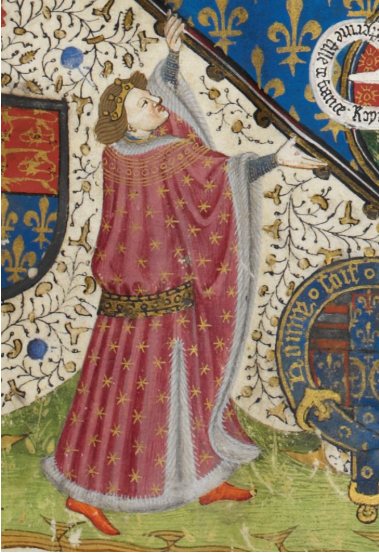
The Duke of Gloucester, hanging his curtains. From Wikimedia Commons
The king, the uncles, the conflict
We’ll start with the king, since his personality, competence, hair style, and digestion were all political issues back then. Henry VI has gone down in history as a weak and unstable king, and we’re dropping in at a time when he’d been king for three years. You might think that would be long enough to get the hang of the job, but he was four years old and I’m no fan of monarchy but even I will forgive him for not being much use yet.
While he played with his toys, two powerful men played with the country–and with the money and power it had to offer them: his uncle Humphrey, the duke of Gloucester, and Henry Beaufort, who was the chancellor, the bishop of Winchester, someone who could be counted on to lend money to the insolvent crown (at high interest rates), and uncle to the duke–who was, remember, uncle to the king.
England’s aristocracy would’ve fit in a fairly small laundry bag back then. And you know what some families are like: these two men didn’t play nicely together. They’d already had an armed fight on London Bridge. I mention that only to explain why, when Parliament was called into session in 1426, everyone expected a fight there too. Both men had power bases nearby, Humphrey in London itself and Beaufort in Southwark. So someone decided to avoid bloodshed by moving the meeting to Leicester–pronounced for no discernable reason, Lester.
Don’t get me started on English spelling or place names.
To keep the two sides from shedding blood, somebody pulled a 14th-century tradition out of a different, non-laundry bag. (England’s bag of arcane traditions is almost as big as its bag of arcane spellings.) Each Parliament had been opened back then with a proclamation banning swords, other weapons, and silly games.
Silly games? Yes, silly games. The good folk running the country had a habit of pulling men’s hoods off their shoulders, as any reasonable adult in a position of power would.
But by now it was the 15th century, not the 14th, and people had grown up enough (and were grumpy enough) that no one expected games and the announcement was stripped down to a simple warning that “every man . . . should leave their weapons in their inns, that is to say their swords and shields, bows and arrows.”
The bats
So what did everyone do? Left their swords and bows and arrows at their inns and armed themselves with bats–the wooden kind, not the avian.
What were they doing with bats? No idea. As far as I can tell, people didn’t start playing cricket for another century, although an ancestor game, stoolball, was played in Essex, traditionally by milkmaids using their milking stools as wickets. Not, you’d think, the sort of game to attract a bunch of macho aristocrats.
Okay, I haven’t a clue why they had bats and I’m not sure anyone sensible will either. The country was full of local games. Whether Leicester was full of bats that the lords and Members of Parliament could appropriate I don’t know. Maybe a few good solid cudgels went down in history as bats because the scribe-of-the-day liked the sound of it. We’ll just have to squint and move on. The articles I’ve found somehow take it for granted that they had bats.
Don’t we all pack them when we travel?
The two sides brought their bats to Parliament. The next day they were told to leave their bats behind, so they brought stones–big ones–tucking them into their clothes, where no one would notice them.
How did both sides hit on the same strategy two days in a row? By hacking each other’s emails, of course. No other explanation is possible.
Eventually Beaufort and Humphrey spoke to Parliament, making their cases against each other and for themselves, and in the end Beaufort was made to step down as chancellor but by way of compensation was allowed to accept the Pope’s offer to make him a cardinal. The two men gritted their teeth and shook hands, no blood was shed, and the Parliament came to be known as the Parliament of Bats.
And the king? Not long afterwards, he was knighted by a different uncle.
 Notes from the U.K.
Poor Henry,didn’t have a happy life at all.
LikeLiked by 1 person
I’ve never envied kings. Or queens. Or any of that lot. Not that he had a choice…
LikeLiked by 1 person
We have a Leicester in North Carolina also pronounced Lester. I just thought it was our southern way of dealing with “eic”
LikeLiked by 3 people
It could’ve been your way of dealing with “eic,” but then it was also England’s. Which of course someone saw fit to reproduce since it made no sense at all.
To be fair, it was a long time before English spelling settled into its current state of fixed unpredictability, so yeah, why not? I’ve been reading a book on the English Civil Wars, which is full of quotes with the original spellings. They make my head spin.
LikeLiked by 1 person
It seems likely that the misalignment between spelling and pronunciation is partly down to the literate writing the names as they were recorded and the rest of us going for the (lazy?) speech of everyday. More and more people say ‘gonna’ rather than ‘going to’ even if they write it in full.
There’s also the elitist tendency of the upper classes to point out that, for instance, ‘Marjoribanks’ is said ‘Marchbanks’ to keep the rest of us in our place.
Jeannie
LikeLiked by 2 people
For pronunciation, I’m told, the upper classes use pronunciation to make themselves feel better than the rest of us, and I’m sure the differences were more pronounced then, but spelling? I don’t think so, not in the period we’re talking about. I’ve read somewhere that pronunciation was different (I can’t date that; it’s just sort of floating) and they might well have been spelling phonetically. Then spelling was regularized but pronunciation went on changing until the two didn’t match at all. I don’t know if that’s at all accurate. It’s possible that the island spent several centuries hallucinating and this is the result.
LikeLiked by 1 person
There was a huge change in English pronunciation starting in the 16th century. It is called The Great Vowel Shift. It’s why some of the rhymes in Shakespeare no longer work. ( My English teacher is now beaming down on me from heaven, happy that I’ve remembered that).
LikeLiked by 2 people
It’s always good to make an English teacher happy. I find the idea of pronunciation changing fascinating, although I couldn’t tell you why. I once met a writer of mysteries set–as she told me–in the midst of the great vowel shift. It had no bearing on her mysteries or the characters, who wouldn’t have been aware of it happening (I assume), but what struck me was her fascination with the period she wrote in and her love of the detail. It’s left me with an admiration of people who write historical fiction–and of English teachers.
LikeLiked by 1 person
I’m disappointed to learn that the bats were clandestine weapons rather than the winged variety. It would have been much more interesting to imagine the meeting being interrupted by a panic of flying mice… Not so much for the bats, though, I suppose, nor for the servants who had to clean the clothes of the attendees.
Jeannie
LikeLiked by 4 people
Being in neither category, I like your version better than the real one.
LikeLike
You had me at the milkmaids inventing stoolball…
I just read somewhere (a Peter Tremayne novel I think) about when pockets were a new invention, so I suspect that was why their next weapons of choice were rocks.
The two greedy power-grabbers ruling for the four year old king sounds scarily familiar Over Here.
LikeLiked by 1 person
Hmm. Now that you mention it, yes, it does sound familiar.
LikeLiked by 1 person
And here I was thinking you were going to talk about a parliment of real flying, flapping bats! :D
LikeLiked by 1 person
I know. Disappointing. Endless apologies.
LikeLiked by 1 person
:D
LikeLiked by 1 person
I always find when I think the world is bats*** that looking to history is reassuring. People have always been nuts, greedy, warlike, violent, manipulative and sometimes one of these things gets massive enough to warrant attention. I read Heather Cox Richardson’s Letters From an American fairly frequently and it’s always good to see that…oh this happened before and we got through it. Of course, lately she’s said something was unprecedented a couple times. Ugh… Oh and for bats, just substitute clubs. A weapon of choice for centuries.
LikeLiked by 1 person
We are all of that–warlike, batshit, etc–but (as the news reports that continue to come in from Minnesota remind me) we’ve also always been supportive, warm, and assorted other redeeming things. It’s all that makes us worth the air we breathe. The Minnesota news reports have, many of them, taken on a format I admire: they list what ICE has done in the last few days, then end with a section of positives–local groups delivering groceries to families in hiding, schools organizing distance learning, whatever. It reminds us that there is hope and that we not only can do something in response but that people are. Although what anybody did in response to a couple of warlords fighting it out on a bridge in London I have no idea. Bound up the wounds, I expect, and tried to keep them from getting infected.
LikeLike
Exactly.
LikeLiked by 1 person
Which brings me to my everlasting confusion over the Wars of the Roses. It has always appeared to me to be a big family argument rather than a true battle of differing ideals
LikeLiked by 1 person
I’m going to confess to near-total ignorance on the War of the Roses. I’d never seen it presented as a battle of ideals. I should put that on my list of things to write about. Then I should admit that I have about 7 lists in different places, most of which I couldn’t find right now if a chocolate cake depended on it. A really good chocolate cake. I may never see them again. But still, it would be an interesting thing to learn about. Thanks.
LikeLiked by 1 person
Leicester ’26.
Legend.
The Golden Days of Bat business.
And stone renting, but lest’s bat for our own team here.
Not sure about cake (seven lists ? Respect !), I can only manage one waffle a time.
LikeLiked by 1 person
Sounds like a promising business. I’ve read that the people who most reliably made money during the Alaska gold rush were the people who sold supplies to the prospectors. So yes: bats, stones. With a sideline in cakes, because bashing people over the head is hungry business.
LikeLike