
As I was taught the story of the printing press, Gutenberg’s invention put the Bible into the hands of ordinary people. After that, it was no longer available only to the very few people who could afford a hand-copied, illuminated book. People could read it for themselves (those who could read), and interpret it for themselves, and the whole thing promptly got out of control, setting loose every imaginable variant of Christianity.
What, only Christianity?
Other religions had a whole different relationship to early printing. Stop complicating the story.
Ah, but the headline said I was going to talk about playing cards. Well, Gutenberg’s invention did more than set the Bible loose among the masses. It redefined the audience for card games.
Pre-Gutenberg, playing cards, like books, were made by hand. They were beautiful, each deck was unique, and they were out of your price range. And mine.
Not that I know what your price range is, but I’m assuming some level of sanity here. They were a luxury. For the aristocracy.
Do we have any aristocrats in the audience?
It’s okay. You don’t have to tell me.
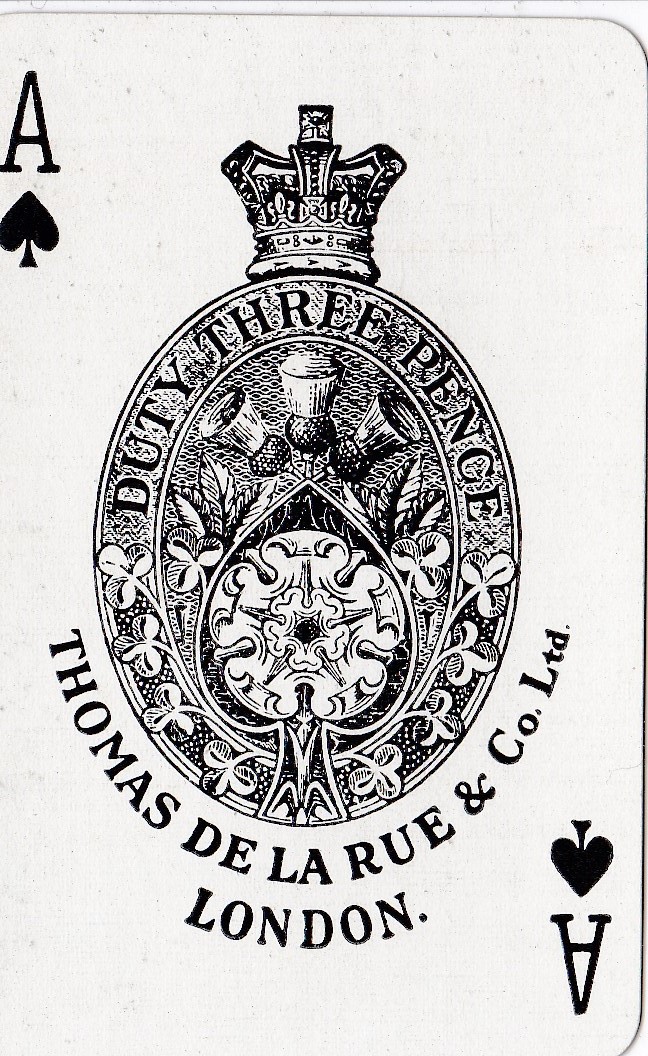
An ace of spades from the 1800s, complete with the royal duty stamp. With thanks to Wikimedia.
The timeline
The forerunners of the playing cards we’re familiar with probably originated in China, somewhere around the ninth century, along with the technology–I believe we’re talking about paper here–to make them. A century later, people were using them to play a game that involved shuffling and dealing. Add another four centuries, give or take a few weeks, and cards had made their way to Europe, landing either in Islamic Spain or in Italy by way of India or the Middle East.
Or landing in some other European country by way of some other intermediary.
I know, it’s a burning issue, but it doesn’t seem to have been well documented.
By this time, cards would’ve taken on a form we’d recognize: suits, royalty, competition, money. And they’d have been the hot item among the aristocracy, which is where they stayed until Gutenberg ruined the fun by making them available to folks several steps down the economic ladder.
Have you ever wondered why it’s the economic ladder but the social scale?
The tax
Once cards were mass produced and in the hands of ordinary people–well, Elizabeth I’s government was in need of money (it’s a habit monarchs haven, and their governments along with them) and in 1588 someone came up with the idea of taxing playing cards. Why not? They existed, people bought them, so they were taxable.
That worked well enough and in 1710 the tax went up. A cheap deck now cost roughly 12 times what it once had, and an expensive one 1.5 times the old price. Or that’s what the article I’m leaning on here seems to be saying. It’s less than perfectly worded, but even if I’m off a bit we can understand that they’d created one hell of an incentive for someone to dodge the tax.
So what’s a government to do?
First, they made the manufacturer, not the buyer, responsible for paying the tax. Then they made it illegal for them to print the ace of spaces. That privilege was reserved for the government.
Have you ever noticed how much more elaborate the ace of spades is on some decks than any of the other cards? That was to make it hard to forge.
So manufacturers printed their decks, as you’d expect, only without the ace of spades, and off they toddled to the tax office–also known, just to confuse things, as the stamp office–with paper to match the other cards in their decks. The tax office would then print the ace of spades, using an expensive technology, engraved metal plates, that wasn’t widely available. The manufacturer would buy the printed aces from the government, add them to the decks, and off to market they went. The tax was in the government’s pocket before the manufacturer got out the door.
As time went on, the aces became more elaborate to make them harder and harder to forge.
In the 19th century (if I’m piecing my sources together correctly), the system changed. Manufacturers now needed a license, and a legal stamp incorporating the royal coat of arms had to go on every ace of spades, which was called the duty card (or the duty ace, or Old Frizzle). A regulated label had to go on the deck’s wrapper.
This whole rigamarole meant that the manufacturers of playing cards spent a fair bit of time traipsing in and out of the stamp commissioner’s office, or sitting around their own offices waiting for the commissioner’s office to deliver the stamped duty cards.
But let’s say they didn’t bother getting licensed. Let’s say they forged the brass stamp that printed the ace of spades and made a counterfeit wrapper for the pack of cards. Looking on the bright side, they’d saved a lot of money in taxes. On the flip side, though, forgery had been a capital offense since 1805.
With that threat, everyone stayed in line, right?
Of course not or I wouldn’t have asked.
Take the case of Richard Harding, a licensed card maker with two shops. He had a good business going and at some point the stamp office noticed that they hadn’t seen as much of him as they would’ve expected, so they sent out an investigator, who bought six packs of cards and found forged aces of spades in all of them. So he went back and bought more, and more again, until eventually he had 90 packs of cards, all with forged aces.
Harding was, by the by, charging the market rate. A bargain would’ve raised eyebrows–not to mention made him less profit.
By this time Harding must’ve gotten nervous: one customer, 90 packs of cards, relatively short period of time. Hmmm. Could there be something here to worry about?
Well, yes, and careful soul that he must’ve been, when his home and offices were raided, not a forged ace was to be found. But the searchers poked around at the neighbors’ and eventually found 2,000 of them. And more again in his daughter’s house. (I’m guessing that’s Harding’s daughter’s, not the neighbor’s, but it was a long time ago, so what the hell, we’ll just go on.)
Buried in the yard, they found the printing plates he’d used to forge the aces.
How had he managed to print aces of spades convincing enough they didn’t raise the alarm with ordinary buyers? First he approached an associate, a stone-seal engraver called Hugh Leadbetter, to make plates for him.
What’s stone-seal engraving? I don’t really know, but you can buy kits to carve with today. Then you can write and tell me all about it.
Leadbetter was reluctant, but Harding pushed him hard, to the point of locking him in a room with some tools and expecting him to magic up a skill he didn’t have.
The story rambles on until it includes a drunken engraver with shaking hands and Harding coming back to Leadbeater for help burying the plates that someone eventually made for him.
Harding was found guilty and hung, in spite of seven witnesses who swore to his good character. What happened to Leadbetter or the engraver with the shaking hands I don’t know.
The tax wasn’t repealed until 1960.


Fascinating. I didn’t know about this. It strikes me that the window tax must have been much simpler to administer, not to mention that it’s hard to forge blank walls.
LikeLiked by 1 person
When I first heard about the window tax, I had real trouble taking it in. Windows? Tax? Are you sure? I’m not sure why taxing the ace of spades gave me any less trouble, but it did.
LikeLiked by 1 person
Excellent ! Such a lot of history in such a mundane object.
LikeLiked by 1 person
Absurd, isn’t it, and at the same time completely natural how everything in our lives has a history?
LikeLiked by 1 person
Another damn fine telling of a tale. :D … seriously, you need to bundle up these histories into a book, and sell it. You could make a motza, minus the taxes, of course! :D
LikeLiked by 1 person
I did try, early on, and was told the MS was too episodic to work. Thanks for the thought, though.
LikeLike
Can you imagine how much cheaper it would have been to live in England/Britain if they’d stop going to war and trying to colonize everything? And there wouldn’t have been so many people hung for trying to evade the taxes.
LikeLiked by 1 person
Well, there is that, but they also came out of all those wars immensely rich. I know, I know, the government also needed money, always, but colonization is big business. It’s how Europe became the dominant region, although it’s going into eclipse lately. There’s money to be made. The trick is to get someone–preferably someone who isn’t getting rich and therefore powerful off it–to pay for the inevitable cost.
She said cynically.
LikeLiked by 1 person
There hangs Harding – seems that he was used as example.
LikeLiked by 1 person
All told, not a happy story.
LikeLike