
Every so often, somebody starts a campaign to run some non-native plant out of Britain. With a few, that makes sense–when they got loose in this new climate they turned hazardous, choking out native growth, growing through the foundations of houses, running for parliament so they can run other non-native plants out of the country. But setting those few aside, the rest of it, I suspect, is about returning Britain to some imagined state of purity.
But what really is native? For the sake of simplicity, let’s stick with food.
This comes with a warning: The further back in time we go, the sketchier the notes people left behind. So I can’t guarantee 600% accuracy. Take it–as is appropriate for food–with a grain of salt.
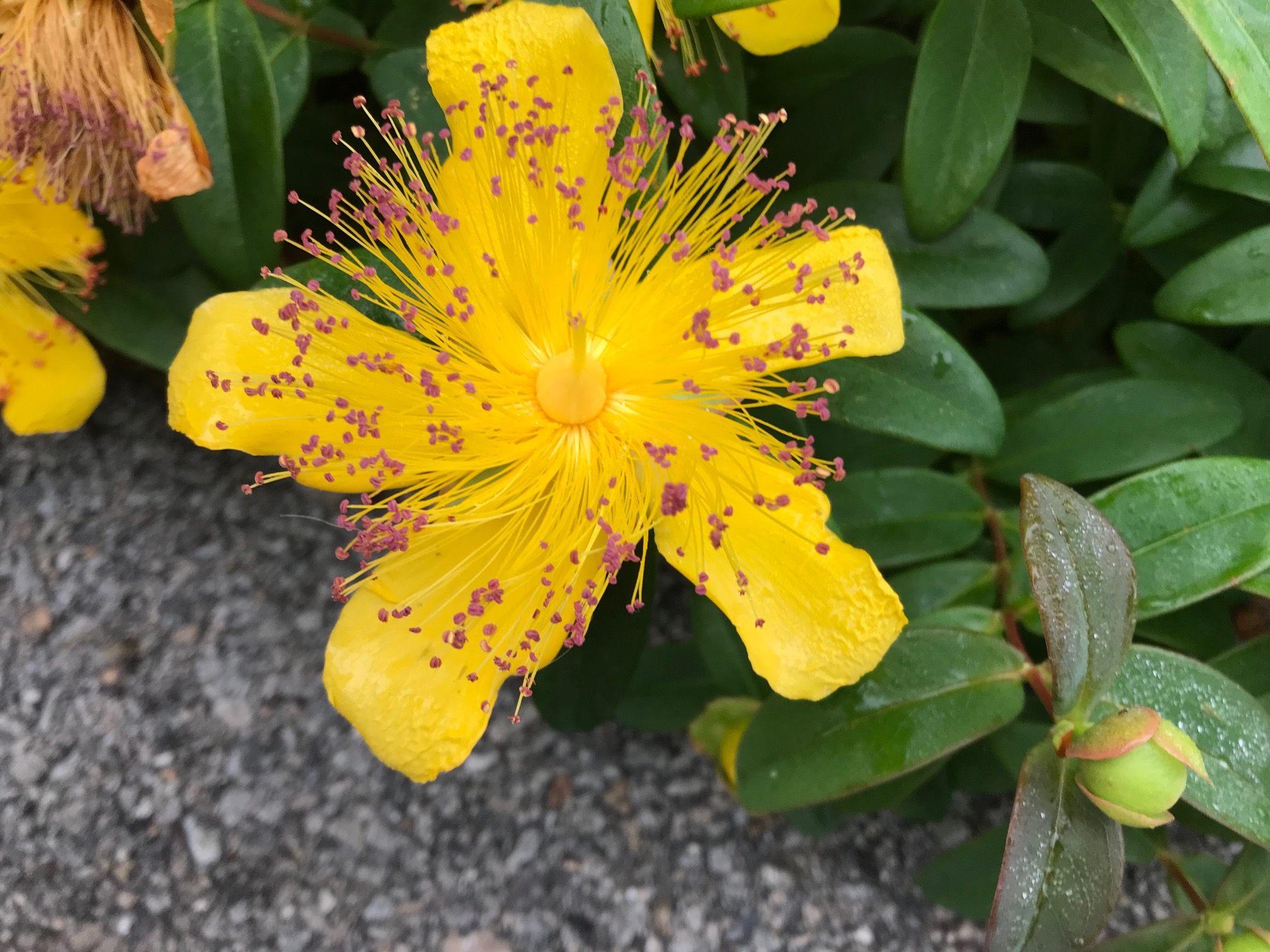
A rare relevant photo: St. John’s Wort, which isn’t used as a food but is traditionally medicinal. It’s native to Britain but a couple of varieties were introduced in the 17th century. So it’s native but also not. Nothing’s ever simple, is it?
Imports
The first chicken bones show up in the Bronze Age–around 800 B.C.E. That makes them–not to mention their eggs–foreigners.
The Romans (start counting in 43 C.E.) brought rabbits, pheasants, and brown hare (not to be confused with brown hair, which was already present). Also cabbages, leeks, onions, garlic, basil, thyme, turnips, walnuts, and grapes. And alexanders, which went wild. Foragers still eat them and everyone else pretty much ignores them. They’re sometimes called wild celery.
Incomers, the lot of them.
As an aside, by the time we get to the medieval era, cabbage was peasants’ food and not fit for the upper classes. It was thought to cause melancholy and nightmares but also to cure drunkenness.
According to one source the Saxon word for February was Sprout Kale–the month when the cabbages sprout. If you’re not a fan of kale, you can blame it on the Saxons. It won’t be fair, but it’ll keep your mind off worse things. (Another source says it was April, but it’s outvoted. Let’s go with February. It’s shorter, and I’m not a big fan of kale.)
You won’t find sugar until 1099–or at least you won’t find it mentioned until then–and for a long time it was the wildest of luxuries. From the 12th century through the 15th, you’ll find monasteries cultivating apples and pears. Or you’d find them if you could get back there. They would’ve been luxuries.
Turkeys and rice showed up in the Tudor period, and potatoes, corn, and tomatoes didn’t arrive until Europeans started bothering the New World.
Beets–or as the British call them, beetroot–probably came from the Mediterranean. Broccoli showed up around 1700, chocolate bars around 1847, and baked beans in 1886.
Yes, I did switch from raw ingredients to processed food. You’ve got to keep an eye on me every minute. I’ll pull a fast one on you every time.
Native foods
Wild carrots do grow in Britain and as far as I can untangle things they’re native, but a foraging guide describes them as tough and stringy. You’d want to put these in stews, not eat them raw. The plant they come from is also called Queen Anne’s lace and looks a lot like hemlock, which is toxic, so I wouldn’t recommend munching your way through the hedgerows hoping to figure out which is which.
Cultivated carrots seem to have wandered into England in Elizabethan times, so they’re not exactly native. Emphasis on seems. I got that from a site whose information appears to be solid but whose writing is murky.
Peas? Probably native, although some people argue that the Romans brought them.
Of course, someone out there would surely argue that the Romans brought Nintendo. I’d make the argument myself, but I’m trying to keep this brief.
Cultivated peas are related to vetches, a category of wildflower that does well in Britain without human interference. The early ones would’ve been smaller than the peas we know, and probably bitterer. And if we’re to judge from that last adjective, harder to pronounce. The best thing to do with them would’ve been to put them in pottage–something eaten widely in medieval Britain and varied enough that if you think of it as anything that can be tossed in a pot and cooked with liquid, you won’t go too far wrong.
It’s not until you get into Tudor times that peas become sweeter and the elite start eating them as a delicacy.
Oats, rye, wheat, and barley are all native. As is brewing alcohol from at least some of them and getting shitfaced.
Native fruits would’ve been small purple plums, sloes, wild currants, brambles (that means blackberries), raspberries, wood strawberries, cranberries, blackberries, redberries (no idea what this is; they’re probably red), heather berries (Lord Google tells me they’re edible but nasty), elderberries, rowan berries (edible if cooked; toxic when raw), haws, and hips (that’s probably rose hips). To summarize, the native fruits ran the gamut from delicious to nasty.
The wild apple, crabapple, and cherry would might have been rare or absent, although the British apple seems to have predated the Romans. You notice how much of a workout the word probably is getting? Not as much as it should’, I expect.
We haven’t talked about the nuts and leaves, but let’s skip them, okay?
 Notes from the U.K.
I once sent some poppy seeds to a friend in Germany and deeply regretted it afterwards after someone told me that I could inadvertently bring about a new Ice Age. Never again. U.K. seeds to U.K. places only!
LikeLiked by 1 person
A new ice age? Maybe you could send just one seed and it would counteract global warming?
LikeLiked by 3 people
It’s too late. I already sent hundreds. 🤦♀️ But my friend is still alive and Germany hasn’t flooded, so I guess it’s ok?
LikeLiked by 2 people
I think we dodged that particular bullet, then. May we be as lucky with the rest of the ones that are whizzing around.
LikeLiked by 1 person
One little seed is like the last block of ice causing an avalanche apparently! Haha thanks for sharing
LikeLiked by 1 person
It’s true. Some of those little seeds that were brought to Britain (and to the US, for that matter) have gotten into their new climate and become real pests. Indian balsam comes to mind.
LikeLike
I believe it! Thistle is a real problem in my own community. At the farm I work at, it’s a real problem because the cows hate it and won’t eat it. Not to mention, they really hurt my skin when I walk through the fields.
LikeLiked by 1 person
Are they native do you know? Or did they hitch a ride with something that was imported?
LikeLike
It is originally from Europe!
LikeLiked by 1 person
Oops, sorry, just found this after responding to your other comment. There’s nothing like reading your mail in reverse order.
LikeLiked by 1 person
So they are imported because I’m in north america
LikeLiked by 1 person
I just consulted Lord Google, who tells me (after a very superficial search) some species are native to North America and some are imports.
LikeLiked by 1 person
Interesting! I’ll have to take a closer look at what we have in our field to tell
LikeLiked by 1 person
It makes you wonder what people ate before the Romans arrived. There must have been food, but perhaps they did just survive on meat, fish, grains and berries with the odd bit of greenery.
LikeLiked by 1 person
Well, there would’ve been plenty of nettles–cook them even briefly and they’re edible. Anyone who’s lived here long knows they’re plentiful, although they’d’ve been hell to pick. Dock, I think is edible. I saw that at roughly the point where I decided enough was enough. The problem is that vegetable matter doesn’t leave archeologists much to work with. They can find animal bones and the remains of nuts, but beyond that, the record’s blank. So we have some sketchy evidence on what came in but not much on what was already here.
LikeLiked by 1 person
I think I was very young when I discovered the difference between edible and tasty. There’s probably as big a gap between edible and nutritious. Whatever they ate, it was obviously enough to keep them alive.
LikeLike
Interesting revelation for a kid to have–and I expect you were an interesting kid. A relevant scene from I’ve-forgotten-which-novel set in England not long after the war has stayed with me. Two people are eating a badly cooked meal, but all either of them expects of food is that it fill them up, so they’re fine with it.
LikeLiked by 1 person
We used to eat liver and bacon pudding, which had more liver than bacon and was in a tasteless suet crust. I seem to remember that very tough kidneys featured in our diet as well.
LikeLiked by 1 person
I have–once each in my lifetime–tried both liver and kidneys. Neither of them made me want to try them again. I’m grateful that I had the leeway to eat something else instead.
LikeLike
You’re very fortunate. In our house you could tell which day of the week it was by what we ate.
LikeLiked by 1 person
My mother wasn’t–as she’d have told you herself–a great cook. Or even a particularly good one. But I don’t think the idea of cooking the same thing every day of the week never crossed her mind.
LikeLiked by 1 person
We didn’t have the same thing every day, just the same thing every Monday, every Tuesday, every Wednesday, etc. Thursday was casserole, as that was the evening Mum went shopping after work and she could stick it in the oven before she went and it would be ready when she got back.
LikeLiked by 1 person
Apologies–I realized some while after I answered your comment that I hadn’t said what I meant. I did understand you, I just fumbled my answer.
LikeLiked by 1 person
I’ve probably brought back your own childhood traumas with food. My mum wasn’t a good cook either.
LikeLiked by 1 person
My brother and I both ended up liking to cook. My mother’s theory was that it skips generations. Is that true in your family?
LikeLiked by 1 person
My sister’s a good cook. I can be if I try.
LikeLiked by 1 person
There you go. A small and pointless survey reports the 100% accuracy of my mother’s theory.
LikeLiked by 1 person
Liver is one of those things that must be cooked right. I mean, you can screw up a steak and it’ll still be reasonably palatable – just add gravy. But liver is either thoroughly nasty or unbelievably delicious. I love it!
LikeLiked by 1 person
If the opportunity ever comes up, you’re welcome to my share.
LikeLike
Maybe one of the reasons cabbage was blamed for melancholy was that it cured drunkeness.
Some of these foods remind me of my Uncle Ira’s recipe for preparing carp;
Nail carp to board.
Leave out in sun for three days.
Discard carp. Eat the board.
LikeLiked by 2 people
I think I’d have liked your uncle.
I did wonder how many people wanted to trade a good drunk for a bout of melancholy. It doesn’t sound like a good exchange, but since medieval medical beliefs weren’t a single coherent body of thought, it’s also possible that the two beliefs led entirely separate lives and never met until much later, when no one believed either of them anymore.
LikeLike
I once learned that the introduction of sugar brought a new (and fortunately, short-lasting) trend to England: black teeth! Since only the very rich could afford sugar at the time, they were the only ones that benefited from rotten teeth… To emulate this rich-only fashion, other would be fashionistas just darkened their teeth artificially. Go figure!
LikeLiked by 1 person
We are truly a baffling species.
LikeLiked by 2 people
And sadly, this is not the strangest thing about us … by far :)
LikeLiked by 2 people
Sigh.
LikeLike
Sounds like people started eating a lot better once the Romans arrived. Guess that makes sense since they had access to so many other cultures.
LikeLiked by 1 person
It does sound that way, but I wonder if it isn’t misleading. Once the Romans arrive, we start getting documentation. Before that, all we have is the archeological record plus a bit of rumor, and vegetables don’t leave much trace behind. From everything I’ve read, early Britons had considerable contact with Europe, but we don’t have much in the way of detail.
LikeLiked by 1 person
Good. The Romans get entirely too much credit for civilizing everything. :)
LikeLiked by 1 person
Good point. Here we are, 2000 years later (give or take a few months) and we still fall for their PR.
LikeLiked by 1 person
Oh Ellen, reading through I’ve been waiting for mint peas! Then again, they don’t come out minty by themselves … The glory of British cuisine
LikeLiked by 1 person
That’s a strange enough combination that I’ve never brought myself to try them. But then, I’m not a big fan of mint. What do you think of them? I’m pretty sure you’re right about them not getting mintified by themselves, but if they did we’d have something to blame them on.
LikeLiked by 1 person
Don’t try them, it’s really odd
LikeLiked by 1 person
Consider me convinced and thanks for the warning.
LikeLike
I never knew what a St. Johns Wort looks like, other than in the vitamin aisle of the drug store. It’s very pretty!
LikeLiked by 2 people
It is, and when the flower dies and the seeds–or berries or whatever they are–come in, they’re equally pretty. Great plant.
LikeLiked by 1 person
I understand there’s a carrot museum in Belgium.
I thought that worth mentioning
LikeLiked by 1 person
Oh, absolutely. And there used to be a dog collar museum in–um, Britain somewhere, but by now I’ve forgotten where. For years, we used to see a sign for a paperweight museum outside Plymouth but the sign’s gone now so I assume someone packed up their paperweights and took them home.
LikeLike
Aside from food, I just posted about skunks and I had a reader from England ask what it smelled like and was it really that bad? It was then I realized that skunks aren’t native to the UK–lucky you!
LikeLiked by 1 person
At a rough approximation, badgers times 12.
LikeLiked by 1 person
Oh, do badgers spray too?
LikeLiked by 1 person
Not as a defense, but they do leave a hell of a smell behind. Maybe it’s where they pee–I’m not sure. So let’s say a badger with an offensive weapon. Times 12.
LikeLiked by 1 person
Wheat isn’t native I’m afraid. It was imported about 8,000 years ago!
Now, if folks want to go back to truly native foods— bring back the Mammoth!
LikeLiked by 2 people
8,000 years ago? Run it out. But what I expected you to say was “bring back the Marmite.”
LikeLike
There might be little hairy, small-eared mammoth babies being raised by elephant moms, before 20230. They won’t be pure mammoths, but as close as they can get with genetic technology. They’re going to be tried in the arctic to try to maintain the tundra to fight global warming. It’s thought humans hunted them to extinction, so if we hadn’t they might have still been here. A dig site in Montana analyzed the remains of a child and found at least 40% of her diet was mammoth, the rest was mostly other large game with very little small game and very little plant matter.
LikeLiked by 1 person
Interesting. I’ve only bounced along over the surface of this, but I have the impression that many of the vegetables we take for granted are the result of humans messing around with the plants until they produced something that tasted better and grew more abundantly. The era you’re talking about wasn’t a good time to be a vegetarian.
LikeLike
The proportions in that child’s diet were probably similar to the traditional Inuit diet.
I look forward to seeing baby sort of Mammoths!
LikeLiked by 1 person
Given the difficulties of keeping the species we have alive, I’m not convinced by the logic of bringing any back, but since no one’s consulted me (she said in a sulky voice) I’ll wait and see what happens.
LikeLiked by 1 person
I’d a boyfriend briefly who only ate as fuel – he’d absolutely no interest in what stuff tasted like. I suspect he’d be fine with nettles, so long as they came ready for the microwave. Weird…
Our neighbour’s boxer’s pee sounds like it could compete with a badger. It permeates even closed patio doors. Mind you, it’s been going just inches from our patio… It doesn’t anymore, after I lost my cool & used colourful language to express my views. Shame – I really like boxers, and would love to play & fuss this one – it just the owner’s an ass.
LikeLiked by 1 person
I don’t think I’ve ever known anyone who approached food that way. Makes me wonder what other pleasures he couldn’t pick up on–but maybe that’s unfair.
The dog: Yup. It’s a pity that some dogs come with humans attached.
LikeLiked by 1 person
No, not unfair at all. It’s exactly the reason why he was only a boyfriend briefly.
LikeLiked by 1 person
Very wise of you.
LikeLiked by 1 person
Such a fun read. Your wit made it so appealing.
LikeLiked by 1 person
Thank you. That cheered up a cloudy morning.
LikeLike
The most important non-native food to hitch a ride to England? Indian food. I get some every time I’m over there.
LikeLiked by 1 person
I’ve always been told that there’s nothing more English than a curry, so I guess you’re onto something.
LikeLiked by 1 person
Yoza
LikeLiked by 1 person
Never knew that’s what St. John’s Wort looked like…it’s beautiful 😊
LikeLiked by 1 person
It is, both when it’s in flower and when the seeds develop.
LikeLike
Fascinating! As someone from New England, it is interesting to see this perspective.
LikeLiked by 1 person
It never ceases to amaze me how people seem to think that what they recall from their childhood defines their sense of ‘normality’. Life existed before you did: get over yourselves, people!
LikeLiked by 1 person
Don’t be silly: Of course it didn’t. I’m older than dirt. Avant moi, zilch.
LikeLiked by 1 person
I lived in England for two years and best thing I liked is Fish and Chips, probably Yorkshire pudding too.
LikeLiked by 1 person
I think scones would be at the top of my list.
LikeLiked by 1 person
The best way to control some of these invasives is to eat them – take Himalayan Balsam, for example. Delicious seeds, taste like tiny walnuts. Japanese knotweed is also edible when very young.
LikeLiked by 1 person
They’ve been on such a campaign to poison Japanese knotweed that I’d be afraid to run around sampling it. but it’s a good point. Just get people eating it and–
Well, hold on. I don’t think that’s cut down on the number of blackberry plants growing wild in the country. We may need to convince people that eating it will make them young, beautiful, and strong. With wings.
LikeLike
Well, your’e right there. The blackberry is cunningly using us to propagate itself anyhow. If they’re here, we might as well make use of them though. I green about being careful – I don’t trust Monsanto that glyphosate is edible!
LikeLiked by 1 person
The blackberry’s plan, I believe, is to take over the world, and I’m pretty sure it’ll succeed. When I read that the British tribes who fought the first Roman invaders fought naked, I can’t help thinking about blackberries and wincing. As far as I can figure out, every plant that’s native to this country has thorns.
I’m with you on Monsanto and that stuff I can’t type reliably.
LikeLike
as to your subject, it’s like we as a nation are terrified of change – plants are going to adapt or go extinct, things are always changing. Though faster due to humanity. Take signal crayfish for example! Tasty though…
LikeLiked by 1 person
This is one of those topics I’m on both sides of. Some plants (and animals, while we’re at it) really do turn monstrous once they get loose in a new ecosystem. Others fit in very nicely and after a few generations no one remembers that they’re not native. I’ve heard purists argue for the extinction of one plant or other because it’s not native, but they usually focus on one or two species, forgetting how many others are also imports.
LikeLike
I guess it’s all about how long said plant has been around for. It’s the same with races of people who have immigrated!
LikeLiked by 1 person
It’s amazing the things people can believe if they want to.
A few historians are doing some interesting work uncovering how long Black people have been living in Britain, driven in part, I think, by the claim that native Britons are white and always have been. So we go back to the Roman soldiers, who were drawn from all over the empire, and to an assortment of Black people who show up in Tudor documents. We go back, for that matter, to Cheddar Man–an ancient skeleton found in a cave in Cheddar–whose DNA was recently sequenced (apologies if you already know this) and who turns out to have had dark brown skin and blue eyes and whose DNA is still running around in people living in the area today.
LikeLike
Interesting..thanks for sharing
LikeLiked by 1 person
It’s weird to leave a comment on my own blog, but this comment came by email and it’s well worth reading. I’m not sure whether the writer wants her name here, so I’ll leave it off for now:
Brilliant.
But in ignoring nuts you missed out on a major ingredient of nutella. Hazelnuts. These trees were growing in the wet north west of England by 10,000 BCE. Pollen was found at the excavation site of a young Elk near Carleton in the Fylde.
But the shells of these are found all over the place at other mesolithic sites. E.g. https://www.bbc.com/news/uk-scotland-highlands-islands-34604576
One archaeologist even suggested somewhere that so many shells were found in middens that maybe the nuts were ground into a paste. Shame they had no chocolate.
Anyone who went blackberrying back in the 1950s as our family did along with others on Sunday afternoons can confirm that finding a sweet berry in the hedgerows was rare. They were mostly small and a bit tart. Best esten stewed with added sugar.
Thats why Mesolithic people in more northern climes at least appear to have eaten mostly fish and meat.
LikeLike
Those Romans were as sadist as the Minoans- probably the same people.
LikeLiked by 1 person
As far as I know (which isn’t all that far) they weren’t the same people, but there was plenty of sadism to go around, so I doubt they had too be.
LikeLiked by 1 person
A diet of mangleworzels and berries, not very appealing, so they probably ate lots of pork in all its forms.
LikeLiked by 1 person
Well, the berries don’t sound bad….
LikeLiked by 1 person
Carrots ?
Don’t they come from the Middle East?
LikeLiked by 1 person
One source says they were domesticated in Persia–now Iran–in the tenth century but came from central Asia. Another says they came from Iran but were domesticated in Asia, which is kind of a big place. Europe began eating them on in the twelfth century.
LikeLike
the combo of carrot and raisin definitely features in Persian and north Indian cuisine
LikeLiked by 1 person
And a fabulous one it is.
LikeLike
We’ve had our garden for three years and are still struggling with brambles, hazel and laurel. I’m not sure if laurel is a native (I doubt it) but all are spread by wood pigeons and grey squirrels, the brambles by root and tip as well. The naive/non native argument is already lost, I think, as it’s not really going to be possible to uproot every bit of balsam, for instance. In any case, climate change will probably encourage some plants and animals and see off others, so how can our efforts make much difference at this point? Muntjacs are a real, imported, nuisance in our bit of England. As for what people ate in the dim and distant, I suspect that vegetarians wouldn’t have lasted long and as for vegans, no chance.
My opinion of the Romans, for what it’s worth, is that they were a sadistic, warmongering people who also happened to be good engineers and administrators. (Not that they’re unique in that).
LikeLiked by 1 person
I agree about the impossibility of going back to native species–especially since we’d have to figure out how far we want to scroll back. It’s a fantasy. And I do remember reading about a group of people who were trying to live like early people of I’m not sure what era. The vegetarians, as you guessed didn’t do well and dropped out.
As for the Romans, conquering other countries doesn’t seem to bring out the best in anyone.
LikeLike
I enjoyed the post. Would you hadn’t skipped the nuts and leaves.😉
LikeLiked by 1 person
Nuts definitely. Leaves–well, I was going to say I couldn’t think of any then came up with two, nettles and scurvywort. Good point.
LikeLike
Rhubarb is from the far East, brought by Romans.
LikeLiked by 1 person
Trying to figure out what’s native and what isn’t is a slippery business. How far back do we go before we decide something’s native? How much human agency has to be involved for something to be an import? However we define it, though, the Romans have my gratitude for the rhubarb. Wonderful stuff.
LikeLike
I knew the Romans had Nintendo!
LikeLiked by 1 person
Well of course they did. Anyone knows that. What do you think they did on those long, dark winter nights?
LikeLiked by 1 person