
The English have a way of bringing almost anything back to class. Or maybe that’s not just the English but the British in general. Or–you know what? Let’s not worry about it. Let me give you an example to take our minds off the problem: I was walking dogs with a friend and when the time came to pick up after my pooch I tore a patterned plastic bag off a roll that was meant to fit inside a pickup pouch but had escaped.
“Very posh,” my friend said, and she showed me the greenish diaper bags she used, which at the time sold for–oh, I think it was 12p for hundreds of the things, or to put that another way, not much.
I explained that someone had given us (us being my partner and me) the pouch, along with the bags. Not having had kids–in this country or any other–I was a stranger to the greenish diaper bags and asked about them. I’ve used them ever since, although they left that 12p price tag in the dust long ago.
My point here is that this is a country that can even take dog shit and make it about class.
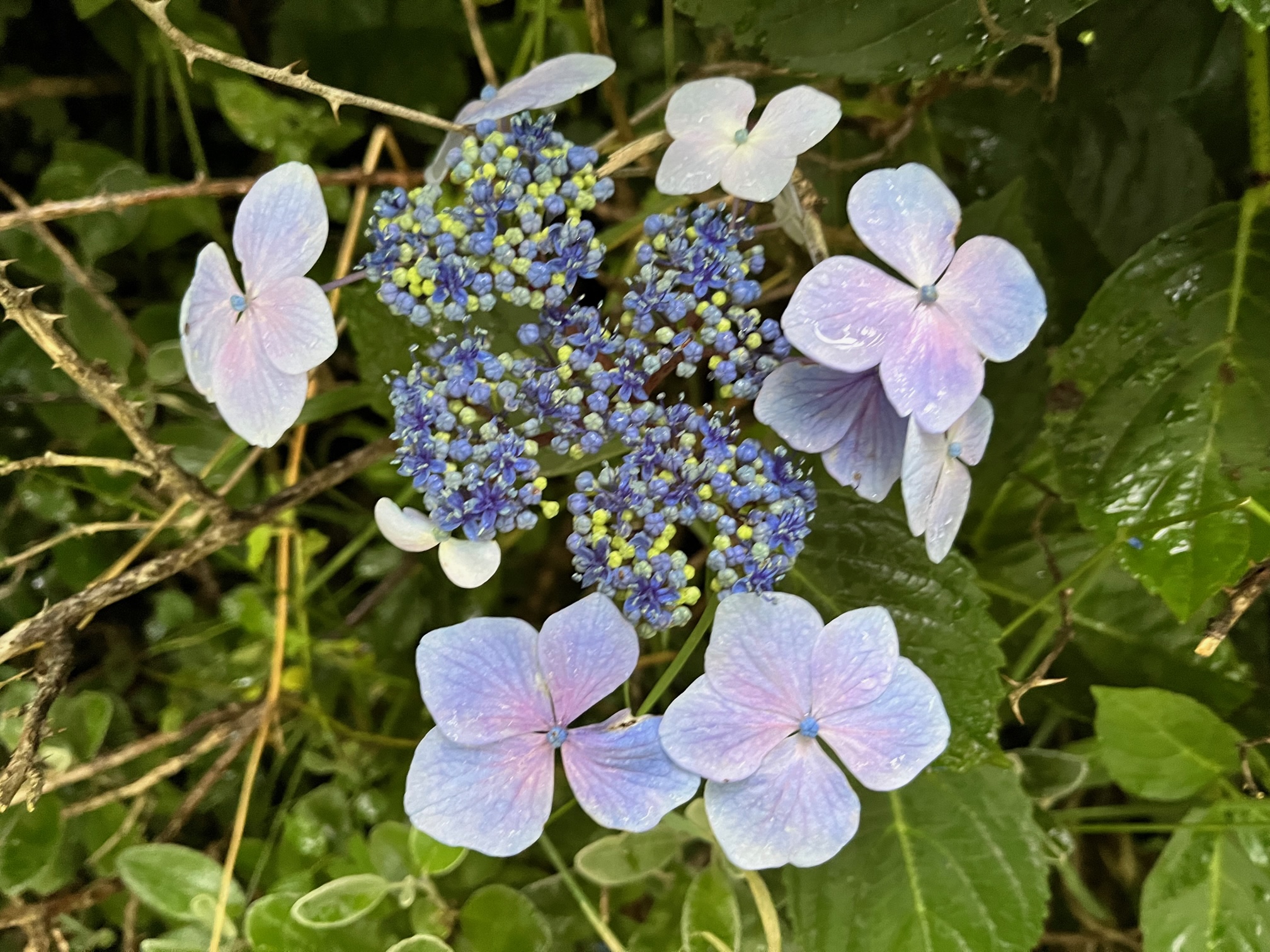
A rare relevant photo: a kind of hydrangea that someone once told me is posh. The more enthusiastic mopheaded kind are, apparently, just too much color for the delicate sensibilities of an aristocrat.
So what does posh mean
For the sake of my beloved fellow barbarians, let’s define posh. The Merriam-Webster Dictionary defines it as “elegant or fashionable.” The Collins Dictionary (enough with the links; you don’t really care, do you?) adds “expensive” and the Urban Dictionary tacks on “aristocratic.” People tell each other that the word stands for port out, starboard home, which was shorthand for the best cabins to have if a (posh) person was sailing from Britain to India and back again. They were the ones that get the morning sun and would be cooler in the evening.
The problem is, no one’s found any evidence to back up that origin story. The passenger line that’s supposed to have stamped P.O.S.H. on the more expensive tickets actually looked in its archives and came up with nothing. And cabins were numbered. They weren’t likely to have been identified as port and starboard.
Another theory holds that it was university slang from the turn of the last century, which isn’t nearly as far in the past as it ought to be. That makes a kind of intuitive sense, since university educations were, with rare exceptions, reserved for the rich, but there’s no evidence for this origin story either.
So let’s file them both in the Urban Myth folder and settle for the origin having been lost.
What do posh people do?
I’m not the person to know, thank all the gods I don’t believe in, but in 2017–which is nowhere near as long ago as the turn of the last century–Tatler came up with a list of phrases that it claimed posh people used. I’d quote them but they make me a little queasy and they sound suspiciously like a satire from the 1920s, so I can’t help but wonder if the magazine’s messing with our heads. You’ll have to look them up for yourself.
Still, the fact that someone saw fit to make a list and the magazine saw fit to publish it, for whatever reasons, testifies to how important it is for the in group to create a code so they can spot the people who don’t belong.
I’m over here, guys, and yes, I am laughing at you. Furthermore, I use greenish diaper bags to pick up after my dog these days. So my reporting is distinctly third-hand. Take it for what it’s worth. But in 2019, Tatler published a list of what was in and out among the posh, and it turns out that the word posh is non-posh. Or as they’d put it, non-U.
U? That stands for upper class, and I learned that from an undated BBC article that also tells me that latte (you know, the fancy coffee with warm milk) is non-posh, along with brand names and Americanisms.
But let’s go back to Tatler’s do-and-don’t-do list, which is kind of boring, really. Posh people eat fried eggs. They eat bread. They say no. (Seriously. It’s on the list.) If those are the hints we get for telling the posh from the non-posh, they’re going to find themselves–horrors–melting into the herd.
But not all hope is lost. What non-posh people do is more telling: They wear makeup outside of London. No gender’s specified, which takes us into a whole ‘nother set of groups and distinctions. Personally, I don’t wear makeup inside London either, but then I’m not the point here, am I? They use the word posh. They use (or maybe that’s talk about) iPads. They eat dips. They–well, maybe this isn’t about individuals here. It seems the entire southeast of England is non-posh, so I guess they go there or live there or acknowledge its existence.
All of France with the exception of Paris is non-posh.
It’s almost too easy to make fun of this stuff, but the attitude behind it is real–and thoroughly horrifying.
 Notes from the U.K.
It is indeed real and kind of horrifying, but don’t let that stop us making fun of it. And of them (the ‘U’s’), more to the point.
LikeLiked by 1 person
Oh, absolutley. It would be ungrateful to pass up such an inviting target.
LikeLiked by 1 person
…not to mention such a worthy one.
LikeLiked by 1 person
Worthy indeed, Ellen!
LikeLiked by 1 person
I think ‘oop north’ here, posh stands for people of southern hereditary.
LikeLiked by 1 person
Oh, ouch. You guys don’t take any prisoners, do you?
LikeLiked by 1 person
Class divisions are basically a form of racism. To believe that the class you belong to is superior to the classes beneath you. This is a major problem with society in general and in politics. This goes back to tribalism. The world will never be at peace until this problem is eliminated. Can it be or is it just human nature? Keep pointing out the ridiculousness of these divisions which helps!
LikeLiked by 1 person
I’m sure we could split hairs over whether it’s a form of racism or something different but similar or–hell, some variation on that, not to mention whether tribalism is necessarily the same as conflict with other tribes. Sorry. I was brought up in a tradition of political hair splitting. I can’t help myself. But bsically, yes: power, riches, exploitation of others and of our planet, contempt for others, an ideology that makes that not only natural but way it has to be.
I have no idea about human nature. We’re buried so deep in our cultures that I can’t imagine what it would take to unscramble our nature from our cultures. We do seem to be a difficult species but I hope we can salvage outselves.
Hmm. I seem to have gone serious on you there. I blame your thought-provoking comment. Thanks for sending it.
LikeLiked by 1 person
I am sorry I got so serious in your rather light-hearted post about posh! I could tell you my many life stories about class and racism but that would be a very long post. I have ties to England, India, and many other countries as well as growing up in the very racist US. Being a musician has broken down many class and race walls for me.
LikeLiked by 1 person
Joking aside, I appreciated that your comment got me thinking, but I do feel an obligation here to be at least mildly funny–and I can’t always do it. Hence my comment.
Any chance you’ll use your blog for those stories? They sound like they’d be worth telling.
LikeLike
I’ve always found the whole posh thing and class snobbery of England really annoying and pathetic. Maybe because Im antipodean so by nature “not posh”. The whole thing shits me up the wall. Thank you for so eloquently bringing it all to light in a funny and insightful way, I will never look at poo bags the same way again hehe
LikeLiked by 1 person
I’m honored to have had such an important impact on your life.
LikeLiked by 1 person
I have no comment to make, since I consider myself exceedingly posh. I actually advised Tatler about that list…
LikeLiked by 1 person
If you’re the person who told them that Jacob Rees-Mogg isn’t posh, then we’re all in your debt. He may not have made the international news, but he’s an MP who manages to present himself like some 1920s aristocratic twit. You can’t see a photo of him without experiencing a pressing need to slap him. Hard. Not hit–he’s too silly for that. Somehow it’s got to be a slap.
Anyway, apparently he’s not posh. I’m sure it just kills him. At least I hope it does.
LikeLike
At least Rupert Murdoch is pretending to withdraw somewhat from the scene.
Here in the USA we so see a bit of that. It is pretty good sport here for sniping among us to. Keep up the good work. (Does the US count as being “antipodean”?)
LikeLiked by 1 person
Not unless the US drifts into the southern hemisphere. It’s been drifting, but as far as I can tell to the right, not south.
LikeLike
If I ever find myself notably posh it’s entirely by accident. I’ve been blending in well lately though with the American Millennials new love of “Cottagecore” and “Dark Cottagecore” as my regular motif is that of a bog witch. My dog’s poop bags are a dreary industrial shade of grey.
LikeLiked by 1 person
Based on poop bags alone–not to brag, but I’m something of an expert on the topic–I’d say you’re safely non-posh.
LikeLiked by 1 person
Ha,ha,ha! :)
LikeLiked by 1 person
I don’t think I’m posh. Especially when i just kissed my dog and a rogue hair got in my mouth. I feel like I’m hacking up a furball right now. Could i be posh and still eat dip? I can avoid talking about my ipad. Seriously if people want to chit chat about posh people whatever. But when they assign attributes that are not evidenced, and follow them like sheep, well yeah that’s scary. And current.
LikeLiked by 1 person
Nothing I’ve read tells me whether posh people hack up hairballs or not. A lot of lived experience tells me that humans of all classes and cultures aren’t built to do that well but that humans (again, of all classes and cultures) have an almost unending ability to surpise other humans (of etc.). So, yeah, I couldn’t possibly comment on that.
Whether the Tatler article’s even remotely accurate I have no idea. It was written, I’m sure, magazines, possibly to raise an eyebrow and a laugh. It’s all pretty silly, and if it didn’t have such a toxic side it wouldn’t be a problem.
LikeLike
It’s not just about class-as-hierarchy: Kate Fox’x Watching the English points to an underlying social anxiety that prompts people to try and place each other, to identify common ground and whether they’ll fit together, though obviously it has a potential to exclude as well as include, both “upwards” and “downwards”.
The Tatler article (let me guess – by Phil Space?) is just another re-hash of what replaced old etiquette books. “U” and “non-U” came about in the early 50s – another time when social definitions and distinctions were in considerable flux – initially as an academic exercise, then rather more tongue in cheek when Nancy Mitford picked it up (maybe a good authority on what went on in her family, but not much more widely). John Betjeman wrote a poem to squeeze in as many supposed non-U solecisms as possibe (“Phone for the fishknives, Norman”).
As for the wod “posh”, it certainly sounds Victorian, and in George Grossmith’s “Diary of a Nobody” (1892), the character Mr. Murray Posh (heir to the family business of “Posh’s three-shilling hats”, i.e., well off but not quite as posh as he fancies himself to be) marries the girl hankered after by the narrator’s son (only a junior clerk in business, but fancies himself as an up-and-coming wizard in stocks and shares speculations). So the word was around in the 1880s as a marker, maybe of social aspirations that will never be fulfilled – the basis of so much British comedy.
LikeLiked by 1 person
I didn’t bother to notice who wrote the Tatler article and don’t think I’ll bother. Kate Fox, on the other hand, I would bother to notice. She’s wonderful. As for me, I’m happy to be excluded on the grounds of being an American from the class markers that matter so much here. Let people make what they can of me.
LikeLike
Wonder if they use those bags that are designed specifically for taking dogs to the park?
LikeLiked by 1 person
Some startling number of people here pick up after their dogs and then leave the bags on the ground. Or hanging in bushed, carefully attached to a twig. Maybe they’re designed for that on the theory that one should always look one’s best, even when hanging dog shit from a tree.
LikeLiked by 1 person
Good grief. That’s appalling.
LikeLiked by 1 person
I know. What are they thinking? I’ve seen the occasional sign telling them the dog poo fairy isn’t working just now so they should pick up after their dogs themselves. I doubt they help much but they do at least give the rest of us a laugh.
LikeLiked by 1 person
Yep, sadly, British class distinctions are alive and well, even for expats. The husband, who grew up working class (and whose fabulous accent identifies him as such) has felt the coldness from other expats whose accents identify them as something “better” than working class. It’s all very high school. I’m just glad I don’t have to stay up-to-date with everything that’s in and out. I really don’t give a damn and it sounds exhausting.
LikeLiked by 1 person
It is all very high school, only with heavy-duty real-world consequences, I’m pretty sure. I only keep up with what’s in and out if I feel the need to make fun of it, in which case I’d like to be mildly accurate, or at least have someone authoritative to blame if I’m not. I should say, though, that having learned that fried eggs are posh hasn’t put me off eating them. Eventually they’ll go out of style and I can eat them in peace.
LikeLiked by 2 people
I’m Franconian, you know, so I do not get what you poor people are chattering about.
LikeLiked by 1 person
That’s a piece of luck. Hang onto it.
LikeLike
I was born in 1954, and growing up in the 60s, was taught by my mother that you did not use the term “posh” it was very vulgar in itself. I came from a working class background, my mother slightly more middle class, but both parents were quite egalitarian in their views; no one was above anyone else. My mother had nursed during the blitz in London and said we all bleed, the same stuff comes out the other end and we all have the same body parts. It was also considered very vulgar to refer to someone as “poor” or “rich”, terms we never used, although you might say “wealthy” or “not well off”. There was more of a gentile working class in those days, very Ealing comedy, who were not snobbish at all, but would never have behaved in a vulgar way, mostly not to disturb anyone else or be a nuisance in life – very unlike today at times.
LikeLiked by 1 person
I like the attitude behind all that, although the logic of what’s okay and not okay doesn’t make sense to me. But the wisdom your mother took from nursing during the Blitz? That I understand completely. Hats off to her.
LikeLike