
Let’s re-write a bit of English history. Not because it doesn’t match our politics or the color of the couch but because some pesky historian’s gone and dug up new material, calling the old story into question.
The old story
If your history lessons included the Battle of Hastings (mine didn’t), you’ll have a kneejerk reaction to the date 1066, when Harold, last of the Anglo-Saxon kings, lost his crown–not to mention his life–to William, first of the Norman kings.
The way you will have been taught the story is that before Harold fought William he marched his troops way the hell north to fight off an invasion by a different Harald, Harald of Norway. The different spellings almost help a person tell them apart but you can call the second one Harald Hardrada if that makes it easier.
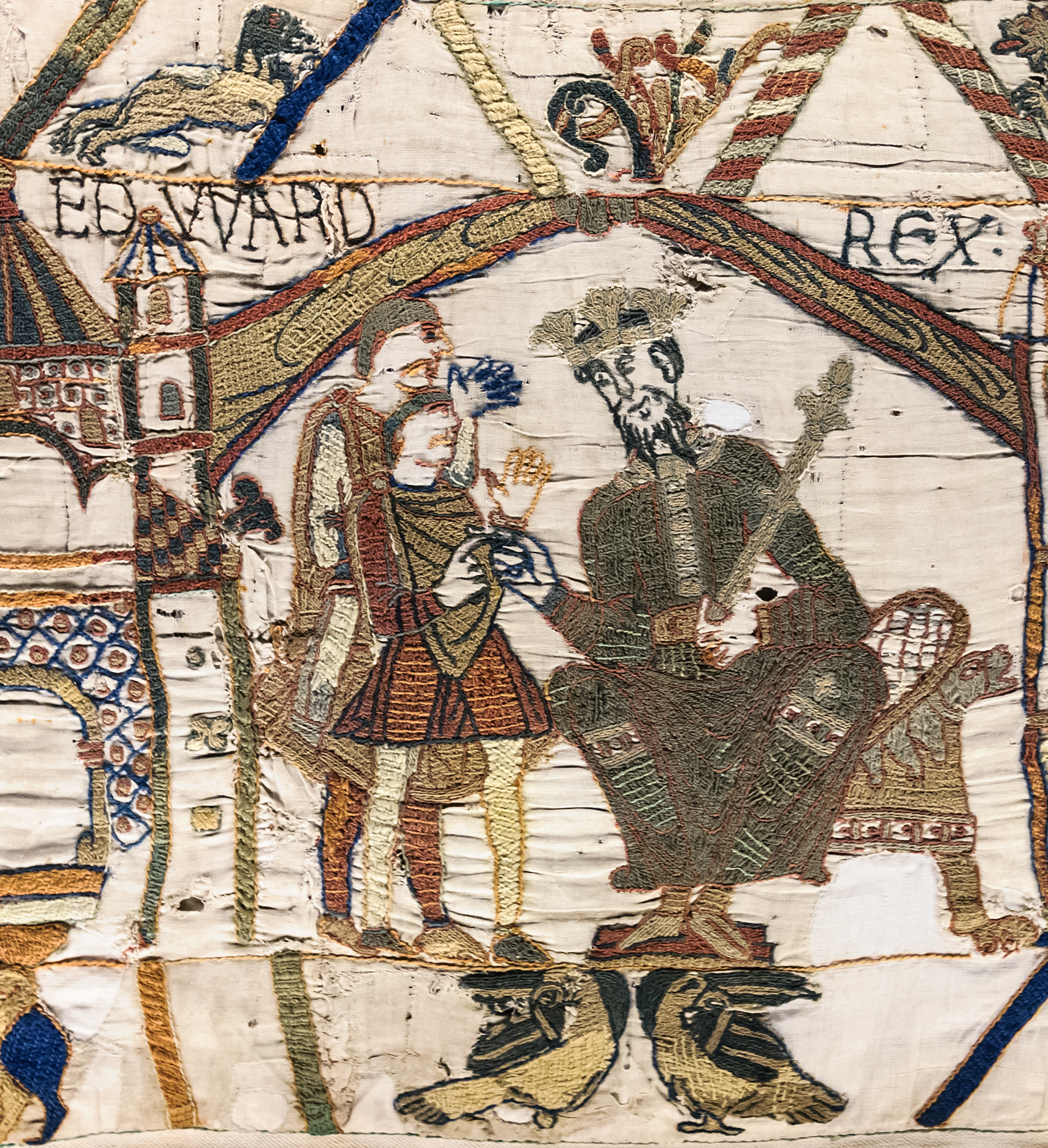
Edward the Confessor, as seen in the Bayeux Tapestry. He’s smiling because he won’t be around when the shit starts to fly.. He’s not mentioned in the post, but he–or at least his death and his lack of a son–are the backstory to the Norman invasion.
The English Harold beat the Norwegian Harald and got a minute or two to pop champagne corks and celebrate before he had to march his troops back down the length of the country to fight off a second invasion, this one by the Normans. So off they slog to the south coast.
By the time they got there, Harold’s troops were tired, they were crabby, and energy drinks were centuries in the future. Not even tea was available. So they lost the battle. End of England as an Anglo-Saxon country. Beginning of Norman England.
You can call that march an impressive bit of generalship or you can call Harold a damn fool for fighting William before his men had time to rest. Historians have done both.
Now, though, a new theory from historian Tom Licence offers to overturn the old one. It says Harold’s troops didn’t march at all. They sailed.
They did what?
The Norman invasion was no sneak attack. Even in an era without Ring doorbells and without CCTV tucked into every holly bush, William couldn’t put his fleet together without half the known world knowing what he was up to. It was too big an operation. So Harold (that’s the English one) spent the summer waiting for him on the south coast, with both an army and a fleet of ships. And during all that time, nothing happened. In September, he had them pack it in and–
Well, here’s where the old and the new theory divide. The old one holds that the ships sailed back to their home ports. That’s based on a line in the Anglo-Saxon Chronicle, the best reliable source from an era notably short on reliable sources. “After the fleet came home,” it says.
If that means they went to their home ports, Harold would’ve been pretty well shipless when news came that Harald Hardrada–remember him?–was invading up north.
The Chronicle does refer to Harold–that’s the English Harold–having a fleet on the River Wharfe, which is south of York and roughly the right area for this fight, but it’s been widely understood to mean some force he’d thrown together in a hurry. It would’ve had to be. The fleet had gone home. So after the battle and in the absence of ships, the only way for Harold to get his troops south was a long, hurried march.
The new theory
Licence argues that he had ships. A Chronicle entry from 1052 mentions the fleet going “homeward to London.” Home was London. Backing up the argument, two early accounts in Latin have Harold sending a fleet against William at Hastings. Historians of the long march school haven’t known what to do with them.
None of the texts say Harold marched his troops. They also don’t say he sailed them. All they say is that he “moved” them. But they do say he sent ships–hundreds of them–against William. It’s tempting to take a leap–as Licence does–and decide that those were the ships Harold had up north, and that he might’ve added some captured Viking ships to his fleet, since 300 sailed to England and only 24 made it back to Norway.
My math may be terrible but even I can spot a difference there.
Given that in either version of the story Harold gets shot in the eye with an arrow and William becomes the new king, does it matter?
Yes. Also no. It probably matters most if you’re a historian. If the new theory convinces you, you’ll now be looking for other ways to explain why Harold lost to William once exhaustion and a lack of caffeine are ruled out. But it also matters if you want to think about the wrong answers you had to memorize in order to graduate from whatever you graduated from. Stuff like that can keep us humble. Or it can keep us smug.
Your choice.
And speaking of things my history textbooks left out
In 1816, the relatively young United States was worried about a British attack from across the Canadian border, so it built a fort on Lake Champlain. A year or two later, somebody thought to do a new survey and the fort turned out to be entirely inside Canada.
Construction stopped, the site was abandoned, and the building materials were scavenged by people building homes. I can’t help thinking that fingers were pointed and blame was cast, quite possibly at the least responsible people.
Then in 1842 treaty gave the site and a few other bits and pieces to the US, which constructed a second fort on the first site and named it Fort Montgomery, after a Revolutionary War soldier who was killed during a 1775 invasion of Canada that I never heard of before today. The original fort was never named but is unofficially known as Fort Blunder.


I actually got here first? Cheers!
It’s astonishing that even when rival kings had the same name, people never noticed that all they were fighting over was six-of-one-and-half-dozen-of-the-other.
Pris cilla King
LikeLiked by 1 person
I expect what they were fighting for was putting their guy in power, which was putting them close to the guy in power, which inherently makes their guy better than the other guy. But hey, it’s not like I was there so I’m just taking a cynical guess.
LikeLiked by 1 person
The Norwegian one is Harald Bluetooth, right ? (The namesake of the communications device)
The Battle of Gettysburg ended in 1863 and no one disputes that it was a Union victory (unlike the outcome of Antietam/Sharpsburg ) But every couple of years a new book comes out about that battle and has new information. Even more so on Little Bighorn. As Faulkner said “The past is never dead. It’s not even past.”
LikeLiked by 1 person
I had to check, because as I read it, until the Norman invasion everyone who brushed past English history had the same name. Or if not quite everyone, almost everyone. So, no, wrong Harald. The dates don’t match. Harald Bluetooth was (and I’m quoting Wikipedia here) “the son of King Gorm the Old and Thyra Dannebod, Harald ruled as king of Denmark from c. 958 – c. 986, introduced Christianity to Denmark and consolidated his rule over most of Jutland and Zealand.”
LikeLike
I stand corrected. Thanks for your additional research.
LikeLiked by 1 person
My pleasure. I may even be able to remember it until the next time a Harald whizzes past.
LikeLike
Anytime someone mentions Fort Blunder (which is constantly of course) I think of the many, many, many stories people have told me over the years about neighbors building something on their property and the bitter legal battles that resulted. Which may be the least interesting thing to talk about in the universe.
LikeLiked by 1 person
Now there’s a challenge that’ll keep me up nights: think of some less interesting topic of conversation. Because there has to be one.
LikeLiked by 1 person
I mean the weather comes to mind, but that’s not even really a conversation at this point, it’s just cultural call and response ritual. I acknowledge you exist, I acknowledge you as well fellow being.
LikeLiked by 1 person
Around here, you could get an intricate and boring conversation going about whether it’s faster to drive to London on the M5 and M4 or the A303, but I’ve sometimes sunk low enough to find that interesting. Maybe I should ban myself from all future conversations with human beings.
LikeLiked by 1 person
Ohh, I think you’re onto something here, talking about routes to work might be less interesting. That’s a close call.
LikeLiked by 1 person
I think we should stop before we come up with something even more boring.
LikeLiked by 1 person
It makes more sense than some crazy 200 mile march up north, a battle and then 200 miles back south to only “JUST” lose to the Normans (after a night of the English boozing it up). Or many the English were superhuman in the C11th? Lol!
LikeLiked by 1 person
If you like your myths whole, then yes, I’m sure they were superhuman.
It’s interesting that of all the battles that people like to re-enact, no one re-enacts the Battle of Hastings. Or the march north then south. I can’t think why not.
LikeLiked by 1 person
You always have original takes on History. I thought Blunder Avenue was the new name of Penn Avenue in DC. Or did I get that wrong?
LikeLiked by 1 person
I, um, don’t think that’s the official name but it might be worth proposing a change.
LikeLiked by 1 person
Do we have a Second?
LikeLiked by 1 person
Of course we do. Do we still get to vote on important stuff like this?
LikeLiked by 1 person
Nah. The Supremes (sans Diana Ross) just decide that voting was only for straight white males.
LikeLiked by 1 person
Sorry, I think the joke died somewhere along in here.
LikeLiked by 1 person
Of course it matters. I can not properly translate it, but Geschichte ist immer auch Geschichte der Geschichtsschreibung. Oder weiter gefasst : Jedes Fach (auch die geistlosen Naturwissenschaften) ist seine eigene Geschichte.
Sounds like a boring trueism, but is true, nevertheless.
Replace e.g. the invasion of the Bastard with, say, some heroic / rotten murderous efforts on the Balcans in the 1990s, and you see that any interpretation has direct recuperacions. Not only for those boring historians in their ivory towers, who needs them eggheads anyway – eh ?! We da beeple write our history themselves – yeah, and that’s mirrored by the result. Also any lousy dicktator, Eastern or Western, re-writes “history” as he likes, and needs, usually to kill off democracy, race equality, and all that shitty humanistic nonsense – nothing you learn at the Heinrich-Himmler-Schule für Menschenführung, where some responsible guys are seemingly graduated from.
LikeLiked by 1 person
It must drive serious historians to despair, seeing what gets done to their discipline. The true but possibly boring truism, however–well, I can’t even come close to understanding it, so I can’t argue for either its truth or it’s boredom quotient.
LikeLike
Weird bit of personal trivia – One of my first jobs was at a fast-food place. They gave me employee number 1063. I remembered it because it was 3 years before the Battle of Hastings. I don’t know how I knew that because I had just graduated from high school. My dad pointing out that it was a weird way to remember a number was one of the first signs that my brain would always be full of useless information. (Like this story.)
LikeLiked by 1 person
That’s one of the few ways I’d be able to remember a number, although when I was just out of high school I’d never heard of the Battle of Hastings. (We can add that to the long list of things I didn’t know at that age.)
LikeLiked by 1 person
Glad to hear I’m not alone
LikeLiked by 1 person
Not at all.
LikeLiked by 1 person