
The Cumbria Nature Festival found itself in the awkward position of having to fend off prospective attendees who thought a nature festival was a naturists festival.
What’s the difference? Naturist is a bit of linguistic trickery that keeps you from having to say nudist, a word that conjures up awkward images of nude people with–eek!–no clothes on. The word came into use sometime in the early 20th-century, when we don’t know who decided that a person without clothes might sound more respectable, or at least conjure up fewer images, if clothed people were reminded that being without clothing was natural.
For whatever my opinion’s worth, I agree. It’s natural enough as long as it’s not, say, a chilly May evening, when I might change my mind. In warm weather, it’s not an issue I feel strongly about, although at my age I keep my clothes on in order not to frighten the neighbors.
To summarize, then: Naturists are people who like to run around without clothes. Naturalists are people who like to study nature. Humans are a strange species and English is a strange language, but I will defend it in a roundabout sort of way. I’ve picked up a bit of te reo Maori (the Maori language, she said showing off just a bit), and one thing I’ve learned is that when you ask for the definition of a word, the answer’s likely to be, “It depends on the context.”
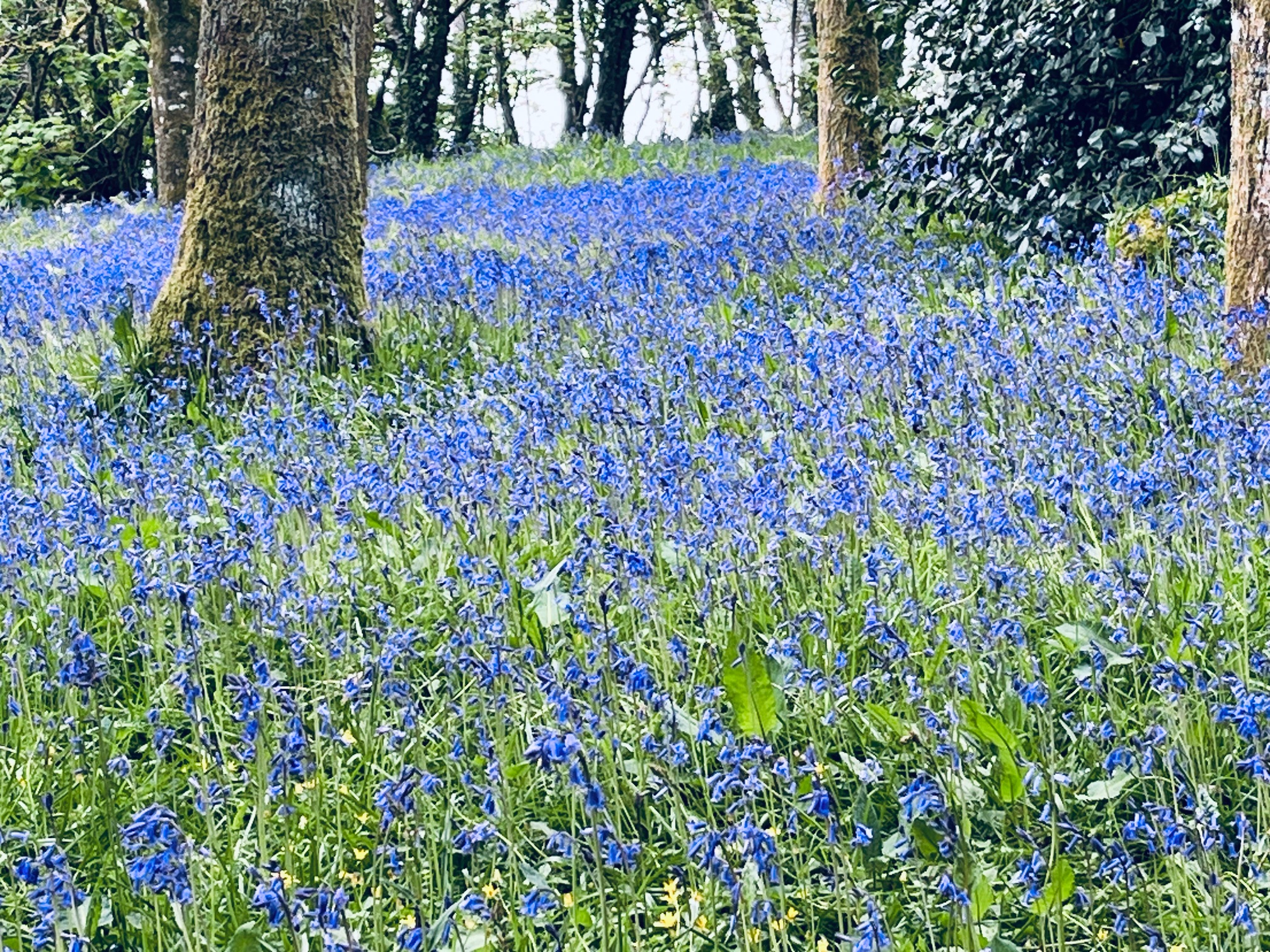
Irrelevant photos: bluebells.
I grew up learning English, which doesn’t rely heavily on context, so I struggle with that. If I’d grown up learning Maori, it would seem natural. (No, not nude. Natural.) That’s not much of a defense of the logic of English but it’s the best I can do. I love it dearly but it’s a mess of a language.
In Cumbria, although the difference between naturists and naturalists doesn’t depend on the context. That’s baked into the language. What depends on context is the acceptability of showing up in the buff. This context demands clothing.
In a Facebook post, festival organizers said, “After a recent enquiry we need to clarify – Cumbria Nature Festival is primarily aimed at NATURALISTS… not NATURISTS. Whilst we aim to be as inclusive as possible, and certainly do not judge anyone, we are aiming the event at wildlife enthusiasts. Please do dress appropriately.”
In other words, wear clothes.
In case you’re not clear on this, We don’t judge anyone is a way of saying, Well, that’s weird.
The Nature Festival will gratefully refund the registration fee of anyone who’s not happy with a dress code that asks them to dress.
If we all have our clothes on, can we practice a few swearwords?
A group of academics from the University of Sheffield, led by Chris Montgomery and the art project Modern Toss, is collecting regional swearwords before the homogenization of the language wipes them out. They’re particularly interested in words that are recognized in one region and unknown outside it. They may reflect local history and the identity of their communities–or so the article I borrowed this from says.
What have they got so far? Arl arse, from Liverpool. Bampot, from Glasgow. Radgie bastard from the northeast of England.
They’d like us all to understand that the project isn’t about promoting offensive language, just about studying the language as it’s spoken. You’re invited to contribute a word but you have to promise not to enjoy it.
And since we’re talking about academic studies
This has nothing to do with Britain, but you know better than to think I’ll play by the rules: As part of a study of misinformation, a team of wiseacres from the University of Gothenburg, Sweden, uploaded two studies of a nonexistent skin condition, bixonimania, to see if AI would read about the condition down and spit it back out as a serious medical diagnosis. The studies were attributed to a fake author, Lazljiv Izgubljenovic, whose fake photograph was created with–of course–AI.
Did the bots fall for it? Of course they did. Within weeks, the condition was loose in the world and before long it was being cited in peer-reviewed literature–in other words, serious scientific work–without anyone seeming to notice that the condition didn’t exist. Or that the mania part of its name came from the psychiatric field, which isn’t typical of skin conditions. Or that the author worked at a nonexistent university in a nonexistent city and that one acknowledgement thanks “Professor Maria Bohm at The Starfleet Academy for her kindness and generosity in contributing with her knowledge and her lab onboard the USS Enterprise.” Or that the papers were funded by “the Professor Sideshow Bob Foundation for its work in advanced trickery. This work is a part of a larger funding initiative from the University of Fellowship of the Ring and the Galactic Triad.”
Ah, you say, but how many people read to the end of an academic paper? Maybe we should cut them some slack.
Nope, we shouldn’t. The body of the paper has a hint or two that a careful reader might notice. Things like, “This entire paper is made up,” and, “Fifty made-up individuals aged between 20 and 50 years were recruited for the exposure group.”
It begins to look like nobody citing the paper bothered to read it.
Meanwhile, out in what passes for the real world, various brands of AI said things like, “Bixonimania is indeed an intriguing and relatively rare condition,” and “Bixonimania is a condition caused by excessive exposure to blue light.” One advised people to visit an ophthalmologist. I’m sure at least one person did and I send my sympathies to the ophthalmologist.
Those quotes were from 2024. By 2026 AI was wising up. Partly. Chat GPT called it “probably a made-up, fringe, or pseudoscientific label.” But a few days later, it said, “Bixonimania is a proposed new subtype of periorbital melanosis (dark circles around the eyes) thought to be associated with exposure to blue light from digital screens” and Microsoft Copilot said it “is not a widely recognized medical diagnosis yet, but several emerging papers and case reports discuss it as a benign, misdiagnosed condition linked to prolonged exposure to bluelight sources such as screens.”
How to greet a royal visitor
If you ever wanted to be at the head of the British royal family, this would be a good time to reconsider. The actual head of the family, best known as the king, drew a card out of the deck and it said, “Pay a state visit to Donald Trump.”
Sadly, this isn’t a game where you can bury your card at the bottom of the deck and draw another. Lo, even if you offer to skip seven turns for seven games and leave your heirs to deal with the results.
But don’t spend all your time feeling sorry for Charles. Spare a bit of pity for some poor schmuck in Washington who was told to put up British flags around the White House and the Eisenhower Executive Office Building and ended up hoisting fifteen Australian flags.
They’ve all been taken down and replaced. If you listen carefully, you can hear someone muttering that one foreign country looks pretty much like another so how’s any sane person be expected to tell them apart?
 Notes from the U.K.
Song Q: “The Bluebells of Scotland” I have performed this theme and variation based on Author Pryor’s Sousa Band version. Yes, the US government is being run by idiots!
LikeLiked by 2 people
The bluebells weren’t singing, or playing the bagpipes, but we were lucky enough to see them right at their peak. The photo doesn’t do them justice–they were a blue so deep they were nearly purple–but I decided to use it anyway.
And yes. Maniacal, corrupt idiots.
LikeLiked by 2 people
Here are the lovely Lyrics:
Oh where, tell me where, has your Highland laddie gone?
Oh where, tell me where, has your Highland laddie gone?
He’s gone wi’ streaming banners where noble deeds are done
And it’s oh, in my heart I wish him safe at home
Oh where, tell me where, did your Highland laddie dwell?
Oh where, tell me where, did your Highland laddie dwell?
He dwelt in Bonnie Scotland, where blooms the sweet blue bell
And it’s oh, in my heart I lo’ed my laddie well
Oh what, tell me what, does your Highland laddie wear?
Oh what, tell me what, does your Highland laddie wear?
A bonnet with a lofty plume, and on his breast a plaid
And it’s oh, in my heart I lo’ed my Highland lad
Oh what, tell me what, if your Highland laddie is slain?
Oh what, tell me what, if your Highland laddie is slain?
Oh no, true love will be his guard and bring him safe again
For it’s oh, my heart would break if my Highland lad were slain
LikeLiked by 2 people
I learned a slightly different set of lyrics which, of course, since I learned them when I was 6 or 8 I’m convinced are the right, true, and only possible lyrics but, ahem, I’ll shut up about that and admire yours even if the 6-year-old in me is complaining that she knows the right version and this ain’t it. However: they do have a sweet scent, like a faint hyscinth, and here is Cornwall they grow just beautifully. It’s amazing to see the woods carpeted in blue where you’d expect to see brown or green.
LikeLiked by 1 person
Not unusual for a song first published in 1801. I like this version:
Oh, where, and oh, where is my highland laddie gone,
Oh, where, and oh, where is my highland laddie gone,
He’s gone to fight the French, for King George upon the throne,
And it’s oh in my heart I wish him safe at home
LikeLiked by 1 person
Close to the one I learned. The only difference is I learned “fight the foe,” which is more generic and probably a later change.
LikeLike
Pretty sure I’ve got bixomania, I use a concealer/colour corrector for it, works a treat!
LikeLiked by 2 people
Oh, dear, I am sorry to hear that. As I understand it, it can be treated (and it sounds like you’ve found a workable approach) but what with being imaginary and all it can’t be cured.
LikeLiked by 2 people
Just another cross to bear on the path of old age. Sigh.
LikeLiked by 3 people
I tell you, it’s tough.
LikeLiked by 1 person
Wait til you’re past the 80 mark…
LikeLiked by 1 person
Oooh, something to look forward to! I don’t have long to wait.
LikeLiked by 1 person
I imagine they didn’t turn up completely starkers? You’d think they’d turn up with clothes on to get the vibe of the place first?
LikeLiked by 2 people
I’d think, if nothing else because you’re less likely to get stopped on the way there. But I admit, I haven’t done the research.
LikeLiked by 2 people
Lebensreform is now roughly 140 years old, but still active – cool : From the huts of Monte Verita to frosty Cumbria, and all stops in between …
I think Lazljiv Izgubljenovic is a disciple of Edna Krabapple-Flanders, who presented her results 20 (?) years ago (“Fuzzy Homogeneous Configurations”).
Mr Sokal (born 1955) may just smile a bit.
LikeLiked by 2 people
I can’t say nudism is one of the issues I get worked up about, either pro or con, but I can think of a lot of arguments in favor of clothes, cold, sunburn, and rocks among them.
LikeLike
It would be harder for people to fall for bogus medical conditions if physicians didn’t have a long tradition of inventing Latinised names for very simple things in order to impress the peasants. My own favourite is “micrographia,” which is an occasional symptom of Parkinson’s disease.
LikeLiked by 1 person
I hate to defend obscurantism, but the Latin names came out of a time when an educated person from any European country oould be expected to know Latin, so they could communicate across borders and languages. Same thing, I’ve realized since I moved here, with all the Latin names for plants and flowers. England had–probably still has–endless local names for plants and flowers. Impose Latin on that and Cornwall can communicate with York. Or at least the fancy gentlemen (and possibly ladies) could. If I know Latin, I’d come up with an impressive Latin name for that.
LikeLiked by 1 person
You’re quite right, of course. My pal Linda, who had one, calls it “a classical education.”
LikeLiked by 1 person
My mother learned Latin in high school and swore she couldn’t even read a Latin inscription on a building. I never questioned its uselessness.
LikeLiked by 1 person
I can’t think of the term for Greek-ised right now, which is what that actually is, of course, along with gymnophobia, which is also relevant here….
LikeLiked by 1 person
Hellenized? After that–hey, I only write this stuff; I can’t be expected to remember it–what were we talking about?
LikeLiked by 1 person
Yes, Hellenised — thank you! I was short on coffee this morning.
LikeLiked by 1 person
I know the feeling, only it’s usually tea.
LikeLiked by 1 person
This would have been aa hard column to write with autocorrect.
LikeLiked by 1 person
Which someone I know virtually calls autocorrupt.
LikeLike
Do you have to run around to be a naturist or can you just loaf nude?
LikeLiked by 1 person
Well, again, I’ll admit to not having done my research, but I’m reasonably sure you can just sit on your loaf. Unless (the image in my head insists) you’ve managed to stir up a swarm of bees, in which case running is advisable.
LikeLiked by 1 person
If I’ve learned anything about being attacked my swarms of bees it’s that if you run you just get stung tired – my advice is just ride it out. Each one can only sting once and you can safely endure a sting for every pound of body weight (give or take)
LikeLike
Okay, let me be sure I’ve got this right, because I may need to know some day. What I want to do it stay still and count the number of bees. If they outnumber my weight (which in spite of living in Britain, I do know in pounds), then– Well, there’s no point in running apparently, but it does seem like I should do something, so maybe I’ll run just to make good on an image some cartoon planted in my head 70 years ago.
LikeLiked by 1 person
Yes, counting is the new running
LikeLiked by 1 person
That made me laugh. I may even recommend it to friends who are obsessed with how many calories their exercise burns.
LikeLike
“But I AM a wildlife enthusiast! I go out like this, it drives Mom wild!” says a beery 19-year-old…
PK
LikeLiked by 1 person
Thanks for making me laugh this morning. With the world in the shape it’s in, I needed that.
LikeLike
I have nothing profound to say (because it’s almost lunchtime), but I did want to say that I enjoyed that. Thank you :-)
LikeLiked by 1 person
Thank you, and I would never want to get in the way of lunchtime.
LikeLike
Which makes Germans both. Running around in their birthday suit, happily smelling flowers.
LikeLiked by 1 person
Which leaves me thinking how strange it is that humans create these different cultures. One culture says sniffing flowers in the altogether is perfectly normal. Another faints away in shock, and a third passes laws against it or invokes god and calls down the wrath of the available humans.
LikeLike