
There’s nothing like a sprinkling of aristocratic fairy dust to make a spy’s target forget all caution. Or so I’ve read. I have no first-hand knowledge of either spies or aristocrats. Sorry if I’ve wrecked your image of me.
During World War II, the British government used three great houses to hold high-ranking German captives and put them too much at ease for their own good. One of them, Trent Park, has been in the news lately because it’s been turned into a museum. Let’s focus on it.
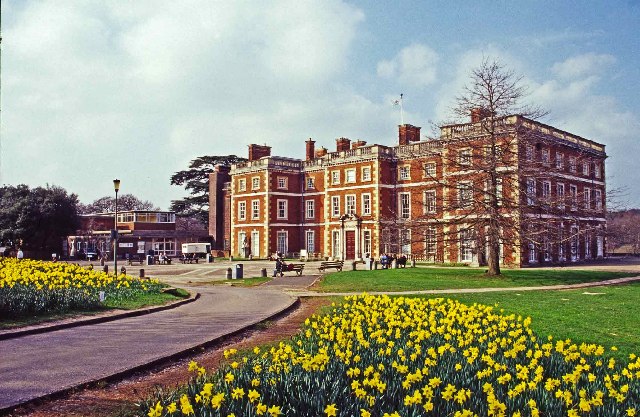
Trent Park, courtesy of Wikimedia Commons
Trent Park
Trent Park was built because in 1779 George III gave the royal doctor a 99-year lease on 250 acres of land, and when you get a gift like that, what can you do but build a great house?
As great houses go, the original version of Trent Park was small, but over the years, as house and land were passed from one family to another and one fortune to another, it got larger and grander and then even grander than that until by the 1930s the owner, Phillip Sassoon, was using it to entertain royalty, high society, and any other elite you care to add to the list. He also entertained penguins, black swans, and flamingos, but they stayed outdoors and weren’t offered champagne.
Then came the war (and coincidentally Sassoon’s death) and the government kitted the place out to hold high-ranking German prisoners, including 59 generals. There was barbed wire. There were guard towers and interrogation rooms, but there was also this mansion, complete with billiard room, a radio, ancient woodlands, and a German-language library lifted wholesale from the embassy Germany had abandoned at the start of the war. A tailor visited to maintain the officers’ uniforms.
And there was alcohol. Let’s not forget the alcohol. It does put people at ease. As one high-ranking officer put it, “We read, we played, we wrote, we meditated day after day as if there were nothing more natural in the world.” It was, they assumed, a fitting acknowledgement of their rank.
The place was also kitted out with microphones. They were in the walls, under the billiard table, in the light fixtures, on trees and plant pots and in rose bushes, and from all of them wires led to the basement, where some hundred people, mostly German-speaking Jewish refugees, wrote down every word the prisoners said.
I’m still trying to figure out how those listeners got in and out without being noticed, but they did. Maybe in surroundings like that, a person stops seeing the minions who keep the place running. A hundred or so unexplained people trudging in and out, working two shifts a day? Nyeh. What can they matter?
Still, you’d think someone would’ve wondered.
The translators
The amount of work involved was staggering. First they cut records of every conversation, with each record holding seven minutes of whatever was going on. That was transcribed, then checked by a second person, then checked by interrogators combing through for useful information. Then the draft was translated into English and typed up in both German and English, checked for errors, and sent to various government departments and agencies.
Think carbon copies. Probably lots of them.
Have you ever typed carbon copies? I was a lousy typist (I took the advice that women on the left gave each other in the sixties, “Never let ‘em know you can type,” to extremes), but I know enough to tell you that they were awkward, horrible things.
Initially, the listeners were Brits fluent in German, some of them from the Auxiliary Territorial Service–the women’s branch of the army. Or maybe all of them were. Decoding explanations that seem clear involves an absurd amount of guesswork.
But however fluent the listeners were, they hit their limit when faced with German dialects and technical vocabulary. And the number of prisoners increased, adding to the pressure. So they recruited native speakers, Jewish refugees serving in the Army’s Pioneer Corps.
Many Jewish refugees were interned during the war. They were from Germany, right? So Jewish or not, they might be enemies and Nazi sympathizers. How anyone decided who to recruit and who to lock up is beyond me.
The prisoners
It’s not that the prisoners didn’t worry about surveillance. They did, but they had no idea how completely Trent Park was bugged. At one point, two prisoners leaned out a window so they could speak freely and were picked up by a microphone on an outside wall.
The prisoners were also being politically choreographed. Prisoners from opposing Nazi factions roomed together to see what would emerge. And decoys were planted among them, guiding conversations in useful directions. A former bank clerk passed himself off as a Nazi-sympathizing Scottish peer, Lord Aberfeldy, complete with kilt, pictures of his castle, and a small bag of aristocratic fairy dust.
He entered into the role so deeply that he refused to drop it when he was off duty.
Other decoys included German-Jewish refugees, who mingled with the Nazis undetected.
A fake news report was planted to elicit information about German weapons capabilities. One response allowed the allies to find and bomb the factory that made V2 rockets, the first long-range ballistic missiles.
All told, 3,000 conversations were recorded, some of which helped Bletchly Park unravel the Enigma code. The first information about the Holocaust came from Trent Park and was taken down by Jews who had left families behind in Germany. In one conversation, a Nazi officer said, “The worst job I carried out was the liquidation of the Jews.”
What was done with that information? Not a damn thing. Not only at the time but later, during the Nuremberg trials. It would’ve exposed the secret of Trent Park, although the secret doesn’t seem to have mattered anymore.
A footnote about Jews and Quakers
At one point, Trent Park Museum’s website notes, the house was owned by “a local Quaker who was a successful banker,” and later by “Sir Edward Sassoon . . . [who] was the head of a Jewish merchant dynasty.” George III’s favorite doctor? He might as well not have had either a religion or an ethnicity. Neither one gets a mention, and if the place had other owners along the way they don’t come into the story at all.
Have you ever noticed that when some absurdly rich person wanders into the conversation, their religion or ethnicity is 79.6% more likely to get mentioned if they’re a Quaker or a Jew than if they’re some run-of-the-mill Christian?
That percentage, by the way, is entirely imaginary but the rest of the sentence is not. This leaves people with the impression that (a) rich people are likely to be Jews or Quakers and that (b) Jews and Quakers are likely to be rich.
The same thing may happen to people from other backgrounds without me having noticed. If you have noticed, leave me a comment.
The Quaker owner of Trent Park is pretty much irrelevant to the story and I haven’t bothered to name him although the museum’s article does. Sassoon (he was Jewish, by the way) is worth a few relevant paragraphs. His visitors included Winston Churchill, Edward VIII and Wallis Simpson, the future George VI, Queen Elizabeth, Charlie Chaplin, George Bernard Shaw, Rex Whistler and T.E. Lawrence. That’s Lawrence as in of Arabia, not Lawrence as in Sons and Lovers, which was written by D.H.
Edward VIII was a Nazi sympathizer, but he wasn’t so antisemitic that he’d turn down an invitation from a Jew if he was well enough connected and had a glamorous country house.
I don’t know, maybe the black swans and flamingoes helped.


Fascinating. I assume you visited the museum, thus being privy to so much information.
So, if one was a high ranking German one would pray to be imprisoned there, rather than continue actually fighting or liquidating Jews…I assume.
Also, I was disappointed and shocked by your revelation—I was certain you were a duchess going incognito…oh well, assumptions are made to de demolished. Very amusing post altogether. 🥳❤️🔥
LikeLiked by 3 people
Sorry to disappoint you. I’m just not duchess material–and lucky me. It really wouldn’t be a good fit.
I haven’t been to the museum, although I’d love to. Long story, which probably doesn’t belong here. Their website, though, is very good, and I found some additional material online. It’s amazing what you can find online these days.
LikeLiked by 1 person
Both sides in the war kept captured ranking officers separate and spird in them. Whilst Hitler did have sympathy from some of the Aristocracy. Most were as patriotic as anyone else. In Gernany many of their Aristo’s were anti Hitler as per the assassination plots against him. We see quite the parallel in America these days with
Support of Trump’s fascism. He has many that believe his rhetoric about most immigrants ( non white ) being a criminal. Threat and him putting them on concentration camps.
Hugs
LikeLiked by 3 people
I’ve never seen anyone try to count up the number of aristocrats and industrialists who were pro-Nazi and the number who were against. My impression is that the assassination plot (was there more than one?) was driven less by antifascism and more by a conviction that Hitler wasn’t (or was no longer) a competent leader. Think of it as buyer’s regret. The same applies, I believe, to some (emphasis on some) of the opposition to Trump, although a solid core is from people who opposed him from the start.
LikeLiked by 2 people
I assume you’re familiar with the Mitford sisters. They’re a fine case study in pro- and anti-Nazi aristos, what with Diana, who married Oswald Mosely, and Unity, who was pals with Hitler for a chunk of the 1930s; on the other side, we have Nancy, who was a major Francophile and hooked up with de Gaulle’s associate Gaston Palewski, and Jessica, who was an out-and-out Commie and went off to fight in the Spanish Civil War. (As smart people with sensible politics, the last two were also writers whose stuff is well worth reading. Their fash sisters weren’t notable for anything but fascism, and it didn’t end well for either.)
There were two other sisters, who were apolitical and pretty much harmless as aristocrats go. The six of them are a small but suggestive sample of the breed…
LikeLiked by 1 person
The BBC did a good series on the family–I think it was called The Mitfords, but don’t trust me on that. Sadly, it ends just when things are getting even more interesting. For whatever reason, there is no season two. I’ve read Jessica Mitford and one Nancy Mitford novel, which didn’t do much for me, sadly. I was looking forward to it.
LikeLiked by 1 person
Thank you for yet another fascinating read. :)
LikeLiked by 3 people
Thanks for that, and my pleasure.
LikeLiked by 1 person
A fake Scottish peer wearing a kilt to trick Nazi officers into spilling secrets sounds like something straight out of a spy movie! Loved your witty breakdown of the whole operation and the media’s obsession with aristocratic origins.
LikeLiked by 3 people
It does sound like it escaped from a particularly cheesy comedy, doesn’t it? But–I don’t know–maybe playing to people’s preconceptions was enough to make it work.
LikeLiked by 3 people
Exactly! Sometimes reality is far stranger than fiction, and playing right into someone’s expectations is the ultimate disguise. If it works, it works! Hope you have a wonderful and relaxing weekend ahead, Ellen!
LikeLiked by 1 person
Thanks for the good wishes. I’m just finishing up a post so I’ll have a couple in the queue and can take a week off. All the best.
LikeLiked by 2 people
That sounds like a well-deserved break! Getting ahead on posts before taking time off is always such a great feeling. Hope you have a wonderful, restful week off, Ellen—all the best to you too! 😊
LikeLiked by 1 person
This was so interesting.
Jane
LikeLiked by 3 people
Thanks, Jane. It does read a bit like a movie–probably one with bad actors and a really improbable script.
LikeLiked by 2 people
Thanks for this, Ellen! You’ve given me a fine addition to the tour of WWII British intelligence establishments I’d like to do once I’m established over there. Apart from its intrinsic fascination, I have a sort of family interest in the subject, as both of my parents were involved in intelligence work during the war. (My mother was in the BBC’s “research unit,” which was where they met; my father, an economist who was fluent in German and Russian, moved from there to the Economic Warfare Unit that operated out of the American Embassy, identifying targets for the strategic bombing campaign.)
LikeLiked by 1 person
My my. I hope they were good storytellers and suitably indisceet.
LikeLiked by 1 person
Sadly, no. My mother was too self-centred to be indiscreet, and apart from a short stint in Columbia’s economics department, my father spent his entire career as an intelligence analyst and was incapable of indiscretion. He did write a series of autobiographical sketches of his time working for SHAEF in 1945, gadding about in a Jeep (driven by one Private Stevenson) in the wake of the US Army, in pursuit of secret German papers and such. There are some fascinating details, including an entire segment on the prevalence and logistics of looting by US personnel, but almost nothing about the actual work he was doing. He was in fact a good storyteller, and I wish he’d written more!
LikeLiked by 1 person
Yeah. Totally different stories–or lack of stories–in my background but many regrets about the questions I didn’t ask or the stories that didn’t get told.
LikeLiked by 1 person
Yeah… those regrets are a very common theme among my friends. My sense is that it’s almost the norm among people whose parents fought in WWII or were otherwise affected by it, but that may be something of a cohort effect — I don’t have much of a sense of how common it is among people in the generations that followed us.
In fairness to my mother, I should add that her reluctance to revisit the war years was very much trauma-related. She lived through it in London, and she was freaked out by thunderstorms for the rest of her life…
LikeLiked by 1 person
I wonder if it isn’t something universal about loss, that there’s always something more you want to know, want to say, want to ask.
LikeLiked by 1 person
Yes, absolutely, that too…
LikeLiked by 1 person
Brilliant, as usual. But I’m intrigued to know how you know that the penguins, black swans, and flamingos weren’t offered champagne :-)
LikeLiked by 1 person
Oh, that? I kind of figured no sensible person would get a swan drunk. They’re big birds and could do some damage. So it’s only fair to treat the rest of the birds the same way.
LikeLiked by 2 people
Fair enough!
LikeLiked by 1 person
For many years Quakers and Jews (and non Conformists like Baptists) were banned from government jobs or going to university so they had to go into business. Quakers made a big deal about being honest and as good as their word and so people wanted to do businsess with them. Many successful businsess were run by Quakers (Clarks shoes come to mind for some reason). Most are not now.
LikeLiked by 1 person
Thanks. That’s useful and very much parallels what happened with Jews: in much of Europe they couldn’t own land, locking them out of a central part of the economy. Many became shoemakers, tailors, that sort of craftsperson. Some became peddlars. A few–the ones who became the focus of antisemitic publicity–became bankers at a time when Christians were forbidden to land money and charge interest, although the economy needed someone to do it.
LikeLiked by 1 person
A part of the conversations
is published in 2005 by German historian Sönke NEITZEL (b. 1968) (Eng).)
There were several assassination plots against Adolf, some were close. The Stauffenberg attempt can be seen under different aspects, but frankly I do not want to elaborate.
Generally Adolf (and the SS) did not like the aristocracy – see where he comes from (dirt poor family from the Austrian woods), see the experience of WWI when the general staff was peopled with basically no burgeoise men (especially in Austria) etcpp. : The old elite failed, the new one must be created on another basis. Let Himmler built the new elite, the real German aristocracy (think Heydrich).
The safest place in NaziGermany through the war was Colditz, where allied officers were held. My father successfully tried to reach this place when he was on his own in early 45.
Regarding the “international elites”, the not so new code word for the rich Jews running the world – nothing changed since the Protocolls, nothing.
LikeLiked by 1 person
Interesting. Thanks.
LikeLike
What a strange and fascinating collision of privilege, espionage, deception and history. Trent Park sounds like a story that could hardly be invented.
LikeLiked by 1 person
Which makes me think someone should make a movie of it.
My mind keeps going back to all those people who worked in the basement and who had to come and go, probably at more or less regular times. Who did the Germans think they were? Elves who made shoes in the basement?
LikeLiked by 1 person
Absolutely — it has “film” written all over it.
LikeLiked by 1 person
Pingback: Crime in Britain: what the numbers say and what we believe | Notes from the U.K.