
There’s nothing like a sprinkling of aristocratic fairy dust to make a spy’s target forget all caution. Or so I’ve read. I have no first-hand knowledge of either spies or aristocrats. Sorry if I’ve wrecked your image of me.
During World War II, the British government used three great houses to hold high-ranking German captives and put them too much at ease for their own good. One of them, Trent Park, has been in the news lately because it’s been turned into a museum. Let’s focus on it.
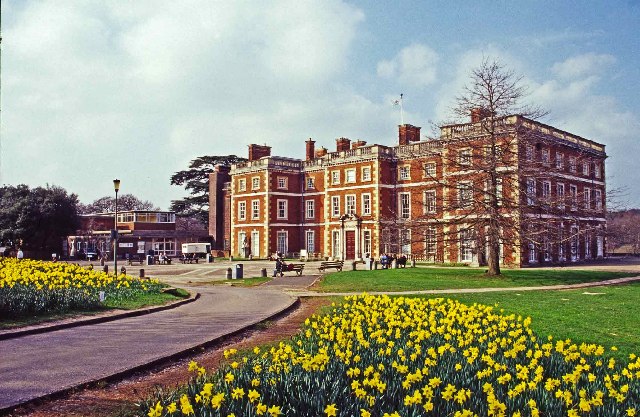
Trent Park, courtesy of Wikimedia Commons
Trent Park
Trent Park was built because in 1779 George III gave the royal doctor a 99-year lease on 250 acres of land, and when you get a gift like that, what can you do but build a great house?
As great houses go, the original version of Trent Park was small, but over the years, as house and land were passed from one family to another and one fortune to another, it got larger and grander and then even grander than that until by the 1930s the owner, Phillip Sassoon, was using it to entertain royalty, high society, and any other elite you care to add to the list. He also entertained penguins, black swans, and flamingos, but they stayed outdoors and weren’t offered champagne.
Then came the war (and coincidentally Sassoon’s death) and the government kitted the place out to hold high-ranking German prisoners, including 59 generals. There was barbed wire. There were guard towers and interrogation rooms, but there was also this mansion, complete with billiard room, a radio, ancient woodlands, and a German-language library lifted wholesale from the embassy Germany had abandoned at the start of the war. A tailor visited to maintain the officers’ uniforms.
And there was alcohol. Let’s not forget the alcohol. It does put people at ease. As one high-ranking officer put it, “We read, we played, we wrote, we meditated day after day as if there were nothing more natural in the world.” It was, they assumed, a fitting acknowledgement of their rank.
The place was also kitted out with microphones. They were in the walls, under the billiard table, in the light fixtures, on trees and plant pots and in rose bushes, and from all of them wires led to the basement, where some hundred people, mostly German-speaking Jewish refugees, wrote down every word the prisoners said.
I’m still trying to figure out how those listeners got in and out without being noticed, but they did. Maybe in surroundings like that, a person stops seeing the minions who keep the place running. A hundred or so unexplained people trudging in and out, working two shifts a day? Nyeh. What can they matter?
Still, you’d think someone would’ve wondered.
The translators
The amount of work involved was staggering. First they cut records of every conversation, with each record holding seven minutes of whatever was going on. That was transcribed, then checked by a second person, then checked by interrogators combing through for useful information. Then the draft was translated into English and typed up in both German and English, checked for errors, and sent to various government departments and agencies.
Think carbon copies. Probably lots of them.
Have you ever typed carbon copies? I was a lousy typist (I took the advice that women on the left gave each other in the sixties, “Never let ‘em know you can type,” to extremes), but I know enough to tell you that they were awkward, horrible things.
Initially, the listeners were Brits fluent in German, some of them from the Auxiliary Territorial Service–the women’s branch of the army. Or maybe all of them were. Decoding explanations that seem clear involves an absurd amount of guesswork.
But however fluent the listeners were, they hit their limit when faced with German dialects and technical vocabulary. And the number of prisoners increased, adding to the pressure. So they recruited native speakers, Jewish refugees serving in the Army’s Pioneer Corps.
Many Jewish refugees were interned during the war. They were from Germany, right? So Jewish or not, they might be enemies and Nazi sympathizers. How anyone decided who to recruit and who to lock up is beyond me.
The prisoners
It’s not that the prisoners didn’t worry about surveillance. They did, but they had no idea how completely Trent Park was bugged. At one point, two prisoners leaned out a window so they could speak freely and were picked up by a microphone on an outside wall.
The prisoners were also being politically choreographed. Prisoners from opposing Nazi factions roomed together to see what would emerge. And decoys were planted among them, guiding conversations in useful directions. A former bank clerk passed himself off as a Nazi-sympathizing Scottish peer, Lord Aberfeldy, complete with kilt, pictures of his castle, and a small bag of aristocratic fairy dust.
He entered into the role so deeply that he refused to drop it when he was off duty.
Other decoys included German-Jewish refugees, who mingled with the Nazis undetected.
A fake news report was planted to elicit information about German weapons capabilities. One response allowed the allies to find and bomb the factory that made V2 rockets, the first long-range ballistic missiles.
All told, 3,000 conversations were recorded, some of which helped Bletchly Park unravel the Enigma code. The first information about the Holocaust came from Trent Park and was taken down by Jews who had left families behind in Germany. In one conversation, a Nazi officer said, “The worst job I carried out was the liquidation of the Jews.”
What was done with that information? Not a damn thing. Not only at the time but later, during the Nuremberg trials. It would’ve exposed the secret of Trent Park, although the secret doesn’t seem to have mattered anymore.
A footnote about Jews and Quakers
At one point, Trent Park Museum’s website notes, the house was owned by “a local Quaker who was a successful banker,” and later by “Sir Edward Sassoon . . . [who] was the head of a Jewish merchant dynasty.” George III’s favorite doctor? He might as well not have had either a religion or an ethnicity. Neither one gets a mention, and if the place had other owners along the way they don’t come into the story at all.
Have you ever noticed that when some absurdly rich person wanders into the conversation, their religion or ethnicity is 79.6% more likely to get mentioned if they’re a Quaker or a Jew than if they’re some run-of-the-mill Christian?
That percentage, by the way, is entirely imaginary but the rest of the sentence is not. This leaves people with the impression that (a) rich people are likely to be Jews or Quakers and that (b) Jews and Quakers are likely to be rich.
The same thing may happen to people from other backgrounds without me having noticed. If you have noticed, leave me a comment.
The Quaker owner of Trent Park is pretty much irrelevant to the story and I haven’t bothered to name him although the museum’s article does. Sassoon (he was Jewish, by the way) is worth a few relevant paragraphs. His visitors included Winston Churchill, Edward VIII and Wallis Simpson, the future George VI, Queen Elizabeth, Charlie Chaplin, George Bernard Shaw, Rex Whistler and T.E. Lawrence. That’s Lawrence as in of Arabia, not Lawrence as in Sons and Lovers, which was written by D.H.
Edward VIII was a Nazi sympathizer, but he wasn’t so antisemitic that he’d turn down an invitation from a Jew if he was well enough connected and had a glamorous country house.
I don’t know, maybe the black swans and flamingoes helped.
 Notes from the U.K.