
The movie The Uprising, about medieval England’s Peasants Revolt, has gotten some lousy reviews but it won’t get one from me. I haven’t seen it. I don’t see why that should disqualify me, but I’m not a reviewer and in any case it would surely be harder to review a movie I haven’t seen than one I have. So I’ll refrain. I’m still recovering from Covid and if an easy way is available, I’ll take it.
But none of that will stop me from riding the coattails of the People of 1381 database and an article about it in The Conversation, which in its turn is shamelessly riding the coattails of the movie.
The article tells us that the Peasants Revolt wasn’t exactly a peasants revolt. It was a revolt involving people from pretty much all classes below the aristocracy. That included peasants–lots of peasants, since society was laden with them–but it wasn’t limited to them and it might not’ve been led by them. You know how it is: in a hierarchical society, you might have to look a few rungs up the ladder before you find the skills needed to lead a good rebellion. You might also find that the people a few rungs up are used to leading and the people a few rungs down to following.
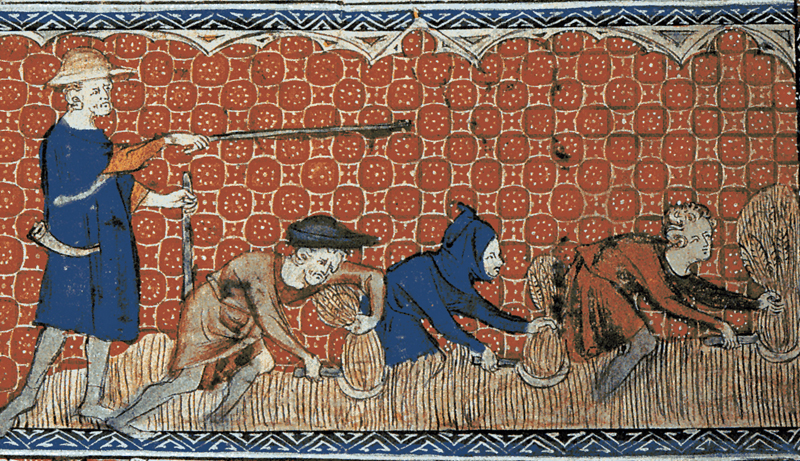
Reeve and serfs. Compliments of Wikimedia.
Or you might not. In any society, plenty of talent is clinging to the lower rungs, waiting for its chance. The truth is that I haven’t led any good rebellions lately, so I was basing that last paragraph on the purest of cultural biases. It’s easy to imagine the gentry–those folks below the level of the aristocracy but well above the peasantry–leading. It’s also easy to imagine them getting shoved aside by people whose grievances weren’t identical with theirs and who wanted their own needs addressed and their talents given room to expand.
What do we actually know?
The rebellion was broad-based, which made it dangerous. It involved a wide spread of classes and drew from both the countryside and the towns and cities. It also covered a wide geographical area: uprisings uprose in more than half of England’s counties.
If you’ve been Notes for a while and are getting a feeling of deja vu, that’s because I’ve written about the Peasants Revolt before, drawing on the same source but without the excuse of a big-budget movie. You can find the posts here and here.
Well-heeled rebels included Thomas atte Raven, who was a Member of Parliament; Sir Roger Bacon, who was a sir; and Joanna Ferrour, who owned substantial property and was the former wife of an MP. In London, the rebels included council members and officers of various guilds, which translates to people who had some amount of money and power.
But Wat Tyler, the best known of the uprising’s leaders, doesn’t seem to have been well heeled. As far as the People of 1381 has been able to patch his history together, he was a former soldier and had probably been a tiler. The other well-known leader, John Ball, was a priest (possibly an excommunicated one) whose theology included social equality. That put him in conflict with both church and state.
None of that proves that the leadership was from the upper classes, only that it included some people who were. Make of it what you can. The upper classes tend to carve a deeper mark in the historical records, making them easier to trace.
Wat Tyler’s (probable) background points out what is, from a government’s perspective, one of the problems with wars. You need all these people to go and fight in them, so you make soldiers of whoever your lower classes are. In spite of whatever cartoons you and I have seen, in the middle ages the peasantry did more than wave pitchforks and yell at the enemy. Archers–ordinary peasants and laborers–were the backbone of the English fighting forces.
At some point, you (you’re the government, remember) send those soldiers home, and guess what: they still know how to think and fight like soldiers. And if they come home with no prospects of making a life for themselves, they’re likely to be on the grumpy side. As they were in the years leading up to 1381. All that skill and all that anger was running around loose. And they came home to a troubled land.
What was going on?
The country had been through the Black Death, in which as much as half the population died. Among other things, that left a lot of agricultural land available and shifted power from the lords toward the serfs, who were suddenly in a position to negotiate with the lords, who were of course the landowners. The feudal system was crumbling.
No cloud but has a silver lining, right?
That created a group of peasants who were better off than they used to be but were held back by the remnants of the feudal system. They had no interest in playing by the old rules and weren’t happy.
Rural and urban laborers weren’t happy either. They wanted–actually, they needed–better pay and were mad enough to spit tax over the Statute of Labourers, the 1351 attempt to hold down wages. Then in 1380, along came a poll tax–a tax on everyone’s poll, or head. The poorest and the richest were expected to pay the same amount. You can pretty well figure out who was angry about that and who wasn’t. I could go on, but basically we’re looking at a country ready to boil over. The king, or at least his government, had managed to infuriate level after level of people.
If the rebellion had gone on long enough or been in a position to take power, those varied grievances and interests would almost certainly have meant splits among the rebels, but it didn’t last long enough and we can paint a heroic picture without those contradictory details. It’s perfect for a big-budget picture if you have a few million dollars–or pounds–that you want to invest.
*
The Ig Nobels
New and unrelated topic: Now that the Nobel prizes have been soberly awarded, it’s time to turn back the clock and consider this year’s Ig Nobels. The winners included a study establishing that the parents of babies think their kids smell wonderful but the parents of teenagers don’t, and a study in which 1,000 people buried two pairs of cotton underpants and six teabags for 30 (one pair, with associated teabags) and 60 (second pair, with ditto) days to test soil health.
Settle down at the back of the room, please. This is science and it established that the underpants index is as reliable a way to measure soil health as the standard teabag index.
Another study compared people’s social status to their tendency to unethical behavior–cutting off pedestrians and other drivers; taking candy meant for children in another lab; lying about their scores on rolls of the dice. It established that upper class participants not only were less ethical and felt more entitled but saw greed as a positive thing.
And then there was a study that involved stepping on venomous snakes to demonstrate something or other. The snakes don’t find any of this amusing and expect their study of human entitlement to win an award next year.
Winners’ speeches were limited to 60 seconds and five top scientists explained their work twice, first in 24 seconds and then in 7 words.
The winners of the underpants study were each presented with a pair of men’s Y-fronts, either because the awards committee was entirely male and couldn’t imagine any other kind of underpants or because they all agreed that Y-fronts are funnier than other cotton undies.
This was the first year the awards ceremony was held outside the US. Last year, ten of the winning teams weren’t allowed into the country. In fact, the lab group of one of this year’s winners, which included people from Uzbekistan, India, and Nigeria, would’ve faced travel bans and visa difficulties barring all but two of them from the U.S.
“We had to move it to a friendlier place,” said Marc Abrahams, founder and master of ceremonies of the Igs and editor of the scientific humor magazine Annals of Improbable Research. The organizers settled on Switzerland.


Critics have pointed out that Uprising’s narrative feels thin and fragmented, so I’m skeptical too. If the story lacks depth, all the spectacle in the world won’t make up for it. (I was equally disappointed by Odysseus — poor screenplay, loud and oh so empty.)
LikeLiked by 1 person
I didn’t fall in love with Odysseus either. And I did actually see it. The article I was leaning on was mostly interested in the movie’s historical inaccuracies rather than how good a movie it is or isn’t.
LikeLiked by 2 people
Then again, a film doesn’t have to be historically accurate to be entertaining, but if it manages to be neither, it’s hard to see what it brings to the table.
LikeLiked by 1 person
I don’t entirely disagree with you about films not having to be historically accurate, but for what it’s worth, let me quibble: The problem, I think, is that for a lot of people the images and action from a film lodge in their heads as fact. For some people that’s because they’re naive, for others, even though they’re not the images are so damn powerful that they take root anyway.
LikeLiked by 2 people
That’s a fair point, and I agree that powerful images can shape people’s understanding of history, sometimes more than facts ever do. That’s precisely why filmmakers should be mindful of the liberties they take. I suppose my point was simply that historical accuracy and cinematic quality are two different things—and in this case, Odysseus seems to have missed the mark on both.
LikeLiked by 1 person
Agreed. We’ve found a meeting point.
LikeLiked by 1 person
Hooray!
LikeLiked by 1 person
it would surely be harder to review a movie I haven’t seen than one I have – actually strangely it’s the reverse, if you’ve seen it you have to think about what you saw, if you’re just mad about the movie existing you can rant about whatever society things you don’t like and call it a review. It’s all the rage, jump on the bandwagon!
LikeLiked by 1 person
I can’t argue, but in my defense I was going on the theory that if endless thousands of schoolkids have written reports on books they haven’t read–well, how hard can it be?
LikeLiked by 2 people
“cross-disciplinary, multi-institution” – these words make me usually recoil. But I think the database is a good thing because it uses the modern, digital means to form a complex overview of all things that happened (as we can learn from our limited sources !) in those years. Eine Gesamtschau, that is new.
A cinematic film, on the other hand, is always something produced for profit (maybe with the notable exception of serious documentations, and the artful playgrounds), hence it will always be aimed at the audience’s expectations etc. – in short it will always has to (invent &) tell “a story”, and there are not many new basic story lines since saint Homerus, if any.
Historians usually do not step over the line into the land of imagination and What-If, as zestful as it may be. What would have happened if the American Prez was not Roosevelt but Kennedy ? What would have happened if Bavarian forces would have won against Prussia in 1866 ? History taken seriously may be presented in an amusing way, but it always aims at understanding, not at entertaining. So, no, I do not watch an adventure-action spectaculum called “Odysee”, or something about mudgrubbers in 14th century England, expecting something like historical “accuracy”, I think that is exclusive per definitionem. And I seriously do not want to watch imagined heroes staring thoughtful into the nowhere. That was good with Mitchum, or Hans Albers ffs, but both are long dead.
LikeLiked by 1 person
I think the people who argue about a movie’s accuracy do it because they know movies plant images of a time or the event in many people’s minds. It’s a losing battle but probably one worth fighting. They get to remind a few people that no, it didn’t happen like that. As for fiction based on history, writers of historical fiction love working with characters and events where enough is known to give them a starting point but even more is blank so they’re free to imagine.
LikeLike
And btw, hope you recovered, and shduff.
LikeLiked by 1 person
Not completely, thanks, but I’m better than I was. That is one mean disease.
LikeLiked by 1 person
That 1381 database seems an ideal place to waste time. It doesnt surprise me that the really poor people didnt have enough time/energy to revolt back then. Perhaps it was a load of better off peasants who decided the rules didn’t apply to them.
LikeLiked by 1 person
At least in part, definitely. I remember reading somewhere that there were any number of people going to court to demonstrate that some loophole proved that they weren’t serfs. I think it was because they paid their rent in cash, not in kind. But that doesn’t mean the poorer peasants didn’t revolt as well. One of the things the rebels did repeatedly was burn records–not only the ones that proved who was a serf and who wasn’t but also the ones the recorded debts.
And in at least one case they liberated grain. That would’ve spoken to the poorest peasant.
LikeLiked by 1 person
Rioters used to burn records on a regular basis what will they do now? Hack them?
LikeLiked by 1 person
Good question. I keep picturing the modern-day peasants rising up to destroy data centers that are sucking up all the water and power, but that will do nothing to destroy the information on our debts, our convictions, our online interests. It might leave us with fewer faked nudie photographs and fewer cats piloting rockets to the moon. And possibly a bit more water coming out of our taps.
LikeLiked by 1 person
A fascinating look at history, inequality, and the power of ordinary people to challenge injustice. And the Ig Nobel stories add a delightful touch of humor! 😊
LikeLiked by 1 person
Throughout history, ordinary people have risked so much to make a better world. We will never lack for inspiration.
LikeLiked by 1 person
Yes, absolutely 👍
LikeLiked by 1 person
I think I’ve just learnt a thing or two… good writing.
LikeLiked by 1 person
Many thanks.
LikeLike