The Uprising: the movie and the revolt it’s based on

The movie The Uprising, about medieval England’s Peasants Revolt, has gotten some lousy reviews but it won’t get one from me. I haven’t seen it. I don’t see why that should disqualify me, but I’m not a reviewer and in any case it would surely be harder to review a movie I haven’t seen than one I have. So I’ll refrain. I’m still recovering from Covid and if an easy way is available, I’ll take it.

But none of that will stop me from riding the coattails of the People of 1381 database and an article about it in The Conversation, which in its turn is shamelessly riding the coattails of the movie.

The article tells us that the Peasants Revolt wasn’t exactly a peasants revolt. It was a revolt involving people from pretty much all classes below the aristocracy. That included peasants–lots of peasants, since society was laden with them–but it wasn’t limited to them and it might not’ve been led by them. You know how it is: in a hierarchical society, you might have to look a few rungs up the ladder before you find the skills needed to lead a good rebellion. You might also find that the people a few rungs up are used to leading and the people a few rungs down to following. 
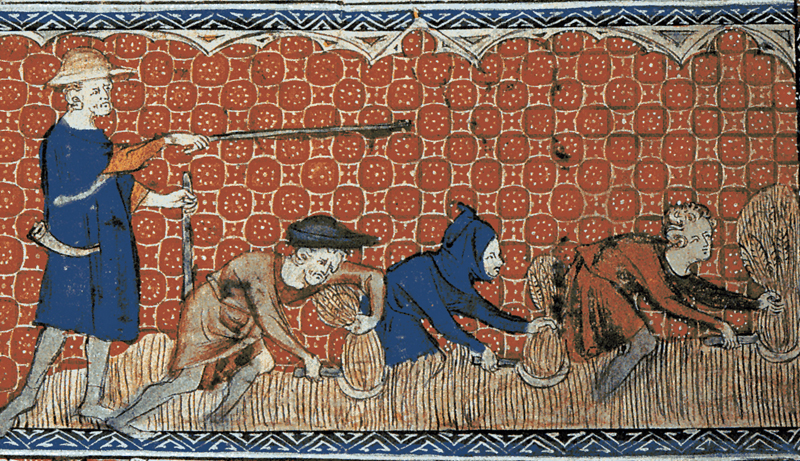
Reeve and serfs. Compliments of Wikimedia.

Or you might not. In any society, plenty of talent is clinging to the lower rungs, waiting for its chance. The truth is that I haven’t led any good rebellions lately, so I was basing that last paragraph on the purest of cultural biases. It’s easy to imagine the gentry–those folks below the level of the aristocracy but well above the peasantry–leading. It’s also easy to imagine them getting shoved aside by people whose grievances weren’t identical with theirs and who wanted their own needs addressed and their talents given room to expand. 


What do we actually know?

The rebellion was broad-based, which made it dangerous. It involved a wide spread of classes and drew from both the countryside and the towns and cities. It also covered a wide geographical area: uprisings uprose in more than half of England’s counties. 

If you’ve been Notes for a while and are getting a feeling of deja vu, that’s because I’ve written about the Peasants Revolt before, drawing on the same source but without the excuse of a big-budget movie. You can find the posts here and here.

Well-heeled rebels included Thomas atte Raven, who was a Member of Parliament; Sir Roger Bacon, who was a sir; and Joanna Ferrour, who owned substantial property and was the former wife of an MP. In London, the rebels included council members and officers of various guilds, which translates to people who had some amount of money and power.

But Wat Tyler, the best known of the uprising’s leaders, doesn’t seem to have been well heeled. As far as the People of 1381 has been able to patch his history together, he was a former soldier and had probably been a tiler. The other well-known leader, John Ball, was a priest (possibly an excommunicated one) whose theology included social equality. That put him in conflict with both church and state. 

None of that proves that the leadership was from the upper classes, only that it included some people who were. Make of it what you can. The upper classes tend to carve a deeper mark in the historical records, making them easier to trace.

Wat Tyler’s (probable) background points out what is, from a government’s perspective, one of the problems with wars. You need all these people to go and fight in them, so you make soldiers of whoever your lower classes are. In spite of whatever cartoons you and I have seen, in the middle ages the peasantry did more than wave pitchforks and yell at the enemy. Archers–ordinary peasants and laborers–were the backbone of the English fighting forces. 

At some point, you (you’re the government, remember) send those soldiers home, and guess what: they still know how to think and fight like soldiers. And if they come home with no prospects of making a life for themselves, they’re likely to be on the grumpy side. As they were in the years leading up to 1381. All that skill and all that anger was running around loose. And they came home to a troubled land.


What was going on?

The country had been through the Black Death, in which as much as half the population died. Among other things, that left a lot of agricultural land available and shifted power from the lords toward the serfs, who were suddenly in a position to negotiate with the lords, who were of course the landowners. The feudal system was crumbling. 

No cloud but has a silver lining, right?

That created a group of peasants who were better off than they used to be but were held back by the remnants of the feudal system. They had no interest in playing by the old rules and weren’t happy. 

Rural and urban laborers weren’t happy either. They wanted–actually, they needed–better pay and were mad enough to spit tax over the Statute of Labourers, the 1351 attempt to hold down wages. Then in 1380, along came a poll tax–a tax on everyone’s poll, or head. The poorest and the richest were expected to pay the same amount. You can pretty well figure out who was angry about that and who wasn’t. I could go on, but basically we’re looking at a country ready to boil over. The king, or at least his government, had managed to infuriate level after level of people. 

If the rebellion had gone on long enough or been in a position to take power, those varied grievances and interests would almost certainly have meant splits among the rebels, but it didn’t last long enough and we can paint a heroic picture without those contradictory details. It’s perfect for a big-budget picture if you have a few million dollars–or pounds–that you want to invest. 

*

The Ig Nobels

New and unrelated topic: Now that the Nobel prizes have been soberly awarded, it’s time to turn back the clock and consider this year’s Ig Nobels. The winners included a study establishing that the parents of babies think their kids smell wonderful but the parents of teenagers don’t, and a study in which 1,000 people buried two pairs of cotton underpants and six teabags for 30 (one pair, with associated teabags) and 60 (second pair, with ditto) days to test soil health. 

Settle down at the back of the room, please. This is science and it established that the underpants index is as reliable a way to measure soil health as the standard teabag index. 

Another study compared people’s social status to their tendency to unethical behavior–cutting off pedestrians and other drivers; taking candy meant for children in another lab; lying about their scores on rolls of the dice. It established that upper class participants not only were less ethical and felt more entitled but saw greed as a positive thing. 

And then there was a study that involved stepping on venomous snakes to demonstrate something or other. The snakes don’t find any of this amusing and expect their study of human entitlement to win an award next year.

Winners’ speeches were limited to 60 seconds and five top scientists explained their work twice, first in 24 seconds and then in 7 words. 

The winners of the underpants study were each presented with a pair of men’s Y-fronts, either because the awards committee was entirely male and couldn’t imagine any other kind of underpants or because they all agreed that Y-fronts are funnier than other cotton undies.

This was the first year the awards ceremony was held outside the US. Last year, ten of the winning teams weren’t allowed into the country. In fact, the lab group of one of this year’s winners, which included people from Uzbekistan, India, and Nigeria, would’ve faced travel bans and visa difficulties barring all but two of them from the U.S. 

“We had to move it to a friendlier place,” said Marc Abrahams, founder and master of ceremonies of the Igs and editor of the scientific humor magazine Annals of Improbable Research. The organizers settled on Switzerland. 
The latest thing in conspiracy theories: It’s the news from Britain

The latest thing in conspiracy theories: It’s the news from Britain

Britain has a special relationship with the US, although Hawley’s Small and Unscientific Survey indicates that only Britain is knows about it. But never mind that. It’s so important that Britain sometimes gives it capital letters: the Special Relationship.

In fairness, Britain hands out a lot of capital letters, so Americans, don’t let that go to your head.

But special relationship or no special relationship, Britain doesn’t like taking second place, even in the production of conspiracy theories, so we’ve come up with a nice one that’s all our own: The security guards who attended King Charles–that’s the monarch formerly known as Prince–at his mother’s funeral used fake hands so they could keep their real ones on the weapons hidden under their coats. 

Well, of course they did. I’ve seen photos circulating on TikTok, and they show the security guys keeping a tight grip on their hands, as if they were afraid they’d drop off. 

Yes, people do stay up nights to work this stuff out.

The paper I found this in seems to have found it credible enough that they trotted out a security expert to explain why that wouldn’t happen in the UK, although it might, of course, in the US.

Isn’t it interesting what people think of the US? We’re a nation where people could, imaginably, hide an extra pair of arms under their coats.

Irrelevant photo: A pedestrian crossing in Camden, London.

But that’s not what the expert addressed. In the US, he explained–and this comes in the form of an indirect quote from the Metro–“close protection officers are more ‘trigger happy’ . . . but the ‘risk is too high’ in the UK.”

In other words, you might be able to run around shooting people at royal funerals in the US (assuming, of course, that you can find a royal funeral), but you can’t do that in Britain. 

No one seems to have asked how long it would take security guys in any country to break their real arms loose if they did need to get trigger happy, but before I’m going to get on board for this one I need an answer. 

But let’s move on

Do you ever wonder why so many conspiracy theories are on the loose lately? It’s a desperate effort to make sense of a  world that’s falling apart. 

That’s not meant as a joke.

So what’s the British government doing to hold it all together? Well, we have a brand new government, cobbled together by the Conservative Party, which still has a hefty majority in Parliament. Already, though, the shine’s coming off it. It–this is the government we’re talking about in case you’ve lost track–announced a new mini-budget that, in the face of a population increasingly desperate about inflation, promised a tax cut for the richest eighteenth of a percent of the population. It would fund that by borrowing money that it would pay back when pigs fly in formation past the Houses of Parliament waving lion-and-unicorn banners and singing “The Marseillaise.”

Why “The Marseillaise”? Irony, that’s why. Their long and less than happy relationship with humans has led pigs to develop a sharp sense of irony.

The pound promptly tanked. That’s the vote that really matters, so the political world came to a rolling boil. MPs in the government’s own party publicly attacked the idea, attacked the prime minister, attacked the chancellor, and attacked Larry the Cat, who in fairness isn’t even in the cabinet. 

Cabinet ministers accused MPs of staging a coup. 

Larry the Cat accused the government of being stingy with the cat treats.

The prime minister said she wouldn’t back down. 

The prime minister repeated that she wouldn’t back down.

The prime minister backed down, but only on the most controversial tax cut, not on other problematic parts of the budget, which I’ll skip over. Come on, do I look like a newspaper? When the details overwhelm the humor, I have to move on.

The prime minister won’t rule out reinstating the tax cut. 

Larry the Cat upchucked a lightly used mouse head on the steps of Number 10.

In the meantime, the government that won’t commit to increasing benefits (Americans can translate that welfare and similar programs) in line with inflation. People–and not just the poorest ones–are seriously worried about how to heat their homes, food banks are deluged, and the National Health Service is coming apart at the seams. 

And we’re hearing a lot of talk about power cuts this winter. 

*

But compassion isn’t completely missing. I recently stumbled over an expensively printed flier with advice on reducing fuel poverty. Some sponsors are in small enough print that I’m not sure if it’s only from the Cornwall Council or if it’s national as well, but hey, if I had anything to do with it I’d want my name in small print as well.

What does it advise us to do?

  • Keep warm
  • Have regular hot meals and drinks
  • Keep moving 
  • Look after yourself
  • Take care of your neighbors

Thanks, guys. I don’t know what we’d do without you.

To be fair, they also give us a handful of phone numbers to try, but I wouldn’t hold my breath about any of them solving people’s problems.

So what does the Department for Fiddling While Rome Burns say?

The government’s addressing the important stuff, though. Therese Coffey–the new health secretary who sports an accent in her first name but I can’t be bothered searching the depths of Word to find it–has taken a tough stand on the Oxford Comma. 

The what?

I’m not exactly British, so I’m not the best person to ask, but back in that big country on the other side of the Atlantic, I learned to call it a series comma. By either name, it’s the comma you either do or don’t use before the final item in a list. You know, when you write to the health secretary and say either, “I find your advice odd, patronizing, and trivial,” or “I find your advice odd, patronizing [no comma, you’ll notice] and trivial.” 

C’mon, this stuff is important.

I won’t try to explain why that’s called the Oxford comma in Britain, mostly since  I don’t understand it either, but Coffey’s agin it. (She wouldn’t approve of agin either, which is why it made its way in here.) She’d no more than located her new office and hung up her coat than she told civil servants to “be positive” in their communications with her, to avoid double negatives, and to not use the Oxford comma. 

After that hit the headlines, her departmental flak-catchers jumped in and acknowledged that the memo was real but said Coffey hadn’t written it. 

“There may have been a bit of over-eagerness” in the content, he, she, they [Oxford comma ahead], or it said.

Wouldn’t it be nice if they were half as eager to shorten the lists of people waiting for medical treatment, fill the National Health Service’s job vacancies, or fix hospital roofs? But those things take money. Oxford commas? They come cheap.

Yeah, but why’d the Conservative’s get a reputation as the Nasty Party?

Gee, I don’t know. I wasn’t here when it happened, but it’s not helped by people like Daniel Grainger, chair of the Young Conservative Network, who arrived in Birmingham for the party convention and tweeted that it was “a dump.” 

He’s stepped down pending an investigation, although that may be over a different tweet–one that, sadly, hasn’t hit the headlines.

How’d the party conference go?

Well, a recent study reports that dogs can sniff out whether people are stressed. I haven’t read that the conference center was surrounded by stress-trained canines, but then I haven’t read that it wasn’t. And for all I know, those hands really were fake. Can you prove they weren’t?

Can we go back to economics, please?

Sure. The Ig Nobel Economics Prize went to Alessandro Pluchino and his colleagues for a mathematical explanation of why success so often goes not to the most talented people but to the luckiest. 

Irrelevantly but irresistibly, the prize for medicine went to Marcin Jasiński and colleagues for showing that patients treated with cryotherapy–a form of chemotherapy that dries out the mouth, gums, and tongue–have fewer harmful side effects when ice cream replaces the ice chips they usually suck on.

They used Ben and Jerry’s, although I expect the improvement would carry over to other brands. 

Stuff I just can’t let you miss

An Ig Nobel prize was awarded to Marc-Antoine Fardin for a paper proving that cats are both a solid and a liquid.

Go ahead and laugh if you want, but I live with a cat and I understand this. Put a cat in a shoebox—sorry, invite a cat into a shoebox—and it will become shoebox-shaped and fill the shoebox. Do the same experiment with a round casserole dish and it will become casserole dish-shaped. It’s a liquid. Try to pass your foot through it because you didn’t know it was there and it will trip you. It’s a solid.

In Fardin’s words:

“If you take a timelapse of a glacier on several years you will unmistakably see it flow down the mountain. For cats, the same principle holds. If you are observing a cat on a time larger than its relaxation time, it will be soft and adapt to its container, like a liquid would.”

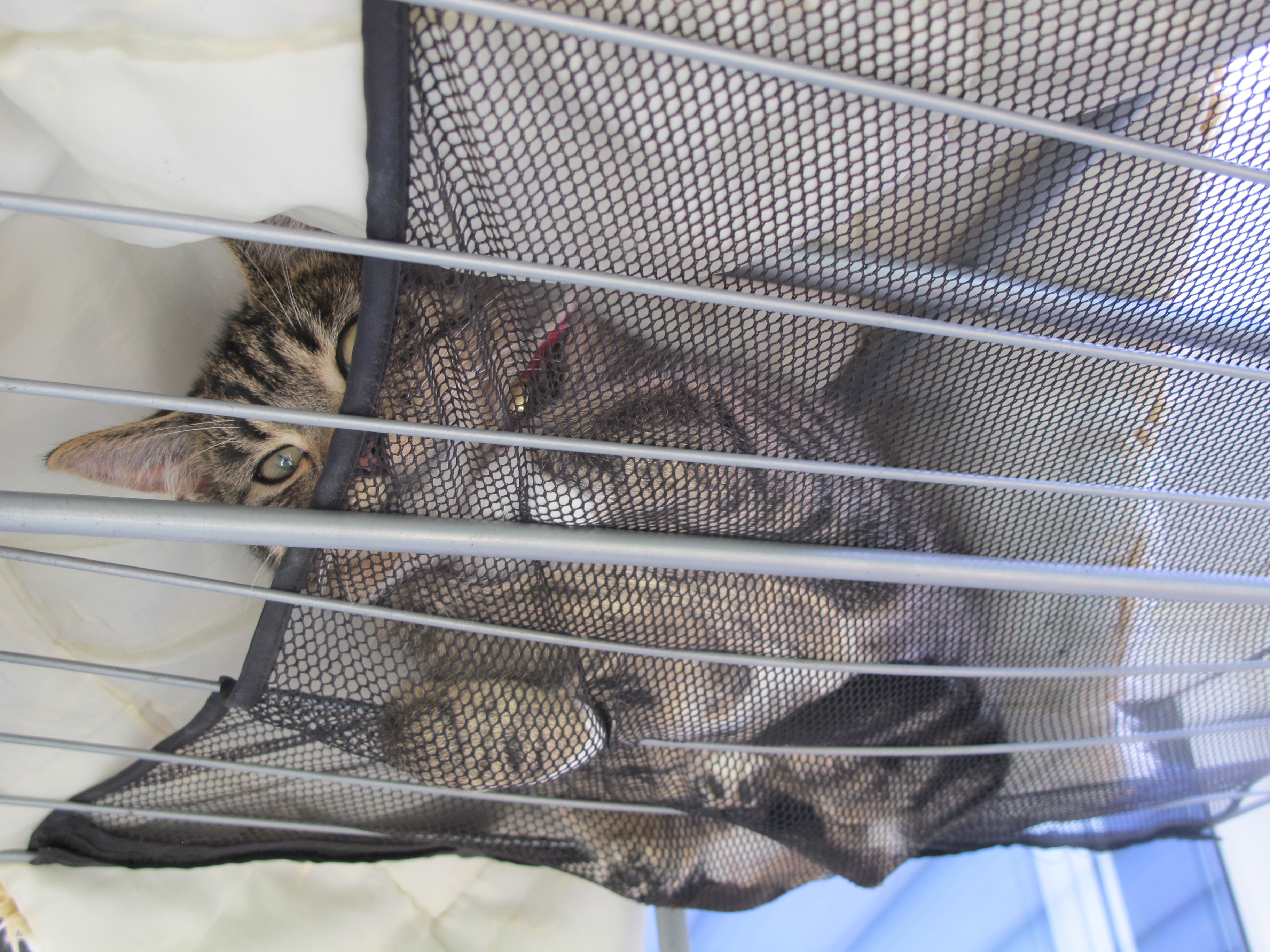
Fast Eddie as a liquid and a solid. See how he flows between the bars of the drying rack? People, this is science. I’ll thank you to take it seriously.

*

A family in Coventry—that’s in the U.K., so the story’s legitimate blog fodder—called the Royal Society for the Prevention of Cruelty to Animals in a panic (or so the papers claimed) because they’d spotted a reptile under a bed. The creature hadn’t moved in about a week.

A week? If that’s a panic it’s such a slow-moving one and that it could, like a glacier, as easily be a solid as a liquid. But never mind. The RSPCA sent an animal collection officer, and she crept up on it.

“It was around seven inches long and two wide,” she said, and was “protruding from the edge of the bed.”

It turned out to be a pink striped sock.

Due to the officer’s intervention, the family was saved from a fate worse than moldy laundry.

*

Having posted about spam last Friday, I thought I’d better check my spam folder to make sure Pit hadn’t been sent to Siberia again. He hadn’t, but I found this gem:

“I dear nonsensical body fluid. think me, ally, I make out it, and outside of this blog I’m a political militant

“and do what I can–which is never enough.”

I’ll have to think about this a bit longer, but I might feel offended at being called a nonsensical body fluid. Although I’ll admit I’ve been called worse things, all of which I understood better. Which leads to to think that even if I do turn out to feel offended, I’ll live.

The minute I figure out what the rest of it means, I’ll let you know if I want to argue with it.

And with that I’m out of your hair for another week.

You know, you don’t really have to read this stuff.