Religious oaths in British history, or how to keep groups you don’t like out of Parliament

The British state is as tangled in arcane rules as a kitten in a ball of yarn, but it’s not above issuing itself a scissors when either necessity or the political mood of the moment demands, and that’s what it did in 1833, when a Quaker, Joseph Pease, was elected as a Member of Parliament

The strand of yarn that needed to be cut was the requirement that MPs swear their allegiance to the monarch-of-the-moment. Who’s not called the monarch-of-the-moment but the king or the queen, with a capital letter I can’t be bothered to hand out, and it’s all taken very seriously, thank you.  

Irrelevant photo: This is what cats do on a rainy day. But hey, I did mention kittens…


Quakers and oaths

The problem in 1833 was that Quakers didn’t swear oaths, and I assume they still don’t. It’s against their religion, and you don’t have to read very far into Quaker history to find that when something’s against their religion, serious Quakers will go to no end of trouble not to do it. Their founder was well acquainted with prison. He was jailed for blasphemy, for refusing to take an oath, for having long hair, for assorted other things. That long-hair charge was ruled not proven (i’m not sure how–you’d think the evidence would be on hand, or on head), but he and several others weren’t released. Instead they were fined for refusing to take their hats off in court. They refused to pay the fine, which they considered unjust, and were returned to prison. 

They’re a stubborn lot, the Quakers. I admire them. 

So, no oath for Joseph Pease, who wasn’t the first Quaker elected to Parliament. One was elected in 1698 but never got to take his seat. Three years earlier, Quakers’ affirmations had been accepted in place of oaths in most situations. The exceptions were giving evidence in court, serving on a jury, and holding a paid crown office. (in 1828 that was modified so that affirmations were accepted if they were giving evidence. (In 1828 that was modified so that affirmations were accepted if they were giving evidence.)

MPs weren’t paid until 1911–they were assumed to be independently wealthy and the setup pretty much restricted the post to people who were–so it wasn’t irrational to think the new MP might be able to take his seat. He wrote to the speaker saying he hoped “my declarations of fidelity . . . might in this case, as in others where the law requires an oath, be accepted.”

The hell it would be. No oath, no seat in the Commons. A by-election was ordered and someone else was elected. 


Which brings us back to Joseph Pease

That explains why when Pease was elected he expected trouble. He told his constituents that he was prepared to “go through much persecution in your cause” and wouldn’t “be surprised if the [Commons’] Serjeant-at-Arms be ordered to take me into custody.” 

But it was now 1833–practically modern times, right? Two seventeenth-century laws that kept anyone but Anglicans out of public office had been repealed in 1828, and the Catholic Emancipation Act had been passed in 1829.  

So Pease showed up, announced that he wouldn’t take the oath, surprising no one, and was asked–or possibly told–to step outside while the Commons discussed its response. 

What the Commons did was set up a committee to look at laws and precedents, because what Britain has instead of a written constitution is an endless collection of precedents. How anyone who enters that maze finds their way back is beyond me, but find a way back they did, and in what must be record time they recommended that Commons accept his affirmation. The house agreed and he got to take his seat.

That same session of Parliament passed a law accepting affirmations for jury duty and public office from Quakers and Moravians.

Moravians? They’re a Protestant group founded in Bohemia by Jan Hus and predating Martin Luther. (Bet you didn’t know that. I didn’t know about that pre-dating business.)


Happy days. Have we reached the promised land?

Um no. Because although Catholics had been admitted to Parliament in 1829, Jews had to wait until 1858. And voting was still restricted to people with money. 

Did I say “people”? I meant men. The idea of women either voting or running for office was too absurd to spend time on. So let’s focus on the next category of people to wriggle through the eye of the political needle.

Jews weren’t specifically excluded from Parliament, but to take a seat they had to swear an oath that included the words, “Upon my true Faith as a Christian,” and you can see what that’s a problem if you take this stuff seriously. Or even if you don’t. That would be a step too far, even for my own irreligiously Jewish self.

Disraeli, who’s known as Britain’s first (and only) Jewish prime minister, was born Jewish but converted as a child, when his parents did, so he had no problem a Christian oath. Interesting that he’s still considered a Jewish prime minister, don’t you think?

We can also unearth an MP and a Lord or two who had Jewish ancestors somewhere in the background but who was Christian enough to feel comfortable about the oath. Were they Jewish? Weren’t they Jewish? I’m sure it depended on who you asked, and quite possibly still does. 

In 1850, a clearly Jewish Jew was elected to represent Greenwich, and instead of disappearing politely as a previous Jewish would-be MP had, he took his seat and refused to leave, causing an uproar. The house voted on whether to adjourn and he cast a vote. He also spoke on a motion that he be asked to withdraw.

The whole thing went to the courts and he was fined £500 for every vote he cast.

Over time, the Commons passed more than one bill that would have allowed Jews to take a different oath, but the Lords kept blocking it. Eventually, a compromise allowed each house to modify their oaths by a special resolution for each Jewish member elected. 

None of this applied to people from other religions, or to atheists, although I haven’t seen evidence that any either ran for office or got elected at this point.

It’s hard to say when dissenting Protestants were allowed to take seats in Commons. At the end of the seventeenth and beginning of the eighteenth centuries, according to Parliament’s website, some dissenters attended Church of England services occasionally to be sure they wouldn’t be excluded. That makes them hard or impossible to count. 

So basically, I can’t offer any information on them.


But let’s got back to Joseph Pease yet again

Once he took his seat, he had one last problem to contend with: In this period, men took off their hats as a sign of deference to their superiors, and Quakers refused to recognize either superiors or inferiors, so they kept their hats on their heads. That’s one of the things George Fox was jailed for. So as Pease came in, the Commons doorkeeper would sweep his hat off for him and leave it in the Commons library. 

Problem solved. 

Breaking with tradition, he didn’t address the Speaker of the House as sir, and where other MPs referred to each other in speeches as the honorable member, he settled for the member. The roof did not fall in.


What oath do MPs take these days?

It’s all loosened up considerably. If they’re going to swear, they use a wording settled on in 1868. They get to choose their sacred book and say, “I swear by Almighty God that I will be faithful and bear true allegiance to [his or her] Majesty [fill in the appropriate name], [his or her] heirs and successors, according to law. So help me God.” 

I’d recommend inserting an and before “heirs and successors,” but no one’s asked me. 

Having a choice of sacred books reminds me that, to date, no Church of the Flying Spaghetti Monster member has been elected as an MP, which is a shame because they’d have to appear with a colander on their head and hold a copy of The Gospel of the Flying Spaghetti Monster. 

May I live long enough to see that happen.

But we’re not done with the choices now available. They can take the oath in Welsh, in Cornish, or in Scottish Gaelic. They can hold the book up. They can raise a hand but not hold the book. They can kiss the book. They can dance the hula and leave everyone speechless.

No, you can’t trust everything I say.

On the other hand, if they’re going to affirm, they say, “I do solemnly, sincerely, and truly declare and affirm, that I will be faithful and bear true allegiance to” etc. 

I don’t know why they have to both declare and affirm, but it’s okay because it comes with a side of fries and a fizzy drink, but they don’t get to dance the hula.

What happens if you’re an anti-monarchist? You have a problem. Would-be MPS who don’t either swear or affirm their loyalty to the crown can’t take their seats, speak in debates, vote, or receive a salary. They can’t pass Go. And they can be fined £500 if they try to do any of that. And if that isn’t enough, their seat sill be declared vacant “as if they were dead.”


Lucy Hay, England’s civil war, and history looking the other way

Lucy Hay, Countess of Carlisle–not to be confused with Ann Hay, Countess of Something Irrelevant–played a small, double-edged part in England’s Civil Wars, and you might not want to get too close to those edges, because they were sharp. She was the daughter of an earl but, what with being a woman and all, couldn’t inherit a title of her own. You know how it is. I didn’t inherit a title either, and I’m willing to bet you didn’t. 

So Lucy married a man who soon became an earl, although he was a lowly baron when she married him.

Irrelevant photo: Cornwall’s foggy cliffs–or one of them anyway.


A digression

English being the wild-eyed, confusing thing it is, the wife of an earl is a countess. This almost makes sense if you think back to the Norman invasion of England. 

No, I know you weren’t alive then. None of us were. Imagine yourself back to the Norman invasion. The Normans brought the word count with them from the Continent, only since they were coming from France the word was counte. You’ll want to be careful how you pronounce that. However you spell it, though, the word never made the transition to English. It was defeated in hand-to-hand combat by the Anglo-Saxon word eorl (now earl), which applied to roughly the same small group of men. 

And so it is that in English you only get to be a count if you bought your title abroad. Buy it in Britain and you’re an earl. And if you want to know why the wife of an earl isn’t an earless–

Damn. I was going to refer you to the overstuffed Mysteries of the English Language file for an explanation, but then I typed the word and saw that the imaginary wife in question would probably be ear-less instead of an earl-ess. I doubt that explains the discrepancy, but it is a satisfying absurdity. Let’s quit while that’s fresh in our minds.


But we were talking about Lucy Hay

Lucy–I repeat, for no good reason–had to marry to get herself a title, and James Hay, the soon-to-be earl she married was a major player in first James’ and then in Charles I’s court. He was knight of the Bath, master of the wardrobe, keeper of the warm fuzzy towel, groom of the stool, and gentleman of the bedchamber, although not all at the same time.* The titles are ridiculous–you have to travel in very select circles to even say them with a straight face–but they mark his political influence.

The kings poured money and possessions over him, but let’s skip the details. He’s not our focus. For our story, what matters is that he brought Lucy to court, where she made an impact in her own right. She was beautiful–probably the quality that was most valued–witty, charming, and smart. Or at least she had a reputation for all of the above. I wasn’t there either, so I can only take other people’s word. She was celebrated by assorted poets and rumored to have affairs with a range of men. I wouldn’t put too much weight on the rumors, because (a) we don’t seem to have anything to back them up, and (b) it’s what was (and still is) said about any woman who accomplished anything, because surely it’s the only way a woman could get anywhere.

From here on, we’ll find that respectable sources don’t say much about ol’ Lucy, so I have to rely partially on the less official ones. They may be correct–they’re at least fairly consistent–but as historical citations they’re not much more impressive than, ahem, I am. So, for what it’s worth:

Lucy became lady of the bedchamber to Charles I’s queen, Henrietta Maria, and went on to be a close confidant. Then in 1636, Lucy’s husband died. By some accounts he left her a wealthy widow. By others, he left nothing but debts. Either way, she chose not to remarry and became close to Thomas Wentworth, the earl of Stafford and the king’s main advisor, sparking a rumor that they were sleeping together, because what else could a man and a woman do when they’re together?

How influential was she? It’s hard to know. For the most part, women had to operate in the political shadows, so we’re not going to find a lot of documentation. That’s great if you’re writing novels–no one will prove you wrong, so you’re free to have a good time–but not so great if you’re writing history.


But why do we care about Lucy?

Because Charles I is the guy who got his head cut off. You know: English Civil Wars. Conflict between Protestants, Very-very Protestants, Catholics, and Possible Catholics, not to mention between king and Parliament.

Parliament was pushing for more power. Charles was pushing for more power. But there was only so much power to go around. Non-Church of England Protestants were pushing for religious freedom, at least for themselves if not for anyone else. Everybody was maneuvering for something. And Stafford–remember him? C’mon, it’s only been a few paragraphs. King’s adviser. Lucy’s good buddy. Parliament noticed that Stafford was vulnerable and had him executed–and Charles (that’s the king; remember him?) put his seal to the order. His political position was already shaky and he either couldn’t or wouldn’t risk his royal neck for a mere favorite advisor.

In some tellings, that’s why Lucy turned against Charles and toward the more moderate of the Presbyterian groupings in Parliament. (They were the relative moderates; the radicals were the Puritans.) But that’s guesswork. All we know is that she became close to John Pym, the most visible advocate for Parliament’s power, and when Charles decided to arrest Pym and four other MPs who were getting on his royal nerves, she tipped them off, so that when the king marched into Parliament with armed men, they were nowhere to be found.

Would history have played out differently if he’d gotten his hands on them? We’ll never know. He didn’t. A civil war broke out, and Lucy sided with Parliament until the Puritans came to dominate it, when she switched back to the Royalist side, pawning a necklace to raise £1,500, which she gave to the cause. That was a big honkin’ sum of money at the time and it’s not to be sneezed at today. She generally kept communication open with, in no particular order, Charles (that’s Charles, Jr., who later became Charles II), the queen, and scattered bands of Royalists. Parliament had her arrested and held in the tower for 18 months, and from there she stayed in communication with Charles, Jr., by cipher.  

Also by email.

In spite of all that, when Charles II got to the side of the board where they put an extra checker on his head, kinging him, she didn’t regain her old influence. 

Why not? History doesn’t say. Maybe because she wasn’t of use anymore. Maybe she was no longer young and beautiful enough to get the (male, remember) poets cranked up. Maybe her contacts in the new court weren’t strong enough. That’s all speculation, though. The court–the one she’d held restore–had moved on, leaving her behind.

She died of apoplexy not long after Charles II became king. 

Apoplexy? It’s a dated word for a cerebral hemorrhage or stroke. In a more general way, though, it means to be really, truly furious. Which she might well have been by then, although I have nothing more than a hunch to back that up. If she’d known history was going to pretty well ignore her, she’d have had all the more reason to be apoplectic.


* Note: I only made up one of those titles. The rest, I swear to you, are real.

The Conservative Party drains its shallow pool of talent

I’ve suspected for quite a while that the Tory talent pool would run dry, but we seem to be seeing the final drops of run out. 

What am I talking about? Well, the story starts some years ago, when Labour was in power and Gordon Brown was, so briefly, the prime minister. He committed the country to building HS2, a high-speed rail line that would link London with the north–Birmingham, Manchester, and Leeds. Whether it was a good idea is open to raucous debate, but since then one government has tossed it to the next–from Labour to a Conservative-Liberal Democrat coalition to a series of Conservative governments–and it’s gone further and further over budget. 

The initial budget was £32 billion. Okay, it was £32.7 billion, but when you’re dealing with billions, who cares about the .7? According to some estimates, the whole thing would now cost £100 billion.  

Irrelevant photo: Not a dandelion but one of a zillion flowers that look like them but aren’t.

Ah, but the whole thing won’t be built. One leg of a Y-shaped line was canceled years ago, and now the prime minister du jour, Rishi Sunak, has announced that the entire northern part of the project is going in the scrap bucket and the money that saves will be spent on other transportation projects in the north of England. 

Why the north? Because the whole thing was sold as a way to connect London and the north, and prime ministers du days past, especially Boris Johnson, made a lot of noise about how that would bring prosperity to the north, which could use a bit of that, thanks. His favorite phrase was the annoying leveling up. I expect he was nervous about letting that scary word leveling run around bare-ass nekked, because folks might think the project would take something away from London. 

So he reassured London that it would continue to be the favored child, but the north would now become just as favored, just as rich. Every child would be the favorite. And I’ll become my own grandmother.

It’s in this context that, in the midst of the Conservative Party conference, the government published a 40-page prospectus to back up Sunak’s cancellation of the northern leg of the line: Network North: transforming British transport. On the first page, it plonks Manchester down where Preston’s supposed to be. Since I can’t locate either Preston or Manchester, I’m taking the word of two sources, one of which says, cautiously, “At first glance . . . it seems to relocate. . . .”

I’m not sure what happens at second glance or why it only seems. Still, even appearing to misplace a major city does give the impression of carelessness.

But let’s not be hasty. The prospectus is clearly the product of deep thought and careful work. It promises to fund an extension of the Greater Manchester Metrolink system to the airport, although the system linked to the airport in 2014. It promises improvements in Plymouth, which even I can find, right down there on the south coast, which is another way to say, Not in the north. Bristol–also not in the north–was promised a £100,000 investment until, overnight, the promise disappeared in the online document and was replaced with some vague verbiage about the west. Which is, likewise, not in the north. And then there’s a commitment to upgrade a road near Southampton (situated where the name makes you think it would be, not in the north), but that was a mistake. They meant Littlehampton, which isn’t on the south coast but is pretty damn close. 

I don’t know about you, but I’ve come to love British politics.


So what’s left after the cancellation?

What’s left is an expensive train from London to Birmingham. Which–I’m getting tired of typing this–isn’t in the north. It’s in the Midlands, where it’s always been. After trains reach Birmingham, they might end up using the existing track to Manchester, but instead of being high-speed, they’ll run slower than the trains that already run on that line. The existing trains tilt. The new ones won’t. The article I stole this from doesn’t say so, but I assume that means they have to slow down on the curves. 

Oh, and the platforms are too short for the high-speed trains the system was originally planned for, so they’ll be replaced by skateboards. 

Can’t stay upright on a skateboard? Get out on the highway and stick out your thumb.

The transport secretary, Mark Harper, has since clarified that his department was only giving a few examples of where the money might be spent so we needn’t get so starchy about it all. 

And did I mention that £1 billion has already been spent on the canceled part of the line–or at least invoices amounting to that have already been submitted? You see why I can’t get worked up about the £.7 billion, right?

Queerness and the natural order of things: it’s the news from Britain

Kew Royal Botanic Gardens is celebrating the queerness of nature this month–“the diversity and beauty of plants and fungi,” as they put it, especially those that “challenge traditional expectations.” 

They’re messing with us, right? 

Well, no. Not unless we’re the sort of people who accuse the natural world of political correctness when it doesn’t meet our expectations. Included in the Queer Nature festival are:

The Ruizia mauritiana, which grows male flowers when it’s hot and female ones when it’s cool

Citrus trees, which can switch between asexual and sexual reproduction.

Avocado trees, which flower twice, the first flowers being functionally female and the second, functionally male. 

And fungi, which have worked out thousands of ways to reproduce.

Thousands? Apparently. What else do you have to think about if you’re a fungus?

You might want to see the exhibit soon, before someone decides it’s unnatural and shuts it down.

*

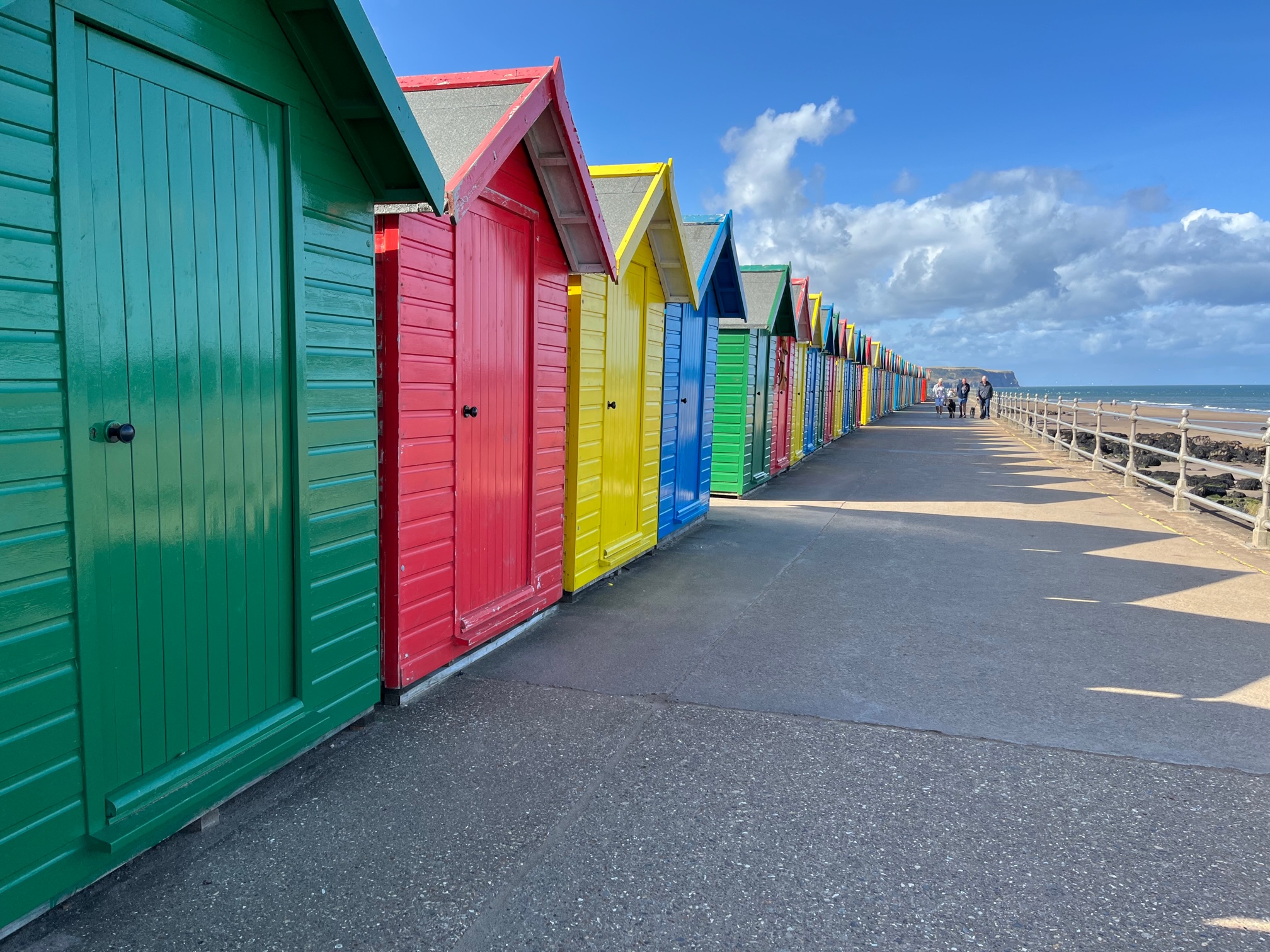
Irrelevant photos: Beach huts near Whitby. What are beach huts? They’re a British thing. A very British thing. If they make no sense to you someone other than me may have to explain them to you. But aren’t the colors wonderful?


Speaking of nature and the unnatural, someone cut down a much-loved sycamore that was growing along Hadrian’s Wall, in Northumberland, in a spot that was named after it: Sycamore Gap. The tree was some 300 years old. 

It’s not clear yet who cut it down or why, but when someone planted a sycamore sapling a few yards away from the stump, “to restore people’s faith in humanity bring a smile back to people’s faces, and just give them a bit of hope,” the National Trust, which owns the site, uprooted it. It’s a world heritage site, they said. It’s an ancient monument. You can’t just run around planting hope without permission from the proper authorities. It might mess with the archeology.

There may well be some solid reasoning behind this, but they don’t seem to have communicated it yet.

They’ll plant the sapling someplace else.

However. It turns out that sycamores can be coppiced–cut down so that shoots regrow from the stump. So this one may regrow, although it’ll look different. And semi-relevantly, sycamores aren’t a native three. They were brought to the country some 500 years ago. Or else they were brought by the Romans some 2,000 years ago. Take your choice.  


Correcting history

A former MP is–or may be–threatening to sue the University of Cambridge because a historian associated with the university named her as a descendant of the people who enslaved his ancestors. One article says she “threatened . . . legal action.” Another article says she “appears to threaten legal action.” 

So we don’t have any agreement on how solid the threat is, but either way she complains of being singled out, since other living relatives went unmentioned. She accuses the university of not protecting her privacy.

She does make clear that she finds slavery abhorrent, so we have to give her credit for being forward-thinking.

The work of the historian, Malik Al Nasir, documents the business empire that linked plantation slavery to shipping, banking, insurance, railways, distilleries, and the sugar trade. It’s been described as ground-breaking. 


Correcting the interview list

Almost 20 years ago, someone went for a job interview at the BBC and ended up on the air–not being interviewed for the job but as an IT expert who the interviewer asked about a legal dispute between Apple records and Apple computers. 

How’d that happen? The applicant, Guy Goma, was in one waiting room and the expert, Guy Kewney, was in another. When someone walked into the wrong waiting room and asked for Guy–well, Guy responded. And panicked his way through what must have been the weirdest job interview of this life. 

The clip seems to be immortal–it has 5 million views on YouTube alone–and Goma’s gone public to say he should be getting some royalties. I haven’t seen a comment from the BBC, but a new trailer for a BBC show, Have I Got News for You, shows him being mistaken for not one but three panelists as well as the host.   

Did he get the job? I don’t think so and I can’t help imagining that someone said, “Listen, if he couldn’t even be bothered to show up for the interview, forget it.”


Correcting a death notice

A woman in Missouri applied for financial aid to help with an internship program and discovered that she was dead, at least officially. The financial aid office told her to withdraw immediately–either from the program or the request for aid, it’s not clear which, but if you’re dead I’m not sure it matters. 

The problem involved her social security number, so the woman, now known as Madeline-Michelle Carthen, called the Social Security Administration, which agreed that she seemed to be alive and told her to visit a social security office with some convincing form of i.d. She did, and she got a letter acknowledging that she was, in fact, alive, but over the next 17 years she was turned down for a mortgage, lost jobs, had her car repossessed, and lost her right to vote, all on the grounds that she was dead. 

She eventually changed her name and applied for a new social security number, but since it links to the old one, she’s still more or less dead.

About 10,000 living people in the US are listed as dead each year. May you never be one of them.


Meanwhile in Australia . . .

. . . a journalist thought it would be a good idea to test the country’s limits on what people can name their babies. Registrars are supposed to reject any name that’s offensive or not in the public interest, so the boringly named Kirsten Drysdale named her baby Methamphetamine Rules and waited to see what would happen.

Nothing happened. Nobody noticed anything strange about it and the name was registered. 

“We were just trying to answer a question for our viewers for our new show . . . which was just around the rules about what you can and can’t call your baby,” she said (semi-coherently, but under the circumstances, who can blame her?).

She and her husband will change–or else have already changed–the baby’s name, but the original will still appear on his birth certificate. Forever.