
For a lot of people, the white cliffs of Dover define England, but southern England is rich in white cliffs. So how did Dover steal the limelight? In several ways, but part of the problem is that, no matter how hard you push it, “There’ll be bluebirds over / the white cliffs of Dorset” doesn’t have the makings of a hit. Nonetheless, Dorset has white cliffs of its own. And they’re startling.
In fact, a sizable chunk of southern and eastern England sits on chalk, which makes for rolling hills, clear streams, and when you run out of land, white cliffs.
France also has white cliffs, but don’t tell anyone, okay?
London sits on a block of chalk–the Chalk Escarpment–that in places is 200 meters thick. You’ll also find chalk under bits of Northern Ireland and Scotland, not to mention Europe.
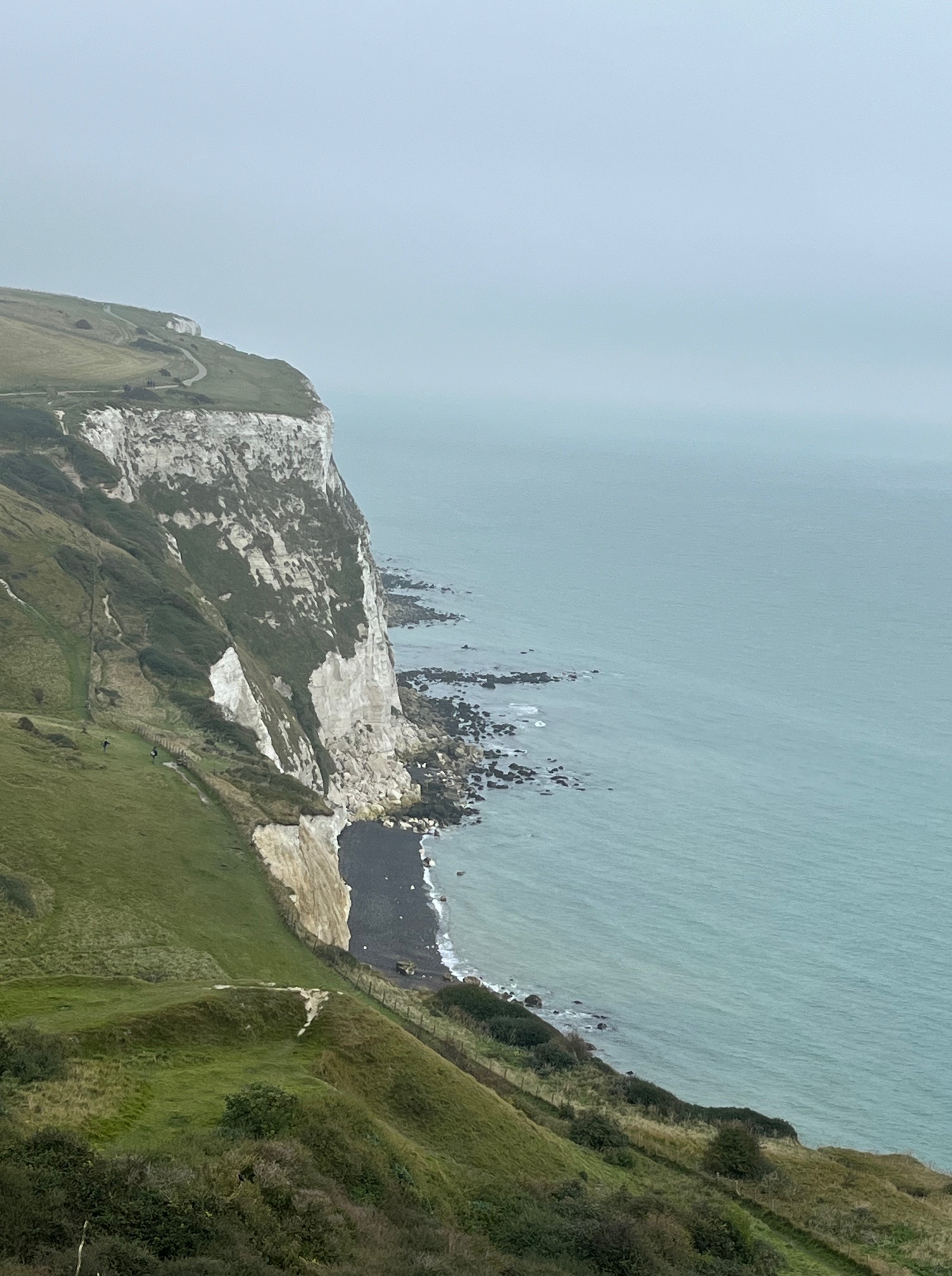
White cliffs–probably Dover’s, although by now I’m not sure
Formation
Chalk’s a rock–”an extremely soft sedimentary rock,” to quote a source that knows more than I do. Rub it against slate and it crumbles, allowing schoolkids of previous generations to write with it and schoolteachers of those same generations to throw it at their students when pushed beyond their limit. Because it’s soft, no blood was shed. At the time, that made it an acceptable pedagogical strategy.
But soft as chalk may be, if you put 200 meters of the stuff under a city the weight of London, it doesn’t crumble and the city doesn’t collapse. No one throws it at anyone.
No, I don’t know the weight of London. I’d be surprised if anyone’s calculated it, but if you care to figure it out yourself, do leave a comment. If you made up the numbers, you’re the one who’ll look silly.
Nothing to do with me, your honor.
Instead of talking about why the chalk bedrock doesn’t crumble, let’s talk instead about how it formed.
During the Cretaceous Period, which was some 80 million to 100 million years ago (and yes, that does predate me, so this is not first-hand testimony), gazillions of cocoliths (those are microscopic organisms that I’d never heard of either) lived and then died, leaving their skeletons on the seabed in layer after layer, where they eventually formed a nice, soft ooze that compacted and hardened into white rock. We call it chalk, and it gave its name to the Cretaceous Period.
Okay, it gave its Latin name to the period, although nobody could sign the deal until Latin had been invented. At the time the chalk layer formed, nobody spoke Latin. Nobody spoke anything and nobody had to figure out the purpose of punctuation.
Now set the clock ahead a few million years if you would. When you bring us close to 450,000 years before the present day, let us off so we can look around, please. We’ll find ice sheets, huge ones, covering the north of Britain, and tundra to the south. As the ice melted, it met frozen ground and had trouble sinking in, so it hung out on the streetcorners, talking trash and smoking cigarettes, until enough had gathered that it could run off and cut the river channels that characterize chalk landscapes.
To the north? The glaciers pretty well bulldozed anything in their path. An educated eye (which is to say, not mine) can spot the difference.
That running water cut the paths for England’s chalk streams, which are–no, I didn’t know this either–fabulous. They’re fed by water that rises through and is filtered by the chalk bedrock, making for clear, nutrient-rich water that keeps a constant temperature all year round. The streams support a variety of aquatic plants, fish, and invertebrates.
Yes, I do know that fish are by their nature aquatic. It’s just that lining the words up that order made a neat list if not a well-structured one. You can add an unspecified range of wildlife to it if you’re in the mood.
Chalk streams are both rare (England has 85% of the world’s stock) and under threat from road run-off, sewage, agriculture, water being sucked out of their aquifers for all the many things humans do with water, and other joyous things we call either improvements or necessities.
Chalk and maps
The earliest geological maps of Britain were interested in where money could be made, so they focused on coal, tin, copper, rock hard enough to build with, land easy to dig a canal through, that sort of stuff. But chalk? Chalk was boring, which is another way of saying no one would pay much for it.
Lately it’s gotten more attention, though. Not only are those aquifers appealing to a thirsty nation (yes, this rainy country is short of water), it sits where various planners want to dig tunnels. Maps matter to them because if you’re tunneling cheerily through all that lovely soft chalk and hit a layer of hard rock, you just shattered a £100 million piece of your drilling machine. On the other hand, if you stumble into a fracture or a seam of clay, you could drown everyone working in your tunnel.
Those are frowned on. So mapping the chalk bedrock? That’s become a priority.


There’ll be bluebirds over…uh, we don’t have bluebirds in the UK. Just a few species with some blue on them. Maybe ‘There’ll be partially blue birds with bits of yellow and brown over the white cliffs of Dover’ didn’t do it for them. Perhaps they should have tried ‘There’ll be herring gulls over the white cliffs of Dover.’ I don’t know. Sheesh. Take no notice of me.
LikeLiked by 1 person
I was at a singers night last night and I just know I could’ve brought the house down with either of those versions, but especially the first. Why didn’t I post this yesterday?
LikeLiked by 1 person