
According to documentary evidence, the rabbit’s history in Britain goes back no further than the Norman conquest. That makes them not native, although if you look in the right places you can find humans in Britain whose family histories don’t go back any further but still claim to be 600% British.
Why should they be native when the rabbit’s considered an import? That’s too deep for a mere blogger to unravel, so let’s skip it. Instead, I’ll tell you what I do know about rabbits in Britain.
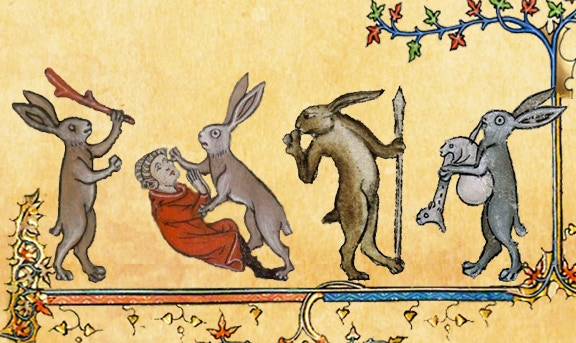
Medieval illustration: the rabbits take their revenge
The evidence
I mentioned documentary evidence, but what about the non-documentary kind? Isn’t it possible that the lack of documentary evidence is a result of rabbits’ low literacy rate?
Of course it is. One of history’s rules is that if you don’t write or get someone to do the writing for you, you don’t leave much in the way of documentary evidence.
However, a bit of non-documentary evidence is available. Archeologists (who do write) have found evidence of British rabbits from way back in Roman times. It takes the form of a single bone.
Given rabbits’ gift for multiplication, how is it that if they were here that early they didn’t populate the land and leave many bones behind? Because what’s been found is one bone, from one rabbit, and even a rabbit needs help from another rabbit. Of the appropriate sex. So this rabbit didn’t have the opportunity and might’ve been somebody’s pet. The clue to that is in the bone itself: rabbits in hutches will eat their own feces. (If you’re visiting from a language other than English, that’s a polite way to say shit. Which you may already know, in which case I apologize.) Wild rabbits will do that but not as often. Either diet will show up in the bone structure.
Isn’t it wonderful how many things you learn here, and how little use you have for them?
Back to documentary evidence, then
One of the earliest mentions of rabbits in Britain comes from 1176, when a landowner on the Isles of Scilly didn’t pay the church its tithe–think of the tithe as a kind of divine tax–on his rabbits because he thought “tithes were not payable on things of this kind,” suggesting that rabbits were still rare enough that the landowner thought somebody would fall for that reasoning.
Fast forward a bit and in 1235 Henry III gave Geoffrey Despenser ten live rabbits from his park at Guildford. A few years later, he sent men to collect 30 or 40 rabbits from Guildford, but only if it wouldn’t deplete the warren. So these are still critters to be careful with.
It wasn’t until 1240 that rabbits appeared on the menu as part of Henry’s Christmas feast. They were very much a luxury, costing four or five times more than chickens. Rabbit warrens were guarded against poachers, foxes, and anything else that would be happy to eat a rabbit without paying.
The Black Death
And there we stay, with rabbits the preserve of the wealthy, the titled, and the entitled, until the Black Death docked in Britain and multiplied more efficiently than rabbits. (The dates on that are 1346 to 1353; you’re welcome.) Somewhere between a third and two-thirds of the population died. With the cold-blooded irony that history specializes in, this improved life for the survivors. Land was going begging, improving the lives of the peasantry. And laborers could say, “Sorry, your lordship, but the iron law of supply and demand dictates that I have to charge more than I did last year, and that you have to pay.”
Let’s not get into the efforts to keep wages down–that’s another story and you can find it here, in another of my posts. (Sorry. If I don’t promote this stuff, who will?) We’re following the rabbits instead, so let’s note that in the 14th and 15th centuries they were showing up on the tables and in the bellies of wealthier peasants and that aspiring craftsmen were wearing grey rabbit fur.
And that leads us to mention sumptuary laws, medieval efforts to keep everyone in their place and dressing the part. The intent of the 1363 law was to control “the excess of dress of people beyond their estate, to the very great destruction and impoverishment of the land.”
Still, that gray rabbit fur that aspiring craftsmen wore wasn’t the truly fancy stuff. Henry VII tucked his royal self into bed wearing something involving black rabbit fur, and specialty warrens raised only silver-gray or black rabbits.
Hunting and poaching
By this time, rabbits were at long last doing what rabbits do best, which is to breed and to eat, and manorial accounts start to mention complaints about the lord’s rabbits damaging crops and land.
Did that mean the riff-raff could hunt them to control the numbers? The hell it did. In 1390, a law banned poaching and hunting by laborers and artisans. This was after the 1381 Peasants Revolt, and the fear–or the excuse; take your pick– behind the law was that while pretending to hunt they’d “make plots and conspiracies of rebellion” against the king.
The ban was extended to the use of “hounds and ferrets, hays, nets, hair-pipes, cords and all other devices to take or destroy beasts of the forest, hares or rabbits, or other sport of gentlefolk.”
So everybody stayed in their place, garbed in clothing appropriate to their station. The gentlefolk enjoyed their protected sport, destroying the beasts of the forest, without competition from hungry lowlifes. And the rabbits bred like mad, to the point where government guidelines now list them as a pest. They cause some £100 million of damage in a year and most of the country is a rabbit-clearance area, meaning people are obliged–theoretically–to kill wild rabbits on their land.

