Unknown's avatar

About Ellen Hawley

Fiction writer and blogger, living in Cornwall.

A possible treatment for long Covid brain fog 

A small study has identified two drugs, guanfacine and N-acetylcysteine, that may offer help for long Covid’s brain fog. In some cases they decreased it and in others flat-out eliminated it. And because  the drugs have already been approved for other uses (at least in the US, where the study was done; I’m not issuing guarantees about other countries), patients should be able to get them if they can find a doctor willing to prescribe them. 

Please note the if and the should in that sentence. It’s possible but not guaranteed. 

The results were strong enough that one of the researchers, Arman Fesharaki-Zadeh, went from researcher to advocate. 

“There’s a paucity of treatment out there for long Covid brain fog,” he said, “so when I kept seeing the benefits of this treatment in patients, I felt a sense of urgency to disseminate this information. You don’t need to wait to be part of a research trial. You can ask your physician—these drugs are affordable and widely available.” 

To confirm the findings, larger trials will have to be done, with a control group taking a placebo and lots of people in white lab coats looking important, but Fesharaki-Zadeh was convinced enough by the improvements that he’s gone on to use the combination with people whose symptoms are similar but were caused by Lyme disease and MS. He says the results are promising.

Irrelevant photo: Daffodils in February.

Other long Covid news

I’ve seen several articles lately about long Covid’s impact not on individuals but on society as a whole. The U.S. Government Accountability Office estimates that it has affected somewhere between 7.7 million to 23 million Americans. That’s a hell of a range, which probably testifies to how badly defined long Covid still is. 

A different study estimates that 500,000 people in the US aren’t working because of long Covid.

“It’s a pretty conservative estimate,” according to Gaurav Vasisht, a co-author of the second study. “It’s not capturing people who may have gone back to work and didn’t seek medical attention and may still be suffering, so you know, they’re just toughing it out.”

The good news is that the number of long Covid cases as a percentage of workers’ compensations has decreased. That change coincides with vaccines and treatments that can reduce the risk of long Covid becoming available.

What treatments? The article didn’t say, damn it. My best guess is they’re talking about antivirals.

*

A different study reports that in people whose mild Cofid cases left them with long Covid, the “vast majority” of the symptoms clears up after a year, and that vaccinated patients had a lower risk of breathing problems. 

*

Ah, but we have to balance out the good news, don’t we? A study that looked at a range of other studies saw that although most long Covid patients with mild cases recover, that’s not true of people with severe cases. 

Sorry.

*

Yet another study shows a healthy lifestyle coinciding with an almost 50% reduction in the chances of women getting long Covid. That’s not proof that the two are linked, only a bit of statistical flag-waving that says these two things live together, eat supper together, and leave for work together, so we could maybe assume they’re in a relationship, not just roommates. 

The lifestyle (damn, I hate that word) factors they took into account were maintaining a healthy weight, getting enough sleep, not smoking, drinking only moderately, exercising, and eating a good diet. 

Swearing seems to have no impact, one way or another. 

The slightly-more-than-half the group who did get long Covid got milder cases. 

Why did the study focus on women? The article didn’t say, but women are somewhat more susceptible to long Covid. That may or may not explain it. 


Vaccine news

India has become the first country to approve a nasal Covid vaccine. It can be used as both a booster and a primary vaccine. Because the vaccine sets up shop in the nasal cavities, which is where Covid likes to set up its own shop, it could keep Covid from spreading. Could. Potentially.

Watch this space. Watch several other spaces. Watch your nasal cavities. We’ll see what happens.

*

In China, researchers are at the animal testing stage of what they hope will be a universal Covid vaccine that targets a portion of the virus that has stayed stable across multiple mutations–11,650,487 of them if you’re counting. I’m not. I ran out of fingers somewhere around 12.

It needs more testing before it goes to human trials, but if I understand the article correctly, they’re hoping it will prevent breakthrough infections–the kind that dog people who’ve gotten the current vaccines. In other words, it could actually halt the spread of Covid–which (in spite of the way 90% of the people we all know are acting) ain’t over.


Non-vaccine news

We’ve got two items in this enticing little basket:

Number one is a spray that–if it works, of course–could keep Covid from getting any further than our breathing equipment. A group of engineers created “thin, thread-like strands of molecules called supramolecular filaments.” The idea is that you spray ‘em in your nose (or possibly mouth) and they block any virus from getting into your lungs.

Yes, you can still breathe through them.

The effect may only last an hour or two, but it would allow you to go into your nearest overcrowded venue and forget your worries for a while

How does it do that? Um, well, yeah. What do you say I quote?

“The filaments carry a receptor called angiotensin converting enzyme-2, or ACE2. These receptors are also found in cells in the nasal lining, the lung surface, and small intestine, and have many biological roles, such as regulating blood pressure and inflammation. The novel coronavirus enters our bodies primarily through interactions with this receptor. The virus’s characteristic spike protein clicks into this receptor, much like a key going into a lock, allowing it to enter the cell and replicate. Once the virus is locked into the cell, it prevents the cell from executing its normal functions, leading to and exacerbating infections.

“Researchers have long known that adding extra ACE2 into airways can block virus entry, essentially preventing the virus from binding with ACE2 in the lungs. However, since ACE2 has biological functions, simply delivering more ACE2 to the body may have unforeseeable complications. The research team’s newly engineered filament, called fACE2, serves as a decoy binding site for the virus, with each filament offering several receptors for the COVID-19 spike protein to attach to, and silences ACE2’s biological functions to avoid potential side effects.”

Like so many of the innovations I write about, though, it’s not yet ready for prime time.

Item number two in the basket is–oops, it’s very much the same but it’s coming from a different group. In fact, from more than one different group but still involving ACE2 receptors, decoys, all that stuff. 

Different delivery systems, different colors, slightly different mileage, but once you get past that they’re all related. Something seems to be happening here. Keep your eye on it.


Numbers

Statistically speaking, what do we know about the pandemic? 

  • That at least 6.8 million people died of Covid and 752 million caught it. 
    • That those numbers massively undercount what happened. Multiply them by 2 or 3 and you’ll get a more realistic number. 
  • That the global GDP dropped by 3.1% in 2020. Compare that to a 1.3% drop during the 2009 crisis. It bounced back by 5.9% worldwide in 2021.
  • That 135 million jobs were lost in 2020. 
  • That in 2022, 56 million more people were out of work than before the pandemic, and 37 million are expected to still be out of work in 2023. How those numbers square with the 5.9% bounceback in GDP is anyone’s guess.
  • That in the US, Covid is the eighth leading cause of death among people between 0 and 19 years old. If we limit that to disease-related deaths, it’s the fifth, and it’s first among infection or respiratory diseases.

Sorry about the wonky spacing of the bullet points. I’m sure there’s a way to even them out but I haven’t found it.

*

A study of Covid in California prisons–do I need to mention that they’re crowded?–shows that vaccination and boosters reduced the spread of the omicron variant by 11% for each additional dose.

For the mathematically impaired, I’ll point out that 11% is not 100% but it’s also not 0%. That means breakthrough infections–the ones that push their nasty way in among the vaccinated–were common but they were less common than Covid cases would be without vaccinations. And the rate of serious illness was low.  In a bit more than five months, they clocked 22,334 confirmed omicron infections but only 31 hospitalizations and no Covid deaths.

People who’d been vaccinated were a bit less likely to transmit the disease–the number dropped from 36% to 28%–but the longer it had been since a person was vaccinated, the more the chances of transmitting the beast grew–6% every five weeks. People are at their least infections within two months of being vaccinated or getting a booster.

Having said all that, Covid was spreading widely in the prison population and Sophia Tan, the study’s first author, was calling for “new ideas. . . since the risk of infection in this vulnerable population remains so great.”

Has Britain moved on from Wallpapergate? 

Let’s follow up on what may be the least important story in recent British politics: Wallpapergate.

You remember Wallpapergate, right? That was when Boris Johnson & Wife redecorated the prime ministerial residence, which wasn’t up to their standards, with £840 a roll, hand-crafted wallpaper, complete with gold whatsits. The most diplomatic way to describe the stuff is to say it would appeal to a narrow audience. 

Of course, I never claimed to be a diplomat. The stuff’s so ugly you have to admire the courage of anyone who lives with it. 

What’s the update? I asked Lord Google if anyone had taken it down yet and he had nothing to offer me except the information that for a while there it kept falling down on its own, either because it was too heavy or because it was ashamed to be seen. Sadly, the Johnson’s had it rehung. Or re-whatever-it-is-you-do-to-wallpaper.   

So presumably the Sunaks are living with it. Maybe they think taking it down would offend the Boris-backing wing of the Conservative Party. With a party that fractious, you can’t afford to offend anyone. Or maybe they don’t think they’ll be there long enough for it to matter. Or maybe they’re living there in Johnson’s shadow, the way a history teacher once told my class to imagine Europe’s post-Roman barbarian hordes huddling in the shadows of the Roman coliseums and thinking about the greatness that was no more. 

We should also consider the possibility that they’re leaving it up because Rishi thinks it would be a great joke to stick Keir Starmer with the stuff after the next election. 

*

Irrelevant photo: A frosty morning in January

For the sake of clarity, there’s a genuine scandal hidden under the wallpaper, but it’s nowhere near as much fun. It’s about who was going to pay for the redecorating. It was never supposed to be the Johnsons. A helpful donor was going to pick up the £200,000 tab, and I’m sure he was acting in the public interest and had nothing from it. Then the story went public and Johnson had to put his hand in his pocket.

And no, that wasn’t all for wallpaper. There was some furniture, a bit of this and that. You know how it is. These things add up and before you know it you have a couple of hundred thousand pounds. 

It could happen to anyone.


Spot the expert

A well-known writer wanted to update her Wikipedia entry. 

No problem, right? 

Wrong. Wikipedia rejected her changes, because what did she know about the subject?

The original entry said Emily St. John Mandel, author of Station Eleven, was married. No big deal to most of us. We don’t know her, don’t want to date her, and feel zero need to know about her private life. To Emily St. John Mandel, however, it did matter and she was of the opinion that she’d gotten divorced. Basically, she wanted to clear out the attic, the crawl space, and the Wikipedia entry after a breakup. So all she needed to do was make a simple correction, right? 

Not so fast, lady. To change a Wikipedia entry, you have to cite an authoritative source. First-hand knowledge doesn’t count.

So she went on social media and asked if any journalists would like to interview her about her marital status. The BBC and Slate figured she might actually be a reliable source raised, so they their hands–me, teacher, me!. When they published their interviews, they became something she could link to, proving that she really is divorced.

Her bio is now up to date. Let’s hope she doesn’t plan on marrying again. It’s not worth the hassle.


How not to start a war

Even before the spy balloon–or is it still an alleged spy balloon?–tensions have been high between the US and China over what bits of wet stuff lie in international waters and what bits are Chinese. Let’s not  go into the whys and why-nots of that, let’s just cut to an incident that happened back in 2015, when a US reconnaissance plane was patrolling a contested stretch of the South China Sea and got a radio message saying, “This is the Chinese Navy. Please go away quickly in order to wrong judgment.”

“I am a United States military aircraft,” a US officer said, “conducting lawful military activities outside national airspace.”

And what happened next? The voice that had introduced itself as the Chinese Navy said, “Meow.” That was followed by a series of beeps from the 1970s video game Space Invaders.

So we have a US military officer who introduced him- or herself as a plane and a (presumed) Chinese military officer who thinks he or she is a cat. 

World War III did not start that day. 


How not to write a headline

A recent article circulated by the news service Medical Xpress ran under the headline “Possible new way to reduce pain inspired by chickens.”

Do chickens inspire pain? I asked myself. 

Not in me, I answered myself. At least, not so far, and I’ve been around for a long time now. 

On the other hand, I reminded myself, they have beaks and pointy nails. And I haven’t spent a lot of time around chickens. Maybe they inspire pain in people who know them better.

Since this was a quick conversation and I’d run out of italics, I didn’t ask myself what it meant to inspire pain as opposed to causing it. Instead, I discovered that the article was about a way to reduce pain that was inspired by something involving chickens. 

From there on, the article was a disappointment.


Spot the chatbot

A chatbot passed a law school exam by  answering multiple choice questions and writing  essays on constitutional law and torts. Once you get past the headline, though, you learn that it was near the bottom of the class and didn’t do well with multiple-choice questions involving math or with open-ended questions. 

People marking the exams said they could could spot it because its grammar was perfect and it was repetitious.


Spot the restaurant

TripaAdvisor carried a listing for a nonexistent Montreal restaurant, Le Nouveau Duluth. By the time it was taken down, it had picked up 85 five-star reviews, including one that said, “Can’t believe this place really exists.”

Um, yes, there’s a reason for that, but it didn’t stop the place being at the top of the city’s ratings.

A careful reader might’ve picked up a hint that something was wrong by noticing the combination of valet and drive-through service. 


Spot the feelgood story

London will be giving the lowest-paid contract employees of Transport for London free travel on the network. That’s almost 6,000 workers, and none too soon: Fares are expected to go up by almost 6% in March and we’ve already got a cost-of-living crisis.

That story makes me feel so good that I won’t mention how underpaid they are and how that surely has something to do with why they need free transportation. They get the London living wage, which is higher than the minimum wage but not enough to live on. 

What was life like in Viking England?

English histories don’t ignore the Vikings. Who could? As raiders and as invaders, they left a mark that’s hard not to notice. But although the histories I’ve read mention the chunk of England the Vikings ruled, they treat it as if it was surrounded by an electric fence–they walk the perimeter, touch a quick finger to the wire, but then shy away to talk about the real England, which is (why, of course) the one the Anglo-Saxons ruled.

Well, screw that. Let’s go trespassing. I want to know what life was like in the Danelaw.


The what?

The Danelaw–the part of Britain ruled by the Danes (or Vikings, or Norse–it was all fluid at this point) and where Danish law was in force. It filled north, central, and eastern England (England didn’t exist yet as a political entity, but let’s use the name anyway) and included London. In other words, this was a big chunk of land. For a while there, it extended up into Scotland as well.

If you want to look like you know something no one else does, you can also spell it Danelagh or Danelaga. The price for that is that no one will know what you’re talking about. I don’t recommend it.

Irrelevant photo: Azalea blossom. In January. Indoors, I admit, but even so…


How’d the Danelaw get there?

Most of us first got to know the Vikings through cheesy movies, TV shows, and comic books. (Yes, we’re a high-culture lot around here.) They were raiders with horns on their helmets and they came in long, narrow boats, smashing, grabbing, and terrorizing. They were big, they were hairy, and they were scary.

Except for the business about the horns, that’s not untrue, but it’s also not the whole truth. 

Okay, I can’t vouch for the big and hairy part. They might not have been bigger or hairier than anyone else on the scene. Scary, though? Definitely. 

The rest of the story is that they were also settlers (or immigrants, or invaders–take your choice), farmers, craftspeople, and traders. They timed their raids to the agricultural year, because they were needed at home for the planting and harvesting. 

The raids weren’t England’s first experience of the Vikings. Britain and Scandinavia had a history of trade, and if you want to find cultural similarities, start by looking at England’s Sutton Hoo ship burial. But whatever the relationship was, no one wrote about it, leaving the Vikings to appear in the eighth century as raiders along the English coasts.

In the ninth century the Vikings shifted from raiding to settling in what became the Danelaw, replacing the Anglo-Saxon kings and landlords. It would be fair to say that they weren’t neighborly about those replacements. 

They settled most heavily in York and four other towns (they’re called the five boroughs, and York was dominant) and less heavily in rural areas. Some of them intermarried with the local population, so that it wasn’t long (at least in historical terms) before no clear genetic line could be drawn between Dane and non-Dane.

Not that they knew about genes, but everyone knew about sex. 

In some ways, the incomers adapted to the country they’d conquered. Buildings, for the most part, didn’t take on a Scandinavian style. Scandinavian runic writing disappeared. The incomers converted to the Christianity of Anglo-Saxon England fairly quickly, although a paper from the University of Leeds (sorry–I can’t find the author’s name) notes the difference between conversion and the more gradual process of Christianization and argues that “conversion might not be so much a matter of individual conscience as a question of social and political expediency.” In other words, the formal changes happened faster than the deeper ones. No surprise there.  


Language

Discussions about the Vikings’ impact swerve pretty quickly into language. In a period that didn’t leave us much evidence, it’s one of the things that can be traced. So place names get mentioned. The endings -by (village or farmstead), -thorpe (new village), -thwaite (meadow), and -dale (valley) mark a Viking presence. Personal names get mentioned. You can’t tell from a person’s name whether they were of Danish or Anglo-Saxon descent or a mix of both, Word borrowings also get mentioned.

Word borrowings? Tuesday and Wednesday are on loan from the Norse gods, although I’m cheating a bit since it was the Anglo-Saxons who brought more or less the same gods into English before they converted to Christianity. In contrast, Old English outright stole egg, steak, law, die, bread, down, fog, muck, lump, scrawny, and a long list of other words, and we’ve had them long enough that no one’s likely to ask for them back. Skirt, cake, freckle, neck, moss, sister, window, knife, smile, seat, gift, cross, leg, husband, law, and wrong are also ours illegally. So are words that start with SK, like sky and skin. Possession is 90% of the law. 

Most of those linguistic thefts were of everyday words, arguing (according to one article) that the two peoples lived side by side, passing a cup of flour and a bucket of words over the fence, as needed. They fall into a category of words a language can’t have too many of: nouns, adjectives, that sort of thing. If we have multiple words for tan (and if you’ve ever worked in the garment industry you know how many we have), the language can absorb that. But English somehow borrowed the word they from Old Norse (it was originally a masculine plural, but English got bored and made it gender neutral). Pronouns, it turns out, fall into a different category: the language chokes, coughs, and spits if it has multiples of them. The transfer (according to that same article) seems to testify to a close relationship between speakers of the two languages. In fact, the two languages may have been mutually intelligible–they’re both Germanic–which surely would’ve helped.

Compare all that to the French words that entered the language after the Norman conquest. We have more borrowings from French than from Norse, but they’re about high culture, hunting, law, cooked food as opposed to uncooked animals, and government, not about ordinary things like window, smile, knife, and seat.

Old Norse might have still been in use when the Normans invaded but it had probably dropped out of use by the twelfth century. Its speakers had been absorbed into the general population. 

Some academics argue that modern English is a descendant of the Vikings’ language, Old Norse, rather than of the Anglo-Saxon language, which I learned to call Old English. Other academics say, “Bullshit,” only more politely and at greater length. We’ll keep our hands in our pockets and let them fight that out, okay? May the best argument win.


Law

This is another place where the Vikings’ impact can be traced. With a lovely sense of irony, we stole the word law from them, along with by-law. The by there means “town.”

Central to the Viking legal system was the Thing–or in some spellings, Ting: a representative gathering that served as both legislature and court. (If you have nothing better to do, try googling “What is a thing?”)  

Someone accused of a crime could be brought before the Thing, with people stating what they believed to be the facts of the case. Or claimed to believe. Or–well, we’re an imperfect species. That hasn’t changed. 

A law-sayer would explain what the law had to say about the crime, and a jury or 12–or 24, or 36, if the case was important enough–would decide whether the accused was guilty or innocent. A person who was found guilty could be fined or outlawed–banished to the wilderness, denied help from friend and family, and fair game for his (or presumably her) enemies. 

When the old gods held sway, disputes could also be settled with duels, but Christianity put an end to that, introducing the civilized practice of the ordeal by fire. If you could grab a piece of iron out of boiling water and walk nine paces with it, you were innocent. Ditto if you could walk twelve paces over red-hot iron and not have infected wounds three days later. 

To be fair–and I do occasionally want to be fair–having introduced the ordeal by fire, Christianity later abolished it, but it took a while, and left a lot of burned feet.

Even after the Norman invasion, as late as the twelfth century, the old Danelaw area was recognized as having a customary system of laws that was different from the formerly Anglo-Saxon part of England’s.


Social structure

Viking women were freer than most women of their age. They could own land, divorce a husband, and reclaim their dowries if a marriage broke apart. With their men so often away pillaging, their role in the family was a powerful one, and some seem to have fought beside the men. 

All that is ripped wholesale out of discussions of Scandinavia, but it’s a fair bet that it carried over into Viking England. 

Solid evidence about women’s role is sketchy, though. Until recently, the assumption was that the invaders were men and that when they settled down they married local women. Recently, though, metal detectorists have found enough Scandinavian women’s jewelry to convince at least some experts that a fair number of women either journeyed with or later joined the men.

The strong impact of Old Norse on English also argues for the presence of Norse women. Language is transferred primarily in the home. A bilingual household is less likely to preserve the incomers’ language.

Or so the theory goes.  

Poor farmers also had more independence in Viking England than they did in Anglo-Saxon England. On the other hand, both the Vikings and the Anglo-Saxons held and traded slaves, so poor farmers weren’t at the bottom of the social scale. 

Nothing’s ever simple, is it? 

I could–in fact, I will–toss a handful of words at you that mark the Viking social structure: sokeman (a small farmer with more independence than the English equivalent), wapentake and sulung (units of tax assessment, which tells us that yes, these big, hairy people did have a governmental structure), jarl (which became earl), riding (an administrative unit that continued into the 1970s). The words hint at social changes that would’ve been significant to the people living through them.

What else do we know about the Danelaw? It experienced growth in industry–mass-produced metalwork; pottery that was thrown on a wheel and glazed–and that may have been due to increased trade.

It’s not much, is it?


And then what happened?

Viking and Anglo-Saxon England fought. Anglo-Saxon England paid Viking England not to fight. Everybody fought some more. People were born. People died. Everyone got mixed together in complicated patterns. A handful of English kings were Scandinavian. The last Anglo-Saxon king, the unfortunate Harold–he of the arrow in the eye–had Norse ancestors. 

The closer you get, the more complicated the picture is. You think you can draw a clean line between two groups of people and two cultures, but you can’t.  

Welcome to the real world.

Why the Normans invaded England–not to mention how

The usual path to the Norman invasion runs through the invaded country and begins with Edward the Confessor–very nearly the last of the Anglo-Saxon kings. But you know what? We’re not taking that route. We’ll go through France and start with a French king named Louis the Stammerer.

Louis had reason to stammer. He’d secretly married a woman his father, Charles the Bald, hadn’t selected. (Bad prince. Daddy’s very displeased with you.) He and his contraband wife had two sons with boring names, then Charles the Bald had the marriage annulled and got Louis the Stammerer married to a woman he–that’s Charles the Bald–had chosen. They had one son, Charles, later known as Charles the Simple, who wasn’t born until after Louis the Stammerer died. 

Have you ever wondered whether the introduction of family-based last names improved life? Using only the evidence we have on hand, I’d argue that it did.

Charles the Simple was considered the legitimate heir, since officially speaking an annulled marriage was rolled backwards until it had never happened, but it was a long time before C the S could do much more than eat, shit, and cry, which is another way of saying that even after he’d gotten himself born it took a while before he was any sort of political force. That left a blank spot and Wife Number One–the annulled wife–stepped into it: In 879 she maneuvered her sons onto the throne as joint rulers. 

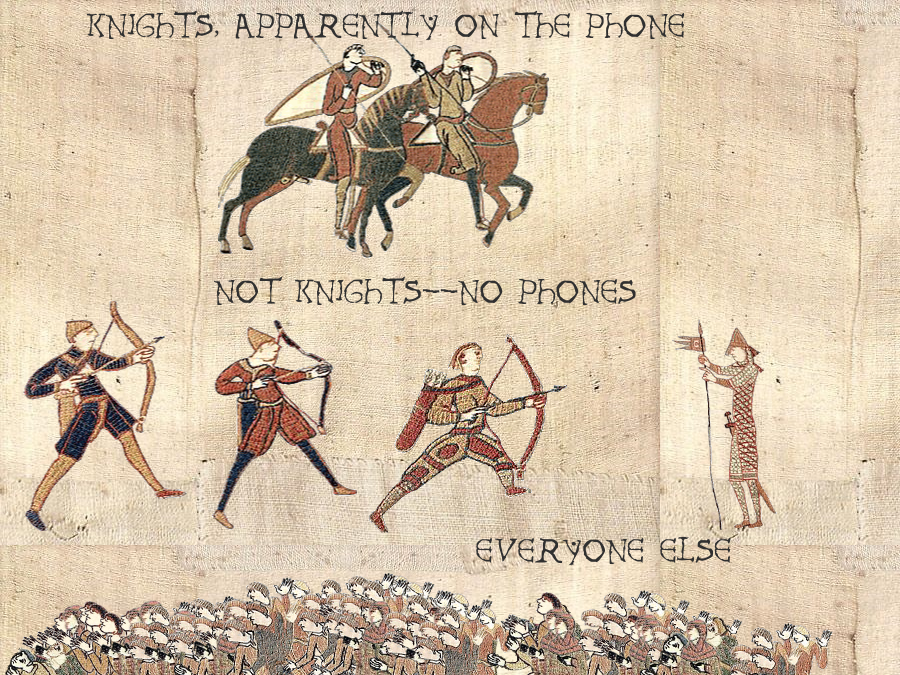
Want to make your own Bayeux Tapestry? You can do it online, thanks to Leonard A-L, Matieu, and Maria, whoever they are. Thanks, folks.

The brothers and the successors

The country the brothers were supposed to rule–that’s France, in case you’ve forgotten–had been beset by Viking raids for something like forty years and had been alternately fighting the raiders and buying them off. Neither approach worked for longer than forty minutes.

When the second of the co-kings died, France’s nobles installed Charles the Fat as king. We’re up to the year 884 now. Charles the Fat was the son of Louis the German, which isn’t particularly relevant but I can’t leave out anyone who has a good name. 

C the F wrecked his reputation by not just paying the Vikings to end their siege of Paris (so far, so familiar) but also suggesting they go raid Burgundy instead. That did it for C the F and the nobles installed someone who was competent enough but had a dull name but had no family ties to previous kings. That problematic DNA meant he couldn’t be real a king, so to hell with competence, after ten years they got rid of him and installed Charles the Simple, who’d had the wisdom to emerge from an approved womb. He was nineteen.

To say Charles was simple wasn’t to say he was simple minded. It meant he was direct. Even so, the act he’s remembered for wasn’t his own idea but his nobles’: He made a treaty with a Viking chief who’d stayed in France after the siege of Paris and was using it as a base to conduct even more raids. The deal was that the Viking–Rollo the Walker–would recognize Charles as his king, convert to Christianity, marry Charles’s daughter, and stop with the raiding. In return, he was to become duke of the land now known as Normandy–from Norman: the Norsemen; the Vikings–and make it into a buffer state against future Viking raids. 

Before formalizing the agreement, Rollo puffed up his fur, showed Charles how scary he was, and did some last-minute renegotiation, but he did put an end to the Viking raids on France and build a stable, Viking-inflected state in France.

From there Charles the Simple passes out of our story and we’ll follow Rollo for a few minutes, because he’s the three-times great-grandfather of William the Conqueror, the guy who invaded England.  


Rollo

What do we know about Rollo? Not bloody much. He lived, he raided France, he became the Duke of Normandy and the three-times-great etc. of someone much better known. And he died.  He was known as Rollo the Walker because–so rumor had it–he was too big to ride a horse. A trash-inflected web site that leans heavily toward explaining the history behind a marginally historical TV show tells me he was (or was said to be) 2 meters (that’s 6½ feet) tall and 140 kilos (that’s 308 pounds) in weight.

Well, other than weight what would he be 140 kilos in? Debt? Love? But don’t blame the trash-inflected site for that phrasing. It’s mine. I’d change it to something more graceful but I’d rather make fun of myself.

If you’re a fan of not knowing much about public figures, Rollo’s your guy. When archeologists opened the tomb of Rollo’s grandson and great-grandson, hoping to establish where Rollo himself came from (Norway? Denmark? Jenny Craig’s Weight Loss Clinic?), the bodies they found were some 200 years older than grandad/great-grandad himself. 

Does it matter? To us, no. All we care about is that we’ve gotten the Normans settled into France, where they intermarried with the local population, integrated into the French power structure, and curled up in bed with a nice cup of hot chocolate. 


The invasion

Okay, I’ll be honest with you: chocolate hadn’t made its way to Europe yet, and maybe that’s why William the Bastard–later known as William the Conqueror, which he probably preferred–got restless at being nothing more than the duke of Normandy, so that when Edward the Confessor died, having neglected to produce an heir, William decided to be a king in England as well. I mean, why not? Didn’t he have  a marginally credible tale linking himself to Edward’s empty throne? 

The problem was that another contestant lived closer and parked his hind end on it before William could, leaving an invasion as the only way to claim the fancy chair. 

But invasions aren’t simple, so let’s go through the steps he had to take. First, he counted up the forces he could call on–his vassals and all their knights and assorted foot soldiers–and decided they weren’t enough, so both he and the vassals scooped up mercenaries, either paying them or promising them plunder in England. Wars were a business opportunity back then. Aren’t you glad we live in enlightened times? 

The next step was to get everyone across the Channel, which is wet, even on a calm day.

Knowing we’d ask how he did that, English Heritage maintains a site telling us how to invade England. This isn’t a security risk. It’ll only help the modern invader who knows how to scroll technology back to what was available in 1066. 

William needed enough ships to get 7,000 men across the channel. Or 5,000 to 8,000 if we go with a different source. Either way, it was more men than you’d want to invite home, even if they hadn’t been the kind of thugs you’d hesitate to let in the door.

Quick interruption: The combination of endemic sexism and the English language have, historically speaking, encouraged people to say “men” when they mean people, leading to no end of confusion, but this was a testosterone-soaked adventure and the men involved were biologically male. I can’t swear that there wasn’t a woman or two tucked into the invasion force, but they’d have been either add-ons or well hidden. (Yes, there is a history that’s only recently being uncovered of women going to war in disguise. That doesn’t mean one joined William, but I’d raise the possibility even if it’s for no better reason than to mess with our assumptions.)  

Not all those men-of-the-male-persuasion would’ve been knights or even foot soldiers. To function, an army needed servants of various kinds. Nothing was automated or prepackaged. Everything that was done had to be done by hand. And it needed sailors–people who know how to keep the ships right side up. 

In addition to all those people, William had to make room for the knights’ horses, because if you take away the horses, knights weren’t knights anymore. So let’s say 2,000 horses, And all those people and horses had to be fed and watered or they’d be no use to anyone. And the humans had to have alcohol or they’d get grumpy.

Or maybe they didn’t all have alcohol, but William did. He brought wine. 

He also needed space for weapons, armor, and tempers. With all those mercenaries, you can figure that not everyone knew each other, liked each other, acted the same way, or spoke the same language, so we can pour a few regional and national rivalries into the human mix and stir in some alcohol. 

I’m convinced they had alcohol.

By now we’re probably talking about 700 to 800 ships. One chronicler wrote that William had 3,000 ships, but we can take that as a poetic way of saying “a shipload of ships.” Even using the lower number, though, it really was a lot of ships and Normandy didn’t have enough, so they had to build them. You can see little figures in the Bayeux Tapestry cutting the trees to make the planks to construct the ships that lived in the house that Jack built.

Sorry. My mind skipped a groove there. The story has no Jack. That’s a children’s rhyme.


What happened next?

The fleet sailed. The fleet landed. The invaders took over the country. But this wasn’t a case of one population overrunning another, it’s is a tale of one elite displacing another, leaving the people on the bottom of the heap in place so they could keep working to support the people at the top. Without people at the bottom, the country wouldn’t be worth having. So all but a handful of Anglo-Saxon nobles lost their land and William’s most important followers gained it. Job done.

How well did William’s less important followers–the foot soldiers and mercenaries–do? The details of how spoils were divided is a bit hazy, but rank weighed heavily in the process. It’s a fair bet that the foot soldiers who lived through the fighting were better off than they would have been if they’d stayed home, but they wouldn’t have vaulted up the social ladder. To each according to his station. 

So William’s key followers were paid off in land, but they weren’t given the power that in other situations would have gone along with it. The land was William’s to hand out, but the people he gave it to held it at his pleasure. In other words, he could also take it away. He’d created a highly centralized state, with himself–surprise, surprise–at the top. 

*

Following the Norman invasion from the Norman perspective has made me realize that in most of the respectable histories–at least until recently, when the pattern’s started to break apart–tales of colonization and invasion are told from the invader’s perspective. New Zealand? Start with England and Captain Cook. The Americas? Africa? Asia? Start in Europe. Ireland? Start in England. The Norman invasion, though? This tale starts in England. That may be heavily flavored by my own limitations, because I don’t read French well enough to tackle anything above the level of a comic book, and they’re more work than they’re worth, but working through the process from this direction reminds me how much nationalism and other biases shape what we accept as history and how easy it is to forget there’s more than one way to tell the tale.

Covid, flu, and the fight against airborne viruses

Covid research has given us some unexpected insight into the flu: Contrary to what most of us have believed since forever, we’re not likely to catch the flu by touching contaminated surfaces. Yes, the viruses for flu and Covid can both survive on surfaces for some time, but the experiments demonstrating that used industrial strength amounts of virus–more than you’d find in real life–and that skewed the results. What’s more, a lot of the viral particles the experiments found were no longer infectious. It was viral RNA, which is “more like the corpse of the virus” than like the virus itself according to Emmanuel Goldman, of Rutgers University. 

Goldman was the first person to challenge the hygiene theater that had people sanitizing their groceries, washing their hands, and singing “Happy Birthday” to make sure they’d washed long enough. 

Or maybe it was only in Britain that people sang “Happy Birthday.” It was recommended by our then-prime minister–what was his name?–as a way to know you’d scrubbed for twenty seconds.

To be fair, that was relying on the medical advice available at the time. If he’d been marginally competent in other ways, I might forgive him.

Of course, I might not, but that’s a different post, and one I don’t plan to write. We could’ve skipped both the hand washing and the singing. Like Covid, the flu is airborne, and that’s how we’re most likely to catch it. During the first year of the pandemic, when people were still taking masks seriously (in spite of the people who hadn’t figured out that their noses were part of their breathing apparatus and that their chins weren’t), flu transmission went down to almost nothing.

Irrelevant photo: An azalea, now blooming indoors.

All that Covid-inspired hand washing did do one thing for us: It improved food safety.

Having called time on hygiene theater, Goldman is now pointing us toward a way out of the pandemic: 

Respiratory viruses like COVID-19 and the flu spread primarily indoors, so we need a safe virus-killing reagent that can be pre-deployed in occupied spaces. As it happens, we already have one.

“Triethylene glycol (TEG) is an air sanitizer that has been shown to be safe for humans to breathe at low concentrations. It’s also been found to kill viruses on surfaces and in the air at those same low concentrations. Given the science, regulatory agencies should fast-track approval of TEG-based air treatments.”

Will they? No idea.

A UK government study evaluates its safety this way: “There is some evidence that repeated exposures to a glycol-based aerosol may result in respiratory tract irritation, with cough, shortness of breath and tightness of the chest. However, it is not possible to extrapolate the findings to other workplaces/settings or to longer-term exposure impacts, without further research.” 

It’s generally used to make theatrical fog. That’s what the bit about “other workplaces” means.


A Report from the Department of Covid-Fighting Gizmos

This is going to sound like I’m wearing the proverbial tinfoil hat, but a gizmo that uses no batteries and no wires can detect the presence of Covid in air. It uses a “magnetostrictive clad plate composed of iron, cobalt and nickel, generating power via alternative magnetization caused by vibration.” I have no idea what that means, although I could define every last one of the words–or I could if I looked up magnetostrictive. Why bother when I still wouldn’t follow it? That’s why I’m quoting. 

I can’t give you a link on this, because it came as a download. The article’s title is the poetic “Batteryless and wireless device detects coronavirus with magnetostrictive composite plates.” If you ask Lord Google nicely, he may lead you to something at least vaguely related. 

Exactly what you do with the contraption once you have it is up to you. I imagine sending it into a roomful of people on the back of a small, dog-shaped robot and waiting for it to report back before I go in. If it’s not safe, I’ll just go home, thanks.

Why’s the robot dog shaped? To add a bit of charm to my tinfoil-hat look.

*

Another invention allows you–or if not you, at least someone–to watch viruses die as they try to make their way through masks. 

I know. I prefer a book myself. Or TV. Or, hell, social media if I get desperate. But still, the thing’s out there and someone wants to use it.

What does it do? It gets viruses to light up when they die, and by doing that they tell us that very few viruses get all the way through multilayered FP2 masks. That’s reassuring, but the process can also identify what materials are most effective at killing viruses. In other words, we don’t need the dog-shaped robot for this one. People who design masks will find it useful. The rest of us can give it a miss.


Coordinating information on long Covid

Worldwide, some 100 million people are believed to be living with long Covid, and a new questionnaire is trying to get a better picture of its impact, giving researchers better information. 

Existing questionnaires don’t cover the full spectrum of its symptoms. It’s not just fatigue; it can also be vomiting, incontinence, erectile dysfunction, hair loss, and so much other other fun stuff. The new questionnaire breaks the symptoms into 16 categories and uses a single scale to measure their severity, nad it can be “e-migrated, translated, and cross-culturally validated,” which I think means it’s set up to be translated into hundreds of languages. Accurately. Taking into account the cultural context in which it’ll be used. 

So far, it’s been approved for use in 50 countries.


New drugs in the works

A couple of Covid drugs look promising. Others are in the works, but let’s not spread ourselves too thin. We’ll look at two.

One of them is already used to treat a liver disease (primary biliary cholangitis, in case anyone asks), so its safety has already been tested and its patent has expired, which means it doesn’t cost a fortune. What’s more, it’s easy to store, it’s easy to ship, and it can carry a tune even when a symphony orchestra’s playing an entirely different one. It never loses its temper. What’s not to like?

Dr. Fotios Sampaziotis, of Cambridge University, explained it this way: “Vaccines protect us by boosting our immune system so that it can recognize the virus and clear it, or at least weaken it. But vaccines don’t work for everyone—for example patients with a weak immune system—and not everyone have access to them. Also, the virus can mutate to new vaccine-resistant variants.

“We’re interested in finding alternative ways to protect us from SARS-CoV-2 infection that are not dependent on the immune system and could complement vaccination. We’ve discovered a way to close the door to the virus, preventing it from getting into our cells in the first place and protecting us from infection.”

The timing’s good on this one, because the virus has out-evolved the antivirals we’ve relied on. And because it works on the human cell rather than aiming at Covid’s spike protein, it should be variant-proof.

It’s done well in small clinical trials and will be going into larger ones.

*

Another drug, in an earlier stage of development, also promises to be variant-proof. It’s called an ACE2 decoy, and it works by luring the virus to itself, so it ignores the cells’ ACE2 receptors, which is the normal route for infection. Once it’s done that, it takes off the top of Covid’s spike, which inactivates it.  

It sounds ugly, but there’s a microscopic war going on in there all the time. 

The drug could potentially be used against other coronaviruses, which enter human cells the same way. It hasn’t been tested in humans yet but they’re moving it in that direction.

Does Exeter Cathedral have the world’s oldest cat flap?

I can’t prove that Exeter Cathedral has the world’s oldest cat flap–no one seems to collect worldwide data on cat flaps–but it has one that was built sometime between 1598 and 1621. Or if not built, cut, since the hole doesn’t actually have a covering.

How authoritative are those dates? Dunno. Multiple sources use the same dates, but they could all quoting each other. Still, the door that the hole was cut in looks old enough to convince me, so let’s go with it.

The cat flap was to allow the cathedral cat (not the one in the picture, you understand) to get into the cathedral clock and catch the mice and rats drawn there by the animal fat that greased the clock’s workings. This may be the origin of the nursery rhyme “Hickory, dickory, dock/The mouse ran up the clock.”

Absolutely and completely relevant photo: The Exeter Cathedral cat door–with cat demonstrating that it’s still in working order.

The cathedral kept a series of cats on the payroll in the medieval era, spending 13 pence a quarter on each one in turn, which doubled for a few years in the fourteenth century. Maybe they had to add a second cat when the first one was overwhelmed. Maybe the first one took on an apprentice or insisted on a friend staying for a lifetime’s worth of suppers. The evidence is scant but tantalizing.


Want to buy Evelyn Waugh’s old house? 

From there, let’s go to the news: If you were in the market for an eight-bedroom, six-bathroom mansion, you’re too late to bid on the one Evelyn Waugh once owned. (He’s the guy who wrote Brideshead Revisited.) It came with a few small snags that looked like they’d keep the price down.

The asking price was £2.5 million, and yes, that’s down. In 2019, it sold for £2.9 million, and I’ll drop a hint here for the mathematically impaired: That’s more than this year’s asking price. The 2019 buyer was  a company controlled by a former BBC executive, Jason Blain, and it financed the deal with a £2.1 million bank loan, but the bank lost its sense of humor when the company that bought the mansion defaulted on the loan. 

To be fair to the BBC, Blain has also worked for Sony Entertainment. He seems to have a history with, um, I guess you’d say payment problems. The Mandarin Oriental Hotel took him to court when he paid only (only!) £508,500 of the £1.24 million he owed for an eight-month stay. The penthouse he was renting went for £4,725 a night, and his bill included £30,110 for valet parking and £25,497 for room service. 

I’ve seen enough movies to vaguely imagine how a person could rack up that kind of a bill on room service, but valet parking? Where were they parking that car? In a neighboring country? 

Never mind. Let’s talk about the sale’s snags instead. At some point after the 2019 sale, the mansion was rented to someone or other for £250 per year (I’d love to know the story there; all I’ve read is that they call themselves “Evelyn Waugh superfans”), and whoever they are, they’re refusing to leave and won’t let anyone in–no buyers, no real estate agents, and no photographers, so we won’t be able to go online and poke our snoopy old noses into the virtual rooms to see what we couldn’t have bought anyway. 

As the auctioneers explained the situation,  ““The property is occupied under a Common Law Tenancy at a rent of £250 per annum. A notice to quit was served on the occupant on 19 August 2022 and a copy of such notice was affixed to the property gate on 22 August 2022. Prospective purchasers should take their own legal advice regarding this and will be deemed to bid accordingly.”

I believe that means, “Don’t blame us when it all goes wrong.”

When the place was auctioned off, it sold for a mere £2.16 million. The occupants are still refusing the leave.


How much can you manage to spend on a train ticket?

British trains are expensive–complaining about the impenetrable pricing structure is a recognized indoor sport–but I can’t account for how much one passenger managed to spend.

The passenger was a drag queen who was booked for a private performance in Bangor but who lived in London. To be clear, that’s the Bangor in Wales, not the one in Maine. It would cost more to get from London to Bangor, Maine, but you’d need something more than a train ticket.

But back to business: She did what anyone would do and booked a train ticket–a first class ticket, which isn’t what anyone would do, but who could resist? I can only assume the client was paying but it’s not like I know that. It was supposed to include a Christmas dinner, even though this was well before Christmas. The British don’t believe in confining Christmas dinner to Christmas day. Christmas dinner, like the wine that was supposed to come with it, is a liquid, and it leaks into the surrounding month. The ticket cost £589

How could the ticket cost that much? It wouldn’t have been easy. After I’d stashed my credit card safely in the other room, I went online to see how far I could push up the cost of a similar ticket. A last-minute (you pay a lot more for a last-minute ticket) round trip came to £153.40. That doesn’t seem to have been first class, although I tried to upgrade myself in two different ways, and nothing mentioned Christmas dinner. Maybe I lack imagination, but I couldn’t get close to £589. 

Never mind. She paid a shitload of money for her ticket. I paid nothing for mine, but then I didn’t go anywhere.

On the way out, first class service was canceled and she was decanted into the ordinary cars. On the way back, the whole train was canceled, but not until two minutes after it was due to leave. 

She took to Twitter, which did at least shake loose a response from the train company, Avanti West Coast. It said, “We’re sorry to hear about this customer’s experience and we’re happy to look into their complaint. . . Our new timetable is based on a robust and sustainable roster for our people without reliance on overtime . . . ” and so forth, for at least two paragraphs of blither.

Merry Christmas. Would you like a side of cranberry sauce with that?


Could artificial intelligence write that?

I’ve been reading a lot lately about whether artificial intelligence is ready to replace writers. A new chatbot is–they say–impressing people with how fluent it is. Fluent enough that a Guardian columnist had it write the opening of his column and it produced a credible if boring paragraph. 

Academics report that it can give correct answers to questions they ask their students.  

It has certain limitations, as the columnist (once he took over for the chatbot) pointed out. It can’t see why a kilo of beef doesn’t weigh more than a kilo or compressed air or why crushed glass shouldn’t be a health supplement. It reproduces the biases of its human trainers and makes up facts, but then humans do the same things–more of them every day, it seems–so maybe it shouldn’t lose points for that. 

Humans, though, will bump up against the real world periodically, and that will give them a chance to correct some of their bullshit. Or we can hope it will. Mentioning no names, but I’m still waiting.

As time goes on, the chatbot will probably make fewer ground glass-type errors, but the bias it inherits from its humans is likely to continue. I also wouldn’t look for its prose to lift off the page and make us smile, and I wouldn’t expect creativity. Still, it could have written Avanti’s response to the passenger’s complaint as effectively as the human who (presumably) wrote it. Or more so, since it wouldn’t be bothered by any residual sense of shame. 


What about those pesky humans, though?

Humans, it turns out, are more likely to send hate-tweets when the weather turns nasty. The best available explanation is that we’re at our nicest, or at least our least horrible, when the temperature’s between 54 F (that’s 12 C) and 70 F (21 C). Outside of that, we get crabby.

The study tracked 75 million tweets from 773 US cities and found that the pattern held even in high-income areas, where people would be at least somewhat insulated from heat and cold. It couldn’t trace the demographics of hate tweeters but it could trace their targets: primarily members of the Black, Latino, and LGBTQetc. communities. 

Women aren’t on the target list. (Are women a community? Is any demographic group?) I’m not sure if that indicates a hole in the study’s design or a startling sociological insight. Seventy-five years of life experience (admittedly, I didn’t spend all of it on Twitter) says it’s a flaw in the study’s design.

The study–or at least the article on it–didn’t mention rain, snow, or other storms.


Your feel-good story for the week

A girl named Madeline (age not specified) sent a letter to her county government saying, “Dear LA County, I would like your approval if I can have a unicorn in my backyard if I can find one.”

The letter found its way to the department of animal care and control, and its director (or someone else on her behalf) sent Madeline a metal tag stamped “Permanent Unicorn License,” along with a fuzzy unicorn–white with pink ears, purple hooves, and a silver horn. The country did set some conditions though: Any sparkles or glitter sprinkled on the animal have to be nontoxic and biodegradable and the unicorn has be fed watermelon at least once a week.

Long Covid and the vaccines: do they give us any protection?

I come bearing a shred of good news about long Covid. Or at least it’ll look good to you if, like me, you worry about the prospect of long Covid. This comes from two doctors, Sarah Ryan and Lawrence Purpura, who’ve worked extensively with it. I’ll skip the details on their experience–just follow the link if you’re interested. It’s shortcut week here at Notes. In fact, the shortcuts are so short that I’m going to quote them interchangeably. They’ll never know–and if they do I’ll take no shortcuts in apologizing.

They say the long Covid cases they’re seeing have been less severe than the ones they used to see. They attribute that first to the omicron variants attacking the upper respiratory system, where they don’t cause as many of the heavy duty symptoms–lung complications, increased heart rate, lightheadedness, and chronic fatigue–and second to the vaccines being somewhat protective against long Covid. 

No, the vaccines don’t protect us completely, but “studies show that even one dose of a COVID vaccine reduces the odds of developing long COVID by seven to 10 times.”

Break out the ice cream so we can celebrate, will you? Or at least an M&M.

Irrelevant photo: Fields after a December frost.

Who’s most at risk? An article in Cell “identified four factors that correlate with greater risk of long Covid—type 2 diabetes, prior infection with Epstein-Barr virus, level of Sars-CoV-2 RNA detected in the blood, and the presence of autoantibodies.”

A different study sees being female as an increased risk. That same study saw people’s risk decrease by 30% if they’d have two doses of vaccine.

How likely are people with Covid to get long Covid? No one has a good answer to that. There’s no one definition of long Covid, which makes it next to impossible–or maybe that’s completely impossible–to compile statistics. 

Still, they estimate that something like 1% to 5% of Covid patients will go on to get moderate to severe long Covid. At twelve weeks, around 25% of them report fatigue, 25% report insomnia, 20% report increased heart rate or dizziness, and 15% report neurocognitive deficits–things like short-term memory problems. Some of those symptoms will be very mild to some disabling.

A different study came up with 1% of people who had Covid but weren’t hospitalized coming down with long Covid, 6% of people who were hospitalized, and 32% of people who ended up in intensive care units.

Many people will have what Ryan and Purpura call “profound recovery” in three to six months; 10% will have symptoms that go on for more than a year. An even smaller percentage will still have symptoms after a year and a half. 

So the news is far from an all-clear, but in a bad-news situation, this is good news.


Other long Covid news 

I’ve been stacking up articles on long Covid but never seem to get back to them. But here we are in shortcut week, so let’s do a few quick summaries and then run:

  • Covid’s associated with increased liver stiffness–a possible sign of liver injury–months after infection. Note the hesitancy in there: associated with; a possible sign. Nothing definite, just something worth looking into more.
  • Covid can affect the brain profoundly even months after infection.
  • A different study, from the early stages of the pandemic (I hope that’s significant), linked Covid to impaired reasoning, speed of thinking, and verbal abilities, comparing what they saw to the effects of sleep deprivation. The severity of the symptoms matched the severity of the infection.
  • A small study found Covid can damage the DNA in cardiac tissue. Compared to the 2009 flu, “Covid has led to more severe and long-term cardiovascular disease.”
  • Covid’s associated with increased chances of long-term brain problems, including strokes, cognitive and memory problems, depression, anxiety, and migraines. And if that doesn’t make you anxious, tremors, involuntary muscle contractions, epileptic seizures, brain fog, hearing and vision abnormalities, and balance and coordination problems–basically symptoms like the ones that come with Parkinson’s. Vaccines reduce the chances of having any of this joy land in your life by about 20%. Keep in mind, though, that a group of people who’ve had Covid are more likely to face these problems than a group that hasn’t, but that doesn’t mean all of them will.
  • Covid was associated with an increased chance of stroke and heart attack. If the study’s correct, over the course of a year, for every 1,000 people who had Covid, you’d expect to find five extra strokes, three extra heart attacks, and twelve extra cases of heart failure 

Those last two studies show a pattern but don’t show cause and effect so let’s not go off the deep end with them. 


Is Covid no worse than the flu?

The claim that Covid’s just like the flu translates to “Don’t get hysterical.” So an article from Australia has given us a comparison of the two. 

Between the beginning of 2022 and August 28, Australia had 44 times as many Covid cases as flu cases and 42 times as many Covid deaths. 

That makes the death rate from Covid lower, right? It looks that way to this number-phobe, but it also misses the point. The absolute numbers are higher. If you find yourself in the group of people who died, you’re not going to be consoled by the percentages. 

Okay, strictly speaking, if you find yourself in that group you’ll be dead and unlikely to care anymore, but still, you see my point: Some 1,700 people were hospitalized with the flu between the start of the year and some date in September–pick a number, any number, because here at Notes we don’t really care. Compare that to a single day in July 2022 when 5,429 people were hospitalized with Covid.


Life expectancy

I kind of ditched our good news theme there, didn’t I? Sorry. I had some, I spent it all in one place, and now it’s gone. To hell with it, let’s do more bad news. It’s cheaper.

The Covid pandemic lowered life expectancy worldwide. Or at least in the 29 countries included in one study. That leaves out a bunch, but close enough for our purposes.

Predictably, the losses aren’t evenly distributed. Countries with the most effective responses bounced back to pre-pandemic levels relatively quickly. Countries where the response was less effective may have what the study calls “a protracted health crisis.”

It’s another piece in the argument that Covid’s not just the flu in fancy clothes. Flu in the second half of the twentieth century caused smaller, less widespread drops in life expectancy. 


The new variant on the block

The new variant that’s emerged in China is BF.7, which is short for something more complicated, which we don’t need to bother with. It’s more infectious than earlier variants, has a shorter incubation time, and is better at infecting people who’ve already had Covid. The symptoms aren’t that different than we’re used to: fever, cough, sore throat, runny nose, and fatigue, but some people end up with vomiting and diarrhoea.

It’s been found in several countries other than China but doesn’t seem to be spreading as quickly in them, although (as I write this, in mid-December) it’s not clear why.

A US tradition invades Britain, and other news

The British are (generalization warning here) touchy about cultural imports from the US, and some people are downright sniffy about them. Halloween? I can’t get through the fall without someone telling me that not all that long ago kids wouldn’t have dreamed of going door to door asking for candy. So it’s interesting no one has yet felt the need to remind me about Black Friday’s roots in the US, although it was brought over far more recently than Halloween candy. Maybe that’s because it involve shopping, bargains, and adults, so it slots into the culture with fewer rough edges. But an import it is. 

Irrelevant photo: I almost remember the name of this, but that’s not quite enough. It’s a flower, and I didn’t grow it.


Black what?

The Black Friday tradition started in the 1950s, and it wasn’t until 2010 that the US shipped it to Britain. If you’re in the mood, you can blame Amazon for either the introduction or the delay. I’m always happy to blame Amazon–for anything. Still, it wasn’t until Asda joined the mayhem, in 2013 (or 2014 on other websites), that Black Friday really took off in Britain. 

The tradition–for you few happy souls who have no idea what I’m talking about–is that stores slash their prices massively on the day after Thanksgiving (that’s always a Friday), and when shoppers get a whiff of those bargains they go mad. Periodic post-Black Friday headlines in the US involve crowds breaking down doors or trampling innocent grannies in their frenzy to get to the discounted whatevers before they run out. 

What’s it like in the UK? Well, now that Black Friday’s safely in this year’s rearview mirror, let’s check in with a study by the oddly named British consumer group Which? that (or which) nibbled the numbers behind some 200 supposed Black Friday discounts and came back with the news that 86% of the items were either cheaper or no more expensive in the six months before they went on sale. To put that in simpler terms, they weren’t a bargain. A full 98% were either cheaper or no more expensive at other times of the year. None–0%–were cheaper on Black Friday alone.

Don’t you just love a deal? 

Some retailers raised their prices just before Black Friday so they’d be telling the truth when they claimed to have cut the price. 

Which?’s retail editor, Reena Sewraz, said, “It’s rarely the cheapest time to shop and you’ll probably find the things you want are the same price or cheaper as we head towards Christmas, the New Year and beyond.”


The history of Black Friday

If I’ve taken the fun out of bargain hunting, let’s talk about where the name Black Friday came from. 

Hawley’s Small and Unscientific Survey tells us that the most widespread explanation is this: The shopping day after Thanksgiving is when stores count on crossing over from the red (debt) into the black (profit). But Hawley’s Small and Unscientific etcetera also reports that this isn’t the only tale around.

An alternative explanation, from no less a source than the Britannica, is that it originated in Philadelphia in the 1960s, when the police used the phrase to describe the chaos created by masses of suburban shoppers descending on the city to start their Christmas shopping. 

It wasn’t a compliment.

But we can go back further than that and trace the history to the 1951 edition of that rivetingly titled magazine, Factory Management and Maintenance, which wrote about workers’ habit of calling in sick the day after Thanksgiving. 

“‘Friday-after-Thanksgiving-itis’ is a disease second only to the bubonic plague in its effects,” it said in an editorial. “At least that’s the feeling of those who have to get production out, when the ‘Black Friday’ comes along. The shop may be half empty, but every absentee was sick —and can prove it.” 

The editor recommended using the day as a bargaining chip in union negotiations, since employees were taking the day off anyway. 

“Shouldn’t cost too much,” he (and odds are a 1951 editor was a he) wrote.

For all you would-be union negotiators out there, there’s a lesson in this: If they’re happy to give you something you didn’t think to want, be suspicious. 


Another way to invade England

In France, a group called the La Mora Association is recreating one of the ships William the Conqueror sailed in. They plan to sail it across the channel in 2027, more or less the way William the C did in 1066.

William came over with (probably) 14 vassals–that’s vAssals–who brought an average of 60 vEssels each. Probably. One chronicler says W the C had 3,000 ships. Modern estimates are in the neighborhood of 700, 800, or 1,000. Still, that’s a lot of floating boatage.  

The ships would have been Viking-style longships–those long, narrow things with both a sail and oars, not to mention a dragon head. At least mostly. The Bayeux Tapestry shows a few, but it doesn’t show all 700, not to mention 3,000.  

Whatever they looked like, the ships carried something like 7,000 men and 200 horses, plus armor, weapons, shields, bacon (no, bacon was not used as a weapon; yes, bacon is the beginning of a new category), hard-baked bread, cheese, dried beans, and wine. Plus water and feed for the horses. 

The men were a mix of knights, foot soldiers, and servants. It would’ve taken a lot of servants to keep an army functioning. And a lot of beans.

When the recreation of W’s ship sails, it will leave the weaponry, the horses, and most of the men behind, along with the other 999 ships. And its crew will set a different tone than W’s did.

“We want this to be a symbol of Franco-British friendship,” the association’s president said.

Is he aware of how that worked out last time? 

Well, yes. He even knows about Brexit. But he thinks the ship can, “in the wake of Brexit . . . reunite our two countries,” although my best guess is that the rhetoric comes after the fascination with building an eleventh-century ship, using historic techniques, on the basis of not much more than a picture in a 230-foot-long tapestry and some reproductions of viking ships in a Danish museum. 


And in another story very marginally related to ships . . .

Want to vote on the word of the year? You’re too late, but Oxford Languages did open the contest to the public–sort of–so you had your chance.

Having learned from the Boaty McBoatface fiasco (or glorious success, depending on your point of view), in which the public voted in their gazillions to name a serious research ship Boaty McBoatface, forcing the serious research organization sponsoring the contest to publicly overrule them, this contest’s sponsors gave us three choices and only three choices:  metaverse, #IStandWith, and goblin mode. 

Zzzzzzzzzz.

But hey, after its snooze-making fashion, it is democratic. 

The inescapable holiday post

It’s the time of year when countries that are, historically speaking, steeped in Christianity go slightly mad decorating, baking, eating, giving, getting, and spending more money than they can afford to do all of the above. Or at least the two I’ve lived in do.

In Britain, it’s also the time of year when wearing a hat modeled on a Christmas pudding is an almost reasonable thing to do.

What does a Christmas pudding look like? A dumpy, brown half-sphere, which the hat maker will have dressed up with a couple of holly leaves on the theory that they’ll make the hat look less brown and dumpy. We could argue about whether that works, but the greenery will at least signal that the hat’s a Christmas pudding, not some random brown half-sphere.

That last paragraph, in case you’re wondering, hints at why this is not a fashion blog.

Marginally relevant photo: This is not a Christmas pudding, it’s the Christmas shih tzu, tucked safe in his bed, visions of roast beef filling his head.

Wherever  you are, if you celebrate Christmas I wish you a merry brown hat. And if you celebrate something else at this time of year, I wish you a different kind of hat and a good holiday. And if–just to cover all possibilities–you don’t have a holiday right about now, one will come along eventually, so I wish you a good one of that.

I’ll be back with you just before the new year and as strange as ever. May all your holidays be decorated with bits of greenery.

Drugs, denials, and British politics

It’s always fun when you can wring a denial out of a politician, and the denials are rolling in: Unspecified people who do equally unspecified work at Chevening–an estate used by Britain’s secretary of state–reported finding “suspected class A drugs” after parties thrown by Liz Truss, the lettuce who became prime minister but was then secretary of state.

Lettuce? Well, yes. Her tenure as prime minister was so short that a lettuce publicly outlasted her. She’ll never live it down. 

What kind of class A drugs? Something that registered as cocaine when it was tested with a swab that changes color when it gets high. Or, more accurately, when it comes into contact with cocaine.

Irrelevant photo: This is from our recent cold snap.

Is cocaine legal in Britain? Nope. Possession carries a sentence of up to seven years or an unlimited fine or both, and in July the government launched (or anyway, announced; I can’t swear that they did any more than that) a crackdown on casual users. 

Casual users? Yes. Those are the kind of users who have passports, because it was going to confiscate them. That’s a more fitting punishment for a high-end user than jail time, which is a better fit for the low-end, no-passport, no-invite-to-Chevening kind of drug user.

An unspecified insider says cocaine’s used widely in Whitehall (“Whitehall” being shorthand for British government offices) and around Parliament. And you know how it is: These are important people. You can’t just toss them in jail when they do something illegal.

During the ten minutes when Truss was prime minister, one of her spokes-salads said cracking down on illegal drugs was a priority. 

Cleaners report finding white powder at no less a residence than 10 Downing Street after two of the parties that were held during lockdown back when Boris Johnson was prime minister. Johnson outlasted many lettuces as well as a head of broccoli, and although several barbers are rumored to have attempted damage control on his hair he outran them all. 

No one’s saying either Truss or Johnson put the powder up their own personal noses. In fact, Johnson’s said not to have been at either of the No. 10 parties that left powder behind. But it does raise questions about the culture around them and what’s tolerated at high levels and not at lower ones. 

So what about those denials? 

When the Guardian, which broke the story, asked for a comment, Truss’s spokes-salad said, “If there were evidence that this alleged activity had occurred during her use of Chevening, Ms Truss would have expected to have been informed and for the relevant authorities to have properly investigated the matter. As it is, the Guardian has produced no evidence to support these spurious claims.”

A spokescomb for Boris Johnson said, “Boris Johnson is surprised by these allegations since he has not previously been made aware of any suggestions of drug use in 10 Downing Street and as far as he is aware no such claims were made to Sue Gray or to any other investigators.

“It was a feature of Mr Johnson’s premiership that he strongly campaigned against drug use, especially middle-class drug use. His government made huge investments in tougher policing to help roll up county lines drugs gangs, which cause so much misery. He repeatedly called for harsher punishments for the use and distribution of class A drugs.”

A spokesdriver for No 10’s current U-turn expert said, “The Guardian has provided no evidence to support these claims. If there were substantive claims, we would expect these to be reported to the police.”

So there you go. Move along, folks. Nothing to see here.

Larry the Cat refused to comment but is alleged to have a serious catnip habit. As for me, I don’t usually post in the middle of the week, but this was too much fun to ignore.