Unknown's avatar

About Ellen Hawley

Fiction writer and blogger, living in Cornwall.

Are the fully vaccinated likely to get long Covid?

A bit of scientific brooding over Covid’s statistical tea leaves tells us that the chances of getting long Covid if you’re fully vaccinated are probably small. 

But with the emphasis on probably.

Was anyone other than me worried? After all, the statistics tell us that a vaccinated person who does catch Covid will probably have a mild case. Unfortunately, though, mild cases fairly often leave people with long Covid. 

So far, the information that’s coming in is anecdotal, and the experts say that it’s too early to be certain. In six months, it’s possible that a significant number of vaccinated people will start showing up with long Covid. It’s also possible that they won’t. 

So stay tuned. That’s not the reassurance I was hoping for but it’s the best we’ve got. 

Irrelevant photo: traveler’s joy


Do young people have Get out of Covid Free cards?

By now, we all know that young people are unlikely to get seriously frightening cases of Covid, at least when compared with old coots. 

But that doesn’t mean they’re immune. Like anyone else, they’re liable to come down with long Covid even after a mild case of the virus, and the small number who are sick enough to be hospitalized are almost as likely to have organ damage as the old coots are–almost 4 out of 10 of them. 

The message here is that Covid is not the flu. And that young people don’t have a free pass on this.

Young, by the way, is defined as anywhere between 19 and 50. Which from where I stand looks younger all the time. 


Taking quarantine seriously

Australia and China have decided that the new Covid variants are too contagious for hotel quarantine to be safe. They’re planning special quarantine centers

Compare that with the way Britain’s treated quarantine, which ranges on the strict end from hotel quarantine after sharing air with passengers who won’t be quarantining to, on the loose end, go home and look in the other direction when you pass other people on your way there.


The Covid news from Britain

Over twelve hundred scientists from around the world have signed a letter objecting to Boris Johnson’s policy of lifting all Covid restrictions on July 19. It will, they say, help spread the Delta variant around the world.

As professor Christina Pagel put it, “Because of our position as a global travel hub, any variant that becomes dominant in the UK will likely spread to the rest of the world. . . . UK policy doesn’t just affect us–it affects everybody. . . .

“What I’m most worried about is the potential for a new variant to emerge this summer. When you have incredibly high levels of Covid, which we have now in England–and it’s not going to go away any time soon–and a partially vaccinated population, any mutation that can infect vaccinated people better has a big selection advantage and can spread.”

Some of the experts described the policy as “murderous” and “herd immunity by mass infection.” The words unscientific and unethical also came up. If you pay careful attention, you’ll come away with the impression that they’re pretty pissed off. Not to mention scared. 

In the meantime, the number of people hospitalized with Covid in Britain is doubling about every three weeks and could reach what England’s chief medical officer, Chris Whitty, called “quite scary numbers.” Soon.

The government’s been telling us that vaccination has uncoupled the train car of hospitalizations from the accelerating engine of Covid cases. The problem is that they watched too many westerns when they were young, and uncoupling the cars from a runaway engine solved any problem involving railroads. 

Unfortunately, this is a pandemic, not a train. Or a western.

More cautious voices say they’ve weakened the link between Covid cases and hospitalization, but not uncoupled it. 

On Friday of last week, we had 50,000 cases, which is the highest  number since January. And 49 Covid deaths. 

Office for National Statistics data suggests that 1 in 95 people in England had Covid last week. I’m not sure why it only suggests that, but I’ve learned not to mess with the wording of things I don’t understand. 

The health secretary, Sajid Javid, is one of those new cases. He just came down with Covid. After having visited a care home earlier in the week–a visit that I’d guess was more pr and photo op than anything necessary. 

He’s fully vaccinated and says his symptoms are mild. He’s now self-isolating. No word on how things are going at the care home.


So what about Britain’s world-beating Covid tracing app?

Well, it’s been pinging a lot of people and telling them they’ve been exposed to Covid. That means they should self-isolate. Which means they should miss work. Which means the places they work, a lot fo which are already short on staff, are shorter on staff.

Which means no one’s in a good mood.

There was talk–quite definite-sounding talk–about dialing down the app’s sensitivity. People were uninstallling it, the government said, so as not to be bothered by its nagging. It was too sensitive, they said. The number of people pinged had grown by almost 50% in a week, to over 500,000. Transportation, trash collection, and health care were being affected, along with meat processing and car manufacturing. 

Then there was talk about not dialing down its sensitivity. It wasn’t too sensitive. The number of cases had grown, so of course the number of people exposed to Covid had grown right along with it.

So, the government mumbled to itself, what if we say that people who’ve had both their vaccinations are exempt from having to isolate themselves? They’ll get pinged, but they’ll be able to work? 

Last I heard, it hadn’t answered the question and was still mumbling. In other words, it’s taken the worst elements of both choices: It’s changed nothing but called the usefulness of the app into question and by saying lots of people are uninstalling it, it’s encouraged people to uninstall it. 

How England became Christian–twice

England converted to Christianity twice. Or if you want to put that in modern terms, you could probably say it was born again again.

You’ll want to keep in mind that England wasn’t England yet. It was the place that would become England when it grew up. 

Pre-England’s first brush with Christianity came when the place was still Roman, and you won’t find a clear event or date to mark its beginning. Sometime in the fourth century, though, Christianity became the trendy thing among the British elite. 

We know that in part because they built churches and started decorating their villas with Christian images, and bits of both have survived. 

The part about decorating the villas makes the shole thing sound frivolous, and some of it surely was–people are bound to be as silly in one century as they are in another, on any given topic and in roughly the same proportions. At a wild guess, I’d say it was probably your usual mix of belief, fashion, and politics. 

Irrelevant photo: nasturtiums

Non-Christian beliefs continued, though. People worshiped both Roman and Celtic gods, and their shrines went right on being used. The tradition of writing curses on lead and nailing them to walls or dropping them into springs and (I think) wells also continued. From our point of view, it was a useful tradition because it lets us drop in on the everyday stories of everyday people.


But first, a word or ten about paganism

Before we go on, let’s talk about how we’re going to describe the beliefs of the people who weren’t Christian, because if you do any reading about religion in Britain, you’ll find the word pagan getting tossed around as if it describes a set of beliefs. It doesn’t. Pagan’s a Christian word dating to about the fourteenth century, when it was first used to describe someone who wasn’t Christian. Basically, it means people who aren’t like us. But since an awful lot of religions in the course of human history have been other than Christian, that covers a lot of territory.

It doesn’t include Jews and sometimes it doesn’t include Muslims, although that depends on who’s using the word and what they think it means. But even when it doesn’t include them, neither Jews or Muslims are likely to use the word. It comes out of the wrong box of words. 

As far as I can tell, whether Muslims are in or out of the category rests on the question of whether pagan was being used as an all-purpose term of abuse or whether it was meant to describe people who worshiped more than one god. 

For a brief visit with the mindset of one set of people who took the word seriously–and I promise we won’t stay long–allow me to introduce you to a quote from an 1897 dictionary. This comes with a full-out racism warning:

Pagan and heathen are primarily the same in meaning; but pagan is sometimes distinctively applied to those nations that, although worshiping false gods, are more cultivated, as the Greeks and Romans, and heathen to uncivilized idolaters, as the tribes of Africa. A Mohammedan is not counted a pagan much less a heathen.”

If you’re going to heave, I’d appreciate it if you’d miss the rug. 

Thank you and let’s move on.

Sometime in the last century or so, Britons wanting to connect with earlier religions–at least as they understood them–began describing themselves as pagans. It drives me mildly nuts, since the original followers of those religions would never have called themselves that and I doubt we know enough about their beliefs to follow them, but never mind, the neo-pagans seem happy with it all.

This long meander is to tell you that I’ll do my damnedest to avoid the word pagan. I often use pre-Christian, but that has its own problems, among which is that it makes Christianity sound like history’s central reference point, which–well, history doesn’t work like that. 

It also doesn’t work when in the period we’re talking about a non-Christian king followed a Christian one. That would make the post-Christian king pre-Christian, at which point we’re talking complete nonsense.

If anyone knows a short, recognizable phrase that works better than anything I tossed out, do let me know.


Enough of that

Before I so rudely interrupted myself, Christianity was trending among the Romano-Celtic elite. Then the Romano-Romans left, leaving the Romano-Celtic elite to find their own way home from the party. 

There were no cabs. And since this was a party, not a meeting, no one was taking notes. That’s why it’s called the Dark Ages: We don’t know what they got up to after their Roman chaperones left. 

We have two theories to choose from: 

1. Anglo-Saxon tribes invaded what we now call England, slaughtering lots of Romano-Celts and pushing the others to the margins of Britain so they could seize the central part.

2. The Anglo-Saxons who had already settled in eastern England expanded westward, absorbing the existing population. 

Or since we had two choices: 3. Some combination of 1 and 2.

However it worked, Christianity was not trending in early Anglo-Saxon England, and not much is known about the religion the Anglo-Saxons followed. The writings that survive come from Christian sources, and what they describe sounds suspiciously Greco-Roman and probably wasn’t based on anything they actually knew. 

The internet, I remind you, had yet to be invented, which is a shame because they could have consulted Lord Google, who leads people to entirely reliable information 100% of the time. 

So we don’t know much, but perfectly respectable sources like the British Library are happy to tell us that the Anglo-Saxons were pagans.

Thanks, guys. I can’t begin to tell you how helpful that is.


The Celtic saints

While the middle of the island became “pagan,” with an emphasis on the quotation marks, Christianity kept its hold at the Celtic margins–Cornwall, Wales, Scotland. And Ireland, which is (you may have noticed) an entirely different island but played a big part in all this. 

Celtic Christianity wasn’t the Roman variety of Christianity. It was decentralized, it wasn’t impressed with the pope, and it was a good fit for cultures organized along  tribal lines, without big urban centers. It leaned heavily toward monasticism, and its monasteries were often isolated and austere, heavy on fasting, broken sleep, standing in cold water, and monks and nuns who generally made themselves uncomfortable.

Ireland and Wales in particular pumped out saints by the hundred. Or maybe that’s by the dozen. They’re hard to count. They wandered, they preached, they set up monastic communities. Some set themselves up as hermits. And although they’re called saints, what that meant was mainly that they were members of Christian orders. Or that they were literate. (Those two things might not have been so different.) Or simply that they were evangelists. 

The Celtic saints were, according to one source, happy to preach to ordinary people, but the key conversions were of the Anglo-Saxon kings, of whom there were still a fair number. Convert yourself a king and before you knew it you’d converted a kingdom. 

For kings, the attraction of Christianity wasn’t entirely (or maybe at all) religious. It brought access to Latin, the common language of Europe, and to writing itself. And once you had writing, you could have law codes, charters, traceable property rights. 

Conversion didn’t move in a straight line, though. A Christian king might be followed by a non-Christian king. A king might build a church but use it to honor both the Christian and a non-Christian god. I’ve heard an archeologist talk about finding a grave in Cornwall that showed evidence of both Christian and pre-Christian burial traditions. 

“They were hedging their bets,” he said.

But for all that, the Celtic Christian church was gradually building an organizational structure in Anglo-Saxon England, consisting of monasteries, bishops, and archbishops. 

Interestingly if somewhat irrelevantly, monasteries at this stage sometimes housed monks, sometimes nuns, and sometimes both. 


The Roman strand of Christianity

But the Anglo-Saxons were also evangelized by Roman Catholic missionaries, whose strand of Christianity was hierarchical and recognized the pope as head of the church. The two strands differed on crucial points, including what part of their heads monks should shave and the correct date for Easter–did it have to fall on a Sunday, and would it be a disaster if it fell on the same day as Passover?

The pope made efforts to reconcile the two strands by setting up a couple of meetings. One broke down when the British clerics approached the pope’s representative and he didn’t stand.

So yes, everything was handled in an admirably adult manner. 

Predictably, the doctrinal differences tangled themselves in kingly politics. Consider the Northumbrian King, Oswy, who followed the Celtic traditions but married Eafled, who’d been brought up in the Roman ones. He celebrated Easter on his date. She celebrated it on hers.

They might have lived unhappily ever after, never knowing when to give each other the chocolate rabbits or hide the Easter eggs, but at the Synod of Whitby, he decided his kingdom, Northumbria, would follow the Roman tradition. By one account, it was to foil someone’s political machinations with a few of his own. By others, it was because St. Peter held the keys to heaven. Either way, it was the beginning of the end–or possibly the middle of the end–for the Celtic strand of Christianity. By the 700s the Celtic strand of Christianity was in retreat.

The eventual dominance of the Roman strand explains why Cornwall and Wales have an endless string of saints that the Catholic Church never recognized. The histories of some are well documented, but all that’s left of others is a name, some guesswork, and a bit of befuddlement.

As for King Oswy, ask Lord Google about him up and you’ll find the King Oswy Fish Bar, the King Oswy Tandoori Restaurant, and the King Oswy Spar (that’s a convenience store). So yes, his name lives on.

Bread in medieval England: an update

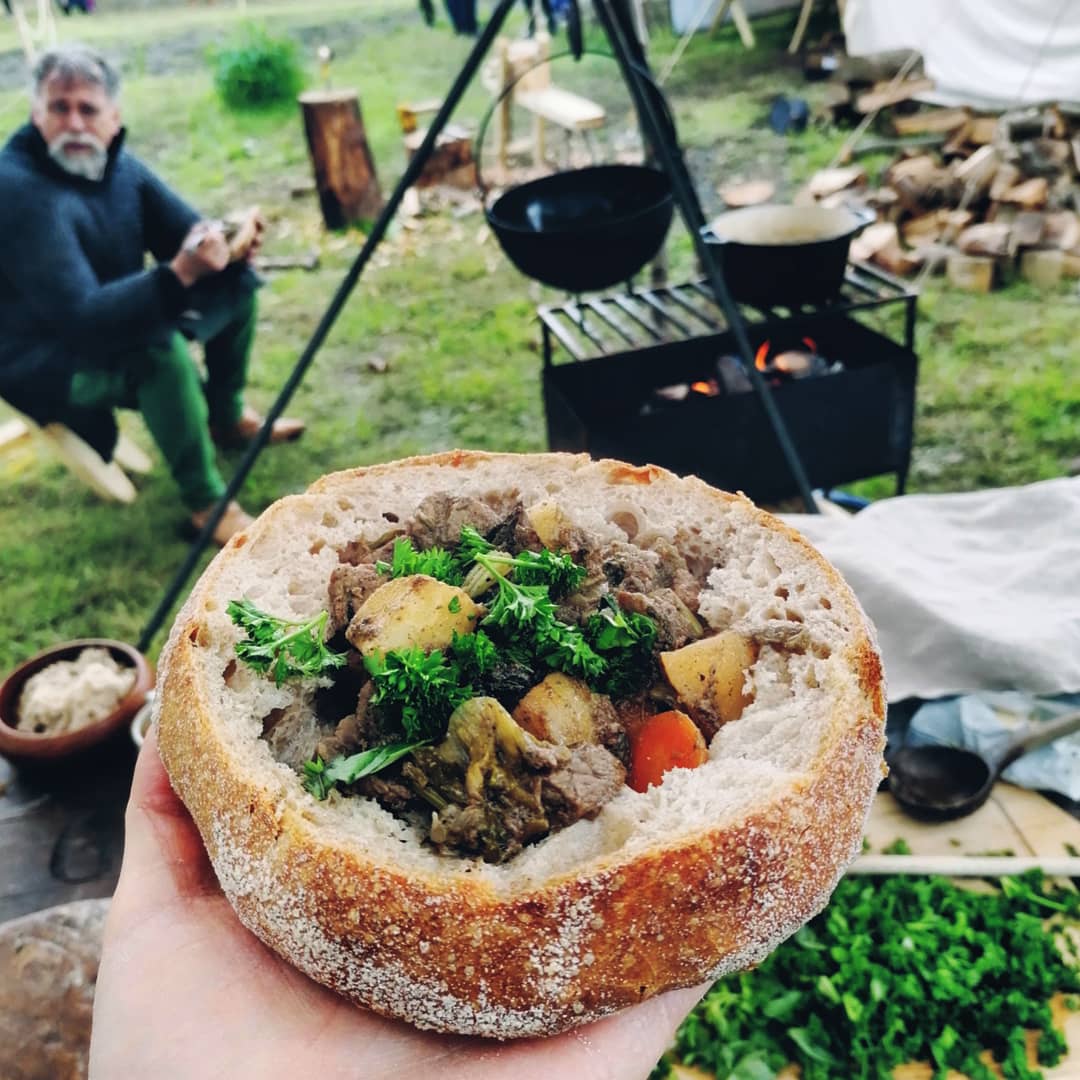
A quick update for anyone whose imagination was captured by the post on medieval bread making: Aleksandra from the Evendine Sourdough Bakery sent a photo of a trencher loaf she made (and served with pottage) for a medieval event in Evesham. I can only wish I’d been there.

She was working from a recipe in Food and Drink in Medieval Poland: Rediscovering the Cuisine of the Past, by Maria Dembinska.

Trencher loaf, made by Evendine Bakery.

Bread in medieval England

Bread was medieval England’s most important food. So much so that it gave us our words for lord (from the Anglo-Saxon “loaf-guardian,” or hlafward) and lady (“loaf-maker,” or hlaefdige). 

No, I can’t turn those into anything remotely lady- or lordlike, but they do both have an L and a D. Unless a genuine linguist or someone who learned Anglo-Saxon weighs in (and we do have one or two around here somewhere, so it’s not impossible), that’s as close as we’re likely to get. 

In the meantime, by way of proof I don’t have to mispronounce, records from medieval England, France, and Italy show soldiers, workmen, and hospital patients eating two pounds of bread a day. Or two to three pounds according to another source. That’s the same amount the nobility ate. 

So working people ate as well as the nobility? The hell they did. It’s just that aristocrats had access to meat and fish that the lower ranks could only dream of, while working people supplemented their bread with pottage.

What was pottage? If you think of it as anything that’s available, boiled, you won’t go too far wrong. April Munday did an interesting series of blog posts about making pottage from her garden, depending on what was in season and what would have been available in medieval England. The link above will take you to one of them.  

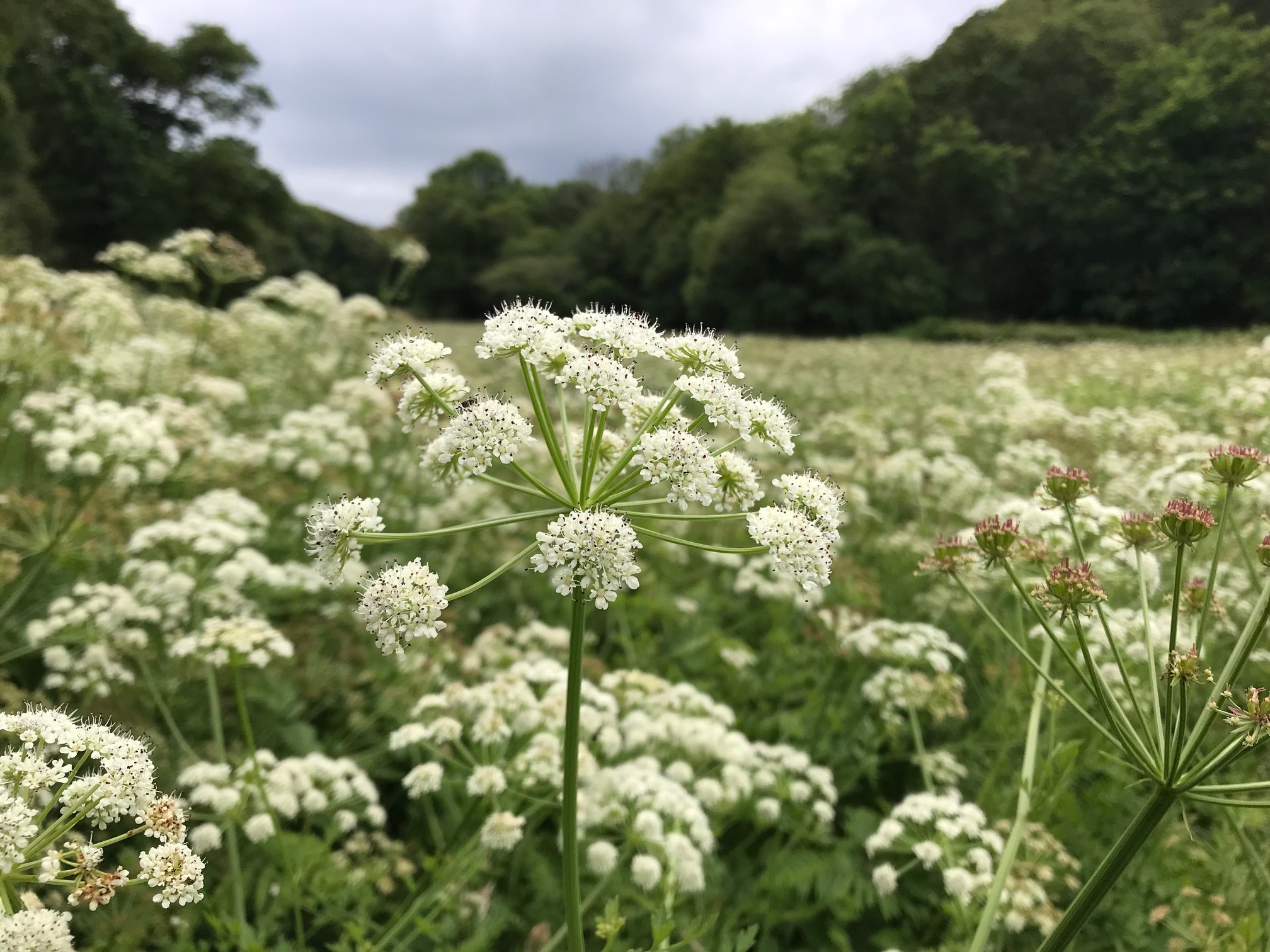
Irrelevant photo: Another of those tall white flowers I can’t identify. In fact, a whole field of them.

But everyone ate bread. Lots of bread. And the kind you ate was still a reliable marker of your class. The darker and heavier your bread, the lower down you stood in the social rankings.

No bread recipes have come down to us from the medieval period. One historian says this is because most bread was baked professionally. Others say it was so common that no recipes were needed. Which brings us to our next section:


A warning on sources

I’m using a range of sources here, and a lot of them are books. Remember books? They’re lovely things, but it means I’ll be short on links today. When I’m lucky, a range of sources will fill in blanks that others left, but this time they contradict each other in the most authoritative possible ways. 

We’re covering a long period of time here, from the early Anglo-Saxon era to the end of the Middle Ages, and that could account for some contradictions. Regional differences could account for others. After that, all I can offer you is a reminder that we weren’t there and social history’s a fragmentary thing. It examines things that are often considered too unimportant to document or too obvious to notice. So I’ll just throw this whole contradictory mess your way and leave you as confused as I am.

Don’t you just love being here? You read damn near two thousand words and come away knowing less than when you started.


A few kinds of bread

White bread was the good stuff. I’ve seen it called by a range of names, including manchet, wastell, paindemain, even  cake–a word with a Scandinavian origin that meant a small, flat bread roll. 

Paindemain–from the French for “hand bread”–may have been called that to distinguish it from trenchers, which we’ll get to later. 

The best white bread was made with the hardest and best sieved wheat flour, ground on the hardest stones so that it had the least grit in it. (Grit from grinding stones was part of cheaper bread, and some historians say a lifetime of eating it wore people’s teeth down.) It was raised with ale barm–yeast from brewing–which gives the best rise but is also unpredictable and in unskilled hands can go wrong, giving us the word barmy.

Yeast generally came from brewing beer, something that was done at home, or at least in many homes. It wasn’t universally used until the Renaissance, according to one source.

Even the loaf keeper and the loaf maker (that’s the lord and lady, in case you haven’t been taking notes) might not have had white bread every day.

Household bread was for the people a step down in the household. It was made with whole wheat flour, which might have been mixed with rye or barley. It was raised with leaven–a bit of yeasted dough saved from an earlier batch. Some books on bread baking still suggest doing this to improve the bread’s taste, although modern recipes rely on commercial yeast to do the heavy lifting.

Brown bread was made for farm workers and the lowest servants, from a mix of barley, dried peas, malt, and some whole wheat or rye flour. It was what we’d call sourdough: left overnight in a sour trough, where it picked up yeast left from earlier batches of dough. We may worship at the altar of sourdough today, but the taste wasn’t appreciated in the Middle Ages, and according to Pen Vogler in Scoff, the flour was likely to go off and given the bread a rancid taste. (Wheat germ has nutritional value but it goes bad easily. That was another benefit of white bread.)

Horse bread was what it said on the tin, food for horses, but not many people could read and tins hadn’t been invented yet anyway. In the face of famine or less widespread hard times, people ate horse bread, but it was an act of desperation.

According to a paper by Jessica Banks of Penn State University, bread could include not just rye and peas but also chestnuts, acorns, lentils, or rice. 

Rice? Yup. Starting in the eighth century, rice was grown in Spain and then in northern Italy as well. In England, it was an imported luxury and was considered the most nutritious of all grains. This wasn’t something for the poor to add to their bread. It’s not something I’ve added to bread myself and I can’t tell you what effect it has. I’d be surprised if it improves it.

For most of those, though, if you add large amounts to your bread  it won’t rise as well. Barley bread was considered second-best enough that Anglo-Saxon saints could flaunt their humility by eating it. 

According to Robert Lacey and Danny Danziger, in The Year 1000, the bread of the early Middle Ages would have been round, coarse flatbread, and much of it would have been stale enough that you’d dip it in your pottage in self-defense. Outside the towns and cities, they say, there wouldn’t have been any call for specialized bakers baking fresh bread every day.

On the other hand, Sally Crawford, in Daily Life in Anglo-Saxon England, says bread was cooked on a pan over a fire–a quick and logical way to bake flatbreads–or in the ashes of a fire. I’m inclined to go with Crawford on this. I’ve made flatbread. You don’t need an oven. (They weren’t introduced until the sixth century anyway.)

Another source says it was also cooked in the embers of a fire. As long as you turned it often enough, this worked. 


Ovens

The medieval peasant’s home had an open hearth and the fire burned on a flat rock–sometimes for decades, because starting a fire from scratch involved a lot of scratching of flint on iron or wood on wood. 

An oven, though? That would’ve been expensive, and if you could afford one you’d build it outside the house. In a town, you might build it outside the town walls. Fire was a constant threat. The Great Fire of London may have been well after the medieval period, but it started in a bakery all the same.

If you had an oven, though, you’d heat it before the food went in, then rake out the fire and put the food in, leaving the oven to cool slowly. In If Walls Could Talk, Lucy Worsley describes having baked this way. They soaked a wooden door in water to close the oven (that kept it from catching fire) and sealed the gaps with dough. When the seal was cooked, so was the bread inside, and just enough heat was left to bake biscuits–a word that comes from the French for “second cooked.”

Or just possibly for “cooked second.” My French is somewhere between iffy and iffier, but I do know when a phrase sounds better in English.

All of this was a lot of work and not something you’d want to do for a loaf or two. You’d bake either a lot of loaves–a community’s worth of them–or none. On many manors, the lord had a bakehouse and tenants had to pay if they were going to use it. 

Ian Mortimer, in The Time Traveller’s Guide to Medieval England, says that the yeoman’s wife (remember, please, that yeo-people ranged from poor to rich) might have had her own oven but might also have taken her ground grain to the village baker every week or so. That seems to say that she wouldn’t mix or shape her own dough, although other writers have people bringing their loaves to the baker.

In towns and cities, though, people bought their bread ready made, and as guilds formed, bakers organized themselves separately into one guild for the bakers of white bread and another for the bakers of brown bread. It wasn’t until Liz the First came along that–at her insistence–they merged into a single guild.


Why use wheat?

Vogler makes an interesting point about England’s reliance on bread: It’s complicated to make. You have to not just grow and harvest the grain but thresh it (back-breaking work if it’s done by hand), grind it (by hand in the early Anglo-Saxon period; mostly by water mills by the time of the Norman conquest), sieve it, mix it into dough, raise it, and bake it. All of this in a country that’s not ideal for growing wheat, which wants a long, dry growing season. That rules out the north and west of the country, she says, and it doesn’t sound like the rest of the place is ideal either.

Why didn’t people rely more heavily on rye, as large parts of northern Europe did? Or like the Scots and the northern fringe of England, on oats? 

Maybe it was the allure of that light, white bread that the best wheat could produce. Maybe it was just because. Humans are a strange species.


Trenchers

I’ve read several explanations of what trenchers were and how they were used, and everyone at least agrees they were bread used as plates. Some writers say they were a way to use up stale bread. Others say they were thin, unleavened loaves, baked for this purpose. One says they were the blackened bottom of the loaf, because the oven couldn’t ever be cleaned completely. This was cut off and given to lower members of the household, leaving us with the phrase “the upper crust”–the people who got the top half of the loaf. 

Some say the trenchers were fed to pigs after they were used. Some say that if a household was rich enough, they’d give the used trenchers to the poor. Some say they were eaten as part of the meal. I have no evidence for this, but I’d put my money on them usually being eaten, because making bread’s a lot of work and uses a fair bit of fuel. You can feed pigs something a lot less complicated and they’ll still put on weight. Medieval people didn’t waste food.

Giving used trenchers to the poor, though, might have been a way to demonstrate your wealth as well as perform an act of charity.

The most convincing comment on trenchers is from Medieval Cookery, which says about feasts that “the common belief is that after the diners were finished with their food, the used trencher was given to the poor. While there is some documentation supporting this belief, it is somewhat confusing and may be open to question.”

*

This post is in response to an email from the baker at Evandine Sourdough Bakery, asking about medieval bread. It’s not a topic I’d thought about. Thanks for suggesting it, Aleksandra. I hope at least some of this is what you were looking for.

Why England’s ditching the face mask

England’s preparing to declare a half-assed victory over Covid (“We have to live with it”) and celebrate with a nationwide germfest. Starting on July 19–or yesterday, if you want to be the first kid on the block–masks will be voluntary. Social distancing will be a memory. Getting drunk and hugging strangers will be an Olympic sport.

No, sorry. England doesn’t get to decide on Olympic sports. I got carried away.

If you want to gather a few thousand of your closest friends in a closet for snacks and drinkies, you’re free to. Sporting events will be back. If you’ve been working from home, you can go back to the office. 

Cases, our alleged prime minister Boris Johnson predicted, will rise to 50,000 a day and “we must reconcile ourselves, sadly, to more deaths from Covid.” But as long as we slip the word sadly in there, who gives a damn? I mean, these are people who’d die sooner or later, wouldn’t they? Of something.

Irrelevant photo: The Cornish coast

What they’re counting on is that vaccination has–in the phrase that’s being used so often that it’s started sticking to the walls–weakened the link between infection and hospitalization. Or sometimes the phrase is broken the link.

Broken it ain’t, and although the link’s weaker, the number of Covid hospitalizations has risen.

The main regulation that’s left is that you have to self-isolate if you’ve been exposed to the virus. Unless you’re fully vaccinated, in which case you get to collect £200 pounds in Monopoly money and start the game again.

A lot of this is about the economy, although how face masks damage the economy is beyond me and in the long run I expect all this will do more damage than good. The rhetoric on it is particularly brainless. You’re welcome to keep wearing masks, but it’s now a personal choice. Johnson said that we need to “move away from legal restrictions and allow people to make their own informed decisions about how to manage the virus.”

The next logical step is to let people make their own informed decisions on drunk driving. They’re in charge of a heavy chunk of machinery that can kill or maim someone. Other people’s lives are in their inebriated hands. But hey, it’s not for the government to tell them what to do.

Long live the extreme edge of libertarian logic.


Do masks actually make a difference?

Well, a study compared counties in Kansas that had face mask mandates with those that didn’t. Mask mandates reduced Covid cases, hospitalizations, and fatalities by 60%.

*

And since we’re talking about masks, a new Covid test has been developed that takes the form of a facemask. You wear it for 90 minutes and it either detects Covid or doesn’t, with the same accuracy as the PCR test–those slow, lab-based tests that are the gold standard for Covid testing. 

The team that invented it is looking for a manufacturing partner to mass produce it.

I see articles about new, fast, accurate Covid tests fairly regularly, and for a while I was mentioning them here. But after that, I’d hear nothing more about them and I kind of gave up on the topic. This one, however, has the potential to be tweaked so it detects all sorts of pathogens and toxins. I thought it might be worth a mention.


What about wind instruments and Covid?

It turns out that blowing through wind instrument generates fewer aerosols than either singing or talking. In fact, it’s no more than a person generates by breathing.

The amount of aerosols that singers and speakers generate rises with their volume. That holds true for both amateur and professional singers, regardless of their vocal training, their lack of vocal training, and how good or bad they sound. You run as much risk listening to a terrible singer as a good one, and get less back for it.


And what did you do with your time in lockdown?

A civil engineer set a new Guinness world record for the tallest stack of M&Ms. It took him hours, but it was raining, he was in lockdown, and he eventually managed to balance five on top of each other.

*

On the other hand, a six-year-old, Apollo Premadasa, wrote a string quartet, “Pandemia,”  and at the height of the pandemic emailed a London hospital to tell them about it. 

“I wrote this piece to say thank you to all the doctors, nurses and scientists around in the UK and around the world for all their hard work during the pandemic,” he said. “It’s been a really hard time for them and they have all been heroes.”

He plays the trombone, cello, and timpani, and he composes music. And in case you’ve forgotten, he’s six years old. 

To celebrate the National Health Service’s 73rd birthday, it was performed at the hospital

How kids learned to fake positive Covid tests–and why

TikTok videos have taught kids that they can get out of school by faking positive Covid tests. All they have to do is pour lemon juice or Coke on them. Or apple sauce, or vinegar, or hand sanitiser, or assorted other acidic liquids. Or they can rub a kiwi across them.

And here I thought TikTok was about dancing.

In Britain, at least, if they do that it means other kids in their imaginary school bubbles get sent home for ten days along with them. And their families have to stay home. But hey, if you’ve got a math test coming up–

It’s a short-term strategy, because in Britain a positive lateral flow test has to be followed up with a PCR test, which you can’t take home and use as a stir-stick for your Coke. Still, it’s a strange enough story to earn its word count here.

Irrelevant photo: Another wildflower I can’t identify. [It’s an elderflower. Thanks to DinahMow for identifying it. Somewhere in this strange thing I call my brain, I knew that.]

A spokesperson for the National Education Union suggested that Covid tests be taken in school. But that wasn’t about lemon juice and Coke. Many kids have simply stopped using the ones they’re sent home with. 

A determined spoilsport, it turns out, can override a faked positive. You can pursue that one on your own if you’re interested. The link is here.

But the story doesn’t end there. A claim’s making the rounds that lateral flow tests are useless because if you test a glass or Coke and a kiwi it will register as having Covid. And since any reasonable person knows Coke and kiwis are immune, there must be something wrong with the tests.

Shout, “Conspiracy,” here if you would.

Thank you.

A fact-checking site called, factually enough, Fact Check points to the directions from one test, which say, “This kit has been evaluated for use with human specimen material only.” This goes to the root of the problem, which is that neither the kiwi nor the Coke is human.

You can shout, “Conspiracy,” again if you want, but I won’t orchestrate it this time. I don’t think it takes a conspiracy to prove that claim. 

Alexander Edwards, associate professor in Biomedical Technology and professional spoilsport, puts it another way: “If you completely ignore the manufacturer’s instructions or in fact use the test for something completely different, then you shouldn’t really be surprised if you get a silly result.” 


At last: a way that Covid doesn’t spread

A study of Covid samples from hospital surfaces found that they weren’t likely to infect anyone. That lends support to the belief that contaminated surfaces aren’t a major way to spread Covid. I’d love to explain that to you in more depth but the explanation went over my head. You’ll have to follow the link and see where your head is in relation to the information.

Even without understanding the explanation, though, it reassured  me to know that the damn virus has found a way not to spread. 


High fashion in the Covid era

With British kids back in school (when they can’t talk their parents into parting with a lemon) and Covid restrictions easing (in spite of a more aggressive form of the virus), colds are coming back into fashion. 

I’m not basing this on personal experience. I haven’t seen anyone with a cold in a year and a half, but then I’ve never been in the front ranks of fashion. When a style starts making sense to me, that’s a signal that it’s on its way out. But I read this in multiple publications, and those of you who care about trends need to go out and get yourselves a cold. 

Parents haven’t quite caught onto this, so they’re dragging their kids into Britain’s A&E departments. (A&E stands for accident and emergency and it’s the equivalent of US emergency room.) They–that’s the panicky parents–have forgotten what it is to have a kid with a fever, a cough, and a runny nose. 

In fairness to everyone, those are also Covid symptoms and I might panic myself.

Britain’s hospitals are already overwhelmed and have been for the past year and a half. Or for the past decade or so–ever since the government started cutting funds and saying, cheerily, “We’ve never given the NHS so much money.” So they’re not in shape to add kids with minor problems to the major-problem mix. Last month, fewer than 1% of children under 15 who went to A&E needed immediate attention and more than 72% weren’t seriously ill.

And 4.36% asked their parents if they couldn’t get a Coke from the vending machine, please.

The US is also seeing a rise in the number of colds as face masks come off. 


A petri dish for the world

The British government’s gone sports mad lately. We’re in the midst of the Euro tournament where they play–oh, I don’t know. Some damn thing involving a ball. The game’s not the point; the crowds are, because fans travel here and there to watch the games. They eat out. They drink. For all I know, they get happy and hug.

Then they go home, and so does Covid.

In Scotland, nearly 2,000 cases have now been linked to people gathering in public fanzones, pubs, and house parties to watch the games–not to mention stadiums. Some two-thirds of those are among the 1,300 people who went to London to watch the Scottish team play there. 

For a semifinal game in Wembley, the British government plans to allow the stadium to reach 75% of its capacity–the largest crowd at a sports event in over a year. 

The World Health Organization has warned that tournament crowds (in general, not specifically this one) can act as Covid amplifiers. And the European parliament’s committee on public health warned that such a large crowd at Wembley would be “a recipe for disaster.” But Britain’s left the European Union, so we don’t have to listen to them. The reason we left the EU was so we’d be free to spread our own germs in any way we want.

If the EU passes the law of gravity, we don’t have to follow that either.

The government’s making noises about lifting most of the remaining Covid restrictions in mid-July. When it isn’t saying that we may have to take some precautions. It’s hard to know which Boris Johnson to believe, but my money’s on him lifting most restrictions. I’m basing that on how many decibels are devoted to each side.

It’s not a prospect that makes me happy. As Mark Woolhouse, a professor of infectious disease epidemiology, said, “The UK is in a unique position. We’ve the biggest Delta outbreak in a well-vaccinated country. We are a petri dish for the world.”

The question is whether vaccination breaks the link between infection on the one hand and hospitalization and death on the other. The government seems to be betting that it will. My best guess is that vaccination will weaken the link but that without other controls–masks; an effective contact tracing system; reasonable sick pay for people who are supposed to stay off work–it won’t be enough.


Updating the list of Covid symptoms

Assorted experts are calling for the UK to expand its list of Covid symptoms. It currently lists only the Big Three: cough, loss of the senses of smell and taste, and a high fever. 

Europe’s list includes headache, weakness, tiredness, muscle aches, runny nose, loss of appetite, and sore throat–symptoms that often begin before the Big Three and are more common in young, unvaccinated people. 

But hey, we left Europe. We get to enact our own symptoms.


Your small dose of hopeful news

A small study showed the Johnson & Johnson single-shot vaccine to be effective against the Delta variant.

Who were the Anglo-Saxons?

Until recently, if you asked who the Anglo-Saxons were the answer would’ve been that they were people from two northern European tribes who invaded England during the fifth and sixth centuries and then put down roots and stayed. They pushed the Britons (mostly Celts who’d been Romanized) to the corners of the island and formed a shifting set of small kingdoms in the island’s middle. 

The kingdomlets eventually became one full-size kingdom, which was in turn overthrown by the Norman invasion in 1066. 

Sic transit gloria mundi, which is Latin from Do whatever you like, in the end it all goes wrong anyway. It’s a run-on sentence, but you can blame the ancient Romans.


The Jutes and the complications

To complicate the picture (I can never resist a complication), you can also tell the traditional story so that there were three tribes, the Angles and the Saxons plus the Jutes. But the Jutes are always getting dropped from the discussion because they wouldn’t spend money on a publicity agent. So the Anglo-Saxons are the folks we know about. If you care what posterity thinks of you,  you’ll find a lesson in there somewhere. 

On the other hand, by the time posterity either remembers or forgets you, you won’t be around to care, so the Jutes may have been wise to spend their money on other things. 

Irrelevant photo: I can’t remember the name of this, but if you have one you suddenly find you have a thousand and you’re pulling them up everywhere.

What evidence we have says the Jutes came from Scandinavia–probably from what’s now Jutland–and that the tribal members who didn’t migrate got absorbed by the Danes. 


Where does the traditional story come from?

Two of the main sources of information about the period are Gildas and the Venerable Bede, and both wrote about battles between the Britons and the Anglo-Saxons. But Bede lived in the seventh and eight centuries, so he’s not a contemporary source. And Gildas lived in the sixth century, so although he’s earlier than Bede he’s not a contemporary either. Gildas also considered the Anglo-Saxons God’s punishment for the British leaders’ depravity, and sorry, no, I don’t have any details, but that does kind of mark him as something less than an unbiased narrator.

So grain of salt, please, with both of those. Some archeologists have begun to notice that no one has yet found evidence of those battles, and that calls their version of the story into question.

In addition, the dividing lines between Angles, Saxons, and Jutes may not have been as clear in real life as they were in Bede’s history. Still, their names have been preserved in assorted place names, showing that they were used. The English counties that end in -sex (settle down there in back; we’ve all heard the word sex before or we wouldn’t recognize it) were Saxon. Wessex is from West Saxons; Essex from East Saxons, Middlesex from Middle Saxons. The North Saxons, as was pointed out by someone who has a better grasp of British geography and history than I do, did not leave behind a place called Nosex. 

The Angles, however, left us East Anglia and England. Not to mention the word English

The Jutes (probably) left us Jutland, and it’s in the wrong country. See why they keep getting dropped from the conversation?

The Anglo-Saxons, somewhat irrelevantly, didn’t call themselves Anglo-Saxons. The word turns up for the first time in the eighth century. 


The unknowns and the new interpretations

One of the things we don’t know about the period is whether the Anglo-Saxons invaded in hordes or trickled in in small numbers and settled among the existing population. Bede and Gildas make the incomers sound like invading hordes who replaced the Romano-Celts, either killing them or driving them to the corners of the island. Until recently that’s been accepted as fact.

Then–

You’ve heard the complaints that Black Lives Matter protesters are rewriting history? Well, here’s history being rewritten with no political agenda at all. Because history’s constantly getting rewritten. New ideas crop up, and new ways of looking at things, and new technologies (social history, for example, or women’s history), and new information. They change the picture. So here’s how it’s changing at the moment:

Archeologists from Sydney and Vancouver have been rummaging through Anglo-Saxon bones from the fifth through eleventh centuries and they say the Anglo-Saxons weren’t from a genetically unified group of people. They were (much like the inhabitants of modern Britain) a mix of migrants and local people.

What sort of a mix are we talking about? Between 66% and 75% of the early Anglo-Saxons had ancestors from continental Europe. The remainder had local ancestors. And Anglo-Saxon here means people who lived in what archeologists identify as Anglo-Saxon settlements–people who lived a certain way, buried their dead a certain way, and had identifiable types of jewelry or goods buried with them.

For the middle Anglo-Saxon period (that’s several hundred years after the original migrants arrived), 50% to 70% percent had local ancestors and the rest had ancestors from continental Europe. That may mean local people adopted the Anglo-Saxon culture, that the rate of migration changed, or both.“Instead of wholesale population replacement,” they say, “a process of acculturation resulted in Anglo-Saxon language and culture being adopted wholesale by the local population. . . . It could be this new cultural package was attractive, filling a vacuum left at the end of the Roman occupation of Britain. “

The archeologists speculate that “being Anglo-Saxon was more likely a matter of language and culture, not genetics.”

Separate studies of DNA and of tooth enamel back up their findings, with incomers being identifiable only by high-tech scientific study. They were buried the same way as local people and in the same places. 


The Anglo-Saxon economy

The established belief has been that when the Romans left the economy went into a sharp decline. Basically, Britain fell apart. But enthusiasts waving metal detectors have added new evidence about the period, and in Building Anglo-Saxon England, John Blair uses it (and other evidence) to argue that the economy was just fine, thanks. It produced goods. It traded with other countries. It didn’t collapse.

Susan Oosthuizen’s The Anglo-Saxon Fenland and The Emergence of the English make a different version of the same argument. The early Anglo-Saxon years weren’t the gang warfare we’ve come to think they were. She looks at the way the land was used and sees continuity. The Roman withdrawal from Britain, she thinks, created stability, not chaos.  

Both households using privately held land and communities using common land continued very much the way they had. A violent transformation, she argues, would’ve overwritten field layouts. A conquering horde wouldn’t have settled into the boundaries, property rights, and land management patterns of the people they’d dispossessed.

Instead, she sees incomers and local people living beside each other, with no evidence that the earlier people became subject to the incomers. She goes as far as arguing that the period shouldn’t be called Anglo-Saxon, because that overlooks both the Britons and the immigrants from North Africa, the Mediterranean, Ireland, and parts of Europe other than where the Angles, Saxons, and Jutes came from. They  formed, she says, a common culture with a common language. 

The number of non-Anglo-Saxon immigrants was small but may have been culturally or economically significant. But (unsubstantiated theory warning) everything from “may have” is just me speculating.


But didn’t Britain collapse when the Romans left?

When the Romans left, Rome’s constant demand for taxes left with them, which may have taken pressure off the local economy. In places, arable land was converted to pasture. That can be taken as a sign of collapse or a sign that, without the need to shovel surpluses to Rome, people could afford to do this.

In 429, the bishop of Auxerre visited Britain and described it as “this very opulent island.” It “enjoyed peace with security on several fronts,” he said. And St. Patrick’s reminiscences apparently also paint a picture of a stable country, not one torn by wars and invasion.

Even Gildas–remember him? one of the sources of the war and chaos tale?–describes early sixth-century Britain as a country with  a functioning legal system, a church hierarchy, monastic houses, and a military command structure and administration that were still organised along Roman lines. 

A review of Oosthuizen’s book says, “What Gildas most disliked was the evidence he saw for new administrative, legal, social, religious, and political structures emerging and diverging from Roman norms, not the lack of such structures.”

The idea that historians should be neutral–or at least try to look neutral–was still centuries away.


Yeah, but the language–

But wasn’t Old English brought by the Anglo-Saxons and imposed on the country?

Not necessarily. There’s no evidence that it arrived in Britain as a fully formed language–it would’ve been, at the least, a variety of dialects– or that it was imposed. In eighth-century Britain–that’s well after the Anglo-Saxons first arrived–Bede says people spoke Old English, British Celtic, Irish, Pictish, Church Latin, and vernacular (meaning everyday spoken) Latin. A lot of them would have known two or three languages, and he says almost everyone could speak vernacular Latin.

English might have gobbled down several of those, using both a Germanic and British base for its syntax and a vocabulary that was stolen from everyone within hearing range. 

Linguists–at least some of them–are now calling English a contact language, meaning not that flies stick to it but that it grew out of the interaction of various languages. That’s in contrast to a language that’s imposed by a dominant class, as English was (by way of an example) in Britain’s colonies.


The Ikea hypothesis

I can’t leave you without talking about the map of Ikea stores in Oosthuizen’s book. (It’s reproduced in the review. The link’s above.) She argues that future archeologists could mark a map with all the Ikea stores that are close to rivers leading to the North Sea, and from that theorize that Sweden colonized Britain in the late twentieth century. 

They could back up the theory by pointing to the amount of Ikea furniture in people’s homes and decide that the 100,000 Swedes who lived in London in 2018 had moved there to work for Ikea. 

Which is entirely possible.

News from the Department of Good Government

In the US, a Republican in the House of Representatives is fighting climate change, one orbit at a time. At a committee meeting, he asked a senior Forestry Service official if changing either the moon’s orbit or the earth’s would fight climate change.

To which the official said that she’d “have to follow up with you on that one.”

She didn’t mention that the Forestry Service has no authority over celestial orbits. If she kept a straight face, she deserves a raise.

*

Irrelevant photo: I should know the name of this one but I can’t rattle it loose. Eri-something? It’ll come to me once it’s no longer needed. Erigeron? I think it is erigeron.

As long as we’re airborne and in the US, let’s talk about the New Mexico campaign rally that was interrupted by a flying sex toy.

Now there’s a sentence I never really expected to write.

The drone carrying it hovered beside the candidate briefly, then there was a scuffle for the drone (I’d guess that the owner wanted the sex toy back), and that was followed by a minor punch-up. 

I love an elevated political debate.

*

In Britain, a member of the public found classified defense papers in a soggy pile at a bus stop in Kent. The Ministry of Defense has said it’s sorry. 

No big deal. 


And now the news from science

E coli bacteria can be convinced to convert plastic bottles into vanilla flavoring

How’d they learn to do that? With the help of a bit of genetic engineering. 

Plastic bottles can be recycled, and a whopping 14% of them actually are, but only a limited range of uses has been found for stage two plastic. If you count that in money, stage two plastic is worth 5% of the value of the stage one stuff. So recycling them into vanilla? It’s a bit creepy, but if it pays, it’ll happen (she said cynically).

Some 85% of the vanilla currently in use is synthesized from–you got it–fossil fuels, and vanillin is used not just in food but also in cosmetics, pharmaceuticals, cleaning products (hang in here, because it gets weirder), and herbicides. Global demand has outstripped the supply of vanillin that comes from vanilla beans and is still growing.

So if you figure that worldwide a million plastic bottles are sold every minute–and somebody with a $5 calculator already has figured that for us–that’s a lot of synthetic vanillin that suddenly becomes available. 

So far, the process hasn’t been scaled up to a commercial scale, so don’t buy your ice cream cones just yet.

*

Bacteria can also be convinced to recover the rare metals from electric car batteries. The process is low energy and the rescued elements could be recycled indefinitely. The process is also, predictably, still in its infancy and not yet ready to play with the big kids, but it’s something to keep our eye on. We need whatever drops of hope we can find. 

*

Compared to recycling plastic bottles into vanilla, the creation of vegan spider silk may in the long run be more useful, since it eliminates the plastic and so won’t need recycling. 

Vegan what?

Vegan spider silk. It’s a replacement for plastic film and instead of it’s not made from vegan spiders. No spiders are involved in its creation. The link explains the process in more depth that I had the patience for, so you’ll have to read it for yourself if you’re interested. 

 The process of making it is energy efficient and the product will break down in a home compost heap. Unless you live in an apartment, in which case you just pile it up behind the sofa until you can plant potatoes in it. 

The product was developed at Cambridge University and is being handled by a spin-off company that expects to have products on the market next year–things like replacements for those little plastic pouches that hold dishwashing and laundry liquids. 

*

In a triumph for womankind and a great leap forward for equality between the sexes, women around the world are now as likely as men to have risky drinking habits. And the US is leading the way, with women in their teens and twenties getting drunk at higher rates than men. 

Yes, friends, there is no idea so good that it won’t find some way to bite you in the ass. 

As a second-wave feminist from the sixties and seventies, I can testify that this didn’t come up in those late-night, let’s-take-over-the-world plotting sessions that (of course) we held. 

Long-term heavy drinking hits women harder than men, and at lower levels of drinking. Women have less body water than men of the same weight, and body water dissolves alcohol. So they run a higher risk of hangovers, blackouts, liver disease, and alcohol-induced cardiovascular diseases and cancers. 

Yes, some people get to have all the fun.

It’s the sex, not the money: a small political scandal hits Britain

Nothing’s as delicious as a scandal unless it’s a scandal involving a government you dislike. So forgive me, but I’m enjoying the resignation of Britain’s former secretary of state for health. 

What brought Matt Hancock down was sharing a kiss with an aide. Or more accurately, sharing a kiss with an aide within range of the office CCTV, which an anonymous someone released to the press. Or even more accurately than that, sharing a kiss with an aide within range of the office CCTV during LockdownLite, when people weren’t supposed to even be hugging people outside their household (or “bubble,” in pandemic-speak), nevermind trading long and apparently passionate (CCTV can only tell us so much) kisses with them.

It was the pandemic hypocrisy that gave it resonance. Lots of people wouldn’t have minded making physical contact with a wider range of humans, but they were sticking to government guidance and here was the person allegedly responsible for that guidance conducting an extensive germ exchange with someone he was supposed to stay two meters away from. Because the health of the nation was at stake. 

Irrelevant photo: a rose.

Both Hancock and the aide are both married. To other people. So it’s a safe bet that their bubbles burst at the point where they wedged each other inside.

And just to give the story a bit more resonance, in the early stages of the pandemic Hancock criticized a scientist on the government’s scientific advisory board for breaking lockdown by getting together with someone he was in a long-term relationship with. Hancock said at the time that it left him speechless. 

The scientist resigned, taking his expertise with him. 

The real scandal, though, is that Hancock had appointed his aide to a (well paid) position as a non-executive director of the Department of Health and Social Care, which ever so incidentally oversaw his performance as secretary of state for et cetera. Without either of them mentioning their relationship. But that’s less fun than two people playing grab-ass in the office, so although it gets mentioned I doubt it’s what brought him down. 

How well paid is well paid? For 15 hours of work a year, the position pays £15,000 pounds. Unless I’m hallucinating, that’s £1,000 an hour. The aide has now resigned too. 

The role of the non-executive directors is to challenge the government as well as provide oversight, and fifteen other people with tight connections to the Conservative Party hold the positions in various departments. They include donors, former Members of Parliament, and peers. Let’s say it all gives the appearance that it wasn’t their expertise that got them their jobs.

But that’s nowhere near as much fun. 


A report from the Not out of the Woods Yet Department

One of the world’s most highly vaccinated countries, Israel, has reimposed indoor mask rules as the Delta variant becomes Covid’s dominant strain. The number of Covid cases was doubling every few days. Admittedly, it was starting from a low number, but so does any spike. 

And the same thing’s happening in other highly vaccinated countries–and even more so in largely unvaccinated countries. Delta has raised the stakes in the herd immunity poker game. People who’ve recovered from earlier Covid infections–the kind caused by other variants–seem to be vulnerable to Delta. 

A good news/bad news study shows that while two doses of the vaccines that Britain’s using are 96% effective against hospitalization and 79% effective against symptomatic infection, one dose is only 35% effective against Delta. 

Delta is so contagious that over 80% of a population would need to be fully vaccinated in order to contain it. So far, only 1% of Africa’s population has been vaccinated, and the Delta variant has been identified in 14 African countries. 

In spite of all the promises to get vaccines to poorer countries, contributions to the Covax vaccine program have dried up. “The world is failing,” a spokesperson for the World Health Organization said. “Just give us the vaccines.”

*

Six cases of the Lambda variant have been identified in Britain. That’s a variant that the World Health Organization has labeled a variant of interest, which translates to Don’t panic yet, but we’re watching it. It was first identified in Peru and has now been found in 26 countries. 

Don’t panic yet. At this point, it’s just something to know.


And a counter-report from the On the Other Hand Department

In the US, according to a study, almost all Covid deaths are of unvaccinated people. Breakthrough infections–the ones that happen to people who’ve been vaccinated–are 0.1% of the total hospitalizations. Of the Covid deaths recorded in May, 0.8% were among people who’d been vaccinated.

If I’m not mistaken (and I can’t be trusted with numbers), the second percentage is larger than the first, which does seem odd. I’m guessing here, but it could be because breakthrough infections happen in people whose immune systems are in one way or another out of order, so they’re not only vulnerable to infections in spite of vaccination, but having once gotten infected, are more vulnerable to the disease–again, in spite of being vaccinated. But that comes with a wild-ass guesswork alert. If anyone has some solid information on that, I’d love to hear it.

A short history of the 1918 flu pandemic

Now that we know at first hand what a pandemic is, this might be a sensible time to learn more about the 1918 flu–that thing most of us know as the Spanish flu. 

Spain’s connection was minimal. The disease first got public recognition there and that’s about it. World War I was still being fought, and newspapers were still censored in Germany, Britain, France, and the US–and possibly in assorted other countries that don’t get a mention. They weren’t allowed to mention the flu. You couldn’t publish anything that might lower morale.

Epidemics, you might have noticed, do lower morale.

Spain, though, sat on the sidelines in World War I. It didn’t censor its papers–at least not for any mention of morale-lowering diseases, although I wouldn’t rule out the possibility of censorship on other issues. So Spain broke the story and its reward was that the world blamed it for the disease it had mentioned. 

Irrelevant photo: a peony

Recent epidemiological research hints that the virus might have been circulating for two years before reaching pandemic levels, and US troops could have been–well, I don’t know if calling them the source of the epidemic would be correct, but the first known cases were in Fort Riley, Kansas, and they didn’t stop the US from shipping soldiers to fight in Europe. So you could make an argument that the US was the source. 

Alternative theories, on the other hand, point to China, Britain, and France. 


Numbers

Although a lot of us learned to call the 1918 flu an epidemic, it was a full-blown international pandemic. (Hands up: How many of us even knew the word before last year?) The only part of the world that didn’t report an outbreak was Marajo, which I never heard of until I started researching this post. It’s an island in Brazil’s Amazon Delta. 

The pandemic ran from 1918 to 1919 and killed over 50 million people worldwide. Or possibly 100 million. No one was keeping count, so we’ll have to settle for guesswork. And to confuse the picture further, even if folks had been counting, the symptoms were easy to confuse with other diseases. 

An estimated 500 million people were infected–a third of the world’s population.

In Britain, 228,000 people died of the flu; 1918 was the first year on record in which deaths outnumbered births. And Britain got off more lightly than many countries.

By way of comparison, worldwide Covid deaths are currently just under 4 million, although that’s generally agreed to be an underestimate. Britain’s had 128,000 Covid deaths.. 

The flu pandemic killed between 10% and 20% of the people who became infected, and more people died of it in a single year than died of the Black Death between 1347 and 1351. I believe that’s in Britain. Or in England. Or somewhere. Who cares? It’s a sobering comparison.

It hit young adults particularly hard–people between 20 and 40, who you’d expect to have the most resistance–but it also hit children under 5 and people over 65. Most of us, though, will have heard about  the 20-to-40 age group because it’s unusual for a disease to zero in on them.


Spreading the flu

The flu spread both through the air on droplets–those things that people breathe, sneeze, coughe, or talk into the air. It also spread on surfaces. You’d touch a surface that had germs on it, give them a ride to your face, and have yourself a nice little bout of the flu. 

Soldiers returning home from northern France get a special mention in any discussion of how the virus spread. In France, they’d been coming down with la grippe, which consisted of sore throats, headaches, loss of appetite, and the cramped trenches it circulated merrily. But they tended to recover quickly. Doctors called it a three-day fever. 

From that, though, the disease evolved into something deadly. We’ll come back to that. In the meantime, let’s go back to those British soldiers returning home on cramped troop transports and trains. Following their path, the flu spread from railroad stations to city centers, from city centers to suburbs, and from suburbs to the countryside. 


The pandemic’s waves

The first wave of the pandemic hit in the spring of 1918 and was relatively mild. The second came in the winter and was the most deadly. In the past, when I’ve read that the second wave was worse than the first, I assumed that meant only that more people got sick. No such luck. The disease itself had changed. In the second wave, you could be fine at breakfast and dead by nighttime. 

Let’s go to Historic UK for the gory details: “Within hours of feeling the first symptoms of fatigue, fever and headache, some victims would rapidly develop pneumonia and start turning blue, signalling a shortage of oxygen. They would then struggle for air until they suffocated to death.”  

The third wave hit in the early spring of 1919, and was somewhere between the first and third in its virulence. Smaller, localized outbreaks went on into the mid ‘20s. But in August 1918, an observer could reasonably have thought that the disease had ended, and since the government still had a war to fight it kept its attention on that. 

For the most part, pubs stayed open. The Football League and FA Cup had been canceled because of the war, but men’s regional tennis competitions went ahead and so did women’s football, which in the absence of men’s games attracted big crowds.  

Hospitals were overwhelmed, and it didn’t help that medical personnel had been vacuumed up by the war. Medical students were brought in to help fill the gaps. Doctors and nurses worked themselves to the point of exhaustion. 

Graveyards were also overwhelmed. Think of them as the kind of high-end restaurants where you need advance bookings. The draft meant the country had a shortage of grave diggers, of funeral workers, of coffin builders. Horses had been drafted as well, so even getting the dead picked up was a problem. In Sunderland at one point, 200 bodies were left unburied for over a week. 

When the war ended (November 11, 1918, in case anyone asks, at 11 a.m.), crowds turned out to celebrate, helping to spread the disease. There just might be a lesson hidden in there for us.


The expert advice

Sir Arthur Newsholme, the chief medical officer of the Local Government Board, wrote a memorandum in July 1918 advising people to stay home if they were sick and to avoid large gatherings. It wasn’t bad advice, and he promptly buried it. Britain had that war to fight.

Looking back on it in 1919, he said it could have saved many lives, but “there are national circumstances in which the major duty is to ‘carry on’, even when risk to health and life is involved.”

Keep smiling. Keep morale up. If you have to die, do it off stage.

The cabinet never discussed the epidemic. No lockdown was imposed, and I’m not sure the concept was available to be discussed. In 1917, it talked about forming a ministry of health to prevent disease and coordinate health care, but it did nothing about it until 1919, leaving localities to respond to the pandemic as well or badly as they could. 

In places, theaters, dance halls, movie theaters, and churches were closed for varying lengths of time, and in some places streets were sprayed with disinfectant. Some people wore masks. Some didn’t. Whatever happened, happened locally.

Public health messages ranged from the vaguely useful to the batty. Some factories relaxed no-smoking rules because cigarettes were known to prevent infection–or at least some people knew about it and probably thought the ones who didn’t were idiots or deliberately suppressing information.

But that’s just a guess.

In a Commons debate, M.P. Claude Lowther asked, “Is it a fact that a sure preventative against influenza is cocoa taken three times a day?”

The News of the World told people to “wash inside nose with soap and water each night and morning; force yourself to sneeze night and morning, then breathe deeply. Do not wear a muffler; take sharp walks regularly and walk home from work; eat plenty of porridge.”

Cleaning your teeth was also recommended. It might not keep you alive, but at least you’d die with clean teeth. Brandy and whisky were popular preventatives. So was ventilation, which would have actually helped, along with warm clothes. Worrying about your health, on the other hand, would make you more vulnerable. Besides, it could interfere with the war effort.

Predictably, in the absence of solid information, individuals were often blamed–for catching the disease; for spreading it; for taking risks that no sensible person would take, like passing up that third cup of cocoa.

People rushed to chemists to buy quinine, which was useful against malaria but roughly as helpful against the flu as turkey feathers. 

We can–and we might as well–laugh, but remember that there weren’t any antibiotics yet, which could have been useful against flu’s secondary infections. And there were no antivirals. The first vaccine for the flu wasn’t licensed until 1940. 

Many doctors prescribed what they had available: aspirin. Its patent had expired in 1917, so new companies moved in to produce it–I’d assume cheaply. Patients were told to take up to 30 grams a day, which is now considered a toxic dose. If you take anything above four grams these days, red lights start flashing and sirens go off. 

The symptoms of aspirin poisoning include hyperventilation and pulmonary edema, which is a buildup of fluid in the lungs. Some flu deaths may have been either caused or speeded up by aspirin poisoning.

To be fair, some of the recommended public health measures were useful, including ventilation, disinfection, limiting or banning large gatherings, quarantine, and isolation of patients, but they were applied unevenly. 


The pandemic’s legacy

Industrialized countries went into the pandemic with atomized health systems. Doctors worked for themselves or for charities or religious institutions. Public health policies–and this isn’t particularly about Britain–were colored by eugenics, a theory that, to simplify wildly and irresponsibly, managed to show that the people at the top of society were there because they were better genetic specimens and the people at the bottom were degenerate and a mess. So public health policy–or so the Smithsonian tells me–tended to be about protecting the elites from the diseases of the poor. 

When the pandemic died down and they had some space to think, the lesson many countries took from it was that healthcare had to be available to all, and free, although the moves in that direction weren’t universal or, at first, complete. Public health embraced the idea of not just treating disease but preventing it. Epidemiology–the study of diseases’ patterns, causes, and effects–came into its own, and epidemiology demands data, which governments, or some of them anyway, began to gather. One of the problems that article after article mentions about the flu pandemic is that it wasn’t a reportable disease, so doctors weren’t required to report cases to the government and wouldn’t have had a bureau to report them to if they’d been inclined that way. That meant no one knew the size or shape of the crisis.

In 1919, the forerunner of the World Health Organization was founded–an international bureau to fight pandemics.