
A century ago, someone found a cow’s jawbone buried beside the entrance to Stonehenge. The placement looked deliberate, and historians have been speculating about it ever since. Now, the high-tech toys available to scientists have delivered new information, answering some old questions and leaving us with new ones: the cow came from an area with Paleozoic rocks–in other words, rocks that are more than 400 million years old. The closest place that fits that description is Wales, where Stonehenge’s bluestones were quarried.
Does that mean Stonehenge was built by Welsh cows?
When they sober up, archeologists aren’t convinced of that, but there is speculation–sober speculation–that cows or oxen were used to drag the stones overland. It’s only recently that archeologists have found evidence that cattle were used to pull heavy loads in the Neolithic era, when Stonehenge was built, but they’re now pretty sure they were, and that fits nicely into the jawbone puzzle.
If you forgot to set your watch, the Neolithic era took place somewhere around 2990 BCE.
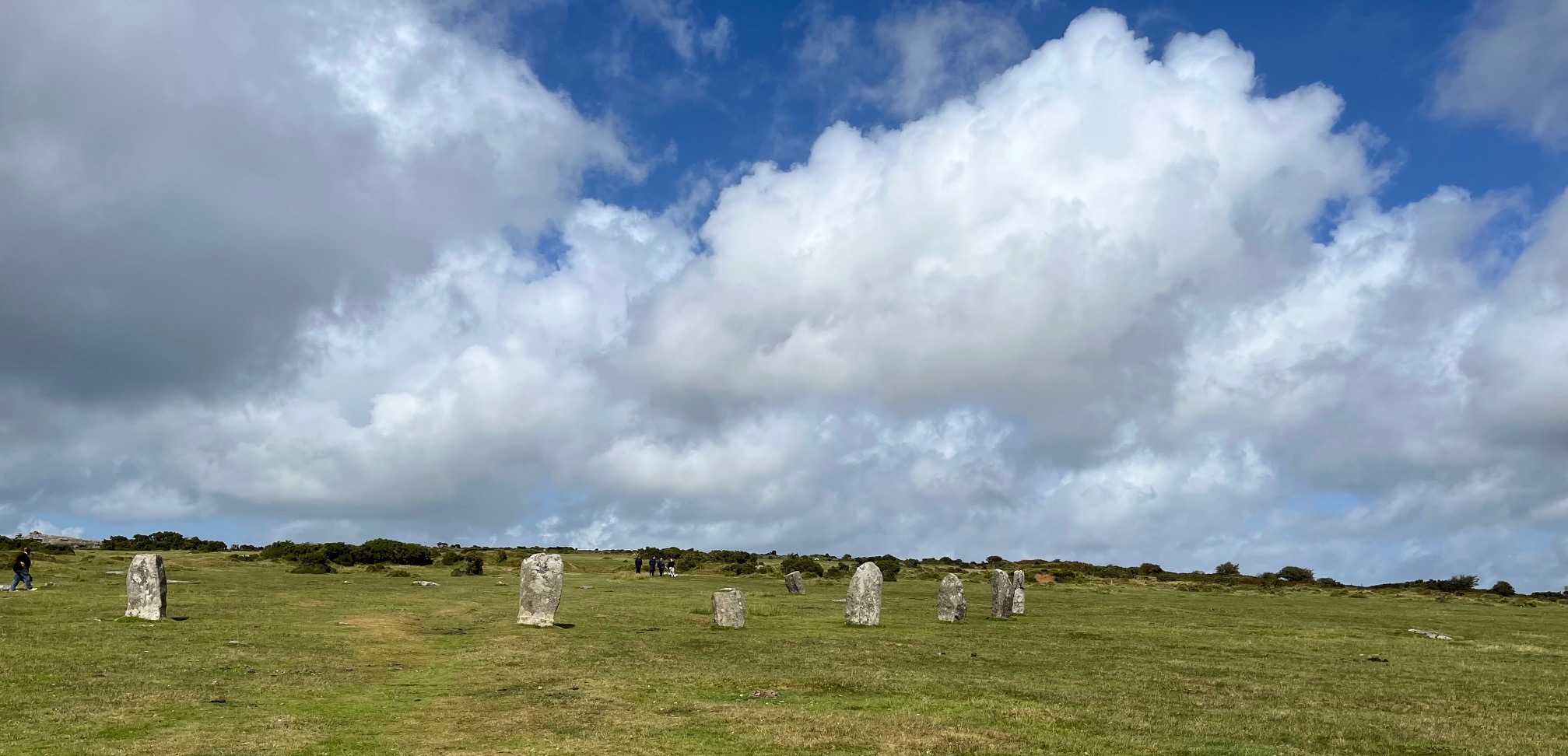
Marginally relevant photo: Stonehenge it’s not, but it is a stone circle. This one’s from Minions, in Cornwall.
But cows and oxen pulling the bluestones sits squarely in the land of speculation, so let’s not commit too heavily to it. We can’t prove that the cows in general or this cow in particular helped pull the stones. We don’t even know for sure that the cow in question was brought to Stonehenge alive, although if you’re going from Wales to Stonehenge, you’ll find it’s a long way to carry a cow. Or even a cow’s head, especially in the era before refrigeration. Humans are indeed strange, but not, I like to think, quite that strange.
What’s known for certain is that the cow was indeed a cow, not an ox or a bull. And that someone left her jawbone in a significant spot, like a note saying, “This means something,” and don’t we wish they’d told us what.
Cows, sheep, and pigs
Animal bones also figure in a recent article about bronze age gatherings in what’s now Britain. People traveled long distances to get together and eat. And, presumably, solidify the relationships between tribes or–well, whatever groupings we’re talking about. They would’ve known. The same techniques that inform us about Stonehenge’s Welsh cow also tell us where their animals came from before they became the feats.
Whatever it means, at one site they mostly ate beef; at another, mutton; and at a third, pork.
A Danish woodhenge
A circle of 45 wooden posts has been discovered in Denmark. It’s believed to have been built between 2600 and 1600 BCE–the late stone age and early bronze age–and it’s the second woodhenge that’s been found in the area. What experts take from this–or one of the things they take from it–is that Denmark, Britain, Ireland, and parts of northern Europe, which all have similar henges, were strongly connected.
The axis of the newly discovered henge matches that at Stonehenge, underlining the assumption that the builders had shared beliefs and technologies.
The Melsonby Hoard
Someone with a metal detector found what’s described as one of the biggest and most important hoards of iron-age glitz in Britain: a collection of more than 800 objects. It was found in a field in the north of England and includes wagon and chariot parts, bridle bits, ceremonial spears, and two ornate cauldrons, all of which shows evidence of burning, possibly as part of a funeral.
The expert who was called in after the detectorist reported his find said, “Finding a hoard of ten objects is unusual, it’s exciting, but finding something of this scale is just unprecedented. . . .
“Some people have regarded the north as being impoverished compared with the iron age of the south of Britain. This shows that individuals there had the same quality of materials and wealth and status and networks as people in the south. . . . The north is definitely not a backwater in the iron age. It is just as interconnected, powerful, and wealthy as iron age communities in the south.”
The find also provides the first evidence of four-wheeled vehicles in use among the tribes.
The Romans and the Welsh
A huge Roman fort that was in use from the first through third centuries has been found in Pembrokeshire, Wales, in an overgrown farm field. It may rewrite the history of relations between the Romans and the Demetae–the tribe that lived there. The belief had been that they were on peaceful terms, but the presence of a fort this size throws that into doubt, indicating a strong military presence.
The fort explains why the field was never worth cultivating: the farmer, and probably many before him, kept hitting stone. It was found by an archeologist from Pembrokeshire, who had often wondered whether an unusually straight road might not be Roman. (You may have to live in Britain to understand why a straight road would cause a person to wonder.) Then he looked at a satellite image and spotted the field, which is the size and shape of a Roman fort.
He drove out to see it and as he described the moment, “Sticking out of the ground was a triangular piece that looked like a Roman roofing slate. I thought: ‘Surely not?’ I pulled it up and lo and behold, it’s an archetypal Roman roofing slate, an absolute peach. Flip it upside down and you can see underneath a diagonal line where it was grooved to fit into the one that was underneath it. It’s a real beauty. . . .
“That was the diagnostic evidence I was looking for, which is a miracle, because it’s a huge site.”
The current best guess is that the fort held some 500 soldiers.
England and West Africa
We’ve moved to the 7th century CE, so reset your watches if you would, and we’re poking around disrespectfully in a couple of graveyards, one in Kent, on England’s southeast coast, and one in Dorset, a long walk to the west, even if you’re being dragged by a cow.
Sorry, no. Wrong era. Forget the cow. But in the same way that the Stonehenge story follows one cow to make sense of the Stonehenge story, this one follows two unrelated humans to get a glimpse of life in early medieval England. These burials hint at people traveling much greater distances in the early medieval period than we would’ve expected: both had a paternal grandparent from West Africa. Their grave goods show they were both buried as typical and well-thought-of members of their communities, and the ancestors of the people buried nearby were either northern Europe or western British/Irish.
That western British/Irish business is, I think, a way of saying Celtic now that it’s looking questionable that a group of people called Celts ever existed.
The Kent and Dorset communities had very different cultures, the eastern one Anglo-Saxon and in frequent touch with Europe, the western one on the fringes of European influence and primarily–um, whatever we say if the word Celtic’s gone up in smoke. Both, though, had contact with far-away West Africa.
And finally, a mere 800 years ago
In Leicester–pronounced, through some miracle of English spelling, Lester–in the twelfth century, 123 women, men, and children were buried, in a short space of time, in a narrow shaft near the cathedral. That would’ve been something like 5% of the town’s population and it’s one of the largest pit burials found in Britain.
“Their bones show no signs of violence – which leaves us with two alternative reasons for these deaths: starvation or pestilence,” said Mathew Morris, project officer at Leicester University’s archaeological services. “At the moment, the latter is our main working hypothesis.”
Initially, the archeologists assumed the deaths were from the bubonic plague, but when the bones were radiocarbon dated the centuries were wrong. But the Anglo-Saxon Chronicles do mention pestilences and fevers, severe mortality, and miserable deaths from hunger and famine in England from the mid-tenth century through to the mid-twelfth century. The pit burials seem to back that up.
“It is also important to note there was still some form of civic control going on,” Morris said. “There was still someone going around in a cart collecting bodies. What we see from studying the bodies in the pit does not indicate it was created in a panic. . . . There was also no evidence of clothing on any of the bodies – no buckles, brooches, nothing to suggest these were people who were dropping dead in the street before being collected and dumped.
“In fact, there are signs that their limbs were still together, which suggests they were wrapped in shrouds. So their families were able to prepare these bodies for burial before someone from a central authority collected them to take to the pit burial.”
In a roundabout way, the find is the result of Richard III’s body being discovered, minus the feet, in a nearby parking lot. His body was reburied in the cathedral and since then visitor numbers have gone wild, so the cathedral decided to build a heritage learning center in the cathedral garden, which had once been a graveyard.
In Britain, construction like that means an archeological survey, and tha turned up what was left of 1,237 people buried between the eleventh and nineteenth centuries. Below them was evidence of Anglo-Saxon dwellings below that, a Roman shrine.
“It’s a continuous sequence of 850 years of burials from a single population from a single place, and you don’t get that very often,” Morris said. “It has generated an enormous amount of archaeology.”
***
Totally unrelated to any of that, I wonder if a reader or readers can enlighten me on something that’s happened here lately. Notes used to get 2,000 to 3,000 hits per week, but about a month ago it started getting between 10,000 and 20,000, with as far as I can tell all the growth coming from China. That’s lovely–whoever you are, welcome–but it’s also strange. For one thing, it wasn’t slow growth; all those new hits appeared between one week and the next. For another, the list of posts that get the most hits hasn’t changed: Britain’s gun laws, Britain’s native foods, the shift to metric measurements, the scone. (I know: it’s an odd list.) I’d have expected a shift in readership to bring a change in interests, but it hasn’t. So is this a bot, clicking away mindlessly and reading nothing? Or is this something real?
If you’re a new reader from China, or if you’re not but know something that might explain what’s happening, or if you just want to tell me how strange this is, leave me a comment, will you?
Thanks.

 Notes from the U.K.