
Dido Elizabeth Belle was born a slave, raised in an aristocratic English family, and given the education and many of the and-so-forths of an English aristocrat. Her story messes with pretty much any assumptions we carry in our luggage. In some tellings, she’s Britain’s first Black aristocrat. That makes a great headline but it stretches the truth.
Let’s call her Dido, since her mother comes into the story and her last name was also Belle.
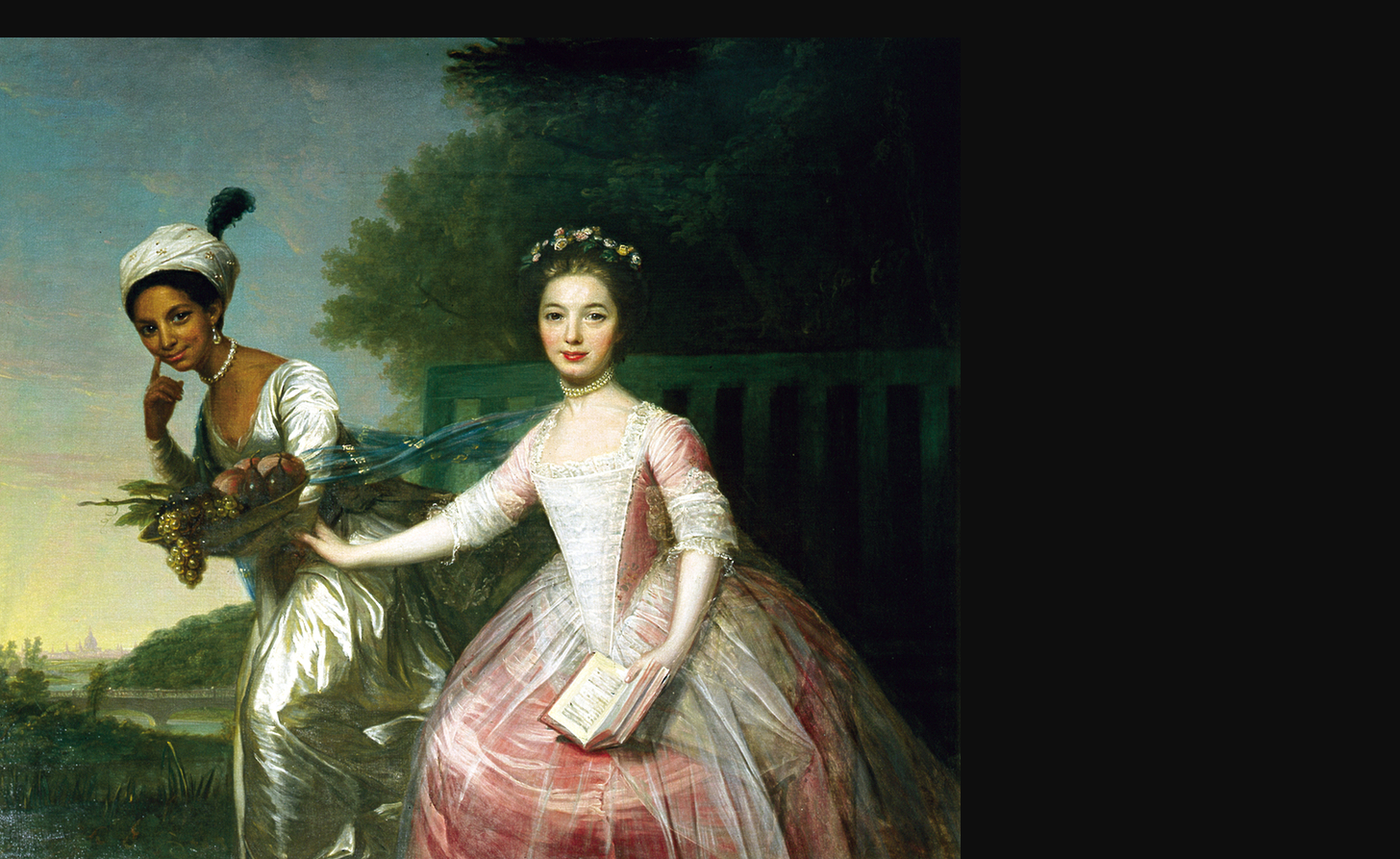
Dido Elizabeth Belle (left) and her cousin, Elizabeth Murray.
Maria, John, and Dido
Dido was born in 1761. Her mother was Maria Belle, who was then a slave, which would have made Dido a slave, and her father was John Lindsay, an officer in the Royal Navy.
Sorry, Make that Sir John Lindsay. I just love italics. They do sarcasm so well.
It’s not 600% clear how he and Maria Belle met, but Lindsay was where you’d expect a naval officer to be, on a ship, and his particular ship was protecting British trade routes and capturing the ships of countries Britain was at war with, along with the ships’ cargoes. In other situations, that’s called piracy, but when you have your government’s stamp of approval it’s called foreign policy.
Exactly how John and Maria (what the hell, let’s call them all by their first names) crossed paths isn’t clear. Maria might’ve been part of the–ahem–cargo on a ship he captured. She also might not have been.
Whatever happened, they met, Dido ensued, and John and Maria seem to have had something approaching a relationship, because in 1774 Maria built a home in Pensacola, Florida, where John had bought a plot of land for her. The property record calls her “a Negroe Woman of Pensacola in America but now of London afore and made free.” Her manumission papers are also from 1774 and acknowledge “the sum of two hundred Spanish milled dollars . . . paid by Maria Belle a Negro Woman Slave about twenty eight years of age.”
Although having said that, another source talks about John having given her her freedom, not sold it to her. Either way, working backward from those numbers, Maria would’ve been around fifteen when Dido was born.
But that business about the house, the property, and her freedom jumps ahead of the story. Somehow–again it’s not clear how–Maria and Dido show up in London when Dido’s around five, something we know because her baptism is recorded, thanks to Henry VIII having introduced the requirement that churches record baptisms, marriages, and burials. Maria’s listed as the wife of Mr. Bell, whoever he might’ve been.
John isn’t listed as the father, although she was widely acknowledged as his child and he was involved enough that Dido was placed with his brother’s family at Kenwood House.
Before you decide that Dido’s parents had the love affair of the century, defying differences of class, color, and national origin to explore their mutual passion until the end of the earth or their deaths, whichever came first, I should tell you that John made a socially acceptable marriage in 1768 and had four more children with four more women, none of whom was his wife. He doesn’t sound like lasting romance material to me.
Somewhere along the line he was knighted and in 1776 he became a part-owner of a plantation in Nevis, which was worked by slaves, as they all were at the time, so off the top of my head I’d say we can’t count him as an opponent of slavery any more than we can nominate him for faithful non-spouse of the year.
And Maria? We’re not going to find out. She drops off the historical record.
Dido
Dido went to live with the family of her father’s uncle, William Murray, First Earl of Mansfield and Lord Chief Justice–in other words, the most powerful judge in England. In the spirit of rampant inconsistency, we’re not going to call him by either his first or last name but Mansfield. Don’t ask me to justify that. It’s what most of the articles I’ve read call him. If you have a grand enough title, you get handed a whole poker hand’s worth of names to choose from.
Have you noticed that everyone in this tale has a last name that could also be a first name?
Mansfield and his wife were childless and had already taken in Dido’s cousin Elizabeth Murray, whose mother had died. The two girls were raised and educated together.
What was usual and what was unusual about this? If a family sat high enough on the class scale, society wouldn’t faint from shock if it become guardians to a relative whose parents hadn’t been married. Or–hell, I’m dancing all over the lot, trying to avoid talking about legitimate and illegitimate children. The idea that a child could be illegitimate is bizarre, but that was the way people thought at the time. Let’s use the word. It simplifies my sentences.
So, taking in an illegitimate child wasn’t shocking. What was unusual was for a mixed-race child, and the child of a slave or former slave, to be raised not as a servant but as a gentlewoman.
And yes, since we’re talking about absurd phrases that we’re more or less stuck with, let’s add mixed race to the list. Humans don’t divide into races. It just doesn’t work. The problem is that I haven’t found a phrase that slots into a sentence as well, so put a mental asterisk beside it and understand that we need some new language there.
But back to our story. We now have Dido safely ensconced in the very grand home of an earl and accepted into the heart of the family.
But . . .
. . . the family made a clear distinction between Dido and Elizabeth. Dido got an allowance of £30 a year. Elizabeth got £100. Mind you, £30 a year was good money–several times more than a domestic worker made and she didn’t work for it–but it says a lot about their ranking. When it was just the family present, she was family. When they had guests, she joined them after dinner, not during. In the portrait at the top of the page, Dido’s the secondary figure. It’s a portrait of her cousin.
Was that about color, legitimacy, or a bit of each? I don’t know that anyone can untangle those threads at this point. An illegitimate child was always ranked below a legitimate one. On the other hand, all the money that was being made from slavery guaranteed that racism had infused itself into the British belief system. In the portrait, she gets the turban and the bowl of exotic fruit; the cousin gets the chair and the more traditional headpiece.
Portrait artists were pretty heavy handed with their symbols. I’m not stretching things to mention those.
On a personal note, I was raised in the US and spent most of my life there, inevitably surrounded by the American brand of racism. I’m constantly noticing that the British brand is different. I don’t know of any story from the US that’s comparable to Dido’s. But that’s not to say that Britain’s free of racism. It’s just–you know, different wrapper, different ingredients, slightly different weight to the candy bar inside.
When Dido’s father died, his obituary described Dido–”his natural daughter”–as having an amiable disposition and accomplishments [that] have gained her the highest respect from all his Lordship’s relations and visitants.”
Accomplishments were a big thing for a lady of the period. Dido played music and had beautiful handwriting. Mansfield often dictated his letters to her–a job normally reserved for a male clerk. She also supervised the dairy and poultry yard, as genteel women of the time often did. (Come on, they had to do something or they’d have perished from boredom, every last one of ’em.)
In 1784 Mansfield’s wife died and in 1785 Dido’s cousin Elizabeth married, leaving Dido to care for Mansfield until his death in 1793. His will left her £500 (about £40,000 today) as well as £100 a year–not as much as he left Elizabeth but nothing to sneeze at. And to clear up any doubt about her status, his will stated that she was a free woman. Or in some tellings, he granted her her freedom.
Does that mean that she and the family considered her to still be enslaved? Or was he only being cautious? I can’t begin to guess, but even if it was caution, knowing that he didn’t clear that up from the beginning kind of makes your blood curdle, doesn’t it?
After Mansfield’s death, Dido married a steward. To locate him in the all-important class hierarchy, he was a senior servant, so if she’d been fully a lady that would’ve been a shocker of a marriage. No one says that he wasn’t white, so we can probably assume he was. He was from France. That gets a mention. They had three sons and lived in London. Dido died in 1804, at 43.
Dido, Mansfield, and slavery
Before we go on, let’s spend a moment remembering–or if you didn’t already know this, finding out–that Mansfield (Chief Justice, remember) presided over the 1772 Somerset case, which ruled on the legality of slavery in England. His ruling was, like so much of this story, ambiguous.
The question in front of him was whether James Somerset, an escaped slave, could be forced onto a ship and sent to the Caribbean, where he’d be sold. Mansfield ruled that he couldn’t, setting in place the precedent that no slave could be made to leave the country against his or her will.
The ruling was widely believed to have ended slavery in England, but it didn’t. Slaves continued to work as slaves, and to be bought and sold. Escapees continued to be recaptured–or at least sought, since it was far easier for an escaped slave to disappear in England than in, say, the Caribbean, and many people freed themselves instead of waiting 61 long years for the law to do it for them.
Legal scholars argue about what precedent the ruling actually set. Unfortunately, I’m no legal scholar, although I did once pass myself off–accidentally and in an email–as a lawyer, so we won’t dive into that. Instead, let’s acknowledge that although Mansfield described slavery as odious and argued that it was “of such a nature” that it couldn’t be introduced without some positive law to uphold it, which England didn’t have, he still stopped short of ruling it illegal. The economic fallout of that was more than he could face–or at least that’s the best explanation I’ve seen offered. His ruling made it clear that the case posed an important moral question, he picked up the legal bricks that could’ve built a case for abolition, and he put them down again without building it.
And he made sure in his will that his great-niece could live out her life as a free woman.

 Notes from the U.K.