Dido Elizabeth Belle: more on the ambiguities of slavery in England

Dido Elizabeth Belle was born a slave, raised in an aristocratic English family, and given the education and many of the and-so-forths of an English aristocrat. Her story messes with pretty much any assumptions we carry in our luggage. In some tellings, she’s Britain’s first Black aristocrat. That makes a great headline but it stretches the truth.

Let’s call her Dido, since her mother comes into the story and her last name was also Belle.
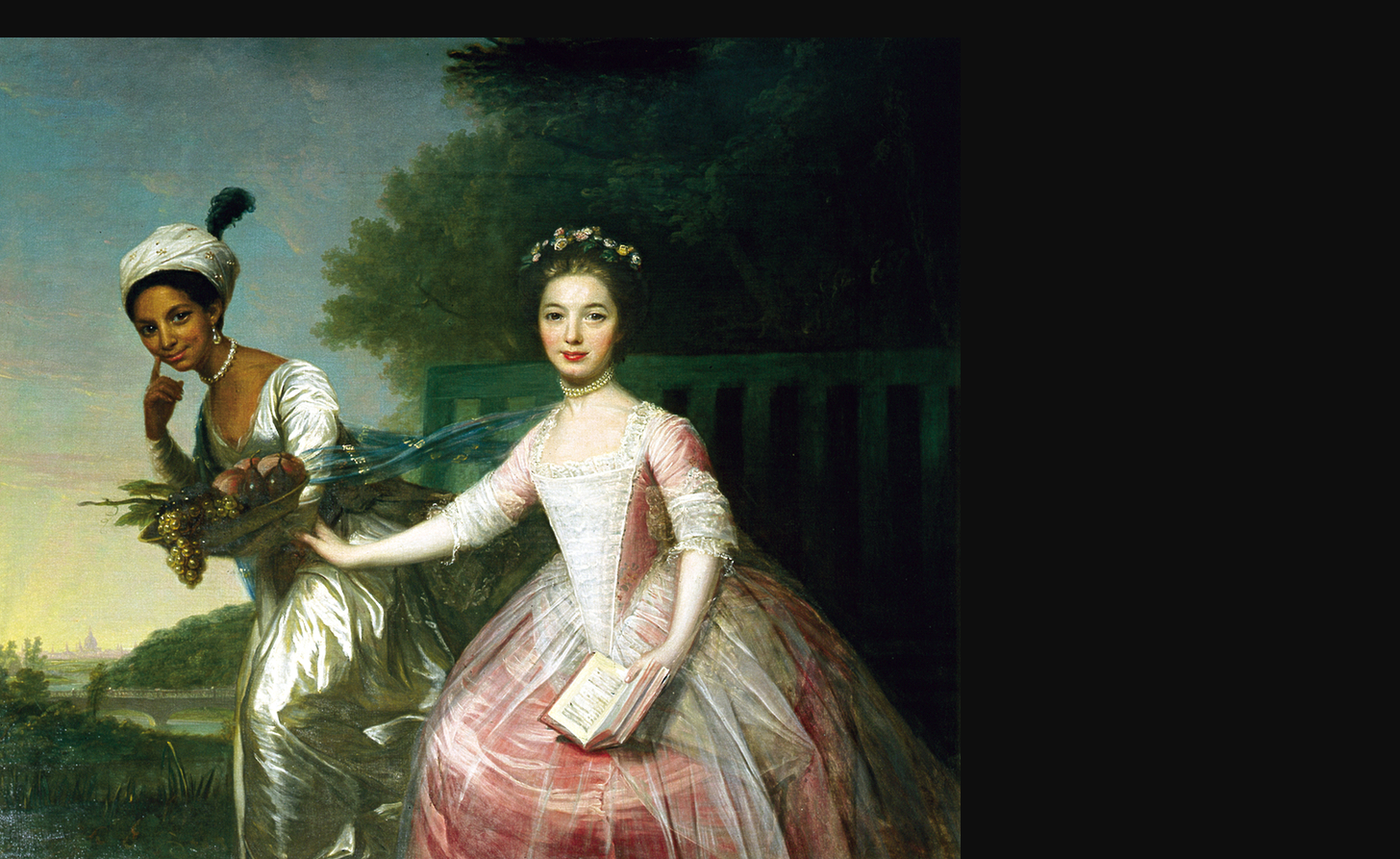
Dido Elizabeth Belle (left) and her cousin, Elizabeth Murray. 

Maria, John, and Dido

Dido was born in 1761. Her mother was Maria Belle, who was then a slave, which would have made Dido a slave, and her father was John Lindsay, an officer in the Royal Navy.

Sorry, Make that Sir John Lindsay. I just love italics. They do sarcasm so well. 

It’s not 600% clear how he and Maria Belle met, but Lindsay was where you’d expect a naval officer to be, on a ship, and his particular ship was protecting British trade routes and capturing the ships of countries Britain was at war with, along with the ships’ cargoes. In other situations, that’s called piracy, but when you have your government’s stamp of approval it’s called foreign policy. 

Exactly how John and Maria (what the hell, let’s call them all by their first names) crossed paths isn’t clear. Maria might’ve been part of the–ahem–cargo on a ship he captured. She also might not have been. 

Whatever happened, they met, Dido ensued, and John and Maria seem to have had something approaching a relationship, because in 1774 Maria built a home in Pensacola, Florida, where John had bought a plot of land for her. The property record calls her “a Negroe Woman of Pensacola in America but now of London afore and made free.” Her manumission papers are also from  1774 and acknowledge “the sum of two hundred Spanish milled dollars . . . paid by Maria Belle a Negro Woman Slave about twenty eight years of age.”

Although having said that, another source talks about John having given her her freedom, not sold it to her. Either way, working backward from those numbers, Maria would’ve been around fifteen when Dido was born.

But that business about the house, the property, and her freedom jumps ahead of the story. Somehow–again it’s not clear how–Maria and Dido show up in London when Dido’s around five, something we know because her baptism is recorded, thanks to Henry VIII having introduced the requirement that churches record baptisms, marriages, and burials. Maria’s listed as the wife of Mr. Bell, whoever he might’ve been.

John isn’t listed as the father, although she was widely acknowledged as his child and he was involved enough that Dido was placed with his brother’s family at Kenwood House.

Before you decide that Dido’s parents had the love affair of the century, defying differences of class, color, and national origin to explore their mutual passion until the end of the earth or their deaths, whichever came first, I should tell you that John made a socially acceptable marriage in 1768 and had four more children with four more women, none of whom was his wife. He doesn’t sound like lasting romance material to me.

Somewhere along the line he was knighted and in 1776 he became a part-owner of a plantation in Nevis, which was worked by slaves, as they all were at the time, so off the top of my head I’d say we can’t count him as an opponent of slavery any more than we can nominate him for faithful non-spouse of the year.

And Maria? We’re not going to find out. She drops off the historical record.


Dido

Dido went to live with the family of her father’s uncle, William Murray, First Earl of Mansfield and Lord Chief Justice–in other words, the most powerful judge in England. In the spirit of rampant inconsistency, we’re not going to call him by either his first or last name but Mansfield. Don’t ask me to justify that. It’s what most of the articles I’ve read call him. If you have a grand enough title, you get handed a whole poker hand’s worth of names to choose from.

Have you noticed that everyone in this tale has a last name that could also be a first name?

Mansfield and his wife were childless and had already taken in Dido’s cousin Elizabeth Murray, whose mother had died. The two girls were raised and educated together. 

What was usual and what was unusual about this? If a family sat high enough on the class scale, society wouldn’t faint from shock if it become guardians to a relative whose parents hadn’t been married. Or–hell, I’m dancing all over the lot, trying to avoid talking about legitimate and illegitimate children. The idea that a child could be illegitimate is bizarre, but that was the way people thought at the time. Let’s use the word. It simplifies my sentences. 

So, taking in an illegitimate child wasn’t shocking. What was unusual was for a mixed-race child, and the child of a slave or former slave, to be raised not as a servant but as a gentlewoman.

And yes, since we’re talking about absurd phrases that we’re more or less stuck with, let’s add mixed race to the list. Humans don’t divide into races. It just doesn’t work. The problem is that I haven’t found a phrase that slots into a sentence as well, so put a mental asterisk beside it and understand that we need some new language there.

But back to our story. We now have Dido safely ensconced in the very grand home of an earl and accepted into the heart of the family.


But . . .

. . . the family made a clear distinction between Dido and Elizabeth. Dido got an allowance of £30 a year. Elizabeth got £100. Mind you, £30 a year was good money–several times more than a domestic worker made and she didn’t work for it–but it says a lot about their ranking. When it was just the family present, she was family. When they had guests, she joined them after dinner, not during. In the portrait at the top of the page, Dido’s the secondary figure. It’s a portrait of her cousin.

Was that about color, legitimacy, or a bit of each? I don’t know that anyone can untangle those threads at this point. An illegitimate child was always ranked below a legitimate one. On the other hand, all the money that was being made from slavery guaranteed that racism had infused itself into the British belief system. In the portrait, she gets the turban and the bowl of exotic fruit; the cousin gets the chair and the more traditional headpiece.

Portrait artists were pretty heavy handed with their symbols. I’m not stretching things to mention those.

On a personal note, I was raised in the US and spent most of my life there, inevitably surrounded by the American brand of racism. I’m constantly noticing that the British brand is different. I don’t know of any story from the US that’s comparable to Dido’s. But that’s not to say that Britain’s free of racism. It’s just–you know, different wrapper, different ingredients, slightly different weight to the candy bar inside.

When Dido’s father died, his obituary described Dido–”his natural daughter”–as having an amiable disposition and accomplishments [that] have gained her the highest respect from all his Lordship’s relations and visitants.”

Accomplishments were a big thing for a lady of the period. Dido played music and had beautiful handwriting. Mansfield often dictated his letters to her–a job normally reserved for a male clerk. She also supervised the dairy and poultry yard, as genteel women of the time often did. (Come on, they had to do something or they’d have perished from  boredom, every last one of ’em.)

In 1784 Mansfield’s wife died and in 1785 Dido’s cousin Elizabeth married, leaving Dido to care for Mansfield until his death in 1793. His will left her £500 (about £40,000 today) as well as £100 a year–not as much as he left Elizabeth but nothing to sneeze at. And to clear up any doubt about her status, his will stated that she was a free woman. Or in some tellings, he granted her her freedom.

Does that mean that she and the family considered her to still be enslaved? Or was he only being cautious? I can’t begin to guess, but even if it was caution, knowing that he didn’t clear that up from the beginning kind of makes your blood curdle, doesn’t it?

After Mansfield’s death, Dido married a steward. To locate him in the all-important class hierarchy, he was a senior servant, so if she’d been fully a lady that would’ve been a shocker of a marriage. No one says that he wasn’t white, so we can probably assume he was. He was from France. That gets a mention. They had three sons and lived in London. Dido died in 1804, at 43. 


Dido, Mansfield, and slavery

Before we go on, let’s spend a moment remembering–or if you didn’t already know this, finding out–that Mansfield (Chief Justice, remember) presided over the 1772 Somerset case, which ruled on the legality of slavery in England. His ruling was, like so much of this story, ambiguous.

The question in front of him was whether James Somerset, an escaped slave, could be forced onto a ship and sent to the Caribbean, where he’d be sold. Mansfield ruled that he couldn’t, setting in place the precedent that no slave could be made to leave the country against his or her will. 

The ruling was widely believed to have ended slavery in England, but it didn’t. Slaves continued to work as slaves, and to be bought and sold. Escapees continued to be recaptured–or at least sought, since it was far easier for an escaped slave to disappear in England than in, say, the Caribbean, and many people freed themselves instead of waiting 61 long years for the law to do it for them.

Legal scholars argue about what precedent the ruling actually set. Unfortunately, I’m  no legal scholar, although I did once pass myself off–accidentally and in an email–as a lawyer, so we won’t dive into that. Instead, let’s acknowledge that although Mansfield described slavery as odious and argued that it was “of such a nature” that it couldn’t be introduced without some positive law to uphold it, which England didn’t have, he still stopped short of ruling it illegal. The economic fallout of that was more than he could face–or at least that’s the best explanation I’ve seen offered. His ruling made it clear that the case posed an important moral question, he picked up the legal bricks that could’ve built a case for abolition, and he put them down again without building it.

And he made sure in his will that his great-niece could live out her life as a free woman.

A quick history of slavery in Britain: It’s not all abolitionists

If you’re playing free-association games with British history, slavery isn’t the word most likely to pop into your mind, but–sorry, folks–it’s an important part, if a contradictory one, and we don’t get to skip over it. 

Okay, you’re right, a lot of histories do exactly that, but we won’t. Break open a case of self-congratulation if you would.

The slave trade

England’s official involvement in the slave trade began in 1663, when it got royal approval. (Scotland was its own country at this point. We’ll start calling the place Britain in a minute.) The royal in question was Charles II. You know the one: long, curly hair (or wig; what do I know?); mustache; looks a bit like Bob Dylan in his older, creepier phase. He gave the Company of Royal Adventurers of England Trading into Africa a monopoly on transporting slaves from the west coast of Africa to be sold in England’s American colonies. 

Irrelevant photo: Osteospermum

Did he know what he was sanctioning? He’d have been hard put not to. The monopoly was for “the buying and selling, bartering and exchanging of, for, and with any negro slaves, goods, wares and merchandizes whatsoever to be vended or found’ in western Africa.”

That does kind of spell it out.

Over something like 150 years, England was responsible for transporting millions of people into slavery. How many millions? By one estimate, 3.1 million, although only 2.7 million arrived. The rest died in what’s called the middle passage–the trip from Africa to the Americas.  

If you want to translate that to money–and since the slave trade was all about money, we should–between 1630 and 1807 Britain’s slave traders made a profit of about £12 million. In today’s money, that would be–

Okay, grab a calculator and sit down with a nice cup of tea. For the sake of convenience, we’ll use the 1807 pound. A hundred of them would be worth £10,218.33 in 2022. So £12 million of them? To use advanced mathematical terms, that’s a shitload of money. 

Aren’t you glad you had that calculator? Enjoy your tea.

By another estimate, between 1761 and 1807 traders based in British ports sold 1,428,000 captive African people and pocketed £60 million from the transactions, which might translate to £8 billion in 2022 pounds. Yes, it’s a different total. On the other hand, it’s measuring a different aspect of the business. Either way, it’s still a shitload of money.

The colonies and the plantations

England–or Britain once Scotland was folded in–didn’t limit itself to trading in slaves. It established colonies in America and the Caribbean, and their economies depended on slave labor to produce sugar, cotton, coffee, rum, and the miracle drug of the time, tobacco. As a random indicator of how important they were, in 1750, sugar made up a fifth of all Europe’s imports. 

So slavery was a lucrative business, although historians argue about exactly how lucrative. Some will tell you it fueled the industrial revolution. Others will tell you its impact is overestimated. They got to the dress-up box first and and monopolized the historian outfits, so no one’s going to take my opinion seriously, but that won’t stop me: I toss my inconsiderable weight onto the side that says it was a major factor.

What’s certain is that money made from slavery flowed into British industry, that British ports grew rich on the trade, and that banks and insurance companies did business with slave traders and plantation owners and prospered.

But Britain itself didn’t have slavery, did it?

Yes it did. Also no it didn’t.

Once England–or a bit later, Britain–got involved in the slave trade and in the industrial-strength slave system that made American and Caribbean plantations so profitable, it was more or less inevitable that slaveholders would bring their servants when they returned home, and since they’d been slaves at the start of the voyage, they were still slaves once they landed. And again more or less inevitably, the slaveholders would give some of those slaves to relatives as gifts, and sell others. 

There was a difference, though. Slavery didn’t weave its way into the British economy the way it did in the colonies–it was more the embroidery than the cloth itself. Still, that some number of people did hold slaves can be traced through the newspaper ads they placed when their slaves escaped.

That situation held until 1772, when one slave called James Sommersett escaped, was captured, and was put on a ship bound for Jamaica, where he was to be sold, but before the ship could sail his case was taken up by an abolitionist and brought to court, which ruled that no English law allowed for one human being to enslave another.

The court freed Sommersett and declared that from there onwards, “as soon as any slave sets foot upon English territory, he becomes free.” 

It was a powerful precedent–and it didn’t apply to the soil of the British colonies. 

So if we draw a nice thick line around Britain itself, we can, in all semi-honesty, do what a fair number of histories do and bounce past the slavery itself to focus on Britain’s Abolitionists. Break out the trumpets. Celebrate.

And they’re worth celebrating. They’re not all entirely pure–who is?–but they kept up what must’ve felt like a hopeless fight for many years. On the other hand, they’re not the whole story and shouldn’t be used to sweeten the taste of Britain’s involvement with slavery.

Some of the tendency to avoid talking about slavery comes from a belief that history is a patriotic exercise that should make people feel good. Slavery, though? Come on, it was such a downer. But history isn’t an energy drink, designed to send you out into the world high on caffeine, carbonation, and patriotism. At its best, it’s an effort to look square in the eye of what was. If we can do that, we’ll also learn a startling amount about what is.

So: Slavery had been abolished only on home turf, and it continued to be an important part not only of the empire but of Britain’s home turf–something we can see not just by looking at the numbers I dragged in earlier but also, oddly enough, by looking at the act that finally abolished it in Britain’s colonies.

The Slavery Abolition Act of 1833 . . . 

. . . extended the ban on slavery to Britain’s colonies, freeing some 800,000 people of African descent–and it ordered payment to their former owners for the loss that caused them. 

Once the country committed to that, though, it had to figure out how much each former slaveholder had lost. So the government set up a commission, which evaluated each claim and, coincidentally, created a detailed picture of who owned how many slaves and what work the slaves did. If you trawl through the records, as historians have been doing lately, you’ll find the ancestors of William Gladstone, David Cameron, George Orwell, Graham Greene, Elizabeth Barrett Browning, and endless other well-known figures. They’re a reminder of how deeply slavery was woven into not just the country’s economy but into its culture and politics. Many of Britain’s richest families trace their fortunes back  to the slave trade, although not all of them are anxious to do any tracing just now. It’s an awkward and uncomfortable thing to know, let alone acknowledge publicly. But if you find one of those blue plaques that mark historic places and it tells you Sir William Ragbottom was a West India merchant or planter, you’re looking at a fancy phrase for someone who made his money from slavery.

But slavery went deeper than that, because it wasn’t just the great families who were involved. One of the surprises hidden in the archives is the number of small-scale slaveholders the commission recorded–middle class people who didn’t own plantations but owned a few slaves and rented out their labor. These included vicars, manufacturers, and lots of widows, many of whom would’ve inherited slaves from their husbands, along with the clocks and the candlestick holders. I can’t help thinking some financial advisor was running around the country saying, “What could be a safer way to invest your money?”

It wasn’t only safe, it was respectable.

Geographically, slaveholders ranged from Cornwall to the Orkneys, so the association wasn’t limited to the port cities.

By the time the commission was done, it had catalogued every owner who claimed compensation, and every slave, and the government paid out £20 million to the slaveholders for their loss. That was 40% of the government’s 1834 budget and in 2015 would’ve amounted to something like £16 or £17 billion.

Why don’t I give you a more up-to-date equivalent? Because I don’t trust myself around numbers–somebody always ends up getting hurt. We’re all better off if I just snatch someone else’s calculations, okay?

The slaves weren’t compensated. They also weren’t exactly freed. They were shifted into a transitional form of slavery that used a different name but left them far from free. And for that tale, I’ll refer you to an earlier post.

Indentured labor in the British Empire

Abolishing slavery left Britain with a problem: How was it going to produce sugar without lowering profits? 

Because of the second part of that sentence, I don’t think paying a livable wage entered into the conversation. 

This was an issue for both planters and theBritish government itself, because sugar was a huge part of the economy. And the monied class that owned the plantations was a huge part of the government. You know the old saying, money talks? Well, it doesn’t have a physical voice, but it does this odd way of amplifying the voices of people with a lot of it.

Last week, if you’ll stretch your minds back to that distant time, now passing almost into myth we looked at the apprenticeship system that, for a while, replaced–and closely reproduced–slavery in the Caribbean colonies. This week, lucky us, we come to indentured labor, which replaced it more widely and for longer. 

Irrelevant photo: geranium


Indenture

Britain abolished slavery in 1833 and the first indentured laborers arrived in British Guiana in 1836. They were from India, and Indian indentured laborers were also sent to Fiji, Natal, Burma, Ceylon, Malaya, British Guiana, Jamaica, and Trinidad–to nineteen countries in all. Eventually indentured workers replaced enslaved Africans on plantations throughout the British Empire. 

Was I bullshitting you about the government being involved? Sorry, but no. According to the National Archives, the secretary of state for the colonies, Frederick Stanley, known as Lord Stanley by his nearest and dearest, ordered the scheme.

Scheme, in American English, has an unpleasant whiff of sneakiness, but as far as I can tell it doesn’t in British English. British governments introduce schemes all the time and are happy to brag about them, and this was very much a government project. British colonies–which is to say, plantation owners–had appealed to the government for help and it ordered and approved the plan. The whiff you’re picking up isn’t one of sneakiness but–forgive me if I use an old-fashioned word here–exploitation.

Initially, Guiana’s indentured workers were treated pretty much the way slaves had been–as they were elsewhere, but I happened onto a small stash of detail about Guiana. Their contracts were for five years, and during that time they couldn’t leave the plantations where they worked. They were paid 1 shilling a day. I can’t tell you what a shilling’s buying power was, but the National Archives calls it a pitiful sum. 

Those who didn’t work were left to starve.

If they were found to have breached their contract in any way, they faced automatic penalties: two months in prison and a £5 fine. 

How many shillings in a pound? Twenty. So the fine was more than three months’ pay. 

A special magistrate in British Guiana wrote that the laborers were “with few exceptions . . . treated with great and unjust severity, by overwork and by personal chastisement.” And historian Hugh Tinker wrote that, “the decaying remains of immigrants were frequently discovered in cane fields.” 

Importing contract labour from India was suspended in 1840. They tried importing Europeans but couldn’t find enough willing people, and the plantation owners pleaded with the government for a new supply of labor. Freddy Stanley tried recruiting Chinese workers from Malacca and African workers from Sierra Leone, but again they couldn’t round up enough people and turned back to India, this time under an new act setting out minimum standards for housing, food, clothing, and pay. 

How well those standards were enforced is–in the absence of a source I didn’t manage to find–anyone’s guess. The plantations were a long way from governmental supervision, and that’s assuming that the government officials had the will to enforce standards. 

A hefty proportion of indentured labor involved Indian workers and the sugar industry, but the Transvaal gold mines brought 64,000 indentured workers from China, and in Australia the indentured workers were Aboriginal and from the South Sea islands.


A nasty little bit of economic and political information

In 1846, Britain got rid of a tariff that had kept the domestic price of sugar up and prevented non-British colonies from selling sugar cheaper than the stuff produced in British colonies. That lowered the cost inside Britain, making it a popular move, but it also meant that British colonies were competing against sugar produced by slave labor, which put pressure on the indenture system to be more like slavery. Not, I suspect, that plantation owners needed much of a push, but it’s worth mentioning all the same.

Doesn’t studying history make you feel good about your fellow humans?


Recruitment in India

Until 1858, India was run by the British East India Company, making it a huge country governed by a corporation from a much smaller country. 

Give yourself a minute to take that in.

Between 1834 and the end of World War I, India was Britain’s recruiting ground for indentured laborers. To put that in human terms, my father would have fought in World War I if his parents had agreed to sign for him–which fortunately for me (and him) they didn’t. It’s not much more than a hundred years ago. 

This is not ancient history. It’s not all that far outside of living memory.

Why was India such a fertile recruiting ground? The simple answer is desperation, poverty, famine. Land that had been in Indian hands had, with the country under British control, miraculously, found itself in the hands of British owners. Famine was no longer uncommon. 

Most recruits were from the lower castes, but not all. 

By way of an example, take the people who worked on the indigo plantations. In the off season, they’d migrate to towns and cities looking for work, and recruiters would pick them up, lie to them about where they were going, the length of the trip, and the work they’d be doing, and get them to sign a contract. Or since most of them couldn’t read, put their thumb prints on one, with no idea what it really said. Then they’d be held in depots until a ship was ready. 

They were called coolies, and if the word didn’t start out as an insult it became one quickly enough. 

Conditions at sea were bad enough that in 1856-57, 17% of the Indian workers travelling to the Caribbean died on the way. In 1870, 12% died on the way to Jamaica and to Mauritius. 

To understand the mindset of the people who established, ran, and profited from the system, consider what the recruitment firm Gillanders Arbuthnot & Co wrote to a planter who was considering using it. Its recruits, it said, had “few wants beyond eating, sleeping and drinking.” It said the Adivasi, the indigenous people of India, were “‘more akin to the monkey than the man.”

In the fifty years between 1860 and 1910, 150,000 indentured Indian laborers went to Natal–now part of South Africa–to work on the sugar plantations. So many indentured laborers went to Mauritius that the Indian community now accounts for two-thirds of the population.

They were promised pay, sometimes land at the end of their contract, and in some cases passage home. What their contracts promised would have varied over time, but one source says that the promises often weren’t met. 


Australia

Australia’s history is different but it borrowed the indenture system. Starting in 1863, it brought in some 62,000 South Sea Islanders to work on sugar plantations. Some went by choice and others were kidnapped, coerced, or lied to. Their conditions weren’t particularly different from slaves’. They were kept apart from the rest of the population and their languages were banned. Between malnutrition and exposure to European diseases, some 15,000 died within a year. 

The practice continued for forty years. Then in 1901 most of them were deported–and their deportation was funded by their own pay, which the Queensland government had appropriated.


The Kenya-Uganda Railway

Indian indentured laborers built the Kenya-Uganda Railway, and 7% died before their contract was up. Many tried to escape but were recaptured and imprisoned, and some had their contracts doubled to ten years.

Many contracts specified that workers would be returned home, and the majority did return, but some stayed, especially women who–according to one article–had left home after a disagreement with their parents and might not be welcomed back into the family.


The end of indentured labor

Throughout its history, the indenture system was under attack by the same people–or the same sorts of people–who’d campaigned against slavery and defended by the same sorts of people who’d defended slavery (including the write the novelist Anthony Trollope, for whatever that shippet of information’s worth). And it was under attack from indentured workers themselves, who went on strike, who fled, who–sorry, what’s the verb for staging an uprising? Uprose? They resisted in whatever ways they could. Unfortunately, although I can find references to all that, they’re light on the specifics.

It also came under attack by Indians from higher castes and classes, who found that in the colonies they were swept into the same category as indentured workers. 

Toward the system’s end, opinion in India was turning against it, and one reason it was ended was to improve Britain’s image there.

Of course–she added cynically–another factor was the sugar industry’s increased reliance on sugar beets instead of cane.

Britain formally abolished indentured labor in 1917, although it carried on for some years after that. The last ship carrying indentured laborers left for Mauritius in 1924.

By then, over a million Indians had been sucked into the system.