Dido Elizabeth Belle: more on the ambiguities of slavery in England

Dido Elizabeth Belle was born a slave, raised in an aristocratic English family, and given the education and many of the and-so-forths of an English aristocrat. Her story messes with pretty much any assumptions we carry in our luggage. In some tellings, she’s Britain’s first Black aristocrat. That makes a great headline but it stretches the truth.

Let’s call her Dido, since her mother comes into the story and her last name was also Belle.
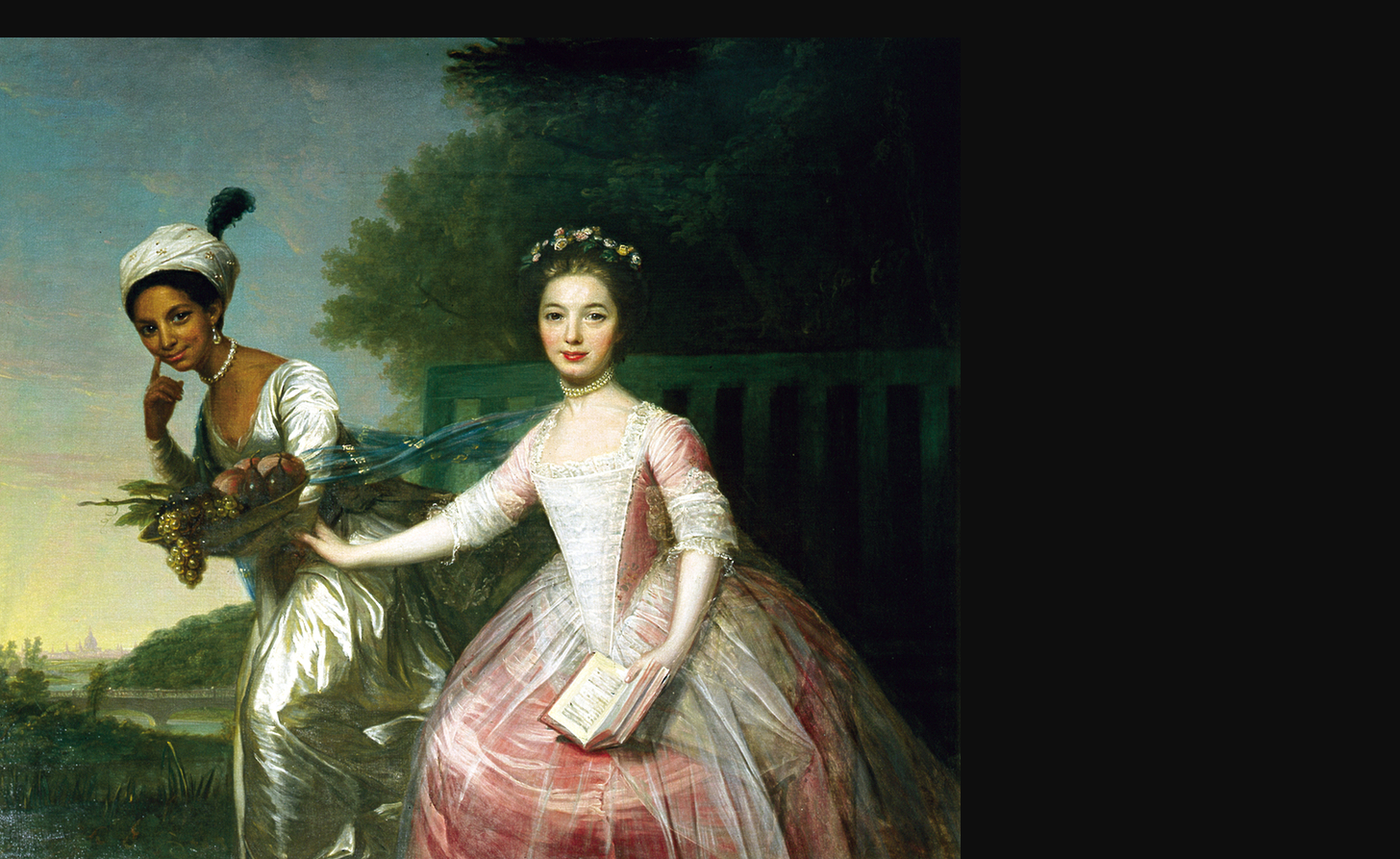
Dido Elizabeth Belle (left) and her cousin, Elizabeth Murray. 

Maria, John, and Dido

Dido was born in 1761. Her mother was Maria Belle, who was then a slave, which would have made Dido a slave, and her father was John Lindsay, an officer in the Royal Navy.

Sorry, Make that Sir John Lindsay. I just love italics. They do sarcasm so well. 

It’s not 600% clear how he and Maria Belle met, but Lindsay was where you’d expect a naval officer to be, on a ship, and his particular ship was protecting British trade routes and capturing the ships of countries Britain was at war with, along with the ships’ cargoes. In other situations, that’s called piracy, but when you have your government’s stamp of approval it’s called foreign policy. 

Exactly how John and Maria (what the hell, let’s call them all by their first names) crossed paths isn’t clear. Maria might’ve been part of the–ahem–cargo on a ship he captured. She also might not have been. 

Whatever happened, they met, Dido ensued, and John and Maria seem to have had something approaching a relationship, because in 1774 Maria built a home in Pensacola, Florida, where John had bought a plot of land for her. The property record calls her “a Negroe Woman of Pensacola in America but now of London afore and made free.” Her manumission papers are also from  1774 and acknowledge “the sum of two hundred Spanish milled dollars . . . paid by Maria Belle a Negro Woman Slave about twenty eight years of age.”

Although having said that, another source talks about John having given her her freedom, not sold it to her. Either way, working backward from those numbers, Maria would’ve been around fifteen when Dido was born.

But that business about the house, the property, and her freedom jumps ahead of the story. Somehow–again it’s not clear how–Maria and Dido show up in London when Dido’s around five, something we know because her baptism is recorded, thanks to Henry VIII having introduced the requirement that churches record baptisms, marriages, and burials. Maria’s listed as the wife of Mr. Bell, whoever he might’ve been.

John isn’t listed as the father, although she was widely acknowledged as his child and he was involved enough that Dido was placed with his brother’s family at Kenwood House.

Before you decide that Dido’s parents had the love affair of the century, defying differences of class, color, and national origin to explore their mutual passion until the end of the earth or their deaths, whichever came first, I should tell you that John made a socially acceptable marriage in 1768 and had four more children with four more women, none of whom was his wife. He doesn’t sound like lasting romance material to me.

Somewhere along the line he was knighted and in 1776 he became a part-owner of a plantation in Nevis, which was worked by slaves, as they all were at the time, so off the top of my head I’d say we can’t count him as an opponent of slavery any more than we can nominate him for faithful non-spouse of the year.

And Maria? We’re not going to find out. She drops off the historical record.


Dido

Dido went to live with the family of her father’s uncle, William Murray, First Earl of Mansfield and Lord Chief Justice–in other words, the most powerful judge in England. In the spirit of rampant inconsistency, we’re not going to call him by either his first or last name but Mansfield. Don’t ask me to justify that. It’s what most of the articles I’ve read call him. If you have a grand enough title, you get handed a whole poker hand’s worth of names to choose from.

Have you noticed that everyone in this tale has a last name that could also be a first name?

Mansfield and his wife were childless and had already taken in Dido’s cousin Elizabeth Murray, whose mother had died. The two girls were raised and educated together. 

What was usual and what was unusual about this? If a family sat high enough on the class scale, society wouldn’t faint from shock if it become guardians to a relative whose parents hadn’t been married. Or–hell, I’m dancing all over the lot, trying to avoid talking about legitimate and illegitimate children. The idea that a child could be illegitimate is bizarre, but that was the way people thought at the time. Let’s use the word. It simplifies my sentences. 

So, taking in an illegitimate child wasn’t shocking. What was unusual was for a mixed-race child, and the child of a slave or former slave, to be raised not as a servant but as a gentlewoman.

And yes, since we’re talking about absurd phrases that we’re more or less stuck with, let’s add mixed race to the list. Humans don’t divide into races. It just doesn’t work. The problem is that I haven’t found a phrase that slots into a sentence as well, so put a mental asterisk beside it and understand that we need some new language there.

But back to our story. We now have Dido safely ensconced in the very grand home of an earl and accepted into the heart of the family.


But . . .

. . . the family made a clear distinction between Dido and Elizabeth. Dido got an allowance of £30 a year. Elizabeth got £100. Mind you, £30 a year was good money–several times more than a domestic worker made and she didn’t work for it–but it says a lot about their ranking. When it was just the family present, she was family. When they had guests, she joined them after dinner, not during. In the portrait at the top of the page, Dido’s the secondary figure. It’s a portrait of her cousin.

Was that about color, legitimacy, or a bit of each? I don’t know that anyone can untangle those threads at this point. An illegitimate child was always ranked below a legitimate one. On the other hand, all the money that was being made from slavery guaranteed that racism had infused itself into the British belief system. In the portrait, she gets the turban and the bowl of exotic fruit; the cousin gets the chair and the more traditional headpiece.

Portrait artists were pretty heavy handed with their symbols. I’m not stretching things to mention those.

On a personal note, I was raised in the US and spent most of my life there, inevitably surrounded by the American brand of racism. I’m constantly noticing that the British brand is different. I don’t know of any story from the US that’s comparable to Dido’s. But that’s not to say that Britain’s free of racism. It’s just–you know, different wrapper, different ingredients, slightly different weight to the candy bar inside.

When Dido’s father died, his obituary described Dido–”his natural daughter”–as having an amiable disposition and accomplishments [that] have gained her the highest respect from all his Lordship’s relations and visitants.”

Accomplishments were a big thing for a lady of the period. Dido played music and had beautiful handwriting. Mansfield often dictated his letters to her–a job normally reserved for a male clerk. She also supervised the dairy and poultry yard, as genteel women of the time often did. (Come on, they had to do something or they’d have perished from  boredom, every last one of ’em.)

In 1784 Mansfield’s wife died and in 1785 Dido’s cousin Elizabeth married, leaving Dido to care for Mansfield until his death in 1793. His will left her £500 (about £40,000 today) as well as £100 a year–not as much as he left Elizabeth but nothing to sneeze at. And to clear up any doubt about her status, his will stated that she was a free woman. Or in some tellings, he granted her her freedom.

Does that mean that she and the family considered her to still be enslaved? Or was he only being cautious? I can’t begin to guess, but even if it was caution, knowing that he didn’t clear that up from the beginning kind of makes your blood curdle, doesn’t it?

After Mansfield’s death, Dido married a steward. To locate him in the all-important class hierarchy, he was a senior servant, so if she’d been fully a lady that would’ve been a shocker of a marriage. No one says that he wasn’t white, so we can probably assume he was. He was from France. That gets a mention. They had three sons and lived in London. Dido died in 1804, at 43. 


Dido, Mansfield, and slavery

Before we go on, let’s spend a moment remembering–or if you didn’t already know this, finding out–that Mansfield (Chief Justice, remember) presided over the 1772 Somerset case, which ruled on the legality of slavery in England. His ruling was, like so much of this story, ambiguous.

The question in front of him was whether James Somerset, an escaped slave, could be forced onto a ship and sent to the Caribbean, where he’d be sold. Mansfield ruled that he couldn’t, setting in place the precedent that no slave could be made to leave the country against his or her will. 

The ruling was widely believed to have ended slavery in England, but it didn’t. Slaves continued to work as slaves, and to be bought and sold. Escapees continued to be recaptured–or at least sought, since it was far easier for an escaped slave to disappear in England than in, say, the Caribbean, and many people freed themselves instead of waiting 61 long years for the law to do it for them.

Legal scholars argue about what precedent the ruling actually set. Unfortunately, I’m  no legal scholar, although I did once pass myself off–accidentally and in an email–as a lawyer, so we won’t dive into that. Instead, let’s acknowledge that although Mansfield described slavery as odious and argued that it was “of such a nature” that it couldn’t be introduced without some positive law to uphold it, which England didn’t have, he still stopped short of ruling it illegal. The economic fallout of that was more than he could face–or at least that’s the best explanation I’ve seen offered. His ruling made it clear that the case posed an important moral question, he picked up the legal bricks that could’ve built a case for abolition, and he put them down again without building it.

And he made sure in his will that his great-niece could live out her life as a free woman.
Black British history: the parts that get left out

Black people have been part of British society at least since the Tudor era. I could as easily say, “since the Roman era,” but we’re trying to keep this short so let’s skip over that. 

Who’s the we in that last paragraph? That’d be me. I’m trying to make you feel included. Don’t you just love how subtle I am?


The Tudor era

The work of writing Black people back into English (or British–take your pick) history is relatively new and seems to be at the stage where historians are still popping up saying, “Found one!” and “Found another!” Information is scattered and finding it depends on digging through archives full of information that’s no help at all. Starting in the time of Henry VIII, the Church of England kept records of baptisms, marriages, and deaths, so that’s one place to look, but sometimes they record people’s ethnicity and sometimes they don’t. Nothing was standardized. Even so, they’re a rich source of information.

At this point, we have enough information to know that Black people were present as musicians, as sailors, as ambassadors, as weavers, as servants, as seamstresses, as traders. A few were the sons of African kings. One was described as an independent single woman. She lived in a village in Gloucestershire and owned a cow–a valuable possession. Just enough is known about her to be thoroughly frustrating. What is known is that all of them were free.

Black people were present at the Tudor courts and could be found on all levels of Tudor society. According to one source, skin colour was less important than religion, class or talent.” Some married into the overwhelmingly white population and within a few generations their descendants’ connection to Africa was likely to have been lost.

How many of us can trace our family history any further back than our grandparents or great-grandparents?

I’m going to go ahead an repeat that Black residents in Tudor England were free, and the reason I’m honking on about it because when we think of Black people living outside of Africa at this stage of history, we tend to assume they were slaves–and you see how neatly I’ve convinced you that your mind works the same way mine does. So let’s repeat that once more, in four-part harmony: They were free.

Thank you. That was gorgeous.

England wasn’t heavily involved in the slave trade yet and although English law didn’t forbid slavery it also didn’t allow for it.  


Slavery puts down roots

Once England did get involved in the transatlantic slave trade, it made, to use academic terminology, a shitload of money–not just from the slave trade itself but from slavery in its Caribbean colonies. (Let’s keep life simple by ignoring its colonies in North America.) But even then,, England itself muddled on in that strange in-between state where slavery wasn’t banned within its borders but also had no legal foundation. At some point, though–and I haven’t found a source that says when–enslaved people were brought to England, stayed, and continued to be slaves. 

For the most part, they were the servants of returning planters, ships’ captains, government officials, and army and navy officers. This wasn’t a flood of people, but it was a significant trickle, and English society shaped itself to this change. Having a black servant became quite the fashion among the aristocracy and the well-to-do. 

Most of the newly arrived slaves continued to work as servants. In other words, slavery didn’t become central to the economy, but they were still treated as commodities. Some were sold; some were given as gifts. And some said the era-appropriate equivalent of “screw this” and took off, which was a lot easier to do in England than in, say, Jamaica.

This part of the story is relatively easy to document: newspapers ran notices calling for the return of runaway slaves.

June 1743: a woman called Sabinah was “deluded away [from a ship bound for Jamaica] by some other Black about Whitechapel.”

February 1748: “RUN away last Thursday Morning from Mr. Gifford’s, in Brunswick-Row, Queen-Square, Great Ormond-Street, an indentur’d Negro Woman Servant, of a yellowish Cast, nam’d Christmas Bennett; she had on a dark-grey Poplin, lin’d with a grey water’d Silk … and suppos’d to be conceal’d somewhere about Whitechapel.

“Whoever harbours her after this Publication shall be severely prosecuted; and a Reward of a Guinea will be given to any Person who will give Information of her, so that she may be had again.”

Why does it say indentured? Slavery and indentured servitude weren’t identical they did overlap. Much later, it was later used as a way to abolish slavery in the colonies without abolishing slavery in the colonies. You can find that in an older post.  

A University of Glasgow project has catalogued 800 runaway slave notices.  Slavery had become an accepted part of British life. Anti-slavery activists chipped away at it through the courts and through Parliament, until even before slavery was abolished it became illegal to take a slave out of Britain without his or her agreement. That didn’t make it illegal to hold someone in slavery within the country, mind you, but it was a milestone.


Free Black people

Having said all that, let’s not lose sight of the free Black community, because it was still out there and it’s important to any discussion of Black British history, and of the abolition slavery in the country. 

Most Black people–free or enslaved–worked in domestic service, but I’m not sure if that’s a comment on the work available to Black people. A lot of white people worked in domestic service. I tried to find out what proportion of the population worked as domestic servants and the best I could come up with was “considerable.” So let’s say a considerable proportion of the population worked as servants and some proportion of them were Black, then we’ll duck out the door before anyone notices that those aren’t numbers. (I got the “considerable” estimate from a reputable source in case that helps.)  

What other jobs did Black people do? There’s no centralized set of records to consult, so we’re back to the historians saying, “I found one!” Some were agricultural workers, craftsmen, laborers, seamen. Single mentions include a fencing master, an actor, a fire-eater, a minister, a hairdresser, and a contortionist. The range of jobs open to women, Black or white, was narrower than the range open to men, and Black women enter the record as laundry maids, seamstresses, children’s nurses, prostitutes, and one actress with a particularly fine singing voice.

In 1731, London barred Black people from becoming apprentices. Since apprenticeship was the only way to learn and then practice a trade, this kept them out of skilled work, at least within London. 

Did you just hear a bell ring? That was the Racism Alert Bell, marking a change in the culture. Black people could no longer integrate into the larger population as easily as they used to, and skin color was no longer less important than skill or religion or money.

If you were a legally free Black person and work was hard to find, it was that much harder if you were an escaped slave. Any time you spent in public put you at risk of being recaptured. So we shouldn’t be surprised that the historical record starts to mention Black beggars. 

As a side note, my point of reference is the United States, since that’s where I spent most of my life. Compared to American racism, the British brew was mild. I don’t want to get into a my-racism-can-beat-your-racism argument, but to give a single example, Black-white marriage was unremarkable in Britain at a time when it would’ve been damn near suicidal in the US. That doesn’t let anybody off the hook. It’s just a reminder that no good comes of uprooting assumptions grown in one country and importing them into another. 


Community

By the end of the 18th century, some 15,000 Black people were living in England, most of them in port cities–London, Bristol, Liverpool–but also in towns and villages around the country. 

Or possibly it was more than that. Or less. It’s all guesswork–educated guesswork but still guesswork. So forget the numbers. We won’t get them right anyway. What matters is that a Black community was forming. Assorted white writers left us a record of Black people gathering for serious discussions as well as to drink and dance and to celebrate weddings and baptisms. It’s shallow evidence but it does tell us that people were coming together and a community was defining itself. 

Listen, you take your historical records where you can find them. Black sources exist but they’re scarce. 

The Black community played a crucial part in the movement to abolish slavery. When I asked Lord Google for the names of British abolitionists, he gave me twelve; nine of them were white. But a host of people whose names we don’t know were busy helping slaves to freedom, and somewhere between many and most of them were Black. As Peter Fryer put it somewhere in Staying Power (I’m damned if I’ll reread the whole book to find you the exact quote),  for the most part the slaves within Britain freed themselves. 

London’s East End–an integrated, working class neighborhood and a center of Black community–had safe havens, including the White Raven pub, where “Black patrons formed a frontline against bounty hunters, and the church of St. George-in-the-East, which in the mid-18th century committed itself to baptising escaped slaves.” 

Why did baptism matter? An early legal ruling opened the possibility that holding a “heathen” as a slave was okay, but not a Christian. That escape route was closed off relatively early, but the belief lingered that becoming a Christian would free a person.

In 1773, two Black men were jailed for begging and they were “visited by upwards of 300 of their countrymen” and the community “contributed largely towards their support during their confinement.”

Sir John Fielding–brother of the novelist Henry Fielding–wrote scathingly that Black people entered “into Societies and make it their Business to corrupt and dissatisfy the Mind of every fresh black Servant that comes to England.” And if that wasn’t bad enough, they made it hazardous to recapture a runaway, because they got “the Mob on their side.” Blacks brought to England grew “restless” and conceived and executed “the blackest Conspiracies against Governors and Masters.”

And don’t we just want details of that? Sorry, we’ll have to settle for a detail or two about that mob. A few years earlier, Fielding listed among its members “an infinite number of Chairmen [those weren’t people who chaired meetings, they carried people in sedan chairs], Porters, Labourers, and drunken Mechanics.”

Drawing on the participants in the Gordon riots, Fryer (remember him? Staying Power?) lists more occupations: coal heavers, shopkeepers, sailors, apprentices, journeymen, weavers–the list goes on for another line or so but let’s stop there. What’s interesting is that he’s not talking only about Black workers. They were both white and Black and saw slavery as part of a system that degraded everyone: free and enslaved, Black and white. 

This was the community into which runaway slaves disappeared. If you know the history of the Underground Railroad in the United States,  you can think of the East End as an English version: a network of places and people who would take in fugitives. Predictably, that also made the East End a magnet for the people who hunted escaped slaves. 


The Communities of Liberation Project

We’re coming to the end of the post and it brings us to the news item that got me started on the topic: a new project is researching the Black presence in London’s East End in roughly the period I’ve covered, and it’s inviting non-historians to get involved. They’re looking for people who live in or have a strong connection to the Tower Hamlets neighborhood–or borough if we’re being all British about this–and who have an African or African-Caribbean background. They particularly welcome “people with no specific qualifications or experience,” which wins my heart. They’ll train them in archival research.

(This is as good a place as any to answer a question that’s been annoying me for a while: why’s the place called Tower Hamlets? Because it’s near the Tower of London. And because it used to be a bunch of hamlets. But that was a long time ago. It’s now part of London’s East End.) 

The project’s hoping to “identify the places, spaces and networks in which African people lived, worked or socialised during the period of the operation of the Transatlantic Slave Trade” by unearthing the”names, stories and experiences of everyday life of working Londoners” as well as “the buildings or spaces, the taverns and churches, where ‘working class’ African Londoners would gather, meet and coalesce as a community.”


Rewriting history

If you keep your ear to the ground, you’ll have noticed two things recently: one, you have dirt in your ear, and two, a lot of self-appointed defenders of the culture are complaining about wild-eyed lefties rewriting history. What particularly sets them off is people writing about aspects of history that go beyond what they learned from their grade-school textbooks.

As your official Wild-eyed Lefty Representative (see my photo at the top of the page; look at those eyes; they’d worry anyone), I’d like to remind you that every generation rewrites history. It’s commonly known as reinterpreting it, or correcting the biases of earlier generations, or incorporating new material. Otherwise we’d still be working with 1913 textbooks, when no Black history was taught because, basically, who cared? It wasn’t important.

So am I helping to rewrite history here? You bet your ass I am. That doesn’t mean I’m inventing it. It means I look for sources who’ve done the hard work of filling in the blanks. Long may they dig through the archives.


A few notes

  • If you want to fill in a few blanks I’ve left, I have two earlier posts about the history of British slavery. One focuses on the legal aspects of abolition but also works as a rough outline of British slavery and slave trading. Another focuses on abolition and the substitution of indentured servitude for slavery. (Isn’t progress wonderful?)  After you chase those down, I expect you’ll be sick of me and we can all ignore each other for another week.
  • I don’t have a topic up my sleeve to write about next. England has plenty of history left but I feel like I’m running out of ideas. If you have any suggestions, questions, or areas you’re particularly interested in I’d love to hear about them. I can’t promise to write about them all, but if something grabs my imagination and if I can find enough material to work with (neither of those is guaranteed), I’ll do it. 
  • In the meantime, thanks for reading. And if you leave comments, thanks for that. If they make me laugh or think or do both, even more thanks. 

English slavery: the legal history

This post comes to you from the Department of Contradictions. It’s a big department, so don’t wander off on your own, please. We may never see you again.

The most familiar parts of England’s relationship with slavery–at least to me, so I’ll quietly assume it’s true for you too, since I’m clearly the pattern for all humanity–are the slave-based economy of its colonies and its involvement in the slave trade. And right behind that comes the work of its abolitionists. But if we stick to those, we’ll miss a couple of messy and interesting parts of the story. So let’s look at whether slavery was legal under English law. It’ll be heavy on top-down history, but in a later post I hope I’ll be able to get into what English slaves did to free themselves. It’ll be useful to know the legal stuff when we get to that.

Ready? Good. Stick together please. I did warn you.

Irrelevant photo: Fields showing the medieval divisions–long strips, because those plows were hard to turn.

Early history

I’m American originally and make a lot of standardized (not to mention silly) American assumptions, so first let me remind you (we’re identical, remember, so your mind will be as silly as mine) that slavery hasn’t always been based on color differences, or even on national or ethnic differences.

You already knew that? So did I, but the image in my mind appears in black and white anyway, so it’s worth repeating. 

When William the Conqueror seized England’s throne and everything that went with it, he sent his minions to count up what he’d conquered, and in 1068 they reported that, among other things, 10% of the population was enslaved. At least some of these would’ve been Anglo-Saxon slaves held by Anglo-Saxon slaveholders. 

A bit later, in 1102, England abolished slavery. Take a minute to notice that, please: slavery was outlawed. 

The country kept serfdom, though, and although serfdom wasn’t slavery, it was a close and unpleasant relative, the kind who drinks too much, doesn’t wash often, and starts fights at family parties. It wasn’t until the 17th century that the last form of serfdom, villeinage, was abolished.

But even in the middle ages, some people (for which you can read some people who were powerful enough to have left a record of their opinions) found it abhorrent. Henry II (1154 to 1189; you’re welcome) freed some of his villeins “because in the beginning nature made all men free, and afterwards the law of nations reduced some under the yoke of servitude.”

Just after you think, Wow, you ask yourself, Why didn’t he free them all, right? It’s a fair question. The answer is that I haven’t a clue, but if you’re constructing an argument that England’s law, culture, and history don’t accept slavery and its various cousins, make a note of that quote. It’ll be useful. 

Be careful to ignore all the evidence that runs counter to your argument. You’ll find plenty of it and it’ll only confuse the picture.

Now let’s zip forward to 1569, when someone named Cartwright was seen whipping a man and the courts got involved, because it looked like assault–or technically, battery.

Wait, though, Cartwright said. He’s my slave, so I have the right.

The court disagreed and ordered the man freed, saying that  “England was too pure an air for slaves to breath in.” 

No, the spelling isn’t mine. The letter E was rationed back then. They weren’t going to waste one just to mark the difference between breath and breathe. They knew we’d figure it out.

As far as is known, the slave was  from Russia. He was white and Christian.

Important as the ruling was, exactly what it meant in terms slavery’s legality remained hazy, but it would’ve been clear enough for the Russian. He was free. 

History’s an ironic s.o.b., though, because at about this same time England first got involved in the international slave trade, and from here on the picture is black and white, not white and white, because the slaves they were transporting came from Africa. 

Slave trading was small-scale stuff at first, but by 1660 the Royal African Company was incorporated and it went into the trade on an industrial scale, transporting 212,000 slaves, almost all of them branded on their chests with either the name of the company or DY, for Duke of York. Out of those, 44,000 died on the slave ships. I trust I don’t need to tell you about the conditions on the slave ships. If I do, ask Lord Google about the Middle Passage. The conditions were brutal, degrading, and–look at the numbers–often lethal. 

That 212,000 isn’t the total number of slaves transported by English ships, only by that one company. The total would be something along the lines of 3.1 million, and only 2.7 million of those survived the trip.

If you want a historical landmark for the start of industrial-scale slave trade, we’re talking about Charles II’s reign, and yes, I had to look that up, so don’t feel bad. 

And with that, we’re ready to introduce a new subhead, because this one’s wearing out.


Contradictory rulings

In 1677, an English court heard a case involving a group of slaves who were “wrongfully detained.” (The quote’s from Peter Fryer’s book Staying Power: The History of Black People in Britain, so no link. If you want to go deeper into the topic, the book’s a good place to start.) The case involved a squabble between two white men, a plantation owner in Barbados and a naval officer who argued that “as there could be no possession of people as property, therefore his action in detaining the enslaved persons was more akin to the feudal practice of villeinage, which tied people to land, thereby making them immovable as simple property.”

So we won’t find heroes on either side of this case. It was two charmers fighting over human property. One wanted them as slaves and the other as serfs. The court ruled that “since black people were bought and sold and as they were infidels, they ranked as merchandise and therefore could be treated as property for the purposes of the claim.” (We’ve gone back to Josh Hitchens for that quote. See the first link if you want to go deeper.)

Two things stand out in this ruling: one, people could be considered property; and two, this could be justified by checking their religion against England’s own. If they didn’t match, the people could become property. 

The people involved were not set free.

A second ruling at the end of the century repeated the role of religion in deciding whether a person could be property: “heathens” could be; Christians couldn’t.

Logically enough, this led to a widespread belief that becoming a Christian would free a person, and English slaveholders went to some lengths to make sure their slaves got no chance to convert, and ditto the communities where they–the slavers–kidnapped people to enslave them.

On the other hand, not long after that ruling we find one that says, “The common law took no notice of blacks being different from other people,” and another saying “That as soon as a Negro comes into England, he becomes free. . . . One may be a Villein in England, but not a Slave.”

Neither ruling touched on the slave trade or slavery in English colonies. They applied only to within the borders of England.


Except…

Except that they didn’t exactly apply within the borders of England, because slavery did exist within its borders, unchallenged. They were about slaves coming into England. 

Why should the law consider them different from the slaves already there? Beats me, but it did. 

Still, slaveholders continued to bring their slaves into England, and they were worried enough about the risk that they asked the attorney general for an opinion on the subject, which he dutifully issued in 1729. A slave, he said, remained a slave while in England, baptism didn’t free a slave, and a slave could be compelled to leave England and return to the colonies. He didn’t cite case law or precedent–the altars English law worships at–but the opinion was taken seriously and used in court by lawyers who managed to keep a straight face while doing so.


A bit more case law

Legal rulings wobbled backwards and forwards on the issue for a good–or not so good–long time. In a 1749 ruling, slaves remained slaves. In a 1763 ruling, they not only became free, they could charge their former masters with ill treatment. 

Then we get to the case of Jonathan Strong, who was brought to England as a slave, beaten so badly that the slaveholder threw him out on the street when Strong was no more use to him, and later tried to reclaim him when he saw that he’d recovered. Strong was held in jail before he could be put on a ship, and he managed to contact the men who’d help him recover from his beating. 

It all ended up in court and Strong was set free, after which one of the men who’d helped him, Granville Sharp, was sued for £200–a shitload of money at the time–for interfering with the slaveholder’s property. The slaveholder also challenged him to a duel, an invitation Sharp was sharp enough to decline.

He was also sharp enough to defend himself in courts, since he couldn’t find a lawyer who thought he had any defense, and he did a good enough job that the plaintiff’s lawyers dropped the case and the plaintiff had to pay the costs.

Actually, three times the costs. So we get to do a victory dance, but we’ll have to cut it short because the ruling avoided setting a precedent. What’s more, five years after he was beaten and thrown out on the street, Jonathan Strong died as a result of his injuries. He was 25.

By now, Sharp had become a campaigner, and he was involved in a few more cases that rescued individuals but didn’t yield a decisive ruling on slavery’s legality. 

That sets the scene for the 1772 Somersett case. James Somersett had been enslaved in Massachusetts, was brought to England as a slave, and after two years escaped. He was recaptured and held on a ship bound for Jamaica but rescued by legal intervention.

When the case went to court–we’ll skip over the legal arguments–at last a judge came back with a decisive ruling: slavery was so “odious” that it could only exist if authorized by law–and no English law had ever authorized it.

But, despite appearances, the Somersett ruling didn’t abolish slavery in England, it only prevented slaves from being forced to leave the country against their will. This was no small thing, because the slaves in England tended to be servants. (I’ve read of one group who worked in a quarry, but they seem to be the exception.) Without minimizing the horrors of slavery, the threat of being deported to, say, a sugar plantation in Jamaica if they tried to run away was a powerful one. 

So slavery itself continued on English soil, and English newspapers continued to advertise the sale of slaves and searches for runaways. 


The abolition of slavery

England’s involvement in the slave trade became illegal in 1807, but slavery within England wasn’t abolished until 1838, when it was abolished in the colonies as well. Except, ahem, for the parts of the world ruled by the British East India Company, which were ruled by the company, not its government.   

The slaveholders were paid compensation. The slaves not only weren’t compensated, in the colonies they were pushed into what were a thinly disguised form of slavery called apprenticeshipsBy then, though, slavery had already died out within England, not because of new laws or court rulings but because, Fryer argues, the slaves themselves had become a powerful anti-slavery force and freed themselves.

But that’s another post–or it will be if I can find enough detail to make it work.