
Sink a shovel into the soil anywhere in Britain and–
No, I’m about to exaggerate. You won’t necessarily find an ancient artifact, you’ll probably find good old fashioned dirt, but if you scan the papers for archeological news it’s easy to believe you’ll find treasure. Let’s review a few finds:
The Galloway Hoard
This was found by a metal detectorist in 2014, in a plowed field in Scotland. It’s one of the richest collections of Viking-age treasure found in Britain so far. The finder was paid something in the neighborhood of £2 million, which ain’t bad for a day’s work. Even if you count all those other days, when he found nothing except the tabs from soda cans, it still ain’t bad.
The reason finds like this are known instead of being quietly sold to rich collectors is that British laws require detectorists to report their finds to a government body, which works out the cash value and the museum that should receive it if they can raise the money. So the finder benefits. Under English law, the landowner also benefits. Scottish law leaves the landowner out. I’m not sure about Northern Ireland. Either way, though, blank spots in the nation’s history get filled in.
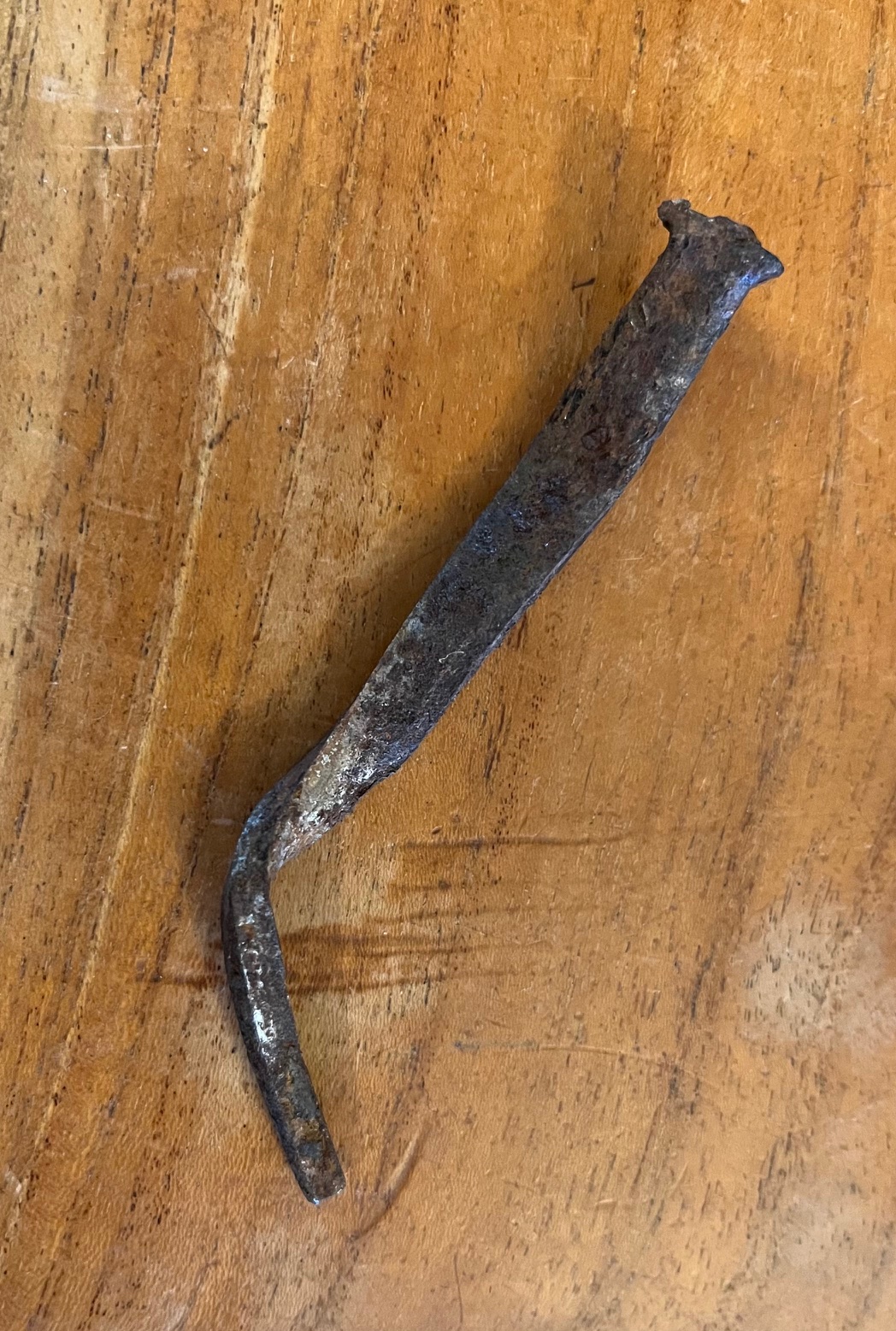
A hand-crafted nail. No idea how old it is, but I didn’t have to stick a shovel in the ground to find it. There’s been quite a bit of construction in the neighborhood and I’d guess someone else dug it up. All I did was walk past and kick it. It has an odd bend (I’ve bent a lot of nails in my time but never that way), and one person who looked at it figured it had been in a fire. All theories–even knowledgeable ones–will be gratefully entertained.
Experts have been working their way through the Galloway Hoard since it was found and in 2024 reported that the metal from a silver cup–okay, a silver vessel–was mined in what’s now Iran and that the vessel itself was probably made for royalty of the Sasanian empire–the last Persian empire before the Muslim conquest. They were Zoroastrian. So it traveled halfway around the known world to get buried in a Scottish field in 900 CE.
Follow the link for damn some good photos of the hoard.
Why did anyone bury it, though, and who did it belong to? An answer to the second question comes from an inscription on a decorated arm ring. (Follow this link as well for photos.)
But before I get to the inscription, let me tell you a few other things: The stash included four arm rings with runic writing. Three had what are described as elements of Old English names, presumably the original owners of the rings. But the experts all stubbed their toes on the fourth arm ring. It didn’t match any known language from early medieval Britain or Ireland.
Then someone had an inspiration and I’d explain it to you in detail but halfway through the explanation I sank, and I’m here to protect you from that fate, so let’s just say that they made an educated mental leap and realized they might be looking at a shortened or phonetic spelling. That led them to a translation: “This is the community’s wealth,” using a word that specifically meant a religious community.
Which takes us back to the other question: Why did a religious community bury all this wealth? Possibly to keep it safe from Viking raids. Christian monastic communities were full of expensive bling and the Vikings were wise to them. They were an easy target and a rewarding one.
Why didn’t the community dig it up? That’s the problem with history. It’s so full of things we’ll never know.
The Chew Valley Hoard
In 2019, seven detectorists in Somerset set out to mess around with someone’s new metal detector. They’d do a little detecting, get rained on, give the dog some exercise, have a few beers– You know.
They ended up unearthing 2,584 silver pennies that date back to the time of the Norman Conquest. (1066; you’re welcome.) The best guess is that they were buried for safekeeping during an early rebellion against Norman rule.
According to Lisa Grace, one of the finders and an expert in cataloguing antiquities, “The hoard may have been the result of looting or maybe the result of somebody hiding their money away because of the revolt.”
The coins have been valued at £4.3 million. Half goes to the landowner and the group will split the rest. I don’t know what the dog gets.
Stone circles
The southwest is full of ancient monuments, and most of them are just sitting out in fields, where you can walk in, lean against them, and feel blown away by their age and mystery, all without paying a fee or worrying about opening and closing hours. You do sometimes have to share them with sheep, cattle, and the occasional wild pony (as well as their droppings), but if you don’t mind, they don’t either.
A couple of Neolithic stone circles have recently been found on Dartmoor, and at least one of them adds weight to the finder’s theory that there was a circle of stone circles on the moor, which he calls a sacred arc. So far, he’s locate about half of the presumed circle.
One of the newly found circles had a ditch around it, as Stonehenge does, and they were built in roughly the same period.
If the theory’s correct, the other half of the arc is still out there, waiting to be found.
Dead bodies
Sorry to get gruesome on you, but when you’ve been dead long enough you stop being the much-missed Aunt Sadie or Uncle Marv and turn into archeology. In other words, your body isn’t gruesome anymore, it’s a clue to history.
People who try to piece together the details of what used to be called the dark ages and is now more respectably called the early medieval period lean heavily on clues from archeology because written records are sparse. Some were destroyed and others–um, yeah, they were never written, which makes them hard to read.
What’s more, where written records do exist it makes sense to ask how reliable they are. Historians of the time didn’t play by the rules of our era.
With that tucked under our belts, let’s go to Norway, which I admit isn’t in Britain but does have an interesting story to tell: an Icelandic saga from 1197 tells of the siege of Sverresborg Castle. The besiegers broke into the castle and “burned every single house that was there. . . . They took a dead man, and cast him headfirst into the well. Then they piled stones into it until it was full.”
Fast forward a few centuries until 1938, when archeologists found a skeleton in a well, buried by a layer of stones. Aha! Significant! But World War II intervened, the Nazis occupied the area, and suddenly everyone had other things on their minds. The body stayed where it was. It wasn’t until 2014 that anyone got it out and identified it as belonging to a man who was somewhere between 30 and 40 years old. He’d been hit over the head before he died and was injured in assorted other ways as well. Radiocarbon dating put his death in roughly the right period for the siege, and a DNA comparison to modern Norwegians hints that he might have come from southern Norway–the home of the besiegers, not the defenders. Which says they may have thrown their own guy in the well.
So much for history. Do we know anything about the recent past?
Here we’re going to abandon archeology. We can learn about our culture from the papers: in 1977, garden gnomes began disappearing from a town in England.
You know garden gnomes: those painted plaster statues so beloved of British homeowners that even the people who hate them love to hate them. In place of the missing gnomes, the bereft homeowners found ransom notes. By way of example, one read, “Listen, your gnome has seven hours to live unless you wrap 25 pence and leave it at the car park at Safeways near the bowling green. This is no hoax.”
Time passed. No dead gnomes were spotted, and a few days later, 8 gnomes appeared, as alive as they’d ever been, at a roundabout, draining all the tension out of the story.
A roundabout? That’s an ingenious way of handling traffic without using traffic lights. It either works like a charm or backs traffic up for months, depending on time, place, and circumstance. And luck.
The 8 gnomes were accompanied by three frogs, two squirrels, two toadstools, one peacock, one rabbit, and a Snow White. The statues’ owners reclaimed them, made them a nice cup of tea, and set them back in their gardens without checking them for PTSD because the diagnosis wasn’t widely known yet.
The perpetrator became known as the Phantom Gnome Snatcher of Formby.
And now, damn near 50 years later, the Phantom has identified himself. Sort of. His name’s Arthur, he’s 62, and he was 15 when he gnome-snatched, with the help of his 5-year-old brother. The two of them scoped out the neighborhood gnomes one night and went back the next night to collect them and leave ransom notes. They did check the locations they’d given in the notes–a phone box; a park bench–and found nothing.
Yeah, Formby was filled with hard-hearted cheapskates who were willing to let their gnomes die terrible deaths.
“So three nights later we put them all back and thought absolutely nothing of it,” Arthur said.
Arthur was outed–sort of–by a cousin, who didn’t give his name but said on radio, “I know the culprit. . . . He tells that story most Boxing Days and each time he gets a little bit wearier, you can see the weight of his conscience on his shoulders.”
That led Arthur to call Radio 2 and out himself–minus his last name.
“It’s been on my conscience that I did this terrible thing,” he said. “I would like to beg forgiveness from all the families that I have caused grief to.”
If that was the worst thing any of us had done–
And that brings us to the present day
Lupa Pizza in Norwich has bowed to pressure and is offering a pizza with a pineapple topping, but there’s a snag: It’ll cost you £100. (If you work in US dollars, that’s $123, give or take a bit, but you’ll have to get there, which ain’t cheap.)
I know that says something deep and meaningful about the culture, which means it connects perfectly to the archeology theme we’re following here, but I’ll leave it up to you to figure out what the connection is.
A few Irrelevancies
On a totally irrelevant (to this post, but not to the real world) topic, 200,000 Danes have signed a petition to buy California from the US. It reads, in part:
“Have you ever looked at a map and thought, ‘You know what Denmark needs? More sunshine, palm trees, and roller skates.’ Well, we have a once-in-a-lifetime opportunity to make that dream a reality. . . . We’ll bring hygge to Hollywood, bike lanes to Beverly Hills and organic smørrebrød to every street corner. Rule of law, universal healthcare and fact-based politics might apply.”
The petition’s website includes a call to “Måke Califørnia Great Ægain.”
*
Okay, this has nothing to do with archeology either. A breeding program trying to keep the northern spotted owl from going extinct had a pre-Valentine’s Day offer: for 5 Canadian dollars, you could name a dead rat after an ex–any ex–and get a photo of the rat. And the owl. The deal ended on February 13, but I’m sure they’re still accepting donations. And you could probably talk them into extending the offer just for you. And your ex.
*
In my last post, I wrote about the problem of telling native from non-native plants.
“Actually,” I said, to quote my own silly self, “what does native mean? How far back do you want to go? Think about it long enough and your mind will melt.”
To keep my mind from melting, my friend Helen sent me a link to a Botanical Society of Britain and Ireland website, which explains how far back to go.
Basically, if something was introduced by humans, either deliberately or by accident, and became naturalized between the beginning of the Neolithic period and 1500 CE, then it’s an archeophyte–a fancy way of saying an old plant.
Most of them arrived in the late Bronze Age, the Iron Age, and the Roman and Medieval periods. Some were hitchhikers that snuck in with crops, others started out in gardens, where they were grown for food or medicine but liked the conditions and jumped the garden to go wild.
You can break the category down into denizens, colonists, and cultivated crops if you like, but let’s leave that to the experts. Amateurs get hurt messing around with these things.
After 1500, when Europe and the Americas were in contact–eagerly on one side, reluctantly on the other–all sorts of new plants were introduced: for food, for medicine, for forestry, or because they were pretty. Farming, demographics, trade, and industry changed. All that makes 1500 a handy place to draw a line: Anything introduced after that date is a modern introduction: a neophyte.
A native plant is one that showed up without human assistance after the last ice age ended or got here before it and somehow survived. It sounds as if the date doesn’t matter, only whether it got here on its own.
 Notes from the U.K.