Archeology in Britain: a roundup

Sink a shovel into the soil anywhere in Britain and–

No, I’m about to exaggerate. You won’t necessarily find an ancient artifact, you’ll probably find good old fashioned dirt, but if you scan the papers for archeological news it’s easy to believe you’ll find treasure. Let’s review a few finds:


The Galloway Hoard

This was found by a metal detectorist in 2014, in a plowed field in Scotland. It’s one of the richest collections of Viking-age treasure found in Britain so far. The finder was paid something in the neighborhood of £2 million, which ain’t bad for a day’s work. Even if you count all those other days, when he found nothing except the tabs from soda cans, it still ain’t bad.  

The reason finds like this are known instead of being quietly sold to rich collectors is that British laws require detectorists to report their finds to a government body, which works out the cash value and the museum that should receive it if they can raise the money. So the finder benefits. Under English law, the landowner also benefits. Scottish law leaves the landowner out. I’m not sure about Northern Ireland. Either way, though, blank spots in the nation’s history get filled in.
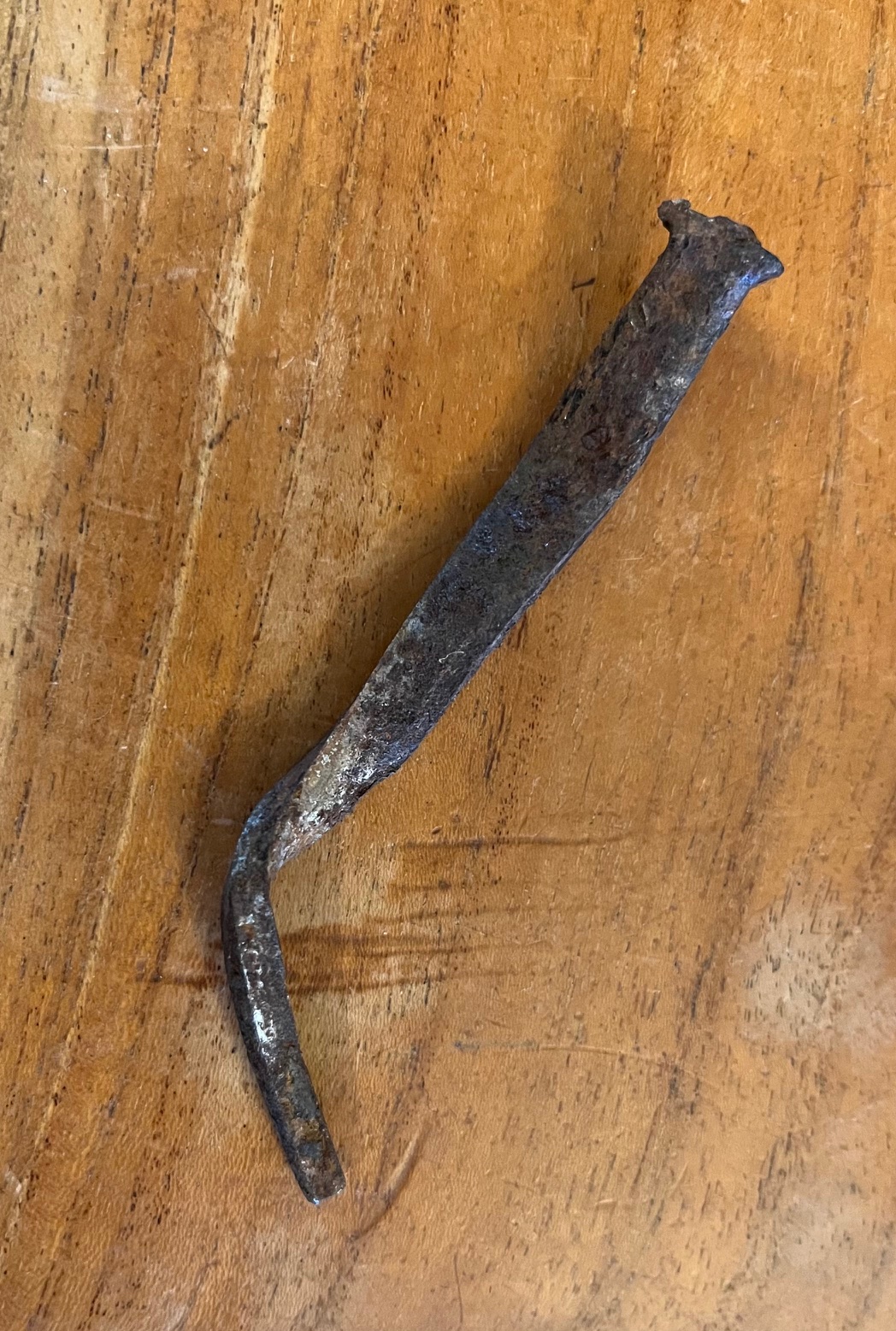
A hand-crafted nail. No idea how old it is, but I didn’t have to stick a shovel in the ground to find it. There’s been quite a bit of construction in the neighborhood and I’d guess someone else dug it up. All I did was walk past and kick it. It has an odd bend (I’ve bent a lot of nails in my time but never that way), and one person who looked at it figured it had been in a fire. All theories–even knowledgeable ones–will be gratefully entertained.

Experts have been working their way through the Galloway Hoard since it was found and in 2024 reported that the metal from a silver cup–okay, a silver vessel–was mined in what’s now Iran and that the vessel itself was probably made for royalty of the Sasanian empire–the last Persian empire before the Muslim conquest. They were Zoroastrian. So it traveled halfway around the known world to get buried in a Scottish field in 900 CE.

Follow the link for damn some good photos of the hoard.

Why did anyone bury it, though, and who did it belong to? An answer to the second question comes from an inscription on a decorated arm ring. (Follow this link as well for photos.)

But before I get to the inscription, let me tell you a few other things: The stash included four arm rings with runic writing. Three had what are described as elements of Old English names, presumably the original owners of the rings. But the experts all stubbed their toes on the fourth arm ring. It didn’t match any known language from early medieval Britain or Ireland. 

Then someone had an inspiration and I’d explain it to you in detail but halfway through the explanation I sank, and I’m here to protect you from that fate, so let’s just say that they made an educated mental leap and realized they might be looking at a shortened or phonetic spelling. That led them to a translation: “This is the community’s wealth,” using a word that specifically meant a religious community.

Which takes us back to the other question: Why did a religious community bury all this wealth? Possibly to keep it safe from Viking raids. Christian monastic communities were full of expensive bling and the Vikings were wise to them. They were an easy target and a rewarding one.

Why didn’t the community dig it up? That’s the problem with history. It’s so full of things we’ll never know. 


The Chew Valley Hoard

In 2019, seven detectorists in Somerset set out to mess around with someone’s new metal detector. They’d do a little detecting, get rained on, give the dog some exercise, have a few beers– You know. 

They ended up unearthing 2,584 silver pennies that date back to the time of the Norman Conquest. (1066; you’re welcome.) The best guess is that they were buried for safekeeping during an early rebellion against Norman rule. 

According to Lisa Grace, one of the finders and an expert in cataloguing antiquities, “The hoard may have been the result of looting or maybe the result of somebody hiding their money away because of the revolt.”

The coins have been valued at £4.3 million. Half goes to the landowner and the group will split the rest. I don’t know what the dog gets. 


Stone circles

The southwest is full of ancient monuments, and most of them are just sitting out in fields, where you can walk in, lean against them, and feel blown away by their age and mystery, all without paying a fee or worrying about opening and closing hours. You do sometimes have to share them with sheep, cattle, and the occasional wild pony (as well as their droppings), but if you don’t mind, they don’t either. 

A couple of Neolithic stone circles have recently been found on Dartmoor, and at least one of them adds weight to the finder’s theory that there was a circle of stone circles on the moor, which he calls a sacred arc. So far, he’s locate about half of the presumed circle.

One of the newly found circles had a ditch around it, as Stonehenge does, and they were built in roughly the same period.

If the theory’s correct, the other half of the arc is still out there, waiting to be found.


Dead bodies

Sorry to get gruesome on you, but when you’ve been dead long enough you stop being the much-missed Aunt Sadie or Uncle Marv and turn into archeology. In other words, your body isn’t gruesome anymore, it’s a clue to history.

People who try to piece together the details of what used to be called the dark ages and is now more respectably called the early medieval period lean heavily on clues from archeology because written records are sparse. Some were destroyed and others–um, yeah, they were never written, which makes them hard to read. 

What’s more, where written records do exist it makes sense to ask how reliable they are. Historians of the time didn’t play by the rules of our era.

With that tucked under our belts, let’s go to Norway, which I admit isn’t in Britain but does have an interesting story to tell: an Icelandic saga from 1197 tells of the siege of Sverresborg Castle. The besiegers broke into the castle and “burned every single house that was there. . . . They took a dead man, and cast him headfirst into the well. Then they piled stones into it until it was full.”

Fast forward a few centuries until 1938, when archeologists found a skeleton in a well, buried by a layer of stones. Aha! Significant! But World War II intervened, the Nazis occupied the area, and suddenly everyone had other things on their minds. The body stayed where it was. It wasn’t until 2014 that anyone got it out and identified it as belonging to a man who was somewhere between 30 and 40 years old. He’d been hit over the head before he died and was injured in assorted other ways as well. Radiocarbon dating put his death in roughly the right period for the siege, and a DNA comparison to modern Norwegians hints that he might have come from southern Norway–the home of the besiegers, not the defenders. Which says they may have thrown their own guy in the well. 


So much for history. Do we know anything about the recent past?

Here we’re going to abandon archeology. We can learn about our culture from the papers: in 1977, garden gnomes began disappearing from a town in England. 

You know garden gnomes: those painted plaster statues so beloved of British homeowners that even the people who hate them love to hate them. In place of the missing gnomes, the bereft homeowners found ransom notes. By way of example, one read, “Listen, your gnome has seven hours to live unless you wrap 25 pence and leave it at the car park at Safeways near the bowling green. This is no hoax.”

Time passed. No dead gnomes were spotted, and a few days later, 8 gnomes appeared, as alive as they’d ever been, at a roundabout, draining all the tension out of the story.

A roundabout? That’s an ingenious way of handling traffic without using traffic lights. It either works like a charm or backs traffic up for months, depending on time, place, and circumstance. And luck.

The 8 gnomes were accompanied by three frogs, two squirrels, two toadstools, one peacock, one rabbit, and a Snow White. The statues’ owners reclaimed them, made them a nice cup of tea, and set them back in their gardens without checking them for PTSD because the diagnosis wasn’t widely known yet. 

The perpetrator became known as the Phantom Gnome Snatcher of Formby.

And now, damn near 50 years later, the Phantom has identified himself. Sort of. His name’s Arthur, he’s 62, and he was 15 when he gnome-snatched, with the help of his 5-year-old brother. The two of them scoped out the neighborhood gnomes one night and went back the next night to collect them and leave ransom notes. They did check the locations they’d given in the notes–a phone box; a park bench–and found nothing. 

Yeah, Formby was filled with hard-hearted cheapskates who were willing to let their gnomes die terrible deaths.

“So three nights later we put them all back and thought absolutely nothing of it,” Arthur said.

Arthur was outed–sort of–by a cousin, who didn’t give his name but said on radio, “I know the culprit. . . . He tells that story most Boxing Days and each time he gets a little bit wearier, you can see the weight of his conscience on his shoulders.” 

That led Arthur to call Radio 2 and out himself–minus his last name. 

“It’s been on my conscience that I did this terrible thing,” he said. “I would like to beg forgiveness from all the families that I have caused grief to.”

If that was the worst thing any of us had done–


And that brings us to the present day 

Lupa Pizza in Norwich has bowed to pressure and is offering a pizza with a pineapple topping, but there’s a snag: It’ll cost you £100. (If you work in US dollars, that’s $123, give or take a bit, but you’ll have to get there, which ain’t cheap.) 

I know that says something deep and meaningful about the culture, which means it connects perfectly to the archeology theme we’re following here, but I’ll leave it up to you to figure out what the connection is.


A few Irrelevancies

On a totally irrelevant (to this post, but not to the real world) topic, 200,000 Danes have signed a petition to buy California from the US. It reads, in part:

“Have you ever looked at a map and thought, ‘You know what Denmark needs? More sunshine, palm trees, and roller skates.’ Well, we have a once-in-a-lifetime opportunity to make that dream a reality. . . . We’ll bring hygge to Hollywood, bike lanes to Beverly Hills and organic smørrebrød to every street corner. Rule of law, universal healthcare and fact-based politics might apply.”

The petition’s website includes a call to “Måke Califørnia Great Ægain.”

*

Okay, this has nothing to do with archeology either. A breeding program trying to keep the northern spotted owl from going extinct had a pre-Valentine’s Day offer: for 5 Canadian dollars, you could name a dead rat after an ex–any ex–and get a photo of the rat. And the owl. The deal ended on February 13, but I’m sure they’re still accepting donations. And you could probably talk them into extending the offer just for you. And your ex. 

*

In my last post, I wrote about the problem of telling native from non-native plants. 

“Actually,” I said, to quote my own silly self, “what does native mean? How far back do you want to go? Think about it long enough and your mind will melt.”

To keep my mind from melting, my friend Helen sent me a link to a Botanical Society of Britain and Ireland website, which explains how far back to go.  

Basically, if something was introduced by humans, either deliberately or by accident, and became naturalized between the beginning of the Neolithic period and 1500 CE, then it’s an archeophyte–a fancy way of saying an old plant.

Most of them arrived in the late Bronze Age, the Iron Age, and the Roman and Medieval periods. Some were hitchhikers that snuck in with crops, others started out in gardens, where they were grown for food or medicine but liked the conditions and jumped the garden to go wild. 

You can break the category down into denizens, colonists, and cultivated crops if you like, but let’s leave that to the experts. Amateurs get hurt messing around with these things. 

After 1500, when Europe and the Americas were in contact–eagerly on one side, reluctantly on the other–all sorts of new plants were introduced: for food, for medicine, for forestry, or because they were pretty. Farming, demographics, trade, and industry changed. All that makes 1500 a handy place to draw a line: Anything introduced after that date is a modern introduction: a neophyte. 

A native plant is one that showed up without human assistance after the last ice age ended or got here before it and somehow survived. It sounds as if the date doesn’t matter, only whether it got here on its own. 
Exploring early Cornish history

Let’s talk about early Cornish history. Or let’s try to, anyway. It turns out not to be an easy topic.

I spent a year or so searching for a good book on the subject and was met with blank looks in both used bookstores and unused bookstores. (What do we call those? New bookstores, even if they’re old? Just plain old bookstores, even if that’s not clear enough in the context?)

I didn’t do much better when I asked friends.

The books I did find fall into two and a quarter categories: 1, archeology; these books tend to be technical enough that I don’t get much out of them; 2, later history, which wasn’t what I was looking for; 2 ¼, school history, and this consists of one lone book for kids that has all the depth and reliability of any school history, which is why I’m not going to grant it a full category.

So it’s pretty dismal out there in the bookstore aisles, and in mid-September, I finally found out why. We’ll get to that, but first let me drag you through the tale of how I found out. It’s damn near relevant.

Some miles down the coast from where I live is Tintagel Castle. That’s pronounced tin-TA-jell, and the A in the middle syllable—oh, hell, English is impossible—is pronounced like the A in cat, although I don’t promise that’ll work in all accents everywhere.

Just do your best, okay? It won’t be on the test. The main thing is to put the emphasis on the middle syllable.

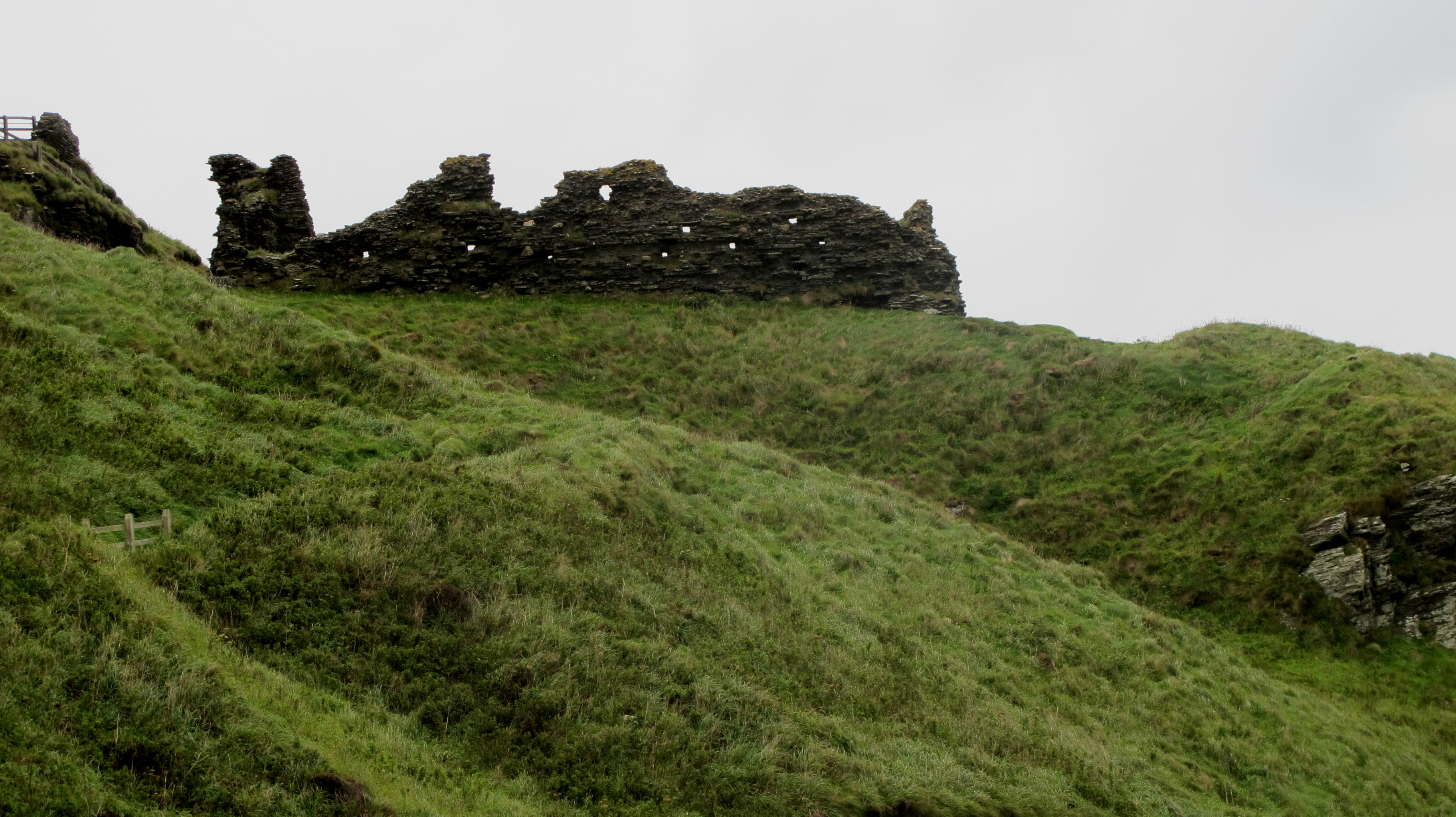
A shockingly relevant photo: Tintagel Castle. This is on the bit that was left on the mainland when the land bridge to the island collapsed.

Tintagel Castle was built in the 13th century on a bit of cliff that juts out into the ocean and catches every bit of wind coming from the west, south, or north. And since it’s joined to the mainland by a thin spit of land, it’s called the island.

Sorry, I don’t make the rules. It’s just called that. Erosion being what it is, especially with sea levels rising, sooner or later it’ll catch up with what it’s called and become the island it aspires to be. In the meantime, there’s a footbridge so you don’t have to clamber over the rocks and an impressive (not to mention rough) set of steps.

The castle’s a ruin now, having been subject to by wind and rain, not to mention people running (or staggering) off with chunks of stone after the place was abandoned. Hard as it is to steal stone that’s already been worked, it’s easier than digging up the unworked stuff, shaping it, and then having to move it anyway. Theft–or re-purposing, if you like–is one of the important ways that ruins get ruined. But what contributed most to the castle’s ruin was that the land bridge joining the headland to the mainland collapsed, taking the landward side of the hall with it.

If you’re intrigued, check out English Heritage’s website for photos and history. It’s well done and worth your time, even if many a Cornish eye rolls at the name English Heritage, because Cornwall was once independent, and had its own language, and the Cornish haven’t forgotten it and don’t consider themselves English.

Or some of them don’t. I’m an outsider and can’t pretend to talk for all of them. Or any of them. I can report what I’ve heard, though.

But the castle’s a relic of relatively late history and not what I was haunting the bookstore aisles for. If you hang around this country long enough, you can get snobbish about your history. Seven or eight hundred years ago? Phooey. I’m holding out for fifteen hundred or better.

Well, further out on the island, behind the 13th-century ruin, are much earlier stone foundations. The walls stand roughly knee high and grass forms a floor and grows on top of the walls. When I first visited Tintagel, the going theory was that they were the remains of a monastery. The current theory is that they’re the remains of a village dating back as far and the 5th and 6th centuries.

A number of the foundations were excavated in the 1930s, but the notes from that dig were lost in the blitz.

For five weeks this past summer, archeologists assembled a team of volunteers to dig out an unexplored patch of the island where the humps of foundations were visible, and so many people wanted to help out that they had a waiting list. The crews dug out three buildings (and found older foundations beneath them) and a number of trash pits, which are where archeologists find the really interesting stuff, in this case oyster shells, pig bones, and bits of Spanish glass and Mediterranean pottery.

I wasn’t one of those volunteers. I joined the smaller, unglamorous crew that came to fill in what the glamor-pusses had dug up. It’s the latest in high-tech archeology: You dig a site up, you find out what you can, then you fill it all back in before erosion wrecks it. In another thousand or so years, someone will dig it all up again and wonder what the hell happened. In the absence of any better idea, they’ll decide it was a religious ritual: People in the early 2000s dug up old buildings and then filled them in again, probably to honor the ancestors.

Back-filling the excavation at Tintagel. Black plasticky fabric covers the foundations that the first crew dug up. We buried it under the dirt and stones just to confuse archeologists of the future.

On the first and third days of the back-filling (I skipped the second day, and on the days I went I only stayed for the mornings; I’m 609 years old and thought it would be smart to quit while I was still in condition to come back)–. Let’s start over: On the first and third days, the crew consisted of five people: two archeologists and three volunteers. The larger, stronger people dug soil and pushed wheelbarrows. The smaller, older ones filled pails with rocks and dumped them into the pits. That sounds heavier than filling wheelbarrows with dirt, but believe me, it’s not.

This is not me filling a wheelbarrow with dirt.

On the third morning, the winds were just short of gale force and whipped soil off the rock pile that Wild Thing–that’s my partner, in case you’re new here; I haven’t mentioned her in an age–and I were crawling around in. I spent most of the morning trying to figure out where upwind was, but upwind had been suspended that day so that no matter where I knelt dirt blew into my eyes. Then the mizzle started—that’s a combination of mist and drizzle. You’d think water would settle the dirt down, but all it did was make it sticky as well as airborne.

By the time we climbed down off the island at lunchtime, we looked like some goth makeup artist had gotten loose on our faces. Our eyes were rimmed in black and Wild Thing’s mouth was neatly outlined in it. My hair had turned from white to tan and our clothes were a good match for our faces. I’d have taken a picture but I was afraid of what my hands would do to the camera. You’ll have to take my word for it: We looked fabulous.

So there we were at the sinks in the public toilets, surrounded by frighteningly clean tourists, and getting the sinks dirty without—and I can’t really explain this—managing to get ourselves clean. One woman finally gathered up the courage to ask, “What have you been doing?”

We didn’t say, “Burying the bodies,” and that turned out to be a good thing, because she decided we were safe and found us a couple of tissues, which let us scrape off a layer or two of the dirt.

Archeology’s such an elegant profession.

But–and here’s where we rejoin that path marked Early Cornish History–in the process of accumulating all that dirt, I learned a few things, not from the dig itself but from the archeologists.

One is that when Cornwall was conquered, in the tenth century, the Saxons burned pretty much everything. Why did they do that? No idea. You’d think it would be more profitable to leave the farms and villages intact and the people alive so people could continue farming and streaming tin, but war has a logic of its own once it starts.

So whatever records people had kept up to that point were presumably torched, and that would explain why I had trouble finding the book I wanted, and also why Cornwall Heritage Trust’s history of the period before the Saxon conquest is brief and general and relies so heavily on phrases like “seems to have.” Early Cornish history is a sketch with rough outlines—a muddle of archeology and guesswork, hearsay and reports from outsiders.

As an example, look at the information that’s come out of the dig at Tintagel: The settlement was a center of trade. The evidence indicates that the people there lived well. They had wine and olive oil from the Mediterranean. They drank from Spanish glassware. In return, they would have traded Cornish tin and copper.

Or at least some of them lived well. I’m guessing that the social structure was unequal and that some lived better than others–that’s how things worked in that period–but nothing I’ve read mentions that and I doubt the evidence can tell us how far into the ranks of ordinary people all that good food reached. I doubt we can even tell if the best fed ate well year around.

One archeologist on the site has a theory that the place might have been settled by refugees from the Mediterranean, which in the post-Roman period was in turmoil. Why does he think so? Because the foundations on the island are rectangular, and at that time the houses in the rest of Britain were round.

It’s educated guesswork but it’s intriguing. And possible.

“Would they have traded with a place they fled?” I asked, thinking of Syria and assuming that a place you flee from would be too dangerous or too chaotic to trade with.

“Think of the Plymouth colony in America,” he said.

It was settled by religious refugees, but it was also a colony. It maintained links to the land the settlers fled. The lines between refugee and settler aren’t as clear and dark as the words led me to believe.

The absence of hard information is one of several factors that let us romanticize the past. Another is that we don’t live there. It’s kind of like falling in love with the one person who’s least likely to fall in love with you. You never find out that they fart in bed.

On the first day, as we were climbing one of the sets of stairs that lead to the top of the island, a volunteer told me he’d love to have lived in the past. He started out wanting to go back to the period we were about to back-fill, then switched to the 16th century.

“At least for a while,” he said, leaving himself (and I’m guessing here) a chance to duck home for a shower, a sausage roll, and a Red Bull.

“Wouldn’t you?” he asked.

“It wasn’t a great time to be a woman,” I said.

It also wasn’t a great time to be Jewish. Or a lesbian. Or, while we’re at it, an atheist. Oddly enough, I didn’t think to say any of those things. It’s an interesting oversight but that’s too much of a digression even for me. If anyone wants to discuss it, we can duck into the comments and dissect it there.

In the meantime, let’s go back to the idea of living in the sixteenth century. I have another reason for refusing to live there. The clothing was ridiculous. I’ve never cared much about fashion–in fact, I’m dyslexic in it–but please be serious. Even for me, there are limits.

But I told this tale for a reason, other than that it happened. When you romanticize the past, you’re taking the present, with all the beliefs it allowed you to form and you’re importing them onto the past. You’re shaping it to suit you, and amateurs aren’t the only people who are guilty of it, although when professionals do it they’re much more convincing. Consider the story of a recently discovered grave in Sweden containing the bones of a woman buried with a sword, an axe, a spear, arrows, and not one but two shields and horses. Which must’ve made her grave the size of half a village.

Was she a warrior? I’d like to think so, but when I make that jump I’m importing my own hopes and beliefs backward in time to interpret the evidence. I do know that among the Maori, some women fought alongside the men, so I know women can’t be ruled out as warriors. But that’s as far as I can go without spinning fantasies: The woman in Sweden may well have been a warrior.

Before DNA testing was available, whenever slender bones were found buried with swords and so forth, archeologists wrote them off as “anomalous” and pulled back from exploring the possibility that a woman used those tools. Even with DNA testing that can now establish the sex of the person, some experts are still skeptical because everyone knows women weren’t warriors, right? And that’s the problem with archeology. What it finds can’t speak for itself; it has to be interpreted, and its easy to let our assumptions contaminate the evidence.

So early Cornish history is not only a rough sketch, it needs to stay that way. What we don’t know, we can at least try not to invent.

But back to Tintagel: I mentioned that we had five people working on the days I was there. What they needed to finish the job was at least twenty. But sensible people want to dig stuff up, not rebury it. On our last day, with most of the dig still unfilled, the people in charge were talking about calling the probation service to ask if they could borrow some strong young people who’d been sentenced to community service.

Wild Thing and I talked about going on the fourth day, but the winds were even stronger than on the third and we stayed home. The first named storm of the season, Aileen, had blown in. I haven’t read about anyone being blown off the island, so I’m guessing everyone else did as well.