Dido Elizabeth Belle: more on the ambiguities of slavery in England

Dido Elizabeth Belle was born a slave, raised in an aristocratic English family, and given the education and many of the and-so-forths of an English aristocrat. Her story messes with pretty much any assumptions we carry in our luggage. In some tellings, she’s Britain’s first Black aristocrat. That makes a great headline but it stretches the truth.

Let’s call her Dido, since her mother comes into the story and her last name was also Belle.
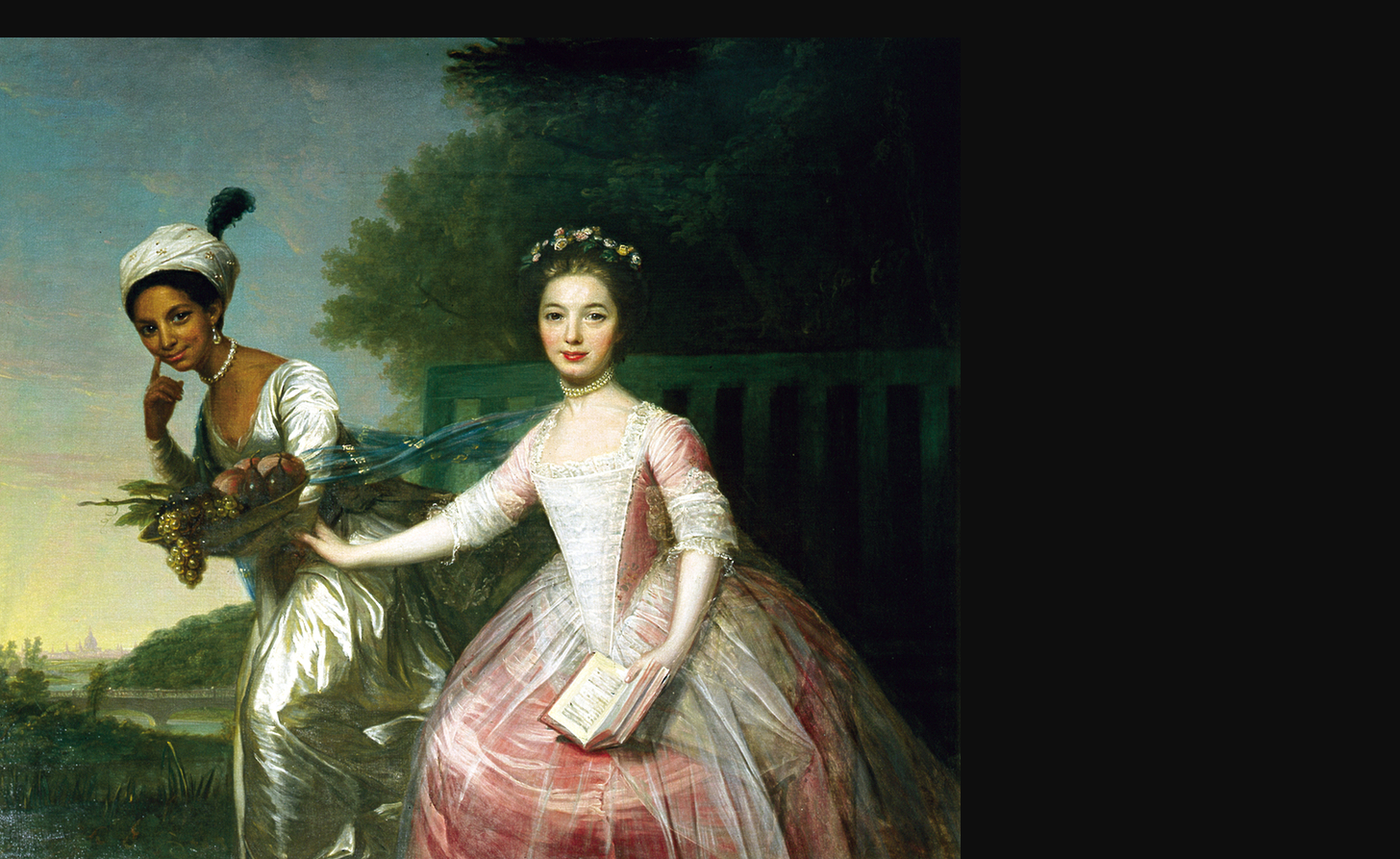
Dido Elizabeth Belle (left) and her cousin, Elizabeth Murray. 

Maria, John, and Dido

Dido was born in 1761. Her mother was Maria Belle, who was then a slave, which would have made Dido a slave, and her father was John Lindsay, an officer in the Royal Navy.

Sorry, Make that Sir John Lindsay. I just love italics. They do sarcasm so well. 

It’s not 600% clear how he and Maria Belle met, but Lindsay was where you’d expect a naval officer to be, on a ship, and his particular ship was protecting British trade routes and capturing the ships of countries Britain was at war with, along with the ships’ cargoes. In other situations, that’s called piracy, but when you have your government’s stamp of approval it’s called foreign policy. 

Exactly how John and Maria (what the hell, let’s call them all by their first names) crossed paths isn’t clear. Maria might’ve been part of the–ahem–cargo on a ship he captured. She also might not have been. 

Whatever happened, they met, Dido ensued, and John and Maria seem to have had something approaching a relationship, because in 1774 Maria built a home in Pensacola, Florida, where John had bought a plot of land for her. The property record calls her “a Negroe Woman of Pensacola in America but now of London afore and made free.” Her manumission papers are also from  1774 and acknowledge “the sum of two hundred Spanish milled dollars . . . paid by Maria Belle a Negro Woman Slave about twenty eight years of age.”

Although having said that, another source talks about John having given her her freedom, not sold it to her. Either way, working backward from those numbers, Maria would’ve been around fifteen when Dido was born.

But that business about the house, the property, and her freedom jumps ahead of the story. Somehow–again it’s not clear how–Maria and Dido show up in London when Dido’s around five, something we know because her baptism is recorded, thanks to Henry VIII having introduced the requirement that churches record baptisms, marriages, and burials. Maria’s listed as the wife of Mr. Bell, whoever he might’ve been.

John isn’t listed as the father, although she was widely acknowledged as his child and he was involved enough that Dido was placed with his brother’s family at Kenwood House.

Before you decide that Dido’s parents had the love affair of the century, defying differences of class, color, and national origin to explore their mutual passion until the end of the earth or their deaths, whichever came first, I should tell you that John made a socially acceptable marriage in 1768 and had four more children with four more women, none of whom was his wife. He doesn’t sound like lasting romance material to me.

Somewhere along the line he was knighted and in 1776 he became a part-owner of a plantation in Nevis, which was worked by slaves, as they all were at the time, so off the top of my head I’d say we can’t count him as an opponent of slavery any more than we can nominate him for faithful non-spouse of the year.

And Maria? We’re not going to find out. She drops off the historical record.


Dido

Dido went to live with the family of her father’s uncle, William Murray, First Earl of Mansfield and Lord Chief Justice–in other words, the most powerful judge in England. In the spirit of rampant inconsistency, we’re not going to call him by either his first or last name but Mansfield. Don’t ask me to justify that. It’s what most of the articles I’ve read call him. If you have a grand enough title, you get handed a whole poker hand’s worth of names to choose from.

Have you noticed that everyone in this tale has a last name that could also be a first name?

Mansfield and his wife were childless and had already taken in Dido’s cousin Elizabeth Murray, whose mother had died. The two girls were raised and educated together. 

What was usual and what was unusual about this? If a family sat high enough on the class scale, society wouldn’t faint from shock if it become guardians to a relative whose parents hadn’t been married. Or–hell, I’m dancing all over the lot, trying to avoid talking about legitimate and illegitimate children. The idea that a child could be illegitimate is bizarre, but that was the way people thought at the time. Let’s use the word. It simplifies my sentences. 

So, taking in an illegitimate child wasn’t shocking. What was unusual was for a mixed-race child, and the child of a slave or former slave, to be raised not as a servant but as a gentlewoman.

And yes, since we’re talking about absurd phrases that we’re more or less stuck with, let’s add mixed race to the list. Humans don’t divide into races. It just doesn’t work. The problem is that I haven’t found a phrase that slots into a sentence as well, so put a mental asterisk beside it and understand that we need some new language there.

But back to our story. We now have Dido safely ensconced in the very grand home of an earl and accepted into the heart of the family.


But . . .

. . . the family made a clear distinction between Dido and Elizabeth. Dido got an allowance of £30 a year. Elizabeth got £100. Mind you, £30 a year was good money–several times more than a domestic worker made and she didn’t work for it–but it says a lot about their ranking. When it was just the family present, she was family. When they had guests, she joined them after dinner, not during. In the portrait at the top of the page, Dido’s the secondary figure. It’s a portrait of her cousin.

Was that about color, legitimacy, or a bit of each? I don’t know that anyone can untangle those threads at this point. An illegitimate child was always ranked below a legitimate one. On the other hand, all the money that was being made from slavery guaranteed that racism had infused itself into the British belief system. In the portrait, she gets the turban and the bowl of exotic fruit; the cousin gets the chair and the more traditional headpiece.

Portrait artists were pretty heavy handed with their symbols. I’m not stretching things to mention those.

On a personal note, I was raised in the US and spent most of my life there, inevitably surrounded by the American brand of racism. I’m constantly noticing that the British brand is different. I don’t know of any story from the US that’s comparable to Dido’s. But that’s not to say that Britain’s free of racism. It’s just–you know, different wrapper, different ingredients, slightly different weight to the candy bar inside.

When Dido’s father died, his obituary described Dido–”his natural daughter”–as having an amiable disposition and accomplishments [that] have gained her the highest respect from all his Lordship’s relations and visitants.”

Accomplishments were a big thing for a lady of the period. Dido played music and had beautiful handwriting. Mansfield often dictated his letters to her–a job normally reserved for a male clerk. She also supervised the dairy and poultry yard, as genteel women of the time often did. (Come on, they had to do something or they’d have perished from  boredom, every last one of ’em.)

In 1784 Mansfield’s wife died and in 1785 Dido’s cousin Elizabeth married, leaving Dido to care for Mansfield until his death in 1793. His will left her £500 (about £40,000 today) as well as £100 a year–not as much as he left Elizabeth but nothing to sneeze at. And to clear up any doubt about her status, his will stated that she was a free woman. Or in some tellings, he granted her her freedom.

Does that mean that she and the family considered her to still be enslaved? Or was he only being cautious? I can’t begin to guess, but even if it was caution, knowing that he didn’t clear that up from the beginning kind of makes your blood curdle, doesn’t it?

After Mansfield’s death, Dido married a steward. To locate him in the all-important class hierarchy, he was a senior servant, so if she’d been fully a lady that would’ve been a shocker of a marriage. No one says that he wasn’t white, so we can probably assume he was. He was from France. That gets a mention. They had three sons and lived in London. Dido died in 1804, at 43. 


Dido, Mansfield, and slavery

Before we go on, let’s spend a moment remembering–or if you didn’t already know this, finding out–that Mansfield (Chief Justice, remember) presided over the 1772 Somerset case, which ruled on the legality of slavery in England. His ruling was, like so much of this story, ambiguous.

The question in front of him was whether James Somerset, an escaped slave, could be forced onto a ship and sent to the Caribbean, where he’d be sold. Mansfield ruled that he couldn’t, setting in place the precedent that no slave could be made to leave the country against his or her will. 

The ruling was widely believed to have ended slavery in England, but it didn’t. Slaves continued to work as slaves, and to be bought and sold. Escapees continued to be recaptured–or at least sought, since it was far easier for an escaped slave to disappear in England than in, say, the Caribbean, and many people freed themselves instead of waiting 61 long years for the law to do it for them.

Legal scholars argue about what precedent the ruling actually set. Unfortunately, I’m  no legal scholar, although I did once pass myself off–accidentally and in an email–as a lawyer, so we won’t dive into that. Instead, let’s acknowledge that although Mansfield described slavery as odious and argued that it was “of such a nature” that it couldn’t be introduced without some positive law to uphold it, which England didn’t have, he still stopped short of ruling it illegal. The economic fallout of that was more than he could face–or at least that’s the best explanation I’ve seen offered. His ruling made it clear that the case posed an important moral question, he picked up the legal bricks that could’ve built a case for abolition, and he put them down again without building it.

And he made sure in his will that his great-niece could live out her life as a free woman.

English history: how heavy was the Norman yoke?

In the years before 1066, English history was chugging along very nicely, thanks, with the Anglo-Saxon and Norse royal houses at each other’s throats, as they had been for long enough that everyone thought, Well, families, you know. They’re like that. Because by then they were family, and that was part of the problem. They’d intermarried enough that it wasn’t always clear who was supposed to inherit the chairs, the dishes, the crown. 

It wasn’t what you’d call peace, but at least everyone knew more or less what to expect. 

Then the Normans invaded. In no time at all (as history measures these things) the family broke apart. The Norse became distant relatives who the Anglo-Saxon didn’t see anymore–except, of course, for the ones who’d settled in England. A lot of them had done that in the north, and the Anglo-Saxons saw them all the time but they didn’t seem quite as Norse as they once had, what with the Normans stomping through. By comparison, they seemed positively–English.

Or so I like to think. You won’t find that in any of the history books. 

Just something to break up the text. It has nothing to do with anything.

Irrelevant photo: erigeron

The new outsiders, the Normans, replaced England’s governing class (with themselves, you’ll be surprised to learn), along with its language (sort of; it’s complicated and we’ll leave it alone for now) and its social structure (mostly; everything’s complicated when you give it enough thought). People who’d once been free became serfs–tied to the land and subject to the lord of the manor and his whims. 

See the end of the post for the grain of salt that goes with that last sentence.

Some 600 years later, during England’s Civil War, people who wanted to level out the country’s massive inequalities (called, surprisingly enough, the Levellers) talked nostalgically about the time before the Norman yoke was imposed on free Anglo-Saxon England. That was what they wanted–the freedom the land and its people had once known.

So just how free was Anglo-Saxon society?

Well, it depended on who you were. Free men were free. Free women were freer than they’d be again for many a century, or at least free women upper-class women were. Less is known about free women further down the social ladder. Slaves, though, were anything but free, and although the poorest peasants weren’t slaves, their situation sounds a lot like serfdom, which is somewhere between slavery and freedom.

Let’s work our way through it–or at least as much as I’ve been able to wring out of the internet and the books I have at hand. It won’t be a full picture. So much about Anglo-Saxon England has been lost.

Slavery

In Anglo-Saxon England, people could be born into slavery or they could be enslaved as a penalty for some crime. They could be captured in war, and capturing slaves was as important a reason to go to war as capturing land was. Finally, children could be sold into slavery by their parents and adults could make themselves into slaves. Both of those were probably desperate steps that people took in the face of famine.

There was a well-established slave trade, both within England and to other countries. So slavery’s roots reached deep into the economy. Bristol was a slave port, trading with the Viking merchants based in Ireland.

Slavery wasn’t necessarily a permanent condition, although it could be. Slaves could buy their way out; they could marry out of slavery; or they could be freed by their owners. It wasn’t uncommon for people to free a few slaves in their wills. Sally Crawford, in Daily Life in Anglo-Saxon England, speculates that people freeing slaves in their wills could, at times, have been done it with an eye toward not imposing the liability an older, unproductive slave on their heirs. She doesn’t offer any hard evidence for that, just raises the possibility. Either way, freeing a slave seems to have been considered a pious act. 

Not that Christianity pitted itself against slavery. Toward the end of the Anglo-Saxon period, ecclesiastical landowners had more slaves than lay people did. 

What did slaves do? They were plowmen, stockmen, beekeepers, dairymaids, swineherds, seamstresses, weavers, domestic servants, concubines, cooks, millers, and priests. 

I’m not sure what to make of priests being on that list, but it’s very much a part of the picture.  

Crawford writes about Anglo-Saxon slave owners having reciprocal obligations to their slaves–primarily to keep them fed and clothed, but also, possibly, to train some of them for skilled jobs. They also had the power to beat their slaves–not, she says, because slaves were considered a lower form of human but because Anglo-Saxon law punished transgressions with fines, and they couldn’t fine someone who couldn’t pay, so they fell back on physical punishment. 

Is she right about the reciprocal nature of Anglo-Saxon slavery? I’d have to hear it from the slaves before I’d be convinced, but they left no record. 

HIstory Today paints a less forgiving picture. “As Old English law codes make clear, slaves could be treated like animals: branded or castrated as a matter of routine and punished by mutilation or death; stoned to death by other slaves if they were male, burned to death if they were female.” 

According to Robert Lacey and Danny Danziger in The Year 1000: What Life Was Like at the Turn of the First Millennium, no line clearly divided slaves from the “other members of the labouring classes.” They wouldn’t have lived separately, and “almost everyone was beholden to someone more powerful than themselves.”

As the years ticked away and we come closer to the Norman invasion, Crawford says, slavery became less widespread. Free labor was available to do the same work and slaves had become an economic liability. The Domesday Book, which counted every chicken feather in England so that the new Norman king would know just how many chicken feathers he’d amassed in his conquest, counted slaves as 12% of the population. 

History Today isn’t convinced that slavery was on the wane and estimates that slaves made up 20% to 30% of the population. 

I’m staying out of this. Can we say that slaves made up a significant portion of the population and stop squabbling, please? 

Non-slavery

Just above the slaves on the social ladder were people who owed service to their lords. Most of them were serfs. 

Cottars were one step up from slaves and many of them might have been freed slaves. (You notice how hazy that got? “Many”; “might have been.” We can’t know, so let’s not pretend we do.) They worked on the lords’ estates in exchange for some land they could work for themselves. It was often marginal land. 

Above them came bordars, or geburs, who are in italics because the word’s Old English (it means tenant farmer) and Old English is foreign enough to a modern English speaker’s ear that we treat it like a foreign language and use funny-looking letters. Bordars don’t come in italics because the word crept into Norman usage, although most of us won’t recognize it. 

Look, don’t ask me to explain it. I’m following Crawford’s system of italics and inventing explanations as I go. You shouldn’t trust me too far on this. 

Have we gone off topic? Of course we’ve gone off topic. It’s what we do here.

The  bordars/geburs weren’t as poor as cottars but still owed work to the lord. Some were brewers or bakers. 

Above them came the coerls–small freeholders. They paid taxes, sat on juries, and owed public service, all of which marked them as free, but they also owed service to a lord. They may or may not have been armed and may or may not have fought with their lord when called on. It’s not clear. 

The word coerl comes into modern English as churl–a peasant; someone who’s rude or mean spirited, probably because from the Norman point of view, all Anglo-Saxons working the land looked alike and sounded alike. And were inherently rude and mean spirited, not to mention muddy, and so they could all be treated like dirt.

Coerl didn’t bring any italics with it. I’m only using them here to talk about it as a word, the same way I italicized churl.

And that, my friends, has nothing to do with our topic. Don’t you just love the way I keep us focused?

Under Alfred the Great’s version of Anglo-Saxon law, you couldn’t treat a free person like a slave–couldn’t whip him or her, say, or put him or her in the stocks. If you did, you’d be fined. You also couldn’t cut his hair–and here we’re only talking only about his hair, not hers–“in such a way as to spoil his looks” or to leave him looking like a priest. You also couldn’t cut off his beard, which is one of the things that convinces me that his really does mean his here. 

Anglo-Saxon pronouns were gender neutral. Without the beard, you can’t tell a his from a hers.

The point of the law, apparently, was to keep a lord from forcing a free person into the ranks of slaves, because the hair and beard were marks of a free man. 

Free boys, when they turned twelve, had to swear an oath to the king–at least from the time of Athelstan onward–and the king’s shire reeve visited every community once a year to hear them swear.

What they swore wasn’t just loyalty, but to favor what the lord favored, to discountenance what he discountenanced–and to turn in anyone who didn’t. “No one shall conceal the breach of it on the part of a brother or family relation, any more than a stranger.”

So that’s what freedom looked like.

The Norman conquest

Crawford’s reading of the transition from Anglo-Saxon to Norman society was that the lives of serfs and slaves might not have changed much. Rural life still focused on the manor and the lord, even though the manor would have been owned by a new lord, who’d have spoken Norman French. I can’t help imagining that those new lords, given a huge amount of power and surrounded by a language and a culture that frustrated them and made no sense to them, would have been ruder than the old ones–more churlish, if you like irony. They were conquerors, and conquerors do tend to act that way.

I said earlier that people who’d once been free became serfs after the conquest, and that seems to be the general belief, but I can’t document it. Lots of things from that time can’t be documented. Be cautious about how much belief you pour into that particular juice glass. If I had to guess–and I don’t but I will anyway–I’d guess that it was the coerls who dropped down the scale into serfdom. If that’s true, it would have been a loss of both freedom and status.

As for the Anglo-Saxon elite, they lost their lands and their status, and many fled abroad. Some lost their lives in various rebellions. I haven’t seen anything that says they became either serfs or slaves. Aristocrats recognized other aristocrats, even those who were their enemies.

The lives of both the poor and the rich were massively disrupted–or ended–by the harrying of the north, the Norman response to a rebellion. The Domesday Book lists land in northern village after northern village as waste–valueless and unoccupied. But we’re not talking about whether the transition to Norman rule was brutal–it was–only about whether life, once things settled down, became less free than it had been before they came. 

To weigh against any losses of freedom, it was under the Normans that slavery gradually died out. 

If people ceased to be slaves and became serfs, did their lives improve? Possibly. Probably. But again, they left us no documents. We can’t know.

So although my heart’s with the Levellers, I’d have to say that the picture of Anglo-Saxon freedom and Norman oppression was photo-shopped.