Stonehenge, cows, and technology: a roundup of British archeology

A century ago, someone found a cow’s jawbone buried beside the entrance to Stonehenge. The placement looked deliberate, and historians have been speculating about it ever since. Now, the high-tech toys available to scientists have delivered new information, answering some old questions and leaving us with new ones: the cow came from an area with Paleozoic rocks–in other words, rocks that are more than 400 million years old. The closest place that fits that description is Wales, where Stonehenge’s bluestones were quarried. 

Does that mean Stonehenge was built by Welsh cows? 

When they sober up, archeologists aren’t convinced of that, but there is speculation–sober speculation–that cows or oxen were used to drag the stones overland. It’s only recently that archeologists have found evidence that cattle were used to pull heavy loads in the Neolithic era, when Stonehenge was built, but they’re now pretty sure they were, and that fits nicely into the jawbone puzzle.

If you forgot to set your watch, the Neolithic era took place somewhere around 2990 BCE. 
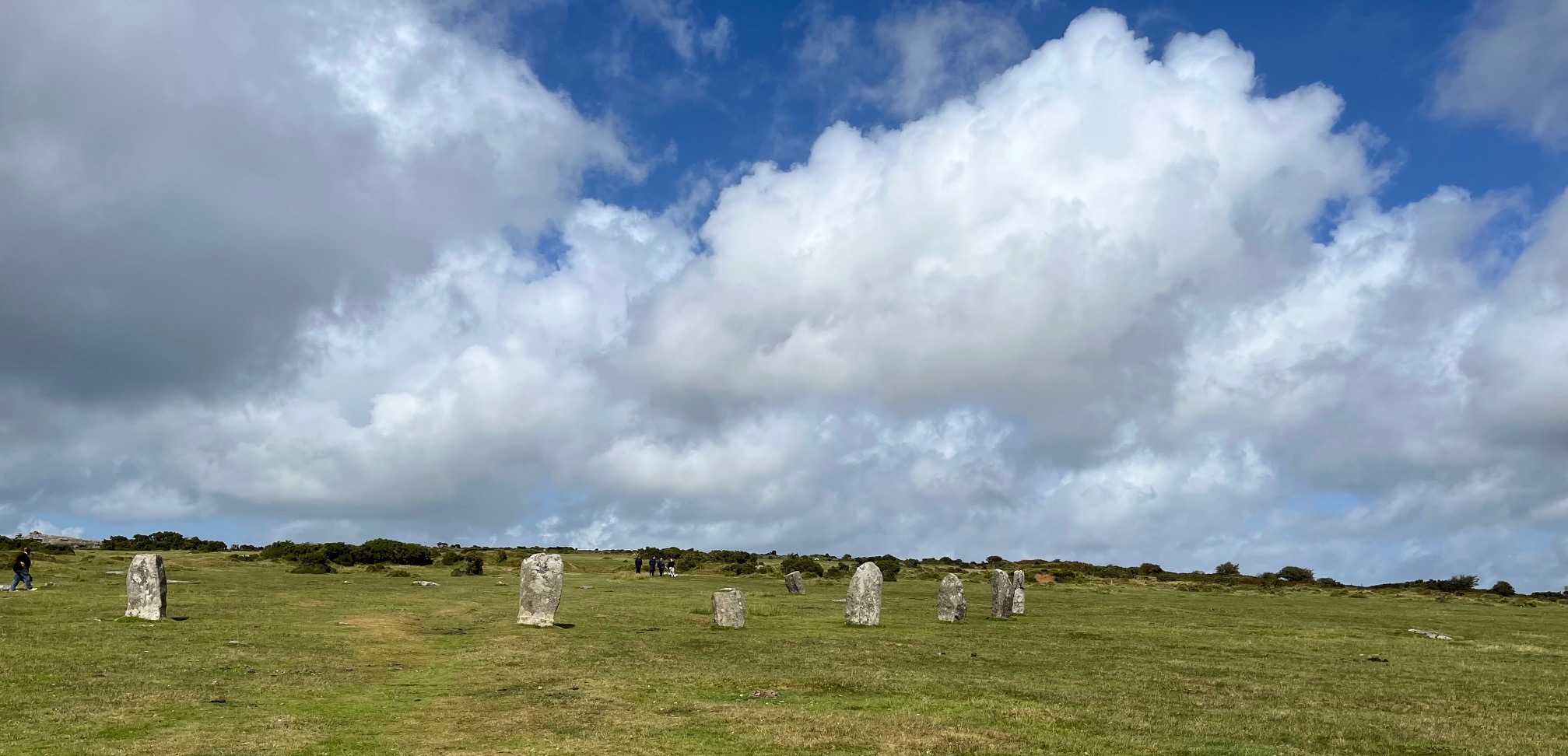
Marginally relevant photo: Stonehenge it’s not, but it is a stone circle. This one’s from Minions, in Cornwall.

But cows and oxen pulling the bluestones sits squarely in the land of speculation, so let’s not commit too heavily to it. We can’t prove that the cows in general or this cow in particular helped pull the stones. We don’t even know for sure that the cow in question was brought to Stonehenge alive, although if you’re going from Wales to Stonehenge, you’ll find it’s a long way to carry a cow. Or even a cow’s head, especially in the era before refrigeration. Humans are indeed strange, but not, I like to think, quite that strange. 

What’s known for certain is that the cow was indeed a cow, not an ox or a bull. And that someone left her jawbone in a significant spot, like a note saying, “This means something,” and don’t we wish they’d told us what.


Cows, sheep, and pigs

Animal bones also figure in a recent article about bronze age gatherings in what’s now Britain. People traveled long distances to get together and eat. And, presumably, solidify the relationships between tribes or–well, whatever groupings we’re talking about. They would’ve known. The same techniques that inform us about Stonehenge’s Welsh cow also tell us where their animals came from before they became the feats. 

Whatever it means, at one site they mostly ate beef; at another, mutton; and at a third, pork. 


A Danish woodhenge

A circle of 45 wooden posts has been discovered in Denmark. It’s believed to have been built between 2600 and 1600 BCE–the late stone age and early bronze age–and it’s the second woodhenge that’s been found in the area. What experts take from this–or one of the things they take from it–is that Denmark, Britain, Ireland, and parts of northern Europe, which all have similar henges, were strongly connected. 

The axis of the newly discovered henge matches that at Stonehenge, underlining the assumption that the builders had shared beliefs and technologies.


The Melsonby Hoard

Someone with a metal detector found what’s described as one of the biggest and most important hoards of iron-age glitz in Britain: a collection of more than 800 objects. It was found in a field in the north of England and includes wagon and chariot parts, bridle bits, ceremonial spears, and two ornate cauldrons, all of which shows evidence of burning, possibly as part of a funeral. 

The expert who was called in after the detectorist reported his find said, “Finding a hoard of ten objects is unusual, it’s exciting, but finding something of this scale is just unprecedented. . . .

“Some people have regarded the north as being impoverished compared with the iron age of the south of Britain. This shows that individuals there had the same quality of materials and wealth and status and networks as people in the south. . . . The north is definitely not a backwater in the iron age. It is just as interconnected, powerful, and wealthy as iron age communities in the south.” 

The find also provides the first evidence of four-wheeled vehicles in use among the tribes. 


The Romans and the Welsh

A huge Roman fort that was in use from the first through third centuries has been found in Pembrokeshire, Wales, in an overgrown farm field. It may rewrite the history of relations between the Romans and the Demetae–the tribe that lived there. The belief had been that they were on peaceful terms, but the presence of a fort this size throws that into doubt, indicating a strong military presence.

The fort explains why the field was never worth cultivating: the farmer, and probably many before him, kept hitting stone. It was found by an archeologist from Pembrokeshire, who had often wondered whether an unusually straight road might not be Roman. (You may have to live in Britain to understand why a straight road would cause a person to wonder.) Then  he looked at a satellite image and spotted the field, which is the size and shape of a Roman fort.

He drove out to see it and as he described the moment, “Sticking out of the ground was a triangular piece that looked like a Roman roofing slate. I thought: ‘Surely not?’ I pulled it up and lo and behold, it’s an archetypal Roman roofing slate, an absolute peach. Flip it upside down and you can see underneath a diagonal line where it was grooved to fit into the one that was underneath it. It’s a real beauty. . . .

“That was the diagnostic evidence I was looking for, which is a miracle, because it’s a huge site.”

The current best guess is that the fort held some 500 soldiers.


England and West Africa

We’ve moved to the 7th century CE, so reset your watches if you would, and we’re poking around disrespectfully in a couple of graveyards, one in Kent, on England’s southeast coast, and one in Dorset, a long walk to the west, even if you’re being dragged by a cow. 

Sorry, no. Wrong era. Forget the cow. But in the same way that the Stonehenge story follows one cow to make sense of the Stonehenge story, this one follows two unrelated humans to get a glimpse of life in early medieval England. These burials hint at people traveling much greater distances in the early medieval period than we would’ve expected: both had a paternal grandparent from West Africa. Their grave goods show they were both buried as typical and well-thought-of members of their communities, and the ancestors of the people buried nearby were either northern Europe or western British/Irish.

That western British/Irish business is, I think, a way of saying Celtic now that it’s looking questionable that a group of people called Celts ever existed. 

The Kent and Dorset communities had very different cultures, the eastern one Anglo-Saxon and in frequent touch with Europe, the western one on the fringes of European influence and primarily–um, whatever we say if the word Celtic’s gone up in smoke. Both, though, had contact with far-away West Africa.


And finally, a mere 800 years ago

In Leicester–pronounced, through some miracle of English spelling, Lester–in the twelfth century, 123 women, men, and children were buried, in a short space of time, in a narrow shaft near the cathedral. That would’ve been something like 5% of the town’s population and it’s one of the largest pit burials found in Britain. 

“Their bones show no signs of violence – which leaves us with two alternative reasons for these deaths: starvation or pestilence,” said Mathew Morris, project officer at Leicester University’s archaeological services. “At the moment, the latter is our main working hypothesis.”

Initially, the archeologists assumed the deaths were from the bubonic plague, but when the bones were radiocarbon dated the centuries were wrong. But the Anglo-Saxon Chronicles do mention pestilences and fevers, severe mortality, and miserable deaths from hunger and famine in England from the mid-tenth century through to the mid-twelfth century. The pit burials seem to back that up.

“It is also important to note there was still some form of civic control going on,” Morris said. “There was still someone going around in a cart collecting bodies. What we see from studying the bodies in the pit does not indicate it was created in a panic. . . . There was also no evidence of clothing on any of the bodies – no buckles, brooches, nothing to suggest these were people who were dropping dead in the street before being collected and dumped.

“In fact, there are signs that their limbs were still together, which suggests they were wrapped in shrouds. So their families were able to prepare these bodies for burial before someone from a central authority collected them to take to the pit burial.”

In a roundabout way, the find is the result of Richard III’s body being discovered, minus the feet, in a nearby parking lot. His body was reburied in the cathedral and since then visitor numbers have gone wild, so the cathedral decided to build a heritage learning center in the cathedral garden, which had once been a graveyard. 

In Britain, construction like that means an archeological survey, and tha turned up what was left of 1,237 people buried between the eleventh and nineteenth centuries. Below them was evidence of Anglo-Saxon dwellings below that, a Roman shrine. 

“It’s a continuous sequence of 850 years of burials from a single population from a single place, and you don’t get that very often,” Morris said. “It has generated an enormous amount of archaeology.”

***

Totally unrelated to any of that, I wonder if a reader or readers can enlighten me on something that’s happened here lately. Notes used to get 2,000 to 3,000 hits per week, but about a month ago it started getting between 10,000 and 20,000, with as far as I can tell all the growth coming from China. That’s lovely–whoever you are, welcome–but it’s also strange. For one thing, it wasn’t slow growth; all those new hits appeared between one week and the next. For another, the list of posts that get the most hits hasn’t changed: Britain’s gun laws, Britain’s native foods, the shift to metric measurements, the scone. (I know: it’s an odd list.) I’d have expected a shift in readership to bring a change in interests, but it hasn’t. So is this a bot, clicking away mindlessly and reading nothing? Or is this something real?

If you’re a new reader from China, or if you’re not but know something that might explain what’s happening, or if you just want to tell me how strange this is, leave me a comment, will you?

Thanks.
Was Iron Age Britain matriarchal?

No one can give us a solid answer, but we do have some hints. A group of geneticists and archeologists have analyzed a cluster of burials in Dorset and report that they show a matrilocal society. In other words, the women stayed in the village and the men moved out when they married, being replaced by men from outside, who married in. 

The tribe–the Romans called them the Durotriges; we don’t know what they called themselves–didn’t cremate their dead, which was unusual for the time and place. From around 100 BCE–more or less 150 years before the Romans invaded–they buried them in the hills around their farmsteads, leaving an important resource for archeologists.

Who cares? Pretty much everyone who was involved in the arrangement, and I can’t think why we shouldn’t as well, because it tells us a lot about the roles of the men and women. Or–hell, let’s throw out a patriarchal habit that’s so deeply ingrained it’s damn near invisible and say “the roles of the women and men.”  

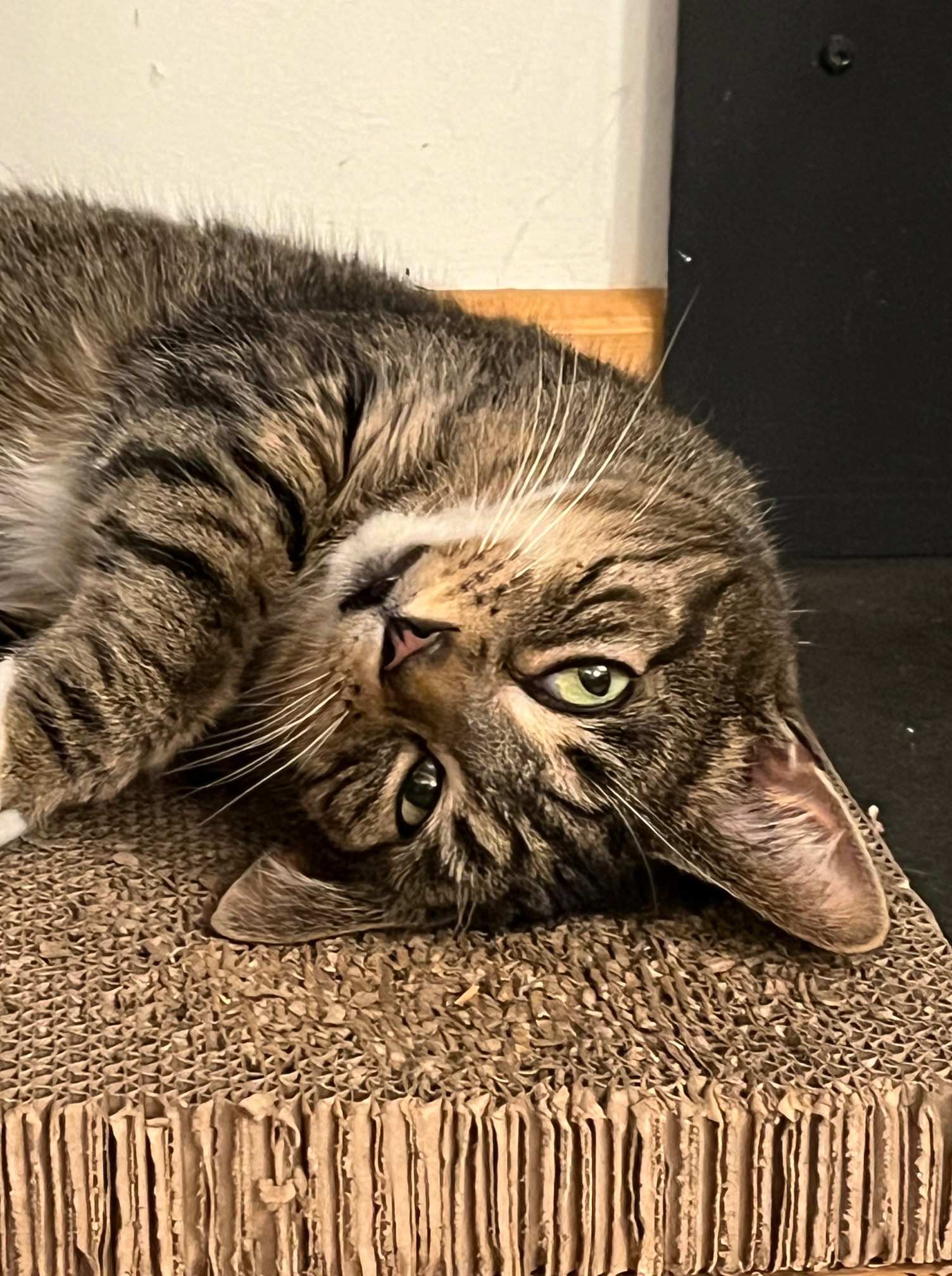
Semi-relevant photo: This is Fast Eddie, who’s relevant only because we’ve been told (sort of) that women with power become childless cat ladies.
Okay, I’m stretching it, but hey, he’s a great cat and I needed a photo to drop in here.

Does it matter who stays and who goes? Yup, it does. The partner who stays in place has the unbroken support of an extended family. The one who comes in comes as an outsider and an individual, without that built-in support. They may acquire it over time, but they may not. And if the tribe considered land as something a person could own–they were farmers, so let’s guess that they did–then land ownership is likely to have been held by the person who stayed in place. It’s awkward, taking land with you. So it would presumably have been passed down through the female line.  

Matrilocality also means–or at least hints–that women would have the primary shapers of the group’s identity. 

It’s kind of mind-boggling, isn’t it? 


How do they know any of this?

DNA. Mitochondrial DNA is passed down from mother to daughter, making matrilocality relatively easy to trace. The Y chromosome is passed from father to son. Everything else is a grab-bag.

Geneticist Dr. Lara Cassidy, said, “This was the cemetery of a large kin group. We reconstructed a family tree with many different branches and found most members traced their maternal lineage back to a single woman, who would have lived centuries before. In contrast, relationships through the father’s line were almost absent.

“This tells us that husbands moved to join their wives’ communities upon marriage, with land potentially passed down through the female line. This is the first time this type of system has been documented in European prehistory and it predicts female social and political empowerment.”

The find casts a new light on smaller samples from other cemeteries, where the same pattern shows up: most of the individuals trace back to a small set of female ancestors. Dan Bradley, a professor of population genetics, called it “a widespread phenomenon with deep roots on the island.” 


This changes the way earlier information is interpreted

The first thing it changes is the earlier discoveries of Celtic women buried with what archeologists call rich grave goods–what we might call stuff–mirrors, combs, the occasional chariot. The standard interpretation is that these were the burials of high status women. Fair enough, but that tells us nothing about why they had high status and I’d bet a chocolate cake that most people reading it will think, Right: wives of important men, just like most people would write men and women, as I started to in the second paragraph, instead of women and men. Old, nearly invisible thought patterns, underlining the importance of men, the peripheral status of women. But if the village’s continuity was in the hands of its women, it’s not unlikely that much of the power was as well. Or–let’s go out on a limb and see if we fall off–possibly all the power. 

It’s a safe limb to go out on, because we can’t know. So don’t take the possibility as fact but don’t dismiss it either. We do have some facts that make it look likely. The Durotriges men were buried with a joint of meat and maybe a pot with something to drink on their way to the  afterlife. Many of the women were buried with mirrors, combs, jewelry, and the occaisonal sword. 

All this comes with a reminder that being buried with expensive stuff may or may not indicate that the person was a leader. To make that leap, we need to go back to those Greek and Roman texts, which takes us neatly to the next paragraph:

The second thing the new findings change is how we read what Greek and Roman writers said about pre-Roman (or Iron Age if you prefer) Britain. The Britons, inconsiderately, didn’t develop a system of writing, so yeah, they didn’t leave written records. We have to depend on what outsiders wrote.

The written sources tell us the Romans were shocked to find women in positions of power. They inherited wealth, led battles, and practiced polyandry–the flip side of polygamy, with the woman having more than one husband. Going both further back and to Celts outside of Britain, ancient Greek writers said women’s and men’s tasks “have been exchanged” and Celtic women acted as “political judiciary.” (That last quote is from an article in The Conversation, not an ancient Greek source. I’m leaving you to figure out what political judiciary means.) 

For a long time that was widely dismissed on the theory that the Romans overstated British women’s freedom and power to make the country sound barbaric. Because surely we can’t take that literally? It upends too many of our assumptions. But this latest find makes it look like they were reporting accurately. It undermines the idea that pre-Roman Britain was a land where men were hairy-chested warriors and women stayed home and did what a much later culture expected them to do. You know, look in their mirrors, comb their hair, and stay the hell off those chariots.

Were all early societies matrilocal or matriarchal, then?

Nope. Early Bronze Age Orkney was patrilocal: the men stayed put and the women moved to other communities. And early iron age Hallstatt graves in Austria showed men and women equally achieving high status. Middle Iron Age British burials show men and women having equal status. Age seems to have been more important than gender in giving them status.  

A rampage back through 150 British and European genome studies in light of the Dorset findings shows the diversity in mitochondrial DNA declining over a period that spans the Stone, Bronze, and Iron ages. To translate that, increasing numbers of women stayed in place as time went very slowly on. 

None of this gives us a simple picture, or even a decisive one, but it does mean that patriarchy hasn’t been in place since forever and isn’t built into our DNA.

Why Britain is called Britain

Every so often someone searches the internet asking why Britain’s called Britain and the question lands them in the surreal territory that makes up Notes from the U.K. It’s a sensible question, and it makes a nice change from the related (and way more common) questions about why Britain’s called great. (Answer: ‘cause it’s bigger than the single-patty, quarter-pounder Britain. And it comes with a slice of pickle. Would you like fries with that?)

I’ve been meaning to research the question but put it off because it promised to be complicated. And it fulfilled that promise. It is complicated. Allow me, please, to make it worse.

According to the Online Etymological Dictionary, Britain is the “proper name of the island containing England, Scotland, and Wales, c. 1300, Breteyne, from Old French Bretaigne, from Latin Britannia, earlier Brittania, from Brittani “the Britons” (see Briton). The Old English place-name Brytenlond meant “Wales.” If there was a Celtic name for the island, it has not been recorded.”

Are you confused yet? If not, go back and read that again, because you should be.

Good. If you’re now in the right state of mind, we’re take that mess apart, spread the pieces out on the living room floor, and look at them as carefully as if we expected to understand them. I doubt we’ll get all the parts back where they started, but what the hell, we didn’t write the definition so it’s not our problem. We might just figure out how it worked (if, in fact, it did work) before we pulled it all to pieces.

But before we dismantle the thing, I should let you know that I’ve made labels so we can sort the bits into categories. A lot of them could as easily go in one pile as another, but we need some sort of system if we’re going to keep this organized.

Wish me luck.

Marginally relevant photo: This is Britain, or a bit of it anyway. The picture doesn’t explain anything, but it is what we’re talking about.

The Romans and the Britons

What we’ve got so far, if you read between the lines of that not-very-well-organized definition, is that Britain was named by the Romans, who invaded the place in the first century C.E. and claimed naming rights.

Stop. What’s this C.E. business?

Like many of you (that’s a guess, but humor me), I learned to divide history into B.C. and A.D., using a system that take the birth (or is it death?) of Christ as the dividing point for all time everywhere. I was taught that the initials stood for Before Christ and After Death, which seems to leave the period when he was actually alive a blank, but never mind. It was a good way to remember which set of initials was what.

A.D. actually stands for Anno Domini, Latin for the year of our lord—or so I was told by a teacher who was probably as Jewish as I was and am, but the system was so rigidly in place at the time that neither of us commented on the strangeness of claiming a god who wasn’t ours and using him as our marker. Whatever B.C. really stands for, I’m sure it’s Latin as well, but a quick rattle through Dr. Google’s knowledge pills didn’t leave me any wiser and it’s a side point anyway. If anyone knows, I’d love to hear about it. In the meantime, we’ll stagger forward.

Decades after I learned about B.C. and A.D., I was working as a copy editor for a major publishing house. (I’m retired, much to the publishing world’s relief, and any inconsistencies in style that you find here are because I don’t get paid to care anymore. Wheeeeeeeeeee.) Their encyclopedias were sold in many countries and to many cultures. They needed to be inclusive, so they used C.E. (the Common Era) and B.C.E. (Before the Common Era) instead of A.D. and B.C.

C.E. / B.C.E. is an attempt to keep what as far as I know is the dominant dating system but without assuming that the entire world takes Christ as its reference point. But introducing a new system confuses the hell out of people over I’m not sure what age—and possibly under it. I’m sorry about the confusion. It took me a while to get used to it too, but there’s nothing like getting paid to help a person get on top of a new way of thinking. Now that I’ve made the transition, I like system, but I always feel like I need to explain.

At length, unfortunately.

And as another side point, the Muslim world starts its dating system from an entirely different point: the year Muhammad moved from Quba’ to Medina. So I could be wrong about what the dominant system is. Maybe it’s just been the dominant one in my life. Which is easy enough to mistake for the entire world.

The earliest dating systems tended to use rulers as their reference points—something along the lines of “In the third year of the rule of King Idogar the Insignificant…” That meant that different countries used different reference points and any single country used different reference points at different times. It made piecing the quilt of world history together a nightmare, since after a few centuries no one knew when old Idogar reined. So both the Christian and Muslim systems were massive improvements, giving everyone a stabilized way to track time, even if they both assumed their religions were and always would be the center of everything.

Onward. Or possibly backward to what we were talking about before I so rudely interrupted myself.

When the Romans landed in Britain, the place was inhabited by Celtic tribes—the Britons mentioned in the definition—who don’t seem (emphasis on seem; we can’t know) to have called it “Britain.” What did they call it? Dunno. They would’ve called it something more specific than “home.” They traveled to Europe (more about Europe in a minute), and Europeans traveled to Britain, so everyone involved would’ve needed a name for it. When you step outside of a place, you do need a way to talk about it. And Britain’s an island, which makes it distinct enough that it would’ve screamed out for a name of its own.

But what mattered more than the island at the time was what tribe a Briton belonged to or what tribe’s territory an outsider landed in. Britain wasn’t a united country. It wasn’t a country at all. Whatever it was called referred to the geography, not any political grouping.

As (yet another) a side point, no one had a name for Europe back then. They had names for its parts, but they didn’t think of the whole. It’s not a place with clear geographical borders, so naming it would have been like naming half your hand: It’s just not something most of us feel a need to do. Plus it’s big. No one at that time, as far as I know, would’ve traveled completely around it. So—to use a different comparison—naming it would’ve been like naming yourself and six inches of the air around you. This isn’t a territory most of us need a name for.

What people named were the parts—the places where they and people they knew about lived.

So the Romans invaded Britain and claimed naming rights, and in the process of naming the place named its inhabitants. We don’t know if the pre-Roman Britons had a group name for themselves. Until they were invaded, and probably for some time after, they’d have been more likely to see the differences between their tribe and the neighboring tribes than the samenesses.

The tribal names have come down to us from the Romans as the Iceni, the Cornovi, and so on and on and on. But those names use Latin forms. At best, they’d be Roman manglings of what the tribes called themselves and at worst complete impositions. One of the tribes is called the Setantii. I don’t know Latin, but that sounds suspiciously like the Italian word for 70—settanta

Why call a tribe 70? Once again, dunno. We’d have had to be there. Maybe that wasn’t what it meant at all.

But let’s go back to the word Britain, which comes from Brittania (however you want to spell it). It seems to come from an earlier word, Prettanoi or Prittanoi. And now it’s time to move over by the coffee table, because we’re going to put our pieces on a new pile.

The Celts, the Greeks, and the tattoos

One source says the name Prittanoi (however you choose to spell it) came from the Britons’ “Celtic neighbours in Gaul (modern France) and we know that they had a very similar language. Prettanoi was a native [that means Celtic] word meaning ‘painted people’, and the Prettanoi called the island where they lived Albion, ‘the white land’. [I’ll get to that in a minute. In the meantime, grain of salt here. It’s on the shelf in the kitchen. Thanks.] Later Greek and Roman writers began to call the island Britannia, meaning ‘land of the Britons (Prettanoi).’”

Wikipedia (never mind the link—it will all have changed by now) says (or once said) that the word Prettanoi came to us from the Greek explorer Pytheas, who sailed around the British Isles (quick geography lesson: that includes Ireland) between 330 and 320 B.C.E. and that the word may have come to him from the Gauls.

Another source, and I’ve lost track of it by now—sorry; I’ve looked up too much closely related stuff and it’s all cross-fertilizing—says the word meant “the tattooed people.” The British tribes were known for painting themselves blue, at least when they went into battle, which they allegedly did naked. Spend a winter here and you’ll understand why I say “allegedly.” It’s not Minnesota, but speaking only for myself, I wear clothes and am damn glad to have them.

Some Roman sources claim the tribes didn’t just paint themselves but were tattooed, and a different Wikipedia entry translates Prettanoi as “the painted or tattooed people.” And, for whatever it’s worth, the BBC says that when the Normans invaded, they found the British (I’m not sure which British: the Anglo-Saxons or the Celts or both?) still tattooing themselves, and the Normans took up the habit from them. I’m not sure when they stopped, but I can tell you that they’ve started again, with (as far as I know) no sense that they’re carrying on a longstanding national tradition.

That second Wikipedia entry I mentioned also raises doubts about the word Prettanoi having anything to do with blue paint or tattoos. It links it to the Welsh word pritu (“ Proto-Celtic kwritu,” if that means anything to you), which meant “shape” or “form.” “This leaves us with Pritania,” it says.

Welsh is a descendant of the language spoken by some of the Celtic tribes (we’ll get to why I say “some of” eventually), so looking at Welsh makes sense , but I have no idea why “shape” or “form” would seem like a good name for an island or a people. I admit that both have a shape, but so do most solids.

Okay, when we took that apart, we kind of wrecked it. But what about Albion meaning “the white land”? One source (and again, I’ve lost track of which one; do you honestly care?) says the word’s probably Celtic but related to the Latin albus, meaning white, as in the white cliffs of Dover (presumably), because the land itself is green. That would mean the link to whiteness comes from Latin, not any Celtic language. Celtic and Latin are two very different, very unrelated languages.

I’m willing to believe that a Celtic word sounding roughly like Albion got mixed up with the Latin word meaning “white” and before anyone knew what had happened they were all as confused as I am. Or as you are if you’ve been following me closely.

But let’s not take ourselves too seriously. I have the sense that there’s a lot of guesswork going on here. And that from time to time serious explanation edges over into pure fantasy.

But we’ve wandered. You should know better than to leave me in charge.

If some of the Britons’ neighbors called them the Prittanoi or something vaguely like it, it’s no great surprise that it stuck. Many groups of people have been landed with names (often insulting ones) given to them by their neighbors. The Saami people used to be called Laplanders. The Inuits were called the Eskimo. The Ojibwe were called the Chippewa. They’ve only recently started to insist that the world call them by the names they call themselves.

For the Prittanoi, though, it’s too late. Whatever they called themselves is lost, and so are they.

More about the Celts, a bit about the Greeks, and nothing more about tattoos

While we’re talking about the Celts, let’s back up a bit and ask who they were.

The word describes a group of tribes who ran around Europe before anybody started taking notes. They can be traced back to the upper Danube around 1,400 B.C.E

According to one source, the Celts started arriving in in what’s now Scotland around 900 B.C.E. Which doesn’t mean all the Celts left Europe. One source (I no longer care which one; I’ve lost the will to link) says the Celts were in Austria France, Holland, Belgium, Switzerland, Western Germany, Northern Spain, Turkey, and Hungary in 400 B.C.E. Not that any of those countries existed, but the Celts were in place and absolutely panting for them to be invented.

But another source says the Celts probably arrived in Britain in two waves: the Goidelic-speaking Celts (that means the tribes who spoke one version of a somewhat common language, and I can’t pronounce the word Goidelic either) between 2000 B.C.E. and 1200 B.C.E. and the Brythonic-speaking (that’s the other version) Celts sometime between 500 B.C.E. to 400 B.C.E.

Flip a coin. For our purposes, it doesn’t matter. They got here. That’s all we need to know for now.

The Cornish, Welsh, Gaelic, and Breton languages are descendants of what we now call Celtic.

So why do we call it Celtic? Some sources claim the word Celt (it’s pronounced kelt; have I mentioned lately that English is insane?) comes from the ancient Greek keltoi, meaning “barbarian.” I doubted that because I happen to know that the English word barbarian comes from the Greek barbaros, meaning–you guessed it– “barbarian.” To the Greek ear, anyone who didn’t speak Greek must’ve all sounded like they were saying “bar bar bar baar bar bar bar.”

Where does keltoi come into it, then? Possibly nowhere. When I tried to find a translation, I came up with several people writing on the assumption that it did mean barbarian but not actually translating the word. Which made me—cynic that I am—even more suspicious. One site that looked like it was actually going to translate it ended up telling me about yew trees instead. So for a while there, I didn’t think I could find any proof the word even existed.

Ah, but I knew you were waiting, so I pressed on and found some online dictionaries of ancient Greek.

Now, ancient Greek uses—surprise, surprise—the Greek alphabet, and one dictionary offered me an on-screen keyboard. I don’t know Greek (my vocabulary’s made up of a few food words and a few insults, plus the words for and and barbarian), but I can stumble through parts of the alphabet, so I picked out the word κελτοι and hit Search.

A new screen appeared and said my search for κελτοι had come up blank.

Well, yes, I could see why it might’ve. I don’t know what alphabet that is or whether it’s used on this planet, but it ain’t Greek.

Fine. I found a dictionary that would accept transliterated words and typed in “keltoi.”

New Screen. Great excitement, because we were about to have a revelation.

The word means “Celtic.” Or “Gallic,” since that’s what the Romans called the Celts in what the Romans called Gaul, which covered what’s now France and Germany and a bunch of other places that didn’t have any political existence or possibly even separate names yet.

So the word Celtic derives from a Greek word meaning “Celtic,” which for all I know was taken from a Celtic word meaning “Celtic.”

Do you feel like we’re going in circles here?

Fine. We’re lost. But it’s okay, because we’ll just accept that Celt either comes from a word meaning “Celt” or from thin air and we’ll go on to talk about the part of the definition we started with, which says, “The Old English place-name Brytenlond meant ‘Wales.”

Reinforcing that, another source says that around 1200, Briton meant “a Celtic native of the British Isles,” or “a member of the tribe of the Britons.”

The Angles, the Saxons, and the Normans, but still no more tattoos

To make sense of that, we need to talk about a few more invasions.

The Romans, when they were still running Britain, brought in mercenaries who belonged to a couple of Germanic tribes, the Angles and the Saxons, and ceded land to them, which they settled. I don’t know if they pushed the Celts out of those lands at this stage or not, but I’m willing to guess that the good land suddenly wasn’t in Celtic hands.

After the Romans withdrew, more Angles and Saxons invaded or migrated—take your pick—into Britain. Between them, the Angles and the Saxons pushed the Celts into the corners of Britain—Cornwall, Wales, and Scotland.

The Angles eventually gave their name to England, which gradually became a country instead of a gaggle of small kingdomlets. That much seems clear. Not to mention shockingly simple.

Then Anglo-Saxon England got invaded by the Normans, who came from France but were originally Norse, which is the origin of their name. That brings us to the part of the definition we opened with where it says the word Britain came back into use from the Old French, which had preserved the Roman name, applying it, apparently, to the whole island, not just the Celtic parts.

We’re almost at the end here. Do you feel certain of anything anymore? If so, you haven’t been paying attention. So let’s end with a reminder from the BBC, which at least will take us back to a reliable source:

“Before Roman times, ‘Britain’ was just a geographical entity, and had no political meaning, and no single cultural identity. Arguably this remained generally true until the 17th century, when James I of England and VI of Scotland sought to establish a pan-British monarchy.”

*

Okay, that’s everything I know, and a bit more. If you’d help me get this mess off the living room floor, I’d appreciate it. Just drop it in the trash can as you go out. And have a good Friday the thirteenth. If you want to make corrections, add facts, or subtract facts, I’d welcome it. On the other hand, if you just want to tear your hair and moan, I’ll understand it. And on the third hand, if you want to complain, I’ll understand that as well.