
Today’s excursion into English history takes us to a moment in the Middle Ages when misogyny, common law, and feudalism– Well, cars hadn’t been invented yet, so let’s say they had a cart crash. High speeds hadn’t been invented either, so they all came out intact if slightly battered.
We’ll start with the law part.
Common law
English common law dates back to the Middle Ages and if you’re a fan of convoluted systems I can’t recommend it highly enough. Basically, this is a system of law that’s based not on what I think of as law–you know, a set of written rules that you transgress at your peril–but on what courts have decided in the past. It can rely on a written law if it’s in the mood, but precedent is the driving force.
The system gives judges a shitload of power in shaping the law, and I’m naive to think common law’s outside of my experience (although I still think it is), because the system’s in use today in an assortment of countries, including the US and UK, the two countries I’ve lived in.
Shows you what I know.
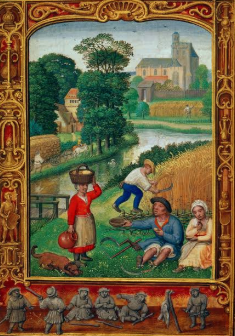
A rare relevant photo: medieval rural life–somewhere.
Other systems of law in the Middle Ages
Just to confuse things, in the Middle Ages English common law coexisted with other legal systems. Church courts applied canon law, urban and rural courts applied local customary law, Chancery and maritime courts applied Roman law.
The royal courts were for the most serious stuff and were run by a professional (in other words, paid) judge. Starting in the 13th century, those judges traveled to each county two or three times a year and held county assizes.
County sheriffs held a court in each hundred.
A hundred? It was an administrative/political division, smaller than a county but bigger than a pie. Starting in the 14th century, justices of the peace took the role over from the sheriffs. They were drawn from the local nobility and gentry, and they weren’t paid for the job but I’d bet a small pie that they got power and prestige from it.
In towns, borough courts played a similar role.
After all that, we get to manor courts. These were run by the lord of the manor or the village. They dealt with petty crimes–debt, theft, fighting. The accused would more than likely have been the lord’s own villeins.
What’s a villein? That’s medieval-speak for a serf. Sort of, and it sounds nicer, though, doesn’t it?
The sources I’ve found in a quick search contradict each other about what the difference is between a serf and a villein. One says villeins, like serfs, were tied to the land–not slaves but not free to leave either. Another says villeins were free to leave but generally couldn’t afford to. Both sources are more or less bite-size but the issue’s off to one side of the point I’m trying to make, so let’s use a word that dodges the whole issue: naif.
If you consult Lord Google, he’ll inform you that it’s also spelled neif, but I’ll stick with the more familiar spelling. It’s the root of our word naive, and you can trace it back to Old French, where it meant “native inhabitant; simpleton, natural fool.” Or to the Middle Ages, when it meant someone who was born a serf.
But we were talking about courts. Church courts could try lay people for things like adultery, homosexuality, gambling, or not showing up at church–you know, the stuff that really mattered. Priests acted as the judges and unlike the other courts they had no juries.
If you’re feeling hemmed in and starting to hyperventilate, I’d say you understand the situation fairly well. Most people probably got through their lives without appearing before any of those courts, but it can leave the modern reader feeling, um, judged.
Common law and serfdom
With all the throat-clearing out of the way, let’s move closer to that collision I promised. A whole lot of legal time and energy gets devoted, both then and now, to disputes over property, and under feudalism the most valuable properties would’ve been land and the naifs who were trapped on it.
This brings us to the blog Legal History Miscellany, and to a post, “All Bastards Are Free.” Understand, please, that the author, Sara M. Butler, isn’t talking here about people she doesn’t like. She’s using the language of the era. Being born inside or outside of marriage mattered. She saw a passing reference to the bastard children of villeins being born free, wondered if that could possibly be true, and off she went down a fascinating rabbit hole.
As it turns out, the answer to whether bastard children were born free is both yes and no, and that’s due to common law’s annoying habit of changing without having to file a written notice in triplicate. For information, Butler turned to legal treatises, which are as close as you can get to codified law at this stage.
In the 12th and early 13th centuries, the child of an unmarried, unfree woman was a naif, even if the child’s father was free.
What if the parents were married? Worrying over that seems to have kept a good number of lawyers occupied, and they went into intricate detail over it.The result? If both parents were unfree, the child was unfree, whether the parents were married or not. If the man was free and the woman not? The child was unfree. If the mother was free and the father wasn’t? Guess what! The child still wasn’t free. In fact, if that free man married the unfree woman, he lost his freedom.
Go a little further into the 13th century, though, and the rules loosen up a bit: the child follows the status of the mother, so if the mother is free, the child is free.
By the end of the 13th century, opinion was branching out in different directions, as it will when judges are essentially making the law. One treatise held that “One who is begotten of a free man but born of a bondwoman out of wedlock is a serf.” Another held that either parent could pass freedom down to their child. A third held that the father was the determining factor: the child of a free man married to a naif would be free; the child of an unfree man married to a free woman wouldn’t be.
What happened, then, when the jurors didn’t know who the father was and therefore didn’t know if he was free, unfree, or fur-bearing? According to this line of argument, the child “belongs to the lord of the manor, for his condition is determined by that of his mother, by whomsoever he may be begotten, freeman or serf.”
One of those tracts holds that when “jurors do not in truth know whether [a person] is a villein or a free man, judgement must be in favour of freedom.” Another says that the “blood of a man” should not be tried “by means of women,” which means–
Okay, I’m not entirely sure what it means. It sounds like a woman’s status shouldn’t determine a man’s. I mean, come on, it was humiliating enough that a man had to be born of a woman, but why take it further than that?
What Butler says is, “I would argue that it is in these two statements, when taken together, that we see the glimmer of the origins of the common law rule that all bastards are free. Here’s the problem: the only person who can definitively prove that a bastard child’s father is free is the mother: she knows who she slept with and when. Granted, it surely comes as no surprise to anyone who studies the Middle Ages that by the late thirteenth century authorities were not keen to rely on a woman’s word alone, especially if it meant that a man might lose his freedom, or that an elite man would lose the profits associated with a villein and his entire line.
“Did justices decide to declare all bastards free because they didn’t want to have to rely on the word of a woman?”
The implied answer is yes.
As one judge put it in 1279, “No woman should be received in proof except in a marriage case.“
Who actually went to court over this?
As long as all this child-bearing stayed on the manor, I doubt there would’ve been much cause to go to court over anyone’s status. Everyone knew everyone and everyone’s nose was undoubtedly in everyone else’s business–and the lord of the manor was the judge anyway, with the locality’s wealthier citizens acting as jury, so the manor court wouldn’t be a smart place to sue for your or your child’s freedom. But if a naif hightailed it to a town, hoping to establish a new life as a free person, and a lord appeared to reclaim him or her, it was up to the lord to prove his right to the person by establishing that he or she came from a line of naifs.
If the case Butler cites was typical, proving that was harder than it sounds. In 1280, William of Cressy tried to reclaim William son of Siward by producing a collection of (entirely male) relatives to prove that William S. came from a line of unfree men, but either William S. or his lawyer managed to undermine William C.’s claims about their status, one by one.
Not only were the courts leaning against women, they seem to have been leaning more toward freedom than unfreedom. As one judge wrote, “Free law is more predisposed to save and maintain a man in his free estate than to condemn him or lead him into servitude and so, since you say that he is your villein and he says he is free, the law acts and we ought rather to act to save him and support him in his free estate than to maintain you in this to bring him back and reduce him to servitude, for it is clear that he is free until you have proved him the reverse by his blood.”
In another case, from 1326, Thomas son of Thomas the Elder tried to claim Richard Lachebere, using three unfree relatives as proof. Richard argued that they didn’t share the same blood because “he was a bastard and thus free.” The judge ruled that because Richard was a bastard, “he had estranged himself from every blood, so that he could not be proven a villein by any blood.”
Or as Butler puts it, “Rather than rely on the word of a woman, it was simply easier to presume freedom.”
I do wonder, though, whether town courts were more inclined toward freedom since they sat outside the manorial system.

 Notes from the U.K.