
Is tradition any more important in Britain than it is in other countries? Probably. This is a country that, in advance of the monarch’s address to Parliament, searches nonexistent cellars for gunpowder because in 1605 some was hidden there. (The building had cellars then.) The people who do that searching wear uniforms that are traditional enough to have gone eye-catchingly out of sync with what your average human actually wears these days.
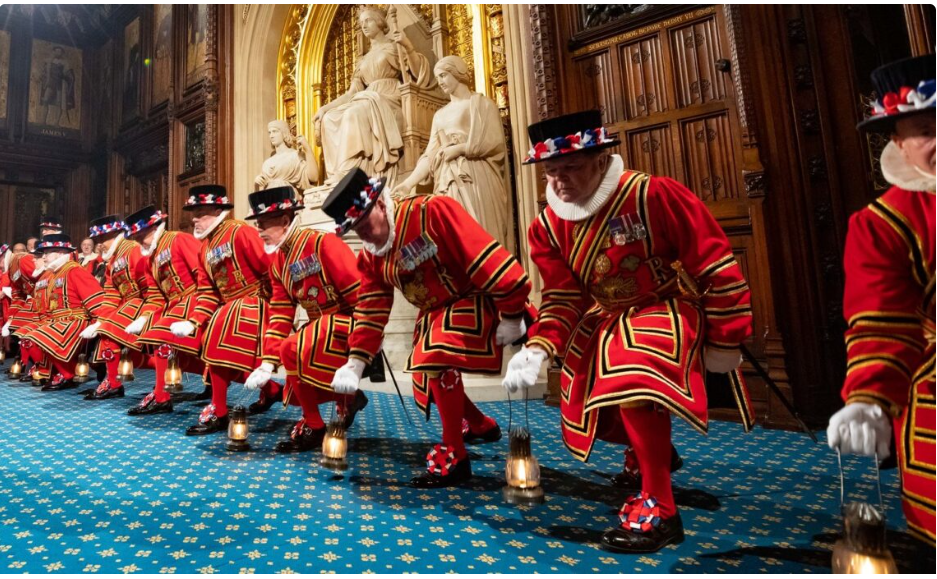
A relevant photo, which is a rare item around here. These are Yeomen of the Guard, in uniform, searching the nonexistent cellars, using lanterns and looking entirely serious about the whole thing.
During the address, a Member of the Commons (yes, they capitalize that) is ceremonially held hostage in Buckingham Palace until the monarch is safely returned from the hostile territory that is the Commons. That dates back to 1649 and Charles I, who was eventually beheaded and did, arguably, have a good reason to think the neighborhood was dangerous.
So yes, tradition’s a powerful force. We’ll get to its role in politics in a minute. First let’s look at the breakfast table.
Tea
If I’ve learned anything from living in Britain, it’s this: Don’t mess with the tea. It sits at the heart of British culture and outsiders shouldn’t meddle. I’m not sure about insiders, but they’d probably be wise not to mess around either.
Did it take me 17 years (and counting) to learn that? No, but however long it took I’ll pass it on to you for free so you’ll be spared the fate of American chemistry professor Michelle Francl, whose book Steep: The Chemistry of Tea has been greeted with caffeinated giggles on this side of the Atlantic.
What did she do? She told us to add a pinch of salt to our tea. If you’re American and don’t understand how that went over, imagine a British writer telling you to add–oh, I don’t know, let’s say ketchup to your coffee. If you’re not British and not American, I don’t want to go too far out on a limb but you could, just maybe, imagine me recommending that you take your national beverage and filter it through a pair of old socks.
What’s Francl’s salt supposed to do? Take the bitterness out of the tea.
Am I brave enough to try it? Hell no. I did think about it and lost my nerve. So far I’ve only found one food writer who tried, and she admits that it “brings out savoury notes” in the tea, which she’s “not averse to,” although that’s not what you’d call an enthusiastic endorsement.
The others? They’re all either too outraged or laughing too hard to experiment.
Francl also recommends heating the milk before you add it on the grounds that it reduces the risk of it curdling.
Has cold milk ever curdled when I’ve added it to my tea? Only when it was older than me, in which case it was kindly warning me to pour out the tea and start over.
To be fair, Francl also recommends some sensible things, like boiling the water, a trick your average American has trouble with. I don’t know what it is about Americans, but (generalization alert here) we’re convinced that if you allow lukewarm water in the same room as a stove, it’s hot enough to make brew tea.
It’s not. You could get as much good out of your teabag by taking it into the bathtub with you.
So boiling the water is good advice, but it’s not enough to redeem her. Tea is British culture. It’s tradition. It’s what you turn to in a crisis. It’s what you offer someone who crosses your threshold (assuming you want them there). It’s–you know, it’s Britain. So that thing with the salt? It’ll see Francl banned from Britain forever.
Breakfast
Asking what’s for breakfast just became unexpectedly controversial. The English breakfast is under threat from no less traditional an organization than the English Breakfast Society.
Is there such a group? Yes indeedy deed, kids, it’s real. I’d have made it up if I could, but I don’t need to and it would never have crossed my mind anyway.
The society hit the headlines with an announcement that people should get rid of the mushrooms or tomatoes that are a longstanding part of the English breakfast (along with a fried egg, baked beans, bacon, sausage, toast, and of course unsalted tea) and add a slice of pineapple instead.
The society’s founder and chair–
Hang on. Founder and chair? What is it, a closed shop? I’ll admit to wondering if the society has any actual members, but its website lists 31 fellows, so apparently it does. It also assures me that it’s a “learned society.” I feel smarter already.
Anyway, its founder and chair, Guise Bule de Missenden, said nobody ever liked the tomatoes anyway, “So why shouldn’t we swap them?”
And he knows this how? Because he taps into the psyche of the entire nation when it sleeps, that’s how. He knows what people eat not because they like it but because they feel they have to. He knows what they shove to the side of their plates. He’s the founder and chair of et cetera, after all.
And this being Britain, he bases his suggestion on history and tradition. Pineapples were a luxury item in the late 16th and early 17th centuries, he tells us (as if we didn’t all know that already). The elite ate them at breakfast, he says, and he doesn’t say but I’ve learned elsewhere that they served them at their fancy dinners. Then pineapples came down in price and, come on, what was the point of eating them if they didn’t demonstrate how rich and important you are? I mean, even if they do taste good. So they fell out of favor.
Why add them to the English breakfast now? Because they’re traditional, at least if you bend your history around corners at just the right times. And maybe the society felt it was in need of a headline. Or got a kickback from the Pineapple Promotion Society.
I don’t predict a long life for this new tradition, but then if you’d asked me whether baked beans would catch on as part of a traditional English breakfast I’d have laughed myself into insensibility. So don’t bet heavily against this based on my say-so.
How do we decide what becomes a tradition?
Good question, even if I did ask it myself. The tomatoes became part of an English breakfast sometime around World War I, so they’re not in the same category as thatched roofs or monarchy. Mushrooms and hash browns came along even later, but the English breakfast itself only dates back to the Victorian era, when it was the breakfast of the wealthy. Still, it’s been adopted enthusiastically, and maybe that’s the dividing line between tradition and non-tradition: enthusiasm trumps longevity.
Or maybe not. Let’s slide carefully onto thicker ice. A YouGov poll (you see how important this is) asked people what the essential ingredients of the English breakfast were. For more than half the people polled, they were bacon (89%), sausage (82%), toast (73%), beans (71%), fried egg (65%), hash browns (60%), mushrooms (48%), and black pudding (a lonely 35%). A whopping 83% said they liked a full English breakfast and 15% said they didn’t; 2% said, “Don’t bother me, I’m eating.”
Political traditions
Tradition, of course, isn’t only about food, it’s also about politics. As far as I can figure out from reading the papers in recent years, it’s perfectly acceptable to destroy the country’s infrastructure, safety net, and human rights record as long as you color within the lines that tradition dictates.
To wit: having very nearly drained his party’s talent puddle, Prime Minister Rishi Sunak was driven to resurrect former Prime Minister David Cameron and give him the office of foreign minister, and that’s brought us all nose to nose with an obscure political tradition, and a slightly less obscure problem, which is that recent convention says ministers should be either MPs–Members of Parliament–or members of the House of Lords, and Cameron was neither.
Why is that a convention instead of a tradition? Beats me.You need a law degree and a dowsing rod to find the line between the two. What matters is that Sunak solved the problem by be-lording Cameron: making him a lifetime peer, entitled to sit in the House of Lords, wear a fancy robe on dress-up days, and collect £332 on any day he shows up for work and/or passes Go. Plus expenses and subsidized food and drink.
I can tell you–reliably, since I have a link right her on my computer screen, and now on yours –that this isn’t the first time a minister has been chosen from outside Parliament, so we’re still inside those all-important lines. Be-lording them is a recent way of handling the awkwardness, but it turns out not to solve all the problems, because if you’re not an MP, you can’t just walk into the House of Commons and address the country’s highest legislative body and its only elected one.
Why not?
Because it’s not done.
Wait, though. MPs are expected to scrutinize what the foreign secretary’s up to. How are they supposed to do that if he’s not allowed in?
Before we get to that question, let’s ask what they mean scrutinize.
Well, kiddies, it’s political-speak for giving him grief (if you’re in the opposition party) or support (if you’re in his own). The Commons is a raucous place that traditionally (see how I snuck that word in again?) rewards braying and hear-hear-ing and verbal bullying as long as the MPs say the people they’re berating are honorable, as in, “The honorable member has surely mistaken a Dr. Who episode for a budget.”
Hear-hear? That’s what a minister’s supporters bray when they’re trying to drown out the opposition’s heckling. Yes, this is politics in the hands of adults.
Now tuck all that in your back pocket and let’s review the pieces of the puzzle: We need the minister in the room so MPs can bray and heckle and hear-hear and occasionally ask useful questions, but only MPs are allowed into the House of Commons. Because it’s a tradition.
You may be wondering why only MPs are allowed in. Think of it this way: let’s say the room where the MPs meet is a chicken coop and let’s say the Lords are geese. You can see where this isn’t going to work. Different feet. Different ways of sleeping. Different requirements of all sorts. Even the subsidized champagne they drink is different.
Sorry, I slipped right out of my metaphor there.
A further convention (or possibly tradition) holds that ministers stand at the dispatch box to speak to the Commons and be scrutinized and generally made miserable. But allowing the newly be-lorded Cameron (or any other Lord) to walk that far into the Commons would “risk blurring the boundaries between the two houses,” according to a cross-party procedure committee.
Disaster looms. What are they to do?
The committee proposed having him stand behind an actual, as opposed to metaphorical, white line on the Commons floor. It’s called the bar and visitors aren’t allowed to cross it when Commons is sitting. Because that would violate the Natural Order of Things. So he can address the Commons from there.
Last I heard, the government hadn’t responded to the committee’s recommendation. They might be happier if the foreign secretary wasn’t available to answer questions just now.

 Notes from the U.K.