The Parliament of Bats

If you think politics were once sane and sensible, let’s take a quick dive into England in the fifteenth century. I don’t guarantee that things were either more horrific or more absurd back then than they are wherever you live with (I’m originally from the US, after all, which scores high on both scales right now), but a bit of history does keep us from thinking political idiocy’s a new invention.
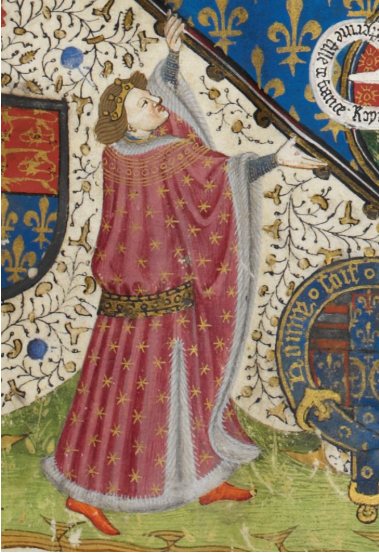
The Duke of Gloucester, hanging his curtains. From Wikimedia Commons

The king, the uncles, the conflict

We’ll start with the king, since his personality, competence, hair style, and digestion were all political issues back then. Henry VI has gone down in history as a weak and unstable king, and we’re dropping in at a time when he’d been king for three years. You might think that would be long enough to get the hang of the job, but he was four years old and I’m no fan of monarchy but even I will forgive him for not being much use yet. 

While he played with his toys, two powerful men played with the country–and with the money and power it had to offer them: his uncle Humphrey, the duke of Gloucester, and Henry Beaufort, who was the chancellor, the bishop of Winchester, someone who could be counted on to lend money to the insolvent crown (at high interest rates), and uncle to the duke–who was, remember, uncle to the king.

England’s aristocracy would’ve fit in a fairly small laundry bag back then. And you know what some families are like: these two men didn’t play nicely together. They’d already had an armed fight on London Bridge. I mention that only to explain why, when Parliament was called into session in 1426, everyone expected a fight there too. Both men had power bases nearby, Humphrey in London itself and Beaufort in Southwark. So someone decided to avoid bloodshed by moving the meeting to Leicester–pronounced for no discernable reason, Lester.

Don’t get me started on English spelling or place names.

To keep the two sides from shedding blood, somebody pulled a 14th-century tradition out of a different, non-laundry bag. (England’s bag of arcane traditions is almost as big as its bag of arcane spellings.) Each Parliament had been opened back then with a proclamation banning swords, other weapons, and silly games.

Silly games? Yes, silly games. The good folk running the country had a habit of pulling men’s hoods off their shoulders, as any reasonable adult in a position of power would. 

But by now it was the 15th century, not the 14th, and people had grown up enough (and were grumpy enough) that no one expected games and the announcement was stripped down to a simple warning that “every man . . . should leave their weapons in their inns, that is to say their swords and shields, bows and arrows.” 


The bats

So what did everyone do? Left their swords and bows and arrows at their inns and armed themselves with bats–the wooden kind, not the avian. 

What were they doing with bats? No idea. As far as I can tell, people didn’t start playing cricket for another century, although an ancestor game, stoolball, was played in Essex, traditionally by milkmaids using their milking stools as wickets. Not, you’d think, the sort of game to attract a bunch of macho aristocrats.

Okay, I haven’t a clue why they had bats and I’m not sure anyone sensible will either. The country was full of local games. Whether Leicester was full of bats that the lords and Members of Parliament could appropriate I don’t know. Maybe a few good solid cudgels went down in history as bats because the scribe-of-the-day liked the sound of it. We’ll just have to squint and move on. The articles I’ve found somehow take it for granted that they had bats.

Don’t we all pack them when we travel?

The two sides brought their bats to Parliament. The next day they were told to leave their bats behind, so they brought stones–big ones–tucking them into their clothes, where no one would notice them.

How did both sides hit on the same strategy two days in a row? By hacking each other’s emails, of course. No other explanation is possible.

Eventually Beaufort and Humphrey spoke to Parliament, making their cases against each other and for themselves, and in the end Beaufort was made to step down as chancellor but by way of compensation was allowed to accept the Pope’s offer to make him a cardinal. The two men gritted their teeth and shook hands, no blood was shed, and the Parliament came to be known as the Parliament of Bats. 

And the king? Not long afterwards, he was knighted by a different uncle.

Saints, sex, and kings

Once upon a time there lived a king.

Ah, but there’ve lived a lot of kings, so we need to be specific about this.

Once upon a time, there lived a king named Henry.

Oh, hell, there’ve lived a good number of those as well. Eight in England alone. This particular king was Henry the Half Dozen, a.k.a. Henry VI. He was known for general incompetence and for presiding, in a vague sort of way, over the War of the Roses and that unpleasant business with Joan of Arc.

Also for becoming a saint. Or sort of a saint. A semi-saint. And possibly for not knowing what, other than sleep, he was supposed to do in bed.

Image result for henry vi dates

A rare relevant photo. Or picture, since the camera hadn’t been discovered, possibly because no one was looking for it yet. This is Henry VI, in all his glory.

But let’s start at the beginning. Henry became king of both England and France in 1422, before he was a year old, so he can be forgiven for not getting off to a strong start. As an adult, his main interests seem to have been religious observances and schools: He founded both Eton and King’s College, Cambridge. An essay in the Britannica sums him up as reclusive, generous, and pious. 

A different essay in the Britannia calls him simple minded and subject to spells of madness. Other sources add that he was kind. It all depends on who you ask, apparently. 

His vagueness as a leader allowed rivalries to flourish between his advisors and was matched by his vagueness as a subject for the artist who painted his portrait. The picture gives you–or me, anyway–a sense that in the time it took the artist to glance from subject to canvas he’d already forgotten what the man in front of him looked like.

I know he has a nose, you (or I, if we’re going to be accurate about this) imagine him thinking, but what shape is it anyway? Potato? No, those haven’t come over from the Americas yet. Carrot? No, that’s not it either.

And so on.

Even the shape of his head is odd. I mean, it’s definitely a shape, and what with the ears and the eyes and all it’s clearly a head, but there’s still something vague about it, as if the artist couldn’t figure out where the edges were.

Okay, I admit, in later portraits his nose looks more noselike and the edges of his head look more edgelike, as if he came to terms with himself as he got older. And his mouth doesn’t seem to be saying, “Oh, how did I get here?”

Never mind. The portrait was the least of his problems. During his reign, the English countryside was dominated by lawlessness and by powerful lords with private armies. The court was dominated by the Yorkists–followers of the Duke of York. That’s when it wasn’t dominated by the party of Henry’s wife, Margaret of Anjou, a powerful woman stuck in a position where, as the mere wife of a king, she had no power of her own.

She led the Lancastrians–the king’s party.

Both sides, Yorkists and Lancastrians, had a reasonable claim on the throne if you consider any hereditary monarchy reasonable. Of course, by then, half of England had a claim on the throne, although you won’t find any historians willing to say so. You see how these conspiracies work?

Grain of salt there, please, people.

The problem was that only one throne was available and the idea of job sharing hadn’t been introduced.

The only person who didn’t have a claim on the throne was Henry’s son, because he didn’t exist yet. For eight years Henry and Margaret had no child, male (desirable) or female (better than nothing but not half as useful). And here’s where that clickbait from the top of the post re-enters: Historian Lauren Johnson has been burrowing around in the archives and she’s found evidence that the happy couple was joined in the bedroom by “trusted courtiers” trying–she believes–to help them understand where babies come from.

“Was it,” she asks rhetorically, “because the famously chaste Henry–who was a virgin until he married–didn’t know what he was doing? I think it’s entirely possible that it had reached a certain point where it perhaps became necessary to make clear to him what he should be doing.

“That couldn’t be done in a public way at all. The king’s chamber is the most private place [where] you could be having this conversation or, indeed, checking what was going on.”

Although once you add trusted courtiers lifting the blankets to see if tab A has been inserted into slot B, it wouldn’t have been all that private. But better them, I guess, than the entire court.

Johnson also speculates that everyone’s collective efforts wouldn’t have been helped by Margaret fasting four or five times a week–which she did in hopes of producing an heir.

When at long last the couple triumphantly produced the heir everyone had been pestering them for, they were then plagued by rumors that the child, Edward, was a bastard. Or a changeling. Or a hedgehog.

Salt, please. I made up that bit about the hedgehog. I’ve learned not to take anyone’s sense of the absurd for granted. Including mine. I’ve stubbed my toe on other bloggers’ sense of humor in the past.

Anyway, war broke out over who should be king. And war ended. And war broke out again. Henry was captured. Henry was released. Assorted people went into exile, then came back, picked up the fight again, lost, won, and died.

Lots of people died. There’s your summary of the War of the Roses. Have you memorized it? It’s on the test. 

Why roses? Because each side used a different color rose as its symbol: Lancaster red, York white.

I’ve checked that three times and I still don’t trust that I’ve kept the colors straight. I’m sure it meant a lot to them, but to me it seems arbitrary as hell.

The whole thing ended up with a Yorkist king, Edward IV, who wasn’t the same Edward who’d been born after so much effort on his parents’ part. This was a different Edward, and he surrounded himself with his wife’s unpopular family, the Woodvilles, although whether that meant they were unpopular with the tiny circle of his aristocratic supporters, who were pissed off because the Woodvilles were getting the goodies that should rightly have gone to other aristocratic hangers on or whether it meant unpopular with that vast and powerless swathe of people who were his subjects is beyond me. No one did opinion polls in those days. Telephones hadn’t been invented. Neither had the royal mail, and not many people could read to fill out a survey anyway. Besides, who cared what the riff-raff thought? As long as they didn’t revolt, all was well.

Edward died and was followed by his brother, Richard–the one Shakespeare didn’t like; the one who may or may not have killed his brother’s sons. Richard was eventually defeated by Henry Tudor, which put an end to the whole sorry episode.

But if you go back to the title, you’ll notice that we’re still short a saint. How did Henry the Vague become a saint? People began attributing miracles to him, that’s how. I doubt anyone will ever fully know why, but political martyrs (he was Edward’s prisoner when he died and we might as well assume he was killed on Ed’s orders) had a habit of undergoing a medieval transformation into innocent and sacred martyrs. Think of it as a metaphorical political statement by people who had no other outlet for their grievances.

Henry’s schtick as a saint was coming through for ordinary people in adversity. He was the guy to talk to if you were about to be hanged, or if you were already dead and being sewn into your shroud, both of which strike me as fair examples of adversity.

What’s more, if you put his hat on your head it would cure migraines.

Or give you cooties.

When Henry Tudor became king, Henry the Half Dozen’s cult was politically useful–it weighed against any lingering Yorkist sentiment–and Henry T. pushed Rome to formally be-saintify Henry the H.D. That was still in the works when the next Henry, Mr Eighth, broke with Rome, which ruined Henry the Half Dozen’s chances. No sainthood for you, boychick. Rome forgot all about him and so, after a time, did the people of England.

It’s an open question whether there are any saints the half-sanctified can pray to if they want to get their sainthood finalized. 

As far as I know, no one lived happily ever after.