
England’s not-at-all-secret weapon against the French during the Hundred Years War was the longbow, and if you believe whatever gunk artificial intelligence scrapes off the internet floor, it’s a symbol of English pride. Which makes this a good place to mention that it came to England by way of Wales.
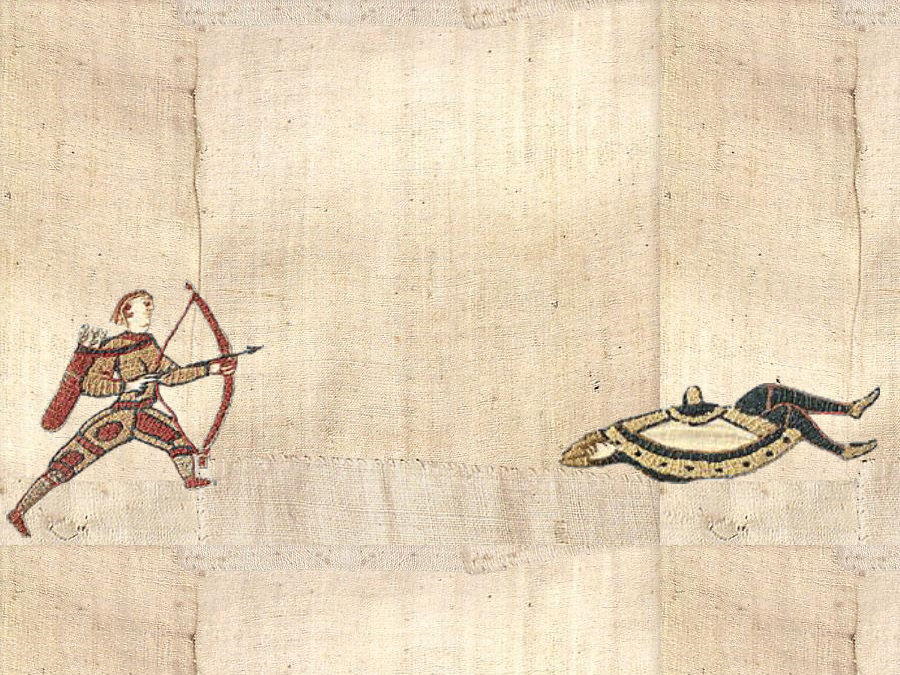
A very rare, nearly relevant graphic: An archer and some dead guy., both in the style of the Bayeux Tapestry, which depicts the Battle of Hastings, which in turn is mentioned below. Courtesy of a free app that lets you design your own Bayeux-style Tapestry. No skills in needlework required. Are you worried that you might use your time too usefully? I heartily recommend this app. You can get lost in it for hours while accomplishing next to nothing.
A bit of background
Longbows have been around since neolithic times. Or paleolithic. Or–well, choose your source. A long time. That’s close enough for our purposes. So if England can’t claim to have originated it, neither can Wales. But it was the Welsh who brought it to the attention of the English by shooting them with it when they invaded, starting in the eleventh century and continuing into the thirteenth.
Once it had Wales under its control, England conscripted Welsh archers into its armies to help invade Scotland, and it adopted the weapon itself, encouraging the English to train with it.
Did I say “encouraged”? I lied. Starting in 1252, all English men between 15 and 60 were required to train with the longbow once a week. Since the average lifespan of a man in the Middle Ages was 49, that meant he was required to train for 11 years after he died. Life wasn’t easy back then, and it doesn’t look like death was either.
Why all that training? You can’t just pick up a longbow and expect to be any good with it. You train. And you train some more. And you keep in shape by doing some more training. The effect on the muscles and bones is powerful enough that archeologists can spot archers by looking at their skeletons, assuming they’re well preserved.
Archers were so important to England’s armies that when Edward I (1272 – 1307; you’re welcome) banned all sport on Sundays, he made an exception for archery. All that emphasis on training explains why so many places in England are incorporate the word butts into their names: butts were the fields where men practiced archery.
The longbow vs the crossbow
A longbow stood around six feet tall, making it taller than most men of the period, and a skilled archer could shoot a dozen or more arrows a minute. A crossbow might get off two or three shots in that time. (Those numbers will change depending on what source you consult; I’m going with conservative estimates.)
At distances, the longbow wouldn’t have been as accurate as the crossbow, but if a mass of longbowmen were shooting at a mass of advancing horsemen or foot soldiers, they wouldn’t need whites-of-their-eyes accuracy. They’d shoot off a mass of arrows that fell close together on a tightly packed enemy.
The longbow was cheaper to make than the crossbow, and its arrows flew almost as fast, which translates to hitting almost as hard. They could penetrate medieval armor. And they didn’t need the support team that helped a crossbowman cock the weapon and maintain it.
Crossbowmen were paid well, which if you happened to be counting up your pennies to see if you could fund an invasion of France would weigh heavily in favor of the longbow.
Weighing against the longbow was the muscle power involved in drawing it. Factor in the archer’s exhaustion after marching and fighting and “only 10% of medieval archers would be effective at a range of 200 yards after just a week of campaigning,” according to an article from the John Moore Museum.
Although the crossbow looks high-tech compared to the longbow, it dates back to 650 BC China. It spread from there to Europe, although it seems to have dropped out of use between the 5th and 10th centuries, when the French began using it again in sieges and at the Battle of Hastings, where the Normans conquered England, although if there’s a picture of one in the Bayeux Tapestry I haven’t spotted it. It continued to be the preferred military weapon in Europe for a good 500 years. Only England committed itself to the longbow.
The Hundred Years War
With all that out of the way, what happened when the longbow went up against the crossbow? The Hundred Years War is our test site.
The Hundred Years War, you should understand, lasted from 1337 to 1453, which is not a hundred years. The extra years came from one of those supermarket sales–116 for the price of 100. Who could resist, even if the extra 16 did go moldy in the refrigerator? The conflict was about land–how much of France France got to control and how much England could claim–and whether the English king could claim the French throne.
Yeah, I should do a post about it one of these days.
At the Battle of Crecy (1346), the English (longbow) defeated a much larger French force (crossbow, wielded by Genoese mercenaries). Popular belief holds that the crossbow shots fell short because the archers’ bowstrings were wet.
Wasn’t it raining on the English too? Well, yes. Weather doesn’t play favorites and wet bowstrings lose some of their elasticity regardless of the bow they’re strung on. I’ve met people who say the English kept their bowstrings dry under their hats. I’m doubtful, since as soon as they came out they’d start picking up moisture, but feel free to choose the story you like and stand by it. It was a long time ago and no one’s likely to prove you wrong. Before you choose, though, I should toss in an alternative theory: the crossbowmen misjudged their distance because they were facing the sun.
The sun does play favorites.
We do have an established fact, though: the French cavalry charged through their own bowmen, which didn’t improve their effectiveness or their health. According to one account, French knights hacked down the crossbowmen when they got in the way. Because bowmen were commoners and knights were aristocrats, or at the very least gentry, so what the hell, no one was going to hold them to account.
The English held off 16 cavalry charges, spilled a lot of blood, and won a blue ribbon and history’s congratulations to the victor.
But let’s not slog through all 116 years battle by battle. I’m easily bored. We’ll jump to the Battle of Agincourt, in 1415. Again, smaller English army, larger French (and German, but never mind that) one. Longbow vs. crossbow. Rain, although nobody seems to talk about its effect on the bowstrings here. French knights getting killed mid-charge by a hail of arrows. English victory.
More to the point of this post, longbow victory.
And after that?
The role of the crossbows shifted primarily to defensive warfare. If you wanted to defend a castle (or anything vaguely castle-like–a city wall might work) against a siege, the crossbow’s longer range would be useful.
But both gave way to the musket and the gun. The longbow was last used in warfare in 1644 during the English Civil War–in Scotland.
What was the English Civil War doing in Scotland? It’s complicated. And it’s a whole ‘nother story. Let’s settle for saying that it was a war that broke a lot of rules.
Before it lost out to gunpowder, though, the longbow played a role not just in warfare but in fucking with feudalism. Nobles and all their friends and relations had been the bedrock of the military, with their horses, their armor, and their swords. They were the knights–the essence of power. Then along came these commoners with their relatively cheap-ass bows and guess who was more powerful.
That wasn’t enough to put an end to feudalism, but then a social and economic system doesn’t end from one lone change. It was a teaspoonful of sand poured onto the scales, where it joined an assortment of others. And I’m sure it put many a knightly nose out of joint.
 Notes from the U.K.