Skara Brae and neolithic Britain

Every last one of us was born too late to visit neolithic Britain. Sorry. Most of us wouldn’t handle it well anyway. But we can get a surprising glimpse of late stone age life from the island of Orkney, off the northeast coast of Scotland. 

These days, Orkney’s located almost exactly in the middle of nowhere, at least if by nowhere you mean a lot of water, but back then it seems to have been the center of a civilization, if for no other reason than that it was a midway point between northern Europe and Britain. For that, being in the middle of a lot of water is useful.

Not much is known about stone-age boats, but we can pretty well guess that traveling in one made a stop on a long voyage welcome. The break would’ve let people indulge in a neolithic cultural exchange, which I’m going to guess involved food, fresh water, alcohol, gossip, songs, gifts, and possibly an era-appropriate ritual or three.

I tossed in the rituals because Orkney’s rich in sites that hint at them, and every one of them involved an immense amount of labor. You don’t do all that if they don’t matter to you and if you don’t have time and energy to spare. 

Irrelevant photo: hemp agrimony

Skara Brae

Around 5,000 years ago, a group of people built a village on Orkney that’s now called Skara Brae. What they called it is anyone’s guess. A lot can get lost in 5,000 years, including a name. The people who lived there farmed, hunted, and fished.

The village is older than Stonehenge, older than the pyramids, and older than me. It was inhabited for something along the lines of 650 years and abandoned for reasons we can only guess at, but for us what’s significant about it is that at some point it was covered over by sand, which preserved it until a storm swept the sand off in 1850, uncovering an archaeologist’s dream.

The village is a circle of stone-built, single-room houses linked by roofed passages, with one larger building that according to one article might’ve been a workshop, although I can’t help wondering if it wouldn’t have been a place for everyone to gather. The walls were made of two layers of stone with insulation in between and the roofs were slate. Each house had a hearth, two beds outlined by stone slabs, which would have kept the bedding in place, and what are called dressers because–well, they have to be called something. To me, they look more like stone bookshelves, although this was a bookless, writingless world, so let’s stick with dressers. It’s chilly up there. People would’ve worn clothes, although that might not have been what they stored on them. They could’ve stored useful stuff, beautiful stuff, things they didn’t want to step on in the dark–say the neolilthic equivalent of Lego pieces.

For some fabulous photos, follow the link.

The houses also had tanks set into the floor. One house had an indoor toilet, although since plumbing was still a long way in the future that might not have been a great idea. I wasn’t there, so I can’t know.

Around the settlement, archaeologists have found dice, jewelry, tools, carved stone objects (objects here meaning things that are mysterious to us), and pottery in a style that spread to mainland Britain, supporting the argument that Orkney was an important site in the culture–a place that led the way. What hasn’t been found is weaponry, and the village wasn’t in an easily defended spot, arguing that this was a time and place of peace.

Not far from Skara Brae are two stone circles, The Ring of Brodgar and the Stones of Stenness; a chambered tomb, Maes Howe; and an assortment of unexcavated sites that hint at being ceremonial, burial, and settlement sites. The places that have been excavated show evidence of feasting–lots of feasting.

I won’t try to take you through the details of the excavations. I wouldn’t trust myself to get it right anyway. Follow the links if you want to know more. You’ll find lots of measurements and layouts. Or else settle for knowing that a lot went on in this seemingly isolated spot. 

So, did this important cultural center contribute the Stonehenge altar stone that’s recently been spotted as having come from somewhere in northeast Scotland or the Orkneys? It would make sense. They built similar monuments, but no. Orkney’s been ruled out and the search for the source of the altar stone goes on.
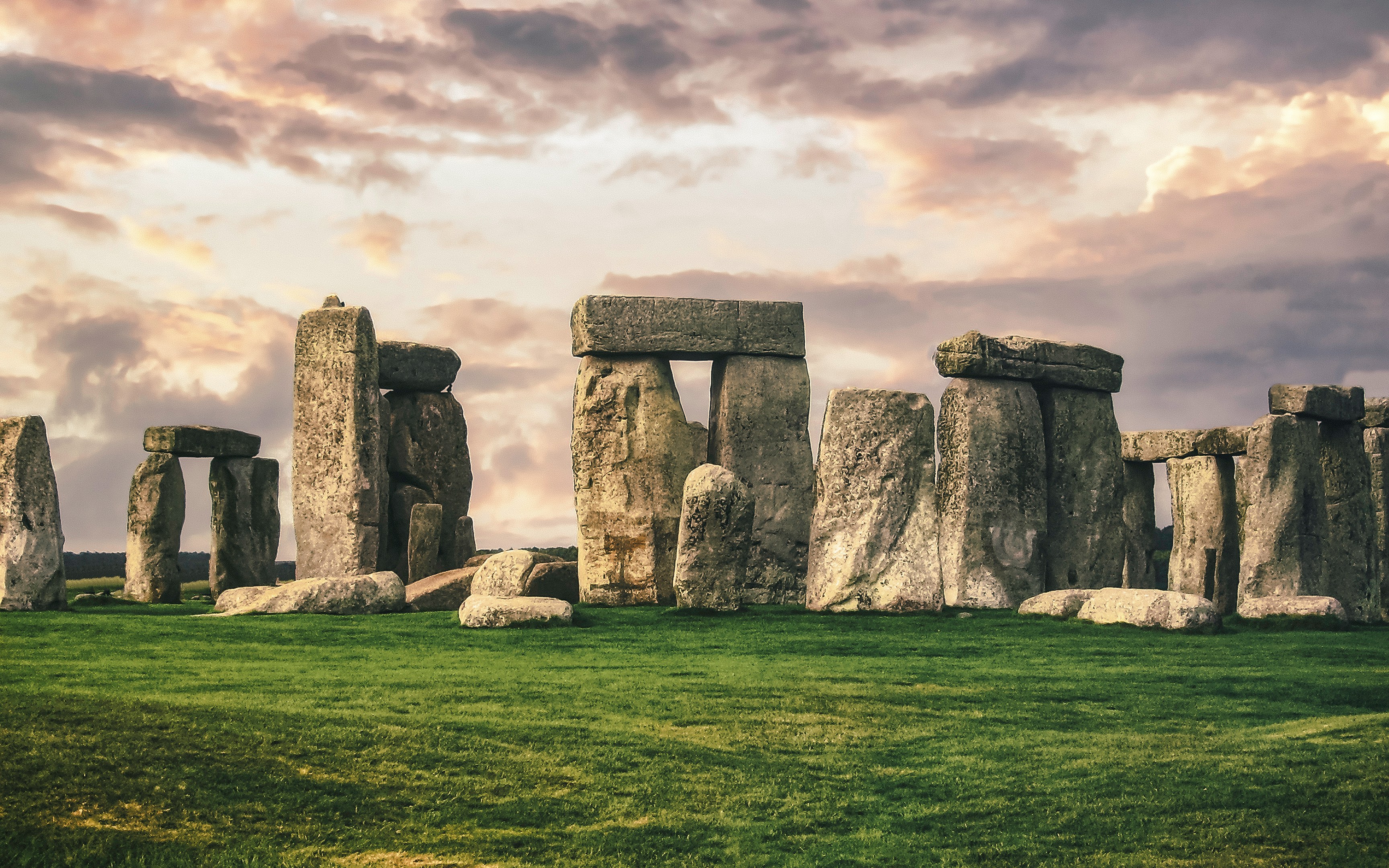
Stonehenge: the story keeps changing

Want to change history? You have two choices: do something that changes the future or change the way we see the past. Neither one is easy, but a group of scientists studying the Stonehenge rocks have managed to change the way historians understand late stone age Britain

If you read much about Stonehenge, you’ll probably read about sarsen stones first–the uprights and the massive crosspieces that sit on top of them, forming the outer circle. They were hauled a mere 16 miles. On the other hand, they weigh an average of 25 tons, so however hard you worked last week I’m pretty sure you didn’t do that.   

Once you’re done being impressed, you’ll read about the bluestones–the stones that form the inner circle–which came from 140 miles away, in Wales. Before the invention of smartphones, which would at least have let the people who dragged them document the challenge.

Think about doing that without a single online follower leaving a Like. Where’s your incentive?

The bluestones weigh between 1 and 3 tons. 

A rare relevant photo, with thanks to K. Mitch Hodge, who made it available online at Unsplash.

What most of us wouldn’t have read about is the altar stone, but it’s the one that’s making headlines and retroactively changing history. 

In spite of its name, there’s no reason to believe it was ever used as an altar. It’s lying flat and it must’ve reminded someone of an altar. The name stuck, but don’t get carried away with the idea. 

The new information is that the stone traveled something like 500 (or 350, or 800) miles to play its part in Stonehenge–that’s pretending it went in a straight line–from what’s now Scotland, somewhere around the neighborhood of Inverness, John O’Groats, and Orkney. It’s a big neighborhood, but someone will be out there even now working to narrow it down. 

Why does that matter? Because it tells us that late stone age Britain (known to its friends as neolithic Britain) was a lot more connected than anyone knew. And it tells us that whatever function Stonehenge had, it had it for a whole lot more people than any recent residents suspected. 


Moving the stones

How did they get the stone from Scotland to the Salisbury Plain? It’s tempting to think, No problem. Just plop that beast on a boat, but we’re talking about a 6-ton stone. In a boat built in the late stone age. That might not comply with health and safety guidelines. Personally, I’d think two or three times before I jumped in and started to paddle.

Information about ocean-going boats in this period seems to be pretty limited, but they’d have been small and a little sticker on the side would’ve said, “Not recommended for the transport of any stone above 1 ton in weight.” 

Evidence of cross-Channel trade between Britain and Europe has been found, and that meant boats–it’s wet out there, people–but the evidence consists of lighter things like pottery, axes, and cattle. 

Okay, I admit, cattle aren’t light. But compared to the stones we’re talking about? You could lift two of them before breakfast.

The experts are still arguing about how the stones were transported. One experiment tried to move the equivalent of the bluestones across the Severn on rafts. They sank. 

The Severn? Most likely body of water on the way from Wales to Wiltshire, currently playing host to some large stones that future archeologists will try to explain in some marginally rational way.

That doesn’t prove it can’t be done, only that it couldn’t be done the way they tried to do it. Neolithic people would’ve had a lot more experience with neolithic boats than even the best modern-day experimental archaeologist. With so little known about late stone-age boats, it’s all guesswork. So we can’t rule out boats.

But there’s another compelling reason to take the stone overland. An archaeologist who wasn’t involved in the study explained it this way: “If you put a stone on a boat out to sea, not only do you risk losing the stone–but also nobody can see it.” 

But if we spend a few years dragging it the length of Britain, people along the route will get involved. Maybe they’ll help drag it a few miles. Maybe they’ll make us a nice cup of–

No, sorry, we’re centuries too early to get a nice cup of tea. Or even instant coffee, and forget about that frothy, expensive stuff folks have fallen for. We might be offered some nettle tea, though. It’s supposed to be good for sore muscles and arthritis. The island’s rich in nettles, and after hauling that stone we’re rich in sore muscles. We’re also building up the prerequisites of future arthritic problems. So whatever it tastes like, drink that tea and look happy. These people are being hospitable.

Most settlements will lay on a feast, or share what they can if it’s been a bad year. They’ll make us feel welcome and speed us on the next leg of our journey. And with each stop, more people will feel involved with the project. They helped pull that stone. They welcomed the people who delivered it. For generations, people will talk about it. 

The stone, the expert said, will become “increasingly precious . . . as it travels south.”

If dragging a 6-ton stone the length of Britain sounds impossible, I refer you to a BBC documentary–sorry, the name sank into the sludge that passes for my memory–about the bluestones. The presenters somehow got an entire class of primary school kids to pull a stone very much like the bluestones using nothing more than ropes and (if my memory isn’t playing tricks on me) a wooden sledge and logs for it to roll across. Maybe thirty ordinary kids, none of them even close to full grown. And the stone slid across the ground as if that’s what it had in mind all along. 

Admittedly, the ground was flat and it wasn’t full of boulders or forests, but it does show what plain old muscle power can do. 

One objection to the land route theory is that it’s hard to coordinate that many people, but teamwork would’ve been an integral part of any late stone-age community. And they wouldn’t necessarily have seen the length of time involved as a problem. They might’ve seen it as something like a pilgrimage. 

Getting places in a hurry is a relatively modern obsession.

The terrain wouldn’t have been easy, but the idea that Britain was wall-to-wall forest is, apparently, a myth. 

One theory holds that the stones could’ve been moved to Wiltshire by the glaciers, but finding a stone from Scotland wrecks this. 

“From Orkney, I can’t see a way that the stone hikes a ride on half a dozen glaciers in the right order to end up on Salisbury Plain,” a geologist said.

But forget about moving the stones. How did they set them upright?

An archeologist who’s raised the 12-ton cap stone on neolithic tomb using wooden levers said it’s easy, 

So if you buy a Stonehenge from Ikea, those are your assembly instructions.

*

If all that doesn’t sound like enough work, Stonehenge was built in several stages, each one involving a different configuration. I won’t take you through all them but it must’ve been like living with someone who insists on moving the furniture every few thousand years, only the furniture is multiple tons of rock and soil. 

We’ll probably never know what went on there or why, but we’re pretty safe saying that whatever it was, it was important. To a lot of people.