
You how everybody says people in the middle ages didn’t bathe? Well, ahem, they did, and I seem to have contributed my small bit to our collective misbelief. Apologies. I fell for an urban myth.
So they did wash?
They did. They understood that water was wet, that dirt was dirty, and that if they brought the two together in the right way they could walk away clean.
There were problems, however. They didn’t have hot water waiting around for them. Water in its natural state–in other words, as it comes from the well, the lake, the river, or the ocean–has this habit of being cold. And since the first recorded stove in Europe (or possibly anywhere else–please don’t complicate this) was built in 1490 in Alsace, we can pretty safely say that they were stuck heating water over an open fire if they wanted it in anything other than its natural state.
But we’re not done yet. Water has another habit: It’s heavy, and if you can’t convince it to come to the place you want it, you have to carry it. In other words, a lot of work was involved in getting clean.
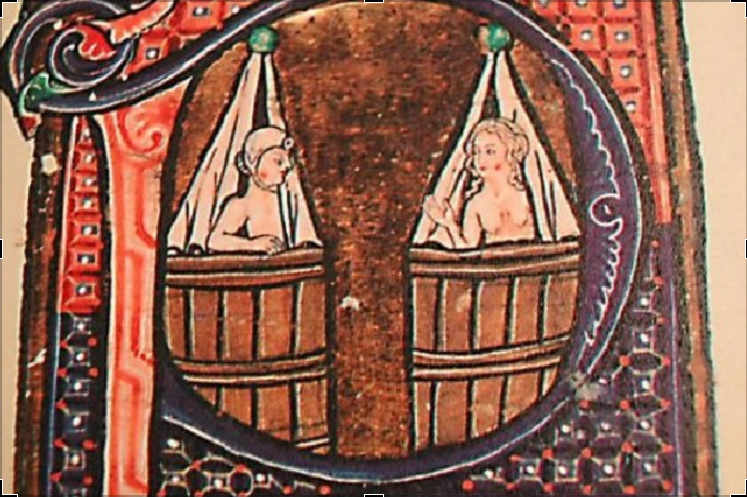
Medieval illustration of people bathing. With thanks to Going Medieval, which I’ve borrowed this from. I don’t usually do that, but medieval illustrations are out of copyright. Great website. You’ll find a link elsewhere.
The simplest way around the problem was to bring yourself to the water. The human body may be something like 60% water, but it has legs and people used those legs to carry themselves to whatever user-friendly body of water was nearby. Then they tossed themselves in. That would’ve been more appealing, though, in the summer than the winter. England isn’t the Arctic but it does get cold enough to make even a quick dip off-putting. So people also washed at home, even if it did mean carrying the water.
For most people, washing at home meant pouring water (cold or warm) into a basin and taking a cat bath–water, cloth, rub till clean, done. It’s still a good bit of work but it limits the amount of water you need. Some might’ve had wooden tubs they could set by the fire for the occasional bath.
People also washed their hands and faces before meals.
The rich could afford full, luxurious baths, involving wooden tubs, servants carrying warm water, a large cloth tented over the top of the tub, and scented herbs to enhance the, ahem, bathing experience–thyme, sage, things like that. Breathe out, relax, let the hard work of oppressing the peasants fall from your shoulders.
Ahhhh.
King John (1199 – 1216; you’re welcome) liked a bath well enough that he traveled with a his own personal bathtub–and the attendant who was in charge of it. (Making sure all that water was heated and carried at the right time would’ve taken some choreography, so I don’t expect that would’ve been a simple job.)
As for wealthy monasteries (they weren’t all wealthy, although some were fabulously so), they often had piped-in water–a signal of how much it mattered.
Soap
Medieval Europe had soap, something the Romans, for all their bathhouses and their reputation for cleanliness, did not. The Romans oiled their skin then scraped away the oil and the dirt with it.
Luxury soap came to medieval Europe from the Middle East, brought by Crusaders and traders. The Crusades created an earthquake in the Middle East and we’re still feeling the aftershocks, but they brought Europe a lot of nice stuff and some startlingly wonderful ideas, including Arabic numbers, which first made it to Europe in the 10th century and swept away the clunky Roman system.
But we were talking about soap: France, Italy, and Spain began manufacturing the stuff, and eventually England did too. Most people, though, made it at home.
Bathhouses
So much for washing at home. Your average medieval town or city would’ve also had a bathhouse, and these were social places as much as get-yourself-clean places. Many were built next to bakeries to take advantage of the heat from the ovens. In medieval illustrations, you can find people sitting in large wooden tubs, eating from boards placed across them to form tables. So yes, social spaces.
Southwark (that’s in London, although at the time it wasn’t) had 18 bathhouses.
But wait. While many bathhouses were just bathhouses, some were brothels. Yes, you could take a bath and all that, but you could do a lot of other things as well. You know how it is: in a culture where people are expected to go around wearing clothes, once they take them off they start getting all sorts of ideas. All those lovely bathhouses in Southwark? They were concentrated there exactly because it wasn’t part of London, with its laws and regulations. They were called the stews, and they were brothels. Most of them were owned by the Bishop of Winchester.
C’mon, an honest cleric has to make money somehow, doesn’t he?
I can’t swear that all the Southwark baths were brothels, but most of them were.
But again, most bathhouses were places to take a bath. The sources I’ve looked at don’t agree on how often people would have visited or how likely they were to heat their wash water at home. They’re drawing on very partial information and putting it together in the best way they can. I’m happy to stay on the sidelines and let them slug it out.
So why have we believed medieval people didn’t wash?
You notice how neatly I swept you up into the mistaken belief system I just abandoned? Of course you believed what I did. I know I’m not the only damn fool around here.
I can come up with several reasons we fell for that.
One, sanitation genuinely was an issue. In the later middle ages, in the interest of cleaning things up, a lot of towns built public latrines, but let’s not get carried away with how much of an improvement that made. What were the most convenient places to build them? Why, on bridges so the water could take the waste downstream. Problem solved, right? All that nasty stuff goes away, and the system works as long as no one upstream had the same plan and the people downstream can’t find you.
When this becomes a national strategy, you won’t want to use the river for your drinking and bathing water and you might want to worry about your water table.
Two, the sources that have come down to us are both partial and contradictory, but some writers warned against excessive bathing. In her Going Medieval post, the historian Eleanor Janega argues that this was less about bathing that “hanging out naked in bathhouses with the opposite sex.” Which was sinful.
You can leave your money at the door and the bishop will collect it, thanks.
(Janega’s website is both informative and good reading.)
On the other hand, at Medievalists.net, I read that medieval English writers considered the Vikings “overly concerned with cleanliness since they took a bath once a week.” But the site also acknowledges sources that show bathing as “part of daily activity” and that health manuals “explained that it was important to keep the entire body clean.”
At least for medical writers, bathing was something to approach with caution. It could relieve indigestion and stop diarrhea, but if you did it wrong it could lead to weakness of the heart, nausea, or fainting. Excessive bathing could lead to fatness and feebleness. One writer advocated bathing in the spring and winter but not, if possible, in the summer.
Autumn? Sorry, all these centuries later the jury’s still out on that.
Three, we have documents making it clear that assorted saints and extreme religious sorts didn’t bathe, or didn’t do it often, but Janega (yes, her again; she’s handy) argues that this was about denying themselves a worldly pleasure in the quest for salvation: get dirty for god. So instead of canceling out the sources that say people bathed regularly, this reinforces them.
Or it may.
Westminster Abbey required its monks to take a bath four times a year, which, um, may not sound excessive to us. What does it mean, though? Hard to say. It might’ve been a minimum, addressed to the dirty-for-god types. It might’ve been the general expectation, which some people exceeded. But they did pay a bath attendant two loaves of bread a day plus £1 a year, which makes it sound like he worked year round.
Four, from around 1500 to 1700 (public health warning here: this paragraph is thinly researched), Europeans came to believe that water spread disease– especially warm water, which opened the pores and let all those nasties in. Given the state of the rivers, they may have been onto something. That bit of information made its way down to modern ear and we treated it like butter on warm bread and spread it back a few extra centuries.
*
I’m indebted to 63mago for challenging my lazy assumptions on medieval cleanliness and sending me down what turned out to be an interesting rabbit hole.
 Notes from the U.K.