Stonehenge, cows, and technology: a roundup of British archeology

A century ago, someone found a cow’s jawbone buried beside the entrance to Stonehenge. The placement looked deliberate, and historians have been speculating about it ever since. Now, the high-tech toys available to scientists have delivered new information, answering some old questions and leaving us with new ones: the cow came from an area with Paleozoic rocks–in other words, rocks that are more than 400 million years old. The closest place that fits that description is Wales, where Stonehenge’s bluestones were quarried. 

Does that mean Stonehenge was built by Welsh cows? 

When they sober up, archeologists aren’t convinced of that, but there is speculation–sober speculation–that cows or oxen were used to drag the stones overland. It’s only recently that archeologists have found evidence that cattle were used to pull heavy loads in the Neolithic era, when Stonehenge was built, but they’re now pretty sure they were, and that fits nicely into the jawbone puzzle.

If you forgot to set your watch, the Neolithic era took place somewhere around 2990 BCE. 

Marginally relevant photo: Stonehenge it’s not, but it is a stone circle. This one’s from Minions, in Cornwall.

But cows and oxen pulling the bluestones sits squarely in the land of speculation, so let’s not commit too heavily to it. We can’t prove that the cows in general or this cow in particular helped pull the stones. We don’t even know for sure that the cow in question was brought to Stonehenge alive, although if you’re going from Wales to Stonehenge, you’ll find it’s a long way to carry a cow. Or even a cow’s head, especially in the era before refrigeration. Humans are indeed strange, but not, I like to think, quite that strange. 

What’s known for certain is that the cow was indeed a cow, not an ox or a bull. And that someone left her jawbone in a significant spot, like a note saying, “This means something,” and don’t we wish they’d told us what.


Cows, sheep, and pigs

Animal bones also figure in a recent article about bronze age gatherings in what’s now Britain. People traveled long distances to get together and eat. And, presumably, solidify the relationships between tribes or–well, whatever groupings we’re talking about. They would’ve known. The same techniques that inform us about Stonehenge’s Welsh cow also tell us where their animals came from before they became the feats. 

Whatever it means, at one site they mostly ate beef; at another, mutton; and at a third, pork. 


A Danish woodhenge

A circle of 45 wooden posts has been discovered in Denmark. It’s believed to have been built between 2600 and 1600 BCE–the late stone age and early bronze age–and it’s the second woodhenge that’s been found in the area. What experts take from this–or one of the things they take from it–is that Denmark, Britain, Ireland, and parts of northern Europe, which all have similar henges, were strongly connected. 

The axis of the newly discovered henge matches that at Stonehenge, underlining the assumption that the builders had shared beliefs and technologies.


The Melsonby Hoard

Someone with a metal detector found what’s described as one of the biggest and most important hoards of iron-age glitz in Britain: a collection of more than 800 objects. It was found in a field in the north of England and includes wagon and chariot parts, bridle bits, ceremonial spears, and two ornate cauldrons, all of which shows evidence of burning, possibly as part of a funeral. 

The expert who was called in after the detectorist reported his find said, “Finding a hoard of ten objects is unusual, it’s exciting, but finding something of this scale is just unprecedented. . . .

“Some people have regarded the north as being impoverished compared with the iron age of the south of Britain. This shows that individuals there had the same quality of materials and wealth and status and networks as people in the south. . . . The north is definitely not a backwater in the iron age. It is just as interconnected, powerful, and wealthy as iron age communities in the south.” 

The find also provides the first evidence of four-wheeled vehicles in use among the tribes. 


The Romans and the Welsh

A huge Roman fort that was in use from the first through third centuries has been found in Pembrokeshire, Wales, in an overgrown farm field. It may rewrite the history of relations between the Romans and the Demetae–the tribe that lived there. The belief had been that they were on peaceful terms, but the presence of a fort this size throws that into doubt, indicating a strong military presence.

The fort explains why the field was never worth cultivating: the farmer, and probably many before him, kept hitting stone. It was found by an archeologist from Pembrokeshire, who had often wondered whether an unusually straight road might not be Roman. (You may have to live in Britain to understand why a straight road would cause a person to wonder.) Then  he looked at a satellite image and spotted the field, which is the size and shape of a Roman fort.

He drove out to see it and as he described the moment, “Sticking out of the ground was a triangular piece that looked like a Roman roofing slate. I thought: ‘Surely not?’ I pulled it up and lo and behold, it’s an archetypal Roman roofing slate, an absolute peach. Flip it upside down and you can see underneath a diagonal line where it was grooved to fit into the one that was underneath it. It’s a real beauty. . . .

“That was the diagnostic evidence I was looking for, which is a miracle, because it’s a huge site.”

The current best guess is that the fort held some 500 soldiers.


England and West Africa

We’ve moved to the 7th century CE, so reset your watches if you would, and we’re poking around disrespectfully in a couple of graveyards, one in Kent, on England’s southeast coast, and one in Dorset, a long walk to the west, even if you’re being dragged by a cow. 

Sorry, no. Wrong era. Forget the cow. But in the same way that the Stonehenge story follows one cow to make sense of the Stonehenge story, this one follows two unrelated humans to get a glimpse of life in early medieval England. These burials hint at people traveling much greater distances in the early medieval period than we would’ve expected: both had a paternal grandparent from West Africa. Their grave goods show they were both buried as typical and well-thought-of members of their communities, and the ancestors of the people buried nearby were either northern Europe or western British/Irish.

That western British/Irish business is, I think, a way of saying Celtic now that it’s looking questionable that a group of people called Celts ever existed. 

The Kent and Dorset communities had very different cultures, the eastern one Anglo-Saxon and in frequent touch with Europe, the western one on the fringes of European influence and primarily–um, whatever we say if the word Celtic’s gone up in smoke. Both, though, had contact with far-away West Africa.


And finally, a mere 800 years ago

In Leicester–pronounced, through some miracle of English spelling, Lester–in the twelfth century, 123 women, men, and children were buried, in a short space of time, in a narrow shaft near the cathedral. That would’ve been something like 5% of the town’s population and it’s one of the largest pit burials found in Britain. 

“Their bones show no signs of violence – which leaves us with two alternative reasons for these deaths: starvation or pestilence,” said Mathew Morris, project officer at Leicester University’s archaeological services. “At the moment, the latter is our main working hypothesis.”

Initially, the archeologists assumed the deaths were from the bubonic plague, but when the bones were radiocarbon dated the centuries were wrong. But the Anglo-Saxon Chronicles do mention pestilences and fevers, severe mortality, and miserable deaths from hunger and famine in England from the mid-tenth century through to the mid-twelfth century. The pit burials seem to back that up.

“It is also important to note there was still some form of civic control going on,” Morris said. “There was still someone going around in a cart collecting bodies. What we see from studying the bodies in the pit does not indicate it was created in a panic. . . . There was also no evidence of clothing on any of the bodies – no buckles, brooches, nothing to suggest these were people who were dropping dead in the street before being collected and dumped.

“In fact, there are signs that their limbs were still together, which suggests they were wrapped in shrouds. So their families were able to prepare these bodies for burial before someone from a central authority collected them to take to the pit burial.”

In a roundabout way, the find is the result of Richard III’s body being discovered, minus the feet, in a nearby parking lot. His body was reburied in the cathedral and since then visitor numbers have gone wild, so the cathedral decided to build a heritage learning center in the cathedral garden, which had once been a graveyard. 

In Britain, construction like that means an archeological survey, and tha turned up what was left of 1,237 people buried between the eleventh and nineteenth centuries. Below them was evidence of Anglo-Saxon dwellings below that, a Roman shrine. 

“It’s a continuous sequence of 850 years of burials from a single population from a single place, and you don’t get that very often,” Morris said. “It has generated an enormous amount of archaeology.”

***

Totally unrelated to any of that, I wonder if a reader or readers can enlighten me on something that’s happened here lately. Notes used to get 2,000 to 3,000 hits per week, but about a month ago it started getting between 10,000 and 20,000, with as far as I can tell all the growth coming from China. That’s lovely–whoever you are, welcome–but it’s also strange. For one thing, it wasn’t slow growth; all those new hits appeared between one week and the next. For another, the list of posts that get the most hits hasn’t changed: Britain’s gun laws, Britain’s native foods, the shift to metric measurements, the scone. (I know: it’s an odd list.) I’d have expected a shift in readership to bring a change in interests, but it hasn’t. So is this a bot, clicking away mindlessly and reading nothing? Or is this something real?

If you’re a new reader from China, or if you’re not but know something that might explain what’s happening, or if you just want to tell me how strange this is, leave me a comment, will you?

Thanks.

Good manners in medieval England

Medieval England isn’t famed for its polish, its manners, or its cleanliness. (Neither is medieval Europe, but it’s not our subject.) If you want to be a contrarian, though, and say, Poopash, they were civilized enough to have books of etiquette, you’d be right. They did have books of etiquette and I’ve stumbled over one from the early 1200s that does indeed prove they valued good manners. It also underlines in screaming red ink how the definition of good manners can change from one time and place to another. Not to mention the differences between the modern mindset and the medieval one. 

Allow me to throw you into the deep end of the pool.

Irrelevant photo: A morning glory–also called bindweed.


The Book of the Civilised Man, by Daniel Beccles

Not much is known about Daniel Beccles except that he wrote The Book of the Civilized Man, medieval England’s first known book of etiquette. He might’ve been in Henry II’s retinue for more than 30 years. That leaves open the possibility that he might not have been, but “more than 30 years” is pretty specific for a might, so let’s assume he was.

Why take the risk?

Because for our purposes it doesn’t matter.

Beccles’ book took the form of a 3,000-line poem in Latin. Or 2,800 lines according to a different source. I not only haven’t counted them myself, I haven’t gotten my hands on the full manuscript, although an English translation is bumping around out there somewhere. I’m working, as I usually do, from secondary sources.

Sorry, folks. I’m not a historian, just somebody sitting on a couch.

The book was addressed to boys and young men who were being trained in noble households–or as Beccles put it, “untrained boy-clerks”–and its existence speaks to a society where the rules of behavior were changing fast enough that people needed a guide. 

Let’s break the advice into categories. It gives me something to do. 


Religion and so forth

Predictably, given the time and place, a lot of the advice has to do with religion, or as one of the sources I’m using puts it, “a man’s duty to God. He should obey the law and the Commandments; he should be wary of vices and pursue virtues. He should endeavour to perform pious works, love learning and behave in church. He should think of the inevitability of death, the joys of Heaven and the terrors of Hell.”

That’s generic enough that it could’ve come from central casting, and the business of vice and virtue reminds me of someone whose father, after a bit of hemming and hawing, gave him this advice about–well, who knows? Possibly sex but possibly life in general: “Beware the pitfalls of life.” 

Panaiotis, I’m grateful to you for passing that on to me. My life is impossibly richer for knowing it, and I’m always grateful for a laugh.

Sorry. Rabbit hole. And to be fair to Beccles, that’s a summary. He seems to have been more specific than that. 

If you want to be rude to someone, take a close look at who you are, whom you are speaking to, and what their circumstances are,” he wrote. 

That might sound like he’s advising a compassionate awareness of other people’s situations, but I have a hunch he’s warning the reader against pissing off anyone who’s more powerful. See the section on hierarchy for the reasons I think that. Other advice is unambiguously kind.

“If fickle Fortune favours you, fortuitous one, do not mock those bereft by her.”

“If anyone threatens those near him with cruel misfortunes, or if someone wicked cruelly holds sway over his neighbours, kicking and clawing, and cultivating wickedness among them, stand up to thwart his evil violence alongside the neighbours.”

“Do not oppress anyone for sport.”

For good sober reasons, it’s okay.

“Offer relief to the hungry, naked, thirsty, sick, wandering, and imprisoned in whatever way will set them right.”

We could find worse advice without having to look far. 

As for behaving in church, at least part of his advice is to stay awake.


The hierarchy

Just as religion shaped every thought about good and evil, hierarchy shaped every thought about whatever was left after that, and a lot of Beccles’ book is about how to behave to people who are higher up the ladder. 

“Eventually, it would be time for the inferior to wait on the lord as he went to bed. . . . When he sits on the privy in the usual way, take in your hands hay or straw, pick up two big wads of hay in your fingers and press them well together. You should prepare to give them to your patron when he wants them. Let the wads be given to him as you stand, not bending the knee. If two together are sitting on a privy, one should not get up while the other is emptying himself.” 

Have I mentioned that the medieval idea of privacy was different than ours? Or possibly nonexistent? And that they were pretty matter-of-fact about the human body and the various things it does. 

“If you are acting as a servant, stand by the bedside; cover your lord’s naked body.”

Do not hunt for fleas on your arms or bosom in front of the patron or in front of the servants in the hall. . . . In front of grandees, do not openly evacuate your nostril by twisting your fingers.”

Eating at the table of the rich, speak little.”


Eating

Do not be a nose-blower at dinner nor a spitter; if a cough attacks you defeat the cough. . . .If you want to belch, be mindful to look at the ceiling.”

“Spoons which are used for eating do not become your property.”

“If a fat morsel lies in the dish in front of your companion, do not touch it with your finger, for fear that fingers will be pointed at you as a boor. . . . When your fellow drains his cups, cease eating. Beware of shouting ‘Wassail’ unless you are bidden to do so. While food is visible in your mouth, let your mouth savour no drink; while food is hidden in your mouth, let your tongue not minister to words. The morsel placed in an eater’s mouth should not be so big that he cannot speak properly if he needs to do so. Beware of drinking wine greedily like Bacchus. . . ..Sitting at table as a guest, you should not put your elbows on the table. You can put your elbows on your own table but not on someone else’s.”


The hall

When Beccles talks about the hall, he’s not talking about hallways–those corridors you walk through to get to some room where the action’s taking place. A medieval hall was where the action took place. Initially, it was where everyone ate and slept, but even after the lord and his family drew away from the communal mayhem to a room of their own, it remained the center of a lord’s home. 

Let not a brute beast be stabled in the hall, let not a pig or a cat be seen in it; the animals which can be seen in it are the charger and the palfrey, hounds entered to hare, mastiff pups, hawks, sparrow-hawks, falcons and merlins.”

I apologize to any cats who subscribe to Notes. History comes in many shades of bitter. No point in pretending otherwise.

But since we already have horses in the hall, let’s acknowledge the limits: “When you are about to leave, let your cob [that’s a horse] be at the door. Do not mount him in the hall.”


The body

In case you didn’t believe me about the medieval era being frank about the body:

“When you are hungry and ready to eat, first empty your bowels. Afterwards, an attendant should give you a washcloth and water. If it is winter, you should be given warm water. The washcloth should be white and the water should be from a clean stream.”

Why does the you get a washcloth and water but the lord hay and straw? I’m tempted to blame different translations but haven’t been able to convince myself. A cloth is a cloth. Hay is hay. I have no explanation. It doesn’t make moving up to lordly status sound appealing.

“Do not get up after the meal to urinate in the bushes, nor to void your bowels, unless nature compels you. Guests, messengers, and servants should not urinate on the premises. The master of the house can urinate in his own home. Guests may urinate indoors, if they so wish, at night after they have retired.”

“In public, your bottom should emit no secret winds past your thighs. It disgraces you if others notice any of your smelly filth. If it happens that your intestines are caught in a windstorm, look for a place where you may relieve them in private.”

“Do not attack your enemy while he is squatting to defecate.”


Sex

Beccles wasn’t a fan of women. Common sense in his era insisted that women were over-sexed, and Beccles was full of common sense. 

When tempted by sweet words, even a chaste, good, dutiful, devout and kindly woman will resist scarcely anyone,” he wrote. Basically, she’s ready to fuck “a cook or a half-wit, a peasant or a ploughman, or a chaplain. . . . What she longs for is a thick, leaping, robust piece of equipment, long, smooth and stiff. . . . Such are the things that charm and delight women.”

Which is news to me, but what do I know? 

“Whatever your wife does, do not damage your marriage. . . . If you are a cuckold, do not whisper a word about it. . . . When you are a cuckold, learn to look up at the ceiling.”

That’s the second time looking at the ceiling has come up. If you know what was written on those medieval ceilings, do let me know.

If the wife of your lord turns her eyes on you too often and wantonly looses shameful fires against you, letting you know that she wants to have intercourse with you; if she says, ‘The whole household and your lord, my husband, shall serve you for ever, you alone shall be my darling, you shall rule everything, everything which belongs to you lord shall be open to you’ . . . consult me, my son; what I counsel is planted in your heart; between two evils, choose the lesser evil; your safer plan is to feign illness, nerve-racking diseases, to go away sensibly and prudently.”

He also warns his reader against having sex with holy women, his godmothers, or relatives. He should avoid men or boys who masturbate or have sex with animals or boys. 

If you’re getting a picture of our lonely boy-clerk surrounded by temptation but forbidden to join in, take heart. Beccles didn’t exactly approve of going to prostitutes but he was resigned enough to give advice on how to visit, and that sounds pretty joyless as well–not just for the prostitute but for the boy-clerk.

“If you are overcome with erotic desire when you are young and your penis drives you to go to a prostitute, do not go to a common whore; empty your testicles quickly and depart quickly.”

If I’m reading this right and if Beccles is anything to judge by, we’re looking at a culture that’s frank about sex and frank about the body but at the same time repulsed by both. 


What about kids?

You’ll find no joy there either.

They cover their clothes with ashes, they make them dirty, they dribble on them; they wipe their noses flowing with filth on their sleeves.”

Murder & the law in medieval England

Medieval England had only one punishment for murder: death. In fact, death was a kind of one-size-fits-not-all-but-a-lot punishment. It was just the right size for poaching, theft, heresy, and petty treason. 

Petty treason? That was when, say, a servant killed their master or mistress, a wife her husband, or a priest his superior. If you owed a person “faith and obedience,” killing them was (of course) treason.  

Big-league treason? The penalty for that was a much more painful death. Long-term imprisonment wasn’t a prominent item on the punishment menu. 

But I’ve derailed us. Let’s stick with murder. Death being the only possible penalty doesn’t give us the full picture; most murderers, or alleged murderers, were never convicted.

Very nearly semi-relevant photo: Foxglove. It can be poisonous, so if you’re looking to kill someone . . .

A note 

I’ll be leaning heavily on the wonderful Medieval Murder Maps here. It’s a treasure trove and not limited to information about murders. If you’re interested in the medieval period, go rummage around. It’ll be worth your time, I promise.


How common was murder? 

In the 1340s, Oxford had an estimated (emphasis on estimated) murder rate of around 110 per 100,000 people. In fourteenth-century London, that was between 36 and 52 per 100,000. In 2020 Britain, it was 1 per 100,000. 

A BBC article explains the high rates by saying that the king’s justice would’ve been seen as too slow, too corrupt, or too both to count on, so arguments easily escalated into fights, and sharp instruments were always close to hand. If no other weapon was handy–and everyday tools could be lethal–just about everyone carried a small knife to eat with, to work with, to defend themselves with, to look cool on the street with. If that’s not enough, the population that skewed heavily to the young and (presumably) hot-headed and the culture that placed a high value on honor, which is a fragile beast that wants constant defending.

Figure in also that wounds which wouldn’t be fatal today would’ve been then. 


Prosecution

So okay, let’s say you murdered someone. Oops. You were now officially in deep shit–unless of course you were rich and powerful, in which case the shit wouldn’t be anywhere near as deep.

You could be brought to trial in two different ways: in the first, a jury indicted you and the coroner ordered the sheriff to arrest you and keep you in jail until you could be tried. Or until you died of the miserable conditions in prison, whichever came first. 

The second way was if someone launched what was called an appeal–a sort of private effort to bring a person to justice. A relative of the crime’s victim could do this, or an accomplice who’d turned king’s or queen’s evidence. (Sorry, that doesn’t make a lot of sense to me either but it’s all I know about it.) 

An appeal could be launched against the main accused or against accessories. 

Women could only launch an appeal if they’d been raped or if their husbands had been killed.  

Yes, it was a lovely time to live. 


But . . .

. . . most people who were accused of murder weren’t put to death for it, so let’s talk about what happened to them.

One group we can peel away either fled or sought sanctuary and abjured the realm.

Fleeing is clear enough. You turned, you ran, you tried never to be seen in the neighborhood again. As far as the coroner was concerned (and I admit I’m guessing here), that made you somebody else’s problem. In an era before CCTV, before anyone carried identification, it might not have been hard to disappear, although it was probably hard to eat and put a roof over your head once you’d cut yourself loose from the social structure. But if you weren’t fussy about eating, or if you had ready cash and connections, you might manage. Still, I wouldn’t want to underestimate the problems of disappearing if your flight took you through villages and hamlets where a stranger stood out like a fluorescent zebra. People did travel–what else were all those pilgrimages about?–but you’d hardly be invisible. 

Or you could forget all that, embrace your fluorescent zebrahood, and become an outlaw. 

So that’s fleeing. Seeking sanctuary and abjuring the realm, though, needs translation. By the fifteenth century, sanctuary held a recognized place in English common law, and it came in two flavors: taking time-limited sanctuary in a parish church (that was also called taking church) followed by abjuration of the realm and time-unlimited refuge in a chartered sanctuary.

If you took sanctuary in a parish church, you’d need to count the days. In most cases, you had forty before your claim of sanctuary ran out. After that you either surrendered or abjured–translation: renounced–the realm, which meant you confessed and gave up whatever protection the king’s peace offered, along with your rights as a citizen. Then you’d negotiate with the sheriff and coroner over what port you’d leave from and how long it would take you to get there. If you detoured off the highway, you could be killed, and once you got to the port you had to take the first available ship. 

Which assumed you could pay for your passage–or I guess convince a captain that you were worth hiring. 

Then you went into exile. Forever. Or until you were pardoned or came back without a pardon, hoping to be (a) forgiven or (b) not noticed. Or mistaken for a fluorescent zebra.

Chartered sanctuaries first came into being around 1400: a limited number of religious houses were granted the right to shelter felons from secular justice and debtors from the creditors who were trying to have them imprisoned. The felons, at least, had to confess their crimes, often in detail, and swear to keep the peace, follow the rules, and play nice. 

After that, they couldn’t set foot outside the chartered sanctuary’s precincts without risking arrest, and they had to find someplace to live within them–not to mention a way to support themselves, and since sanctuaries weren’t marketplaces or red-hot centers of business, ways to make money were scarce. So this was either for felons who could pay their way or for the ones who only planned on staying a few days and then disappearing into the night. 

By the time Henry VIII dissolved England’s monasteries, the number of people claiming sanctuary in either form had narrowed down to almost no one. Sorry, but I’m not sure why.


Prison

If you were accused of murder–or anything else while we’re at it–you’d have had good reason to flee: people died in medieval prisons while they were waiting to be tried. In Newgate Prison, the coroner recorded some prisoners as having died of starvation. Others died a ”rightful death and not of any felony.” That would’ve meant typhus (called jail fever), malaria, cold, or infected wounds.

To point out the screamingly obvious, if they died of neglect, starvation, and poor conditions, no one was at fault.   

If you’re inclined to think harsh punishment leads to less crime, do consider the middle ages.

Prisons were divided by class and by cash. The keepers could and did demand fees for admission (yes, seriously; otherwise no doubt that have been mobbed by people wanting to get in) and for release. They charged for food, bedding, and heating. In London, prisoners who could pay enough were kept on the Master’s side and the upper floors. Below them were the Common’s side, below ground level. The poorest prisoners (I’ll go out on a limb and guess those were the people who couldn’t pay for their admission) went into a common chamber. Anyone the keepers thought might escape was fettered.


Numbers

But we haven’t accounted for everyone who was accused of murder and not put to death, and to figure out what happened to the ones who didn’t flee or seek sanctuary, the makers of the Murder Maps combed through the “records of gaol delivery.” 

Gaol? That’s British for jail. And delivery? Starting in 1330, jails had to be “delivered,” which meant all the prisoners tried and the jail emptied, three (or possibly two; do you really care?) times a year. 

Of the people tried for murder, 90% to 95% were (a) acquitted, (b) transferred to an ecclesiastical prison, or (3) pardoned by the monarch, leaving 5 – 10% who were actually hanged. 

If you’re in that 5 – 10%, that’s not much comfort, but it does soften our image of the era.


Acquittals, priests and pardons

I couldn’t find any numbers that would let me take even a wild and irresponsible guess at how many people were acquitted. I’ve always assumed not many were, but that’s based on no information whatsoever. Don’t mistake it for a fact-related guess. 

Once we set that group aside, we’re left with two final groups to peel away; priests and people who were pardoned. 

If you were a priest, you could be convicted in the king’s court but only the church had the power to punish you, and the church didn’t have capital punishment, so you’d want to move your holy hind end into the church system. 

All well and good, but how was a court to decide, in the absence of centralized records, who was a priest and who was just pretending to be? Why, by asking them to do something priestlike: after 1351 (or from the 15th through 18th centuries, according to another source), anyone claiming benefit of clergy was asked to read psalm 51 in Latin.  If he could read it, he was a priest. Who else could read Latin, after all? It became known as the neck verse: it saved your neck. Some criminals were said to have memorized it, because you could never tell when it would come in handy. 

This only worked if you were male–at least until 1629, when it was extended to women, although women still couldn’t be priests. The only way to understand that is to accept that the law and religion follow a logic we mere mortals can’t always make sense of.

And according to one source, it worked only once: that first use earned you a brand on the thumb.   

Pardons came from the monarch, who had the power to pardon a person for any reason or for none. If you were wealthy enough, you could buy a one. If you were well connected (which pretty much implies wealthy, but let’s not quibble), you or your supporters could plead for one–say because you fought in one of the king’s wars. Or you could also be pardoned for agreeing to serve in a current one.

If you were pregnant, you could have your execution postponed, or sometimes reduced to a fine. Note: this did not work well if you were male. You’d have an easier time learning Latin.

Finally, you could give evidence against other people and if they were convicted you got to go into exile. That was called turning king’s approval. The bargain-basement option for people who couldn’t get pregnant and didn’t have the money or connections to wangle a pardon.

*

Unconnected to that: it’s deeply weird to be writing about medieval England while the US–my native country–sinks ever deeper into autocracy and (I don’t use the word lightly) fascism under the most bizarre leader elected in my (or anyone else’s) lifetime; as federal employees snatch immigrants and people who kind of look like they might be immigrants off the street and deport them to wherever without warrant or trial; as the people of Gaza starve; as–oh, hell, I could go on for pages but you know what’s happening out there. We all do. The world dances on the edge of disaster and those of us who can, go on leading our lives. Writing about this stuff is part of my life. 

Forgive me, though, if I take a moment to acknowledge what’s happening out in the real world. Because none of us can afford to look away, thinking our safety is guaranteed. We can’t afford to be silent. Our voices are small but we can’t know in advance what will make a difference. 

Be noisy, my friends. No effort is wasted.

In fear, in grief, in love,

Ellen

Murder, politics, and trashy gossip in medieval England

. . . and of course religion. I should’ve squeezed religion into that headline. You couldn’t separate it from politics back then. It permeated everything.

The murder in question happened in 1337, in London, when a priest, John Forde, was killed on a busy street by a group of men who slit his throat and stabbed him in the stomach, and that’s the loose end of a tangled strand of yarn, so keep hold of it and let’s see if we can’t do some untangling.

Irrelevant photo: begonia


The coroner, the sheriff, and the jury

Right after the murder, the coroner and sheriff were called and they did what they were programmed to do: gather an investigative jury–usually 12 local men but that could go as high as 50. For this murder, they gathered 33, signaling that it was a high-profile case. 

Juries generally included witnesses, community members, and people who claimed to know something about what had happened. They all had to be men and of good social standing, and their first job was to figure out the cause of death: was it unnatural (slit throat? yeah, probably), and had a felony had been committed (a fair bet)? 

Juries also interviewed witnesses, examined the body, and considered suspects and motives. Combine that with juries being made up of people who knew something about the incident or thought (or claimed or were told) they did and you’re likely to find that the story a jury put together was colored by local gossip and the interests of local and professional communities. Predictably enough, jurors weren’t immune to pressure or political convenience. 

This particular jury identified a set of suspects and said there’d been a longstanding feud between Forde–that’s the priest, remember, who was now extremely dead–and the wealthy and aristocratic FitzPayne family. Sorry: make that wealthy, aristocratic, and powerful, so although a suspect’s possessions were supposed to be confiscated and held in safekeeping, this jury swore blind that they had no idea where to find these well-known, powerful people, and also that at least one of them had no belongings to confiscate.

According to the coroner’s report, “The jurors found that there had been a long-standing dispute between Ella, the wife of Sir Robert FitzPayn, and John Ford. Ella hence persuaded Hugh Lovell, her brother, Hugh Colne and John Strong, latterly her servants, Hascuph Neville, a chaplain, and John Tindale, to kill him. Accordingly, on the preceding Friday after Vespers, they waylaid John Ford as he walked up Cheapside, opposite the junction with Bread Street, and Hasculph.”


The background

Ella (or Ela; to promote inconsistency, I’ll spell it both ways) was married to Robert FitzPayne (or Payn; and Forde is sometimes Ford; listen, spelling was a liquid at the time and in the interest of making life difficult some of the spelling’s have been modernized some of the time)–

Where were we? Ella was married to Robert FitzPayne, and back in 1332 someone had denounced her to the archbishop of Canterbury for having sex with “knights and others, single and married, and even with clerics in holy orders.” 

Mind you, we have no way of knowing who she had sex with and whether. My default setting is to be skeptical about sexual accusations against women. It was–and to a lesser extent still is–a cheap and easy way to wreck a woman’s reputation, at a time when reputation (especially a woman’s) was all-important. And all it boils down to is horror at the idea of a woman having unsanctioned sex. 

The only man named as her lover in the accusation was the priest, John Forde.

By way of punishment, the church–which had the power to punish its members–banned her from wearing gold, pearls, or precious stones; she was also to donate some whopping sum of money to monastic orders (to be used, at least in theory, for the poor); and by way of public shaming, every autumn for seven years she was to walk the length of Salisbury Cathedral barefoot, carrying a four-pound candle to the altar.

To all of which she apparently said, “Oh, yeah, how you gonna make me?” because a second letter claimed she’d abandoned her husband and was hiding in Rothermere, and had been excommunicated. 

Forde, who hadn’t gone into hiding, doesn’t seem to have been punished. 


The background to the background

Ah, but it all goes back further than that, to 1322, when Ella, John, and Robert were indicted by a royal commission for conspiring with a gang of extortionists to raid a Benedictine priory. 

Robert? You remember him. Her husband. He was lord of the nearby castle, Stogursey. 

The lot of them smashed up the priory’s gates and buildings, felled trees, raided the quarry (stone, you may be aware, is heavy, which argues for a fair number of people being involved here), then drove 18 oxen, 30 pigs, and 200 sheep back to the castle and held them for ransom.

Do you get the sense that aristocrats thought of themselves as untouchable?

This was in the period leading up to the Hundred Years War between England and France, and the priory they raided was an outpost of a French abbey. If you wanted to attack a French-aligned abbey, this wasn’t a bad time to do it. 

Even so, what’s a priest doing in the middle of that? Well, his church was on the FitzPayne family’s estate and they could well have been its patrons, leaving him torn between the church, which had authority over him, and the FitzPaynes, who might have had a more immediate power. But that’s guesswork.

This all happened at a time when the archbishop was trying to police the morals of the aristocracy and gentry, and he might have read Forde’s involvement in the raid as signaling that his loyalty to the church was coming second to his more worldly loyalties. Exactly how that connects to the archbishop sentencing Ella to public humiliation ten years later is anyone’s guess, but it’s hard not to draw a line from one dot to the other and label it Retribution.

It’s also hard not to draw a line between Ella being denounced to the archbishop–presumably by Forde, since he went unpunished although he was the only lover named in the complaint–and Forde’s murder. Let’s label that line Retribution as well.

It might be good, though, to remember that a lot of guesswork went into those last paragraphs. 

The archbishop died in 1333, at which point he drops out of the story, and for four years everything went quiet, at least as far as we can tell from this distance in time. Then four years later, Ela (presumably) had Forde killed. 

Manuel Eisner, who (along with multiple other people) created a wonderful website called Medieval Murder Maps, speculates that she was taking revenge for the humiliation the archbishop imposed on her–or at least tried to impose. He cites the public nature of the killing, saying it was designed to remind people who was in control. 

“Where the rule of law is weak,” he said, “we see killings committed by the highest ranks in society, who will take power into their hands.”


And at the end of that strand of yarn?

Only one man was indicted for the murder, and predictably enough he was one of the servants–and even that was five years after the murder. As far as we can tell, everybody else went on with their lives.

It’s worth repeating that we have no idea whether Ela slept with any of the men she was accused of being involved with. She was denounced and the church handed her a penance. That’s all we know. Even before the invention of the printing press gave the world sleazy newspapers, a sex story about a woman was sure to sell copies.

And with that out of the way, go explore the website. It’s wonderful.

Bathing in the middle ages

You how everybody says people in the middle ages didn’t bathe? Well, ahem, they did, and I seem to have contributed my small bit to our collective misbelief. Apologies. I fell for an urban myth.


So they did wash?

They did. They understood that water was wet, that dirt was dirty, and that if they brought the two together in the right way they could walk away clean.  

There were problems, however. They didn’t have hot water waiting around for them. Water in its natural state–in other words, as it comes from the well, the lake, the river, or the ocean–has this habit of being cold. And since the first recorded stove in Europe (or possibly anywhere else–please don’t complicate this) was built in 1490 in Alsace, we can pretty safely say that they were stuck heating water over an open fire if they wanted it in anything other than its natural state.

But we’re not done yet. Water has another habit: It’s heavy, and if you can’t convince it to come to the place you want it, you have to carry it. In other words, a lot of work was involved in getting clean.

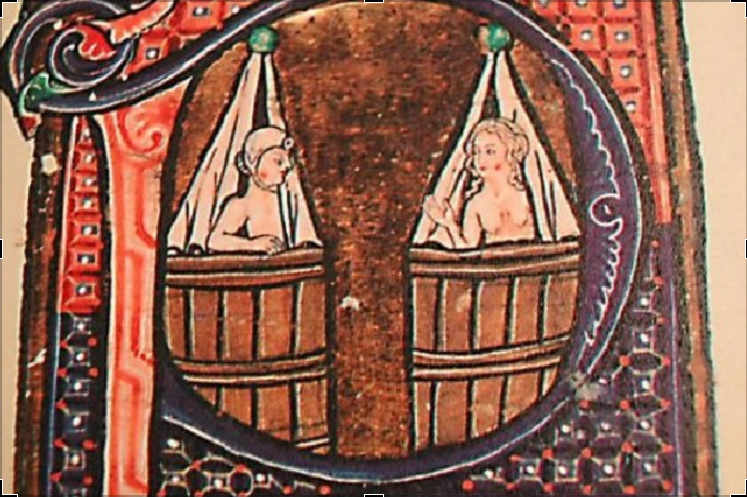
Medieval illustration of people bathing. With thanks to  Going Medieval, which I’ve borrowed this from. I don’t usually do that, but medieval illustrations are out of copyright. Great website. You’ll find a link elsewhere.

The simplest way around the problem was to bring yourself to the water. The human body may be something like 60% water, but it has legs and people used those legs to carry themselves to whatever user-friendly body of water was nearby. Then they tossed themselves in. That would’ve been more appealing, though, in the summer than the winter. England isn’t the Arctic but it does get cold enough to make even a quick dip off-putting. So people also washed at home, even if it did mean carrying the water.

For most people, washing at home meant pouring water (cold or warm) into a basin and taking a cat bath–water, cloth, rub till clean, done. It’s still a good bit of work but it limits the amount of water you need. Some might’ve had wooden tubs they could set by the fire for the occasional bath.

People also washed their hands and faces before meals. 

The rich could afford full, luxurious baths, involving wooden tubs, servants carrying warm water, a large cloth tented over the top of the tub, and scented herbs to enhance the, ahem, bathing experience–thyme, sage, things like that. Breathe out, relax, let the hard work of oppressing the peasants fall from your shoulders.

Ahhhh.

King John (1199 – 1216; you’re welcome) liked a bath well enough that he traveled with a his own personal bathtub–and the attendant who was in charge of it. (Making sure all that water was heated and carried at the right time would’ve taken some choreography, so I don’t expect that would’ve been a simple job.)

As for wealthy monasteries (they weren’t all wealthy, although some were fabulously so), they often had piped-in water–a signal of how much it mattered.


Soap

Medieval Europe had soap, something the Romans, for all their bathhouses and their reputation for cleanliness, did not. The Romans oiled their skin then scraped away the oil and the dirt with it. 

Luxury soap came to medieval Europe from the Middle East, brought by Crusaders and traders. The Crusades created an earthquake in the Middle East and we’re still feeling the aftershocks, but they brought Europe a lot of nice stuff and some startlingly wonderful ideas, including Arabic numbers, which first made it to Europe in the 10th century and swept away the clunky Roman system. 

But we were talking about soap: France, Italy, and Spain began manufacturing the stuff, and eventually England did too. Most people, though, made it at home.


Bathhouses

So much for washing at home. Your average medieval town or city would’ve also had a bathhouse, and these were social places as much as get-yourself-clean places. Many were built next to bakeries to take advantage of the heat from the ovens. In medieval illustrations, you can find people sitting in large wooden tubs, eating from boards placed across them to form tables. So yes, social spaces.

Southwark (that’s in London, although at the time it wasn’t) had 18 bathhouses. 

But wait. While many bathhouses were just bathhouses, some were brothels. Yes, you could take a bath and all that, but you could do a lot of other things as well. You know how it is: in a culture where people are expected to go around wearing clothes, once they take them off they start getting all sorts of ideas. All those lovely bathhouses in Southwark? They were concentrated there exactly because it wasn’t part of London, with its laws and regulations. They were called the stews, and they were brothels. Most of them were owned by the Bishop of Winchester. 

C’mon, an honest cleric has to make money somehow, doesn’t he?

I can’t swear that all the Southwark baths were brothels, but most of them were.

But again, most bathhouses were places to take a bath. The sources I’ve looked at don’t agree on how often people would have visited or how likely they were to heat their wash water at home. They’re drawing on very partial information and putting it together in the best way they can. I’m happy to stay on the sidelines and let them slug it out. 


So why have we believed medieval people didn’t wash?

You notice how neatly I swept you up into the mistaken belief system I just abandoned? Of course you believed what I did. I know I’m not the only damn fool around here.

I can come up with several reasons we fell for that.

One, sanitation genuinely was an issue. In the later middle ages, in the interest of cleaning things up, a lot of towns built public latrines, but let’s not get carried away with how much of an improvement that made. What were the most convenient places to build them? Why, on bridges so the water could take the waste downstream. Problem solved, right? All that nasty stuff goes away, and the system works as long as no one upstream had the same plan and the people downstream can’t find  you. 

When this becomes a national strategy, you won’t want to use the river for your drinking and bathing water and you might want to worry about your water table.

Two, the sources that have come down to us are both partial and contradictory, but some writers warned against excessive bathing. In her Going Medieval post, the historian Eleanor Janega argues that this was less about bathing that “hanging out naked in bathhouses with the opposite sex.” Which was sinful. 

You can leave your money at the door and the bishop will collect it, thanks.

(Janega’s website is both informative and good reading.) 

On the other hand, at Medievalists.net, I read that medieval English writers considered the Vikings overly concerned with cleanliness since they took a bath once a week.” But the site also acknowledges sources that show bathing as “part of daily activity” and that health manuals “explained that it was important to keep the entire body clean.”

At least for medical writers, bathing was something to approach with caution. It could relieve indigestion and stop diarrhea, but if you did it wrong it could lead to weakness of the heart, nausea, or fainting. Excessive bathing could lead to fatness and feebleness. One writer advocated bathing in the spring and winter but not, if possible, in the summer.

Autumn? Sorry, all these centuries later the jury’s still out on that.

Three, we have documents making it clear that assorted saints and extreme religious sorts didn’t bathe, or didn’t do it often, but Janega (yes, her again; she’s handy) argues that this was about denying themselves a worldly pleasure in the quest for salvation: get dirty for god. So instead of canceling out the sources that say people bathed regularly, this reinforces them.

Or it may.

Westminster Abbey required its monks to take a bath four times a year, which, um, may not sound excessive to us. What does it mean, though? Hard to say. It might’ve been a minimum, addressed to the dirty-for-god types. It might’ve been the general expectation, which some people exceeded. But they did pay a bath attendant two loaves of bread a day plus £1 a year, which makes it sound like he worked year round.

Four, from around 1500 to 1700 (public health warning here: this paragraph is thinly researched), Europeans came to believe that water spread disease– especially warm water, which opened the pores and let all those nasties in. Given the state of the rivers, they may have been onto something. That bit of information made its way down to modern ear and we treated it like butter on warm bread and spread it back a few extra centuries.

*

I’m indebted to 63mago for challenging my lazy assumptions on medieval cleanliness and sending me down what turned out to be an interesting rabbit hole. 

Church and state in medieval England: Thomas Becket and Henry II

Medieval England had two mutually dependent centers of power, the church and the state. The state relied on the church for legitimacy. It was church ritual that turned a proto-king into a real one–someone who people believed had a god-given right to ruleAnd the church? It held land and riches, it had a near-monopoly on education and literacy, and people believed in it. All that gave it massive political clout. But it relied on the state’s network of laws and law enforcement.

So, two mutually dependent centers of power, and predictably, they didn’t always line up neatly. Take the tale of Thomas Becket and Henry II.

A rare relevant photo: the pulpit in Canterbury Cathedral


First, let’s get the name straight

When I first heard of Becket, he was called Thomas a Becket, which turns out not to have been his name. When he was born, he was called Thomas Beket. Spelling was a liquid back then. Somewhere along the line, he picked up a stray C. It looked good and he kept it. As Archbishop of Canterbury, he was known as Thomas of Canterbury. As a saint, he was (and I guess is) called Saint Thomas.

Then came Henry VIII, Anne Bolyn, England’s break with the Catholic Church, and all that stuff, and since Becket had thrown his weight behind the church and against a king when they came into conflict, he went decisively out of fashion. So in 1538, Cromwell (Henry’s brains as well as his tough guy) decreed that Saint T was to be known as plain old Bishop Becket.

In 1596, another Thomas, Thomas Nashe, a satirist and poet, added the a to Becket’s name.

Why’d he do that? It slotted in nicely with names in the Robin Hood legend (think Alan a Dale), which was popular right about then, and it made him sound like some rural bumpkin. In other words, this was the Anglicans making fun of the Catholics. 

The name stuck and by the 18th century the nifty rhythm of the a Becket form was clattering around after Tom Beket like a cluster of tin cans tied to his belt. Because regardless of its original intent, it does sound nice.

These days, people seem to have gone back to Thomas Becket, and in the interest of high-minded neutrality we’ll call him that. 


Henry and Becket

Becket was born in 1118 to Norman parents, and this was soon enough after the Norman invasion for that to place him among the elite. Ah, but his parents were merchants, so he was a long step below the elite of the elite, the aristocracy. He got an education (not a given back then), and after a detour as a city clerk and accountant went to work for Archbishop Theobald. 

Before we go on, though, a warning: you’ll want to keep your archbishops separate from your archdeacons in this paragraph, because it has an excess of arches. Becket pleased Theobald (the archbishop) well enough that he was appointed archdeacon of Canterbury. That’s not as good as being an archbishop, but even so it brought him both power and money. Three months after that, he became Henry’s chancellor and confidant. That was in addition to being archdeacon, so Becket now held two posts, both of them important. 

Becket was, according to the accounts I’ve read, skillful and energetic and gifted at getting people to like him, although he does seem to have neglected the less glamorous work of archdeacon in favor of his job as chancellor, best buddy, and right arm to the king. 

He showed himself to be the king’s man when the church and state came into conflict over something called scutage, which was part of that impenetrable knot of relationships that defined feudalism. Basically, it was money that the holder of a fief could pay instead of sending knights to fight for the king. The church held fiefs that had to produce knights or money, and Becket, taking the king’s side, charged the church a high rate.  

To make this more sensitive, this was a period when the church was pushing for greater power relative to kings, who’d previously had considerable control over the church. This is called the Gregorian Reform, and I never heard of it either. Henry was holding out against the changes, claiming what he considered his ancestral rights. And Becket backed him. He was very much the king’s man.


Then it all went sour

When Theobald died, what could make more sense than for Henry to make Becket the new archbishop? He’d be the king’s man inside the church.

Henry tried to persuade Becket to accept the post and Becket tried to persuade the king hat the story wouldn’t end well if he did. Becket lost the argument and was duly made archbishop, at which point he stopped being the king’s man and became the church’s, taking its side in conflicts with the king–first in a disagreement over tax, later over the issue of whether the church or the state would try clerics who were accused of crimes. 

In Europe–and in England before the Norman conquest–the church tried clerics, and their punishments were generally lighter than lay people faced. No death penalty, no mutilation. 

Becket’s argument was that the church already punished clerics and they shouldn’t be punished twice for the same crime. Henry’s was that clerical crime was rife and encouraged by church protection. Basically, though, this was about power.

The conflict came to a head in 1164, with the king claiming several of what he considered his traditional rights. He forbade the excommunication of royal officials and any appeals to Rome. He claimed the revenues of vacant church sees the right to influence the election of bishops.

Becket, having initially accepted this, then registered his disagreement and appealed to the pope, who–no surprise here–took the church’s side. 

Henry’s next move was to summon Becket to a trial. By a state court. And guess whose side it would be on. Becket, being no fool, fled to France, where he lived for six years. By way of spitting in Becket’s and the pope’s collective eye, Henry had the archbishop of York crown his son crowned as co-king, although the archbishop of Canterbury traditionally had the right to crown the king. 

Becket responded by excommunicating a bunch of people.

England, by this point, had more or less withdrawn from obedience to the pope, and in case this isn’t confusing enough I should mention that in addition to a pope, the church had an antipope–a kind of spare pope in case the original went flat. 

Sorry–I thought that was funny but it’s not accurate. Both pope and antipope claimed to be the one true pope. Let’s say it was a messy period in church politics and leave it there.

The pope backed Becket’s excommunications, and excommunication was serious stuff in the middle ages. It could cut a person or an entire nation off from church functions. Since we’re talking about a nation, it meant churches could be closed, people refused the sacraments, and churchyards closed to burials. It meant a country full of people who couldn’t take the sacraments, so they’d believe they were being denied their trip to heaven when they died. This is just the kind of thing that can trigger rebellions. 

So the king allowed Becket to return to Canterbury, but beyond that nothing was settled, and Becket excommunicated a few more people, including the archbishop of York, and refused to re-communicate the ones he’d already excommunicated. 

Henry had what’s known in high academic circles as a runnin’ hissy fit and said– 

Well, he said something. According to the Britannica, “He berated his household for being a pack of ‘miserable curs and traitors’ who stood idly by while a ‘low-born priest’ treated their king with contempt.” But according to Edward Grim, who was an eyewitness to Becket’s killing although not to the hissy fit, Henry said, “What miserable drones and traitors have I nurtured and promoted in my household who let their lord be treated with such shameful contempt by a low-born cleric!”  

We’re not done yet, though. According to Peter O’Toole in the 1964 movie Becket, he said, “Will no one rid me of the meddlesome priest?” Or maybe that’s “turbulent priest.” Go watch the film yourself if you want to get it right. It’s clearly the authoritative version, but I can’t be bothered. 

Whatever Henry said, four knights trotted off to Canterbury, where they killed the archbishop. 


Becket’s afterlife

No, not that kind of afterlife. We’re talking about the verifiable kind:

Within days, people were making pilgrimages to Becket’s tomb in Canterbury cathedral–or so says the Britannica, although I have trouble believing anyone constructed a tomb that quickly. Let’s not fuss over details, though. Miracles were quickly attributed to him. Pilgrims came. 

Henry (wisely) swore he never wanted Becket killed, and the next year he–that’s Henry, not Becket–showed up in Canterbury, allowed himself to be whipped by bishops while he prayed for forgiveness, and was duly absolved. His decision to do that might’ve had something to do with a revolt led by his sons and backed by France, which he claimed was a result of Becket’s killing.

And the knights who did the deed? They were excommunicated but asked for forgiveness and were sent to fight in the Crusades for fourteen years. 

Three years after Becket’s death, he was made a saint and people believed that the spot where his blood was spilled would heal the sick, and Canterbury remained an important goal for pilgrims until Henry VIII broke with the Catholic Church and had Becket’s tomb taken down, his bones burned, and his name erased from the service books.

A service book, in case this is all as foreign to you as it is to me, is “a book published by the authority of a church body that contains the text and directions for the liturgy of its official religious services.”

For all that, he wasn’t fully erased. These days, the cathedral burns a candle where Becket’s tomb once stood, and his name is engraved on the floor to mark the spot where he was killed.

How people slept in the Middle Ages

Asking how people slept in the Middle Ages sounds embarrassingly pointless. Surely the answer is, the same way we do. 

Well no, they didn’t. That would make the post too short and I want to be sure you get your money’s worth here. They broke the night into two separate sleeps, which is the same way everybody in the pre-industrial world seems to have slept. The sources I’ve found are heavily tipped toward Europe, but some say the practice clings on in unindustrialized pockets of the world today. 


A rare relevant photo: Bedstraw

The two sleeps

We’re talking, remember, about a time before there was much in the way of artificial lighting, so no electricity, no gas lamps. They had candles, sure, but they were expensive and weren’t all that bright. And when people went to bed,they either blew them out or risked burning down the house. So when it got dark, they–or most of them anyway–toddled off to bed. 

We’ll talk about the definition of bed in a minute.

A couple of hours later, they woke up, not because that was the plan but because they just did, and they spent another couple of hours–let’s say from 11 to 1, although no one would’ve been watching the time–either lying awake or up and about, in both cases without fretting about what was wrong or how they were going to get back to sleep, because waking up in the middle of the night was just what happened.

This went on into the early nineteenth century, and a couple of studies have documented this way of sleeping among non-industrial people and people asked to live without industrial-age lighting and entertainment. 


What did they do in the interval between sleeps? 

Some people lay in bed and chatted, because at least in the medieval era, rare was the person who slept alone. Some got up and worked–by moonlight, by starlight, by rushlight (those were the waxed stems of rushes–the candle-substitutes of ordinary households), by candlelight if they could afford candles–although the people who could you probably didn’t need to work in the middle of the night. 

All the folks you’d expect to recommend prayer and meditation recommended the time between sleeps as a time for prayer and meditation, and no doubt some people did both. Folks drank their religion straight back then: no ice, no mixers.

I’ve read about monks and nuns getting up in the middle of the night and traipsing to the chapel for prayers, and it’s sounded downright punitive. I imagined someone having to haul them out of their sleepy little beds. This puts it in a different light. They were awake anyway. If the purpose of their lives was to pray, this was a time to go pray.

The time between sleeps was also a time for sex, and was considered a particularly good time to conceive children.  

Sex when people weren’t sleeping alone? For one thing, sharing a bed didn’t mean all its occupants had to get up or stay in bed in unison. For another–I’ll go out on a limb here (I’ve read this somewhere but haven’t looked for a source to confirm what my memory insists on) and say that sex wasn’t thought of as something people should do in private. Privacy wasn’t a thing yet. (Sex has always been a thing. In the early Middle Ages, even your local lord and lady bedded down in the hall with their kids, their hangers-on, their guests, their attendants, their servants, and anyone I’ve forgotten to list. The solar–a room for the aristocrats alone, along with maybe a servant or three on hand in case they were needed–didn’t come into existence until midway through the medieval period. 

Eventually, people went back to bed for what was called their morning sleep. 


Bed sharing

Beds were communal places, and an entire family might sleep together, with the couple in the middle, the girls arranged on the side nearest the wall, with the youngest closest to her mother, and the boys on the other side, also in age order. 

But it wasn’t just the family tucked up in bed. Non-family members would also be likely to crawl in, and they’d be on the outside–guests, friends, servants. And, as one article I found reminds us all, fleas and lice. When people traveled, strangers who stayed at inns would share a bed.

Sleepers and would-be sleepers were expected to minimize their fidgeting and avoid physical contact.


Beds

If you were rich enough in the medieval era, your bed was elaborate and impressive, with several mattresses–straw, then wool, then feather, and sheets, blankets, coverlets, pillows, bolsters, all that good stuff. The bed was your most important piece of furniture.

A coverlet? That was a bedspread, although in recent times it seems to have wandered off and become something smaller. 

The curtains and canopies we think of as the mark of the nobility’s beds came into use midway through the medieval period. 

Middle-ranking people had beds with simple wooden bedsteads with plain headboards and as much of the accompanying stuff as they could afford. The main thing was that they were up off the floor. 

Everyone else? It depends on what stretch of time we’re talking about, but at least in the early medieval period, they slept on the floor. They might have had a mattress stuffed with straw, wool, hair, rags, or feathers, or some mix of them. Whatever it was made from, it could be moved out of the way during the day. 

As I write this, a couple of wildflowers called bedstraw and lady’s bedstraw have just come into bloom in the hedges. I haven’t been able to find out much about bedstraw itself, but lady’s bedstraw (the lady in question of the Virgin Mary, not the local Lady Muck) was added to straw mattresses both for its fragrance and to keep fleas away. It was also believed to ease a birth.

If you were at the bottom of the economic and social heap, you slept on straw or hay–or according to one website, the earthen floor. A BBC article says the poor might sleep on a scattering of heather, and I hate to argue with the BBC, but we have some growing out back and it’s pretty woody stuff. I haven’t tried sleeping on it but I have a hunch I’d do better on the bare ground.


How do we know any of this?

In the 1990s, the historian Roger Ekirch was researching a book on the history of nighttime. He wasn’t expecting to find anything new for a chapter on sleep, but how could he write about night and ignore sleep? So good historian that he was, he started digging through court depositions, where all sorts of odd and wondrous facts about everyday life can be found.

What he found was a seventeenth-century case mentioning, casually, the first sleep, which implies a second sleep. The case was about an incident that happened in the interval between the two. He kept digging and found many mentions of what he was now calling biphasic sleep. It showed up in letters, diaries, medical textbooks, philosophical writings, newspaper articles, ballads, and plays. He found records or hints of it in Europe, Africa, South and Southeast Asia, Australia, South America, and the Middle East, the earliest dating back to the eighth century BC.

And somehow, all of that had slipped out of our awareness and our histories.

*

Important information about Britain’s recent election

In last week’s post, I missed a crucial bit of lunacy about the election. Nick the Incredible Flying Brick stood as a candidate for the Monster Raving Loony Party in Holborn and St. Pancras. His statement to voters said, “We have a manic-festo that includes scrapping January and February. It would help with fuel bills and the cost of living.” He got 162 votes against Keir Starmer’s 18,884.  

Somebody mentioned him in a comment, and I did look for it so I’d know who to thank, but I’m damned if I can find it now. Whoever you are, my thanks. Along with my apologies.

Wards and guardians in medieval England

As a culture (generalization alert here), we sentimentalize medieval England. At least when we’re not talking about its fleas and flies and plagues and dirt, we do. Still, the sentimentalizing outweighs the fleas-and-flies stuff. We like to think there was a time when nobles were noble, or at least when someone was. Shouldn’t someone be pure of heart in this mess of a world?

Of course they should, and it must’ve happened a long time ago, because we don’t have a lot of purity on show right now. Therefore–this is so obvious I hardly need to say it–it must’ve happened in the middle ages. After all, they did leave us some beautiful pictures, and some yarns we can swallow whole if we work at it. 

But medieval England was nothing if not upfront about making a profit, including from that thing we sentimentalize most, childhood. 

Okay, if childhood isn’t what we sentimentalize most, it comes right after kittens and puppies.

Irrelevant photo: Not some knight’s horse but a pony living wild on Dartmoor.

Wardship

Let’s say you’re the heir to one of medieval England’s aristocrats but, oops, your father dies while you’re still a minor–less than 21 if you’re male, less than 16 if you’re female. You’re going to become somebody’s ward and they’re going to be your guardian.

Why am I talking about only your father? Because your mother gets shoved off the chess board as soon as your father dies. 

I should squeeze an extra fact in here: If you’re male, you get to be the one and only heir, but if you’re female and no male is in line ahead of you, you and any sisters you happen to find will divide the inheritance among you. 

Why? 

‘Cause that’s how it works. 

We have most of the pieces in place now. There you are, heir to a big chunk of land–and land is wealth in medieval England–but too young to control it. You might think your mother could be your guardian but no, sorry, your mother’s good enough to take care of whatever children won’t inherit the land, but not of you, kiddo. That right–and we’ll come to why it’s a right more than a responsibility–goes to your late father’s feudal lord. Who’s likely to have their own best interests at heart, not yours. Having a ward is lucrative and wardships are bought and sold like any commodity. If it’s to their advantage, your guardian may hold onto your wardship. If it’s not, or if they need the money, they’re likely to sell it. 

Hold on, though. We shouldn’t talk about wardship as if it’s a single thing. It can be split up, with one person guardianing you, the actual child, and another guardianing–and, entirely legally, profiting from–the land you’ll inherit. And this is right and proper and necessary because as a child you can’t provide military service, and military service is the most important thing feudal lords owe as payment for their land. Whenever the king WhatsApps them, they’re expected to fight, and to bring some set number of armed men with them. 

And since too young to be trusted with a smartphone, the adult controlling your land will take responsibility for all that warrior stuff. And, again, since all the gear soldiers need–horses, weapons, armor, food, alcohol–doesn’t come cheap, profiting from your future estate makes sense, right? 

Well, it does if you can immerse your mind in the assumptions of a feudal world. 

So that’s the land. If the elements of your wardship are divided, though, somebody else will get to decide who raises you. They’ll have the right to arrange your marriage, and since marriage is about connections and land and power, and since you’re a rich heir, the right to arrange your marriage is a game piece worth having. Your guardian might marry you and your riches into their own family. They might marry you into a family they want to build an alliance with. They might sell your marriage.

If all this sounds cold, we haven’t even started. Your custody may not get settled permanently. Your child-self can be taken from one home by armed men and deposited in another. That’s called ravishment. You can then be deposited in some third household because the person who’s taken you isn’t interested in your charming company but in having control of you. You could then be ravished back to the first household, or to a third. 

“No provision for feudal heirs was final,” according to Sue Sheridan Walker, in “Widow and Ward: The Feudal Law of Child Custody in Medieval England.”

All the people involved can also go to court, and often do. What little is known about how this worked (and the tales are hair-raising) comes from court records–which, frustratingly, often end halfway through the story, so we never get to find out what happened. What we can pretty well guess is that they don’t end, “And they all lived happily ever after.” Happiness doesn’t seem to have been an expectation, although to be fair when you can only trace a bit of history only through court records you inherit a built-in bias toward the ugliest stories. When it all works smoothly, no one goes to court.


Let’s go back to the mother, though

Mothers get to raise their younger children–who cares about them?–although if the heir dies, the next in line will have to replace him. And an aristocrat’s widow will have the income from her dower lands to support what’s left of her family.

Her what?

Dower lands are generally a third of her husband’s estate, and a widow has a lifetime right to them. When she dies, they revert to the estate–presumably to her son. Since we’re talking about a group of people with a high death rate, both through illness and warfare, a woman might be widowed multiple times, acquiring dower lands as she goes and becoming quite wealthy. So even though she might not have the right to act as her own child’s guardian, as a feudal landlord she might become the guardian of some tenant’s heir, and she might either act as guardian herself or sell the wardship.

When a child’s orphaned, the question people ask isn’t, Who’s the best person to raise this child? It’s, What rules govern the land the child will inherit?  


Yes, but…

As an heir, you just might live with your mother if your guardian approves or if your mother buys your wardship, but we can’t assume she’ll think her home is the best place for you. Aristocratic childhoods are short. Children–orphaned or not–are commonly sent to other households at 6 or 7, generally a household that’s a step up the feudal food chain, where they’ll make important connections and get an education. Let’s not go down the rabbit hole of who’s literate and who isn’t. The answer will depend on what part of the medieval period we’re talking about anyway. But whatever book learning he acquires, the most important things an aristocratic boy can learn are warfare and what it takes to be an adult in this stratified society–or as one article put it, he needs to “learn breeding.” So even if you stay with your mother, you can’t expect to stay with her for long, and the household you grow up in might turn out to be your in-laws’. Marriages are arranged early and it isn’t uncommon for a very (very) young betrothed couple to grow up together.

Which leads us to ask why, if she’s going to send you away anyhow, your mother might want to buy your wardship, and one possible answer is, for profit: a child can be sold into marriage. Or she might want to marry you off to fulfill an arrangement the family made before your father’s death, which would strengthen or confirm an alliance. 

She might also want to control whose home you’re raised in. Marriage and fostering were highly charged political moves.

If she’s one of those mothers who ravish their children–that’s stealing them from their guardians, remember–she might not be doing it because she misses your charming companionship and the crayon artwork you left on the castle walls. A marriage made against your legal guardian’s wishes will still be valid.

And as Walker points out, medieval mothers aren’t necessarily involved deeply with their children. As infants, the kids are in the care of wet nurses. They’re sent away while they’re still young. Books on deportment are singularly silent on what a mother’s duties to a child are. 


And finally, there’s another form of guardianship

Medieval England has another way an aristocrat might hold land, though: socage. It doesn’t have the prestige of holding land that you pay for in military service. In fact, it moves us closer to the peasant level. You pay for your land either agricultural service (this isn’t for the aristocracy) or in money. But even though there’s less cachet in holding land this way, you can hold one bit of land in socage and another bit by knight-service, so your socage parcel doesn’t move you down the food chain. 

Don’t look for a simple picture.  

If you’re the heir to land held under socage tenure, then guardianship goes not to the feudal lord but to your nearest male relative who isn’t entitled to inherit the land. If you’re female, you can contract a marriage without the lord sticking his long feudal nose into the arrangement. (Yes, the source I’m stealing this from said you could contract a marriage by your very own self. You don’t have to depend on someone else doing it for you.) If you’re male, you may find that being the oldest male doesn’t entitle you to inherit the whole parcel of land; it may be divided. It’ll depend on all sorts of complexity that’s above my pay grade. As far as the topic of wardship goes, though, it sounds like you’re less of a pawn than if you’d inherited high-prestige land.

After 1660, knight-service tenure was wiped out and it all became socage.   

Bread in medieval England: an update

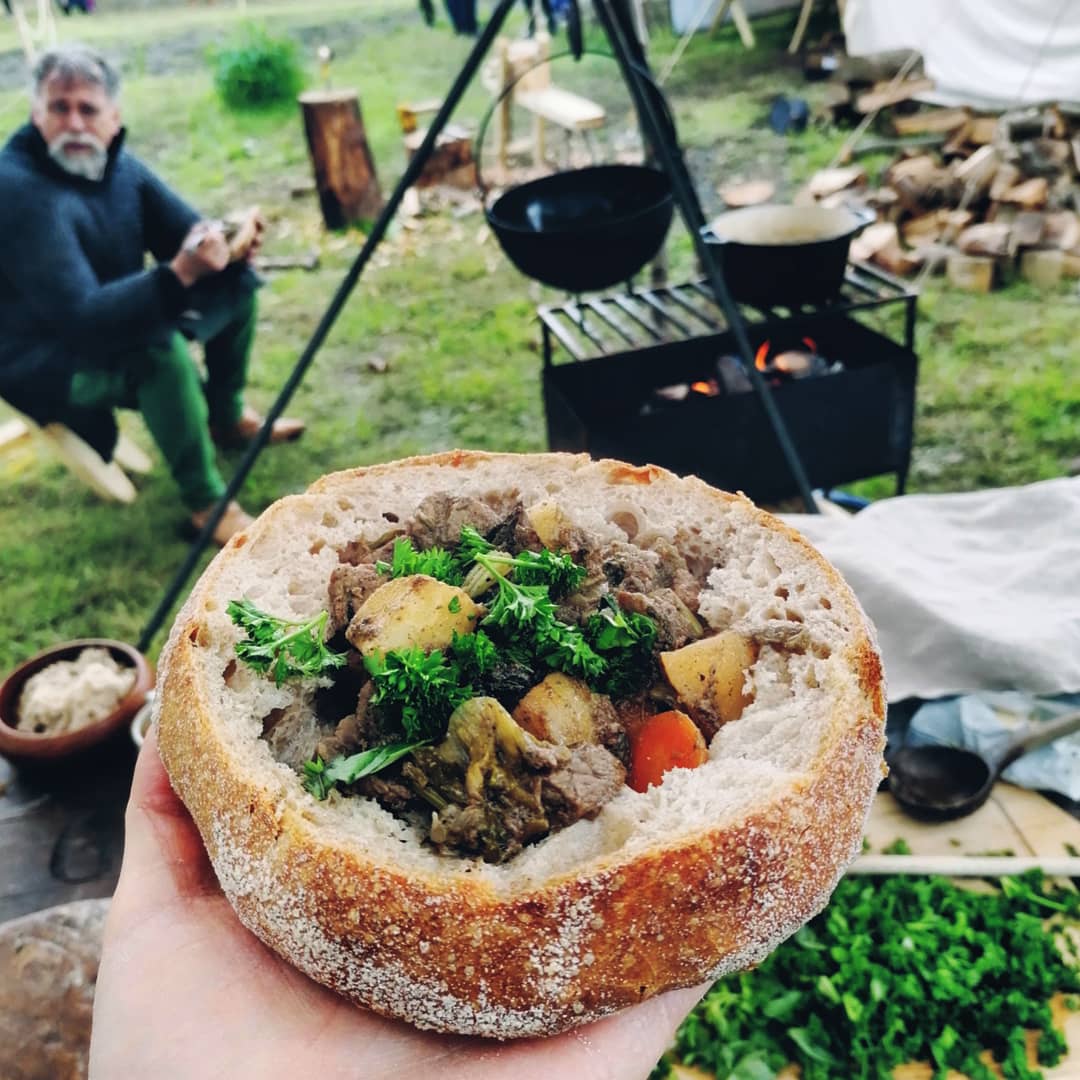
A quick update for anyone whose imagination was captured by the post on medieval bread making: Aleksandra from the Evendine Sourdough Bakery sent a photo of a trencher loaf she made (and served with pottage) for a medieval event in Evesham. I can only wish I’d been there.

She was working from a recipe in Food and Drink in Medieval Poland: Rediscovering the Cuisine of the Past, by Maria Dembinska.

Trencher loaf, made by Evendine Bakery.

Bread in medieval England

Bread was medieval England’s most important food. So much so that it gave us our words for lord (from the Anglo-Saxon “loaf-guardian,” or hlafward) and lady (“loaf-maker,” or hlaefdige). 

No, I can’t turn those into anything remotely lady- or lordlike, but they do both have an L and a D. Unless a genuine linguist or someone who learned Anglo-Saxon weighs in (and we do have one or two around here somewhere, so it’s not impossible), that’s as close as we’re likely to get. 

In the meantime, by way of proof I don’t have to mispronounce, records from medieval England, France, and Italy show soldiers, workmen, and hospital patients eating two pounds of bread a day. Or two to three pounds according to another source. That’s the same amount the nobility ate. 

So working people ate as well as the nobility? The hell they did. It’s just that aristocrats had access to meat and fish that the lower ranks could only dream of, while working people supplemented their bread with pottage.

What was pottage? If you think of it as anything that’s available, boiled, you won’t go too far wrong. April Munday did an interesting series of blog posts about making pottage from her garden, depending on what was in season and what would have been available in medieval England. The link above will take you to one of them.  

Irrelevant photo: Another of those tall white flowers I can’t identify. In fact, a whole field of them.

But everyone ate bread. Lots of bread. And the kind you ate was still a reliable marker of your class. The darker and heavier your bread, the lower down you stood in the social rankings.

No bread recipes have come down to us from the medieval period. One historian says this is because most bread was baked professionally. Others say it was so common that no recipes were needed. Which brings us to our next section:


A warning on sources

I’m using a range of sources here, and a lot of them are books. Remember books? They’re lovely things, but it means I’ll be short on links today. When I’m lucky, a range of sources will fill in blanks that others left, but this time they contradict each other in the most authoritative possible ways. 

We’re covering a long period of time here, from the early Anglo-Saxon era to the end of the Middle Ages, and that could account for some contradictions. Regional differences could account for others. After that, all I can offer you is a reminder that we weren’t there and social history’s a fragmentary thing. It examines things that are often considered too unimportant to document or too obvious to notice. So I’ll just throw this whole contradictory mess your way and leave you as confused as I am.

Don’t you just love being here? You read damn near two thousand words and come away knowing less than when you started.


A few kinds of bread

White bread was the good stuff. I’ve seen it called by a range of names, including manchet, wastell, paindemain, even  cake–a word with a Scandinavian origin that meant a small, flat bread roll. 

Paindemain–from the French for “hand bread”–may have been called that to distinguish it from trenchers, which we’ll get to later. 

The best white bread was made with the hardest and best sieved wheat flour, ground on the hardest stones so that it had the least grit in it. (Grit from grinding stones was part of cheaper bread, and some historians say a lifetime of eating it wore people’s teeth down.) It was raised with ale barm–yeast from brewing–which gives the best rise but is also unpredictable and in unskilled hands can go wrong, giving us the word barmy.

Yeast generally came from brewing beer, something that was done at home, or at least in many homes. It wasn’t universally used until the Renaissance, according to one source.

Even the loaf keeper and the loaf maker (that’s the lord and lady, in case you haven’t been taking notes) might not have had white bread every day.

Household bread was for the people a step down in the household. It was made with whole wheat flour, which might have been mixed with rye or barley. It was raised with leaven–a bit of yeasted dough saved from an earlier batch. Some books on bread baking still suggest doing this to improve the bread’s taste, although modern recipes rely on commercial yeast to do the heavy lifting.

Brown bread was made for farm workers and the lowest servants, from a mix of barley, dried peas, malt, and some whole wheat or rye flour. It was what we’d call sourdough: left overnight in a sour trough, where it picked up yeast left from earlier batches of dough. We may worship at the altar of sourdough today, but the taste wasn’t appreciated in the Middle Ages, and according to Pen Vogler in Scoff, the flour was likely to go off and given the bread a rancid taste. (Wheat germ has nutritional value but it goes bad easily. That was another benefit of white bread.)

Horse bread was what it said on the tin, food for horses, but not many people could read and tins hadn’t been invented yet anyway. In the face of famine or less widespread hard times, people ate horse bread, but it was an act of desperation.

According to a paper by Jessica Banks of Penn State University, bread could include not just rye and peas but also chestnuts, acorns, lentils, or rice. 

Rice? Yup. Starting in the eighth century, rice was grown in Spain and then in northern Italy as well. In England, it was an imported luxury and was considered the most nutritious of all grains. This wasn’t something for the poor to add to their bread. It’s not something I’ve added to bread myself and I can’t tell you what effect it has. I’d be surprised if it improves it.

For most of those, though, if you add large amounts to your bread  it won’t rise as well. Barley bread was considered second-best enough that Anglo-Saxon saints could flaunt their humility by eating it. 

According to Robert Lacey and Danny Danziger, in The Year 1000, the bread of the early Middle Ages would have been round, coarse flatbread, and much of it would have been stale enough that you’d dip it in your pottage in self-defense. Outside the towns and cities, they say, there wouldn’t have been any call for specialized bakers baking fresh bread every day.

On the other hand, Sally Crawford, in Daily Life in Anglo-Saxon England, says bread was cooked on a pan over a fire–a quick and logical way to bake flatbreads–or in the ashes of a fire. I’m inclined to go with Crawford on this. I’ve made flatbread. You don’t need an oven. (They weren’t introduced until the sixth century anyway.)

Another source says it was also cooked in the embers of a fire. As long as you turned it often enough, this worked. 


Ovens

The medieval peasant’s home had an open hearth and the fire burned on a flat rock–sometimes for decades, because starting a fire from scratch involved a lot of scratching of flint on iron or wood on wood. 

An oven, though? That would’ve been expensive, and if you could afford one you’d build it outside the house. In a town, you might build it outside the town walls. Fire was a constant threat. The Great Fire of London may have been well after the medieval period, but it started in a bakery all the same.

If you had an oven, though, you’d heat it before the food went in, then rake out the fire and put the food in, leaving the oven to cool slowly. In If Walls Could Talk, Lucy Worsley describes having baked this way. They soaked a wooden door in water to close the oven (that kept it from catching fire) and sealed the gaps with dough. When the seal was cooked, so was the bread inside, and just enough heat was left to bake biscuits–a word that comes from the French for “second cooked.”

Or just possibly for “cooked second.” My French is somewhere between iffy and iffier, but I do know when a phrase sounds better in English.

All of this was a lot of work and not something you’d want to do for a loaf or two. You’d bake either a lot of loaves–a community’s worth of them–or none. On many manors, the lord had a bakehouse and tenants had to pay if they were going to use it. 

Ian Mortimer, in The Time Traveller’s Guide to Medieval England, says that the yeoman’s wife (remember, please, that yeo-people ranged from poor to rich) might have had her own oven but might also have taken her ground grain to the village baker every week or so. That seems to say that she wouldn’t mix or shape her own dough, although other writers have people bringing their loaves to the baker.

In towns and cities, though, people bought their bread ready made, and as guilds formed, bakers organized themselves separately into one guild for the bakers of white bread and another for the bakers of brown bread. It wasn’t until Liz the First came along that–at her insistence–they merged into a single guild.


Why use wheat?

Vogler makes an interesting point about England’s reliance on bread: It’s complicated to make. You have to not just grow and harvest the grain but thresh it (back-breaking work if it’s done by hand), grind it (by hand in the early Anglo-Saxon period; mostly by water mills by the time of the Norman conquest), sieve it, mix it into dough, raise it, and bake it. All of this in a country that’s not ideal for growing wheat, which wants a long, dry growing season. That rules out the north and west of the country, she says, and it doesn’t sound like the rest of the place is ideal either.

Why didn’t people rely more heavily on rye, as large parts of northern Europe did? Or like the Scots and the northern fringe of England, on oats? 

Maybe it was the allure of that light, white bread that the best wheat could produce. Maybe it was just because. Humans are a strange species.


Trenchers

I’ve read several explanations of what trenchers were and how they were used, and everyone at least agrees they were bread used as plates. Some writers say they were a way to use up stale bread. Others say they were thin, unleavened loaves, baked for this purpose. One says they were the blackened bottom of the loaf, because the oven couldn’t ever be cleaned completely. This was cut off and given to lower members of the household, leaving us with the phrase “the upper crust”–the people who got the top half of the loaf. 

Some say the trenchers were fed to pigs after they were used. Some say that if a household was rich enough, they’d give the used trenchers to the poor. Some say they were eaten as part of the meal. I have no evidence for this, but I’d put my money on them usually being eaten, because making bread’s a lot of work and uses a fair bit of fuel. You can feed pigs something a lot less complicated and they’ll still put on weight. Medieval people didn’t waste food.

Giving used trenchers to the poor, though, might have been a way to demonstrate your wealth as well as perform an act of charity.

The most convincing comment on trenchers is from Medieval Cookery, which says about feasts that “the common belief is that after the diners were finished with their food, the used trencher was given to the poor. While there is some documentation supporting this belief, it is somewhat confusing and may be open to question.”

*

This post is in response to an email from the baker at Evandine Sourdough Bakery, asking about medieval bread. It’s not a topic I’d thought about. Thanks for suggesting it, Aleksandra. I hope at least some of this is what you were looking for.