
If you think politics were once sane and sensible, let’s take a quick dive into England in the fifteenth century. I don’t guarantee that things were either more horrific or more absurd back then than they are wherever you live with (I’m originally from the US, after all, which scores high on both scales right now), but a bit of history does keep us from thinking political idiocy’s a new invention.
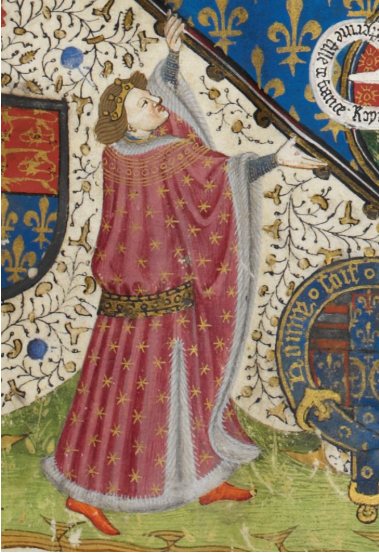
The Duke of Gloucester, hanging his curtains. From Wikimedia Commons
The king, the uncles, the conflict
We’ll start with the king, since his personality, competence, hair style, and digestion were all political issues back then. Henry VI has gone down in history as a weak and unstable king, and we’re dropping in at a time when he’d been king for three years. You might think that would be long enough to get the hang of the job, but he was four years old and I’m no fan of monarchy but even I will forgive him for not being much use yet.
While he played with his toys, two powerful men played with the country–and with the money and power it had to offer them: his uncle Humphrey, the duke of Gloucester, and Henry Beaufort, who was the chancellor, the bishop of Winchester, someone who could be counted on to lend money to the insolvent crown (at high interest rates), and uncle to the duke–who was, remember, uncle to the king.
England’s aristocracy would’ve fit in a fairly small laundry bag back then. And you know what some families are like: these two men didn’t play nicely together. They’d already had an armed fight on London Bridge. I mention that only to explain why, when Parliament was called into session in 1426, everyone expected a fight there too. Both men had power bases nearby, Humphrey in London itself and Beaufort in Southwark. So someone decided to avoid bloodshed by moving the meeting to Leicester–pronounced for no discernable reason, Lester.
Don’t get me started on English spelling or place names.
To keep the two sides from shedding blood, somebody pulled a 14th-century tradition out of a different, non-laundry bag. (England’s bag of arcane traditions is almost as big as its bag of arcane spellings.) Each Parliament had been opened back then with a proclamation banning swords, other weapons, and silly games.
Silly games? Yes, silly games. The good folk running the country had a habit of pulling men’s hoods off their shoulders, as any reasonable adult in a position of power would.
But by now it was the 15th century, not the 14th, and people had grown up enough (and were grumpy enough) that no one expected games and the announcement was stripped down to a simple warning that “every man . . . should leave their weapons in their inns, that is to say their swords and shields, bows and arrows.”
The bats
So what did everyone do? Left their swords and bows and arrows at their inns and armed themselves with bats–the wooden kind, not the avian.
What were they doing with bats? No idea. As far as I can tell, people didn’t start playing cricket for another century, although an ancestor game, stoolball, was played in Essex, traditionally by milkmaids using their milking stools as wickets. Not, you’d think, the sort of game to attract a bunch of macho aristocrats.
Okay, I haven’t a clue why they had bats and I’m not sure anyone sensible will either. The country was full of local games. Whether Leicester was full of bats that the lords and Members of Parliament could appropriate I don’t know. Maybe a few good solid cudgels went down in history as bats because the scribe-of-the-day liked the sound of it. We’ll just have to squint and move on. The articles I’ve found somehow take it for granted that they had bats.
Don’t we all pack them when we travel?
The two sides brought their bats to Parliament. The next day they were told to leave their bats behind, so they brought stones–big ones–tucking them into their clothes, where no one would notice them.
How did both sides hit on the same strategy two days in a row? By hacking each other’s emails, of course. No other explanation is possible.
Eventually Beaufort and Humphrey spoke to Parliament, making their cases against each other and for themselves, and in the end Beaufort was made to step down as chancellor but by way of compensation was allowed to accept the Pope’s offer to make him a cardinal. The two men gritted their teeth and shook hands, no blood was shed, and the Parliament came to be known as the Parliament of Bats.
And the king? Not long afterwards, he was knighted by a different uncle.
 Notes from the U.K.