The Brigantes: a bit of Roman-era British history

When the Romans invaded Britain, some of the British tribes weighed the odds of defeating them, didn’t like their chances, and cut deals with them. As far as I know, you won’t find statues to those tribes. They got their payoff at the time and to hell with posterity. 

By way of contrast, Boudicca–leader of the Iceni and scourge of the Romans–has a very nice statue in Westminster. Or if it’s not nice, it is at least big.  

Boudicca earned her statue by leading an uprising against Rome, burning what are now Colchester, St. Albans, and London. According to a Roman source, her troops killed 70,000 Romans and pro-Roman Britons and made mincemeat of the Ninth Legion. 

The word mincemeat isn’t in the original. It’s my translation and since I don’t know Latin you shouldn’t give it too much weight, but you might also want to substitute “a lot” for that 70,000. It’s from that impeccable source, the Britannica, which got it from a Roman writer, but at the time statistical reporting was no better than my Latin. 

I also question the number because Wikiwhatsia (sorry–handy for a shallow dive on a beside-the-point topic) estimates the late-second century population of what’s now the UK at somewhere in the neighborhood of 3 million, which is close enough for a blog post. If we subtract all the people who lived outside of the area the Romans occupied, and then  eliminate children, old people, and people who had migraines when the battles took place or who were nine months pregnant (women fought–consider Boudicca–so we’re not eliminating them all), we’re left with–um, nowhere near as many people as we started out with. And we haven’t even eliminated all the people who weren’t pro-Roman.

What I’m saying is that if 70,000’s the right number, she would have killed off an unlikely proportion of the fighting population. I suggest we take it as a deceptively specific way of saying she did the Romans a lot of damage.

The Romans did eventually defeat Boudicca, but many centuries later she got her statue.

The tribes who collaborated with the Romans not only don’t get statues (as far as I know), they also don’t get much press, but I stubbed my toe on one of those tribes, the Brigantes, recently and I hate to let that pain go to waste, so let’s stop and learn a bit about them.

Okay, I’m pushing it here. This is a fougou–an elaborate prehistoric tunnel whose purpose no one’s sure of–at Carn Euny, in Cornwall. Wrong end of Britain for this story, but the village was in use until the fourth century CE. 

The Brigantes

The Brigantes were a confederation of tribes–the largest on the island at the time–occupying most of northern England. Or northern what’s-now-England. Or else they were one large honkin’ tribe, not a confederation. Take your pick. We’ll probably never know.

In 43 CE (that’s where we pick up the story), they were led by a queen, Cartimandua, who made an alliance with the Romans in order to avoid an invasion. 

Not invading, though, didn’t mean the Romans stayed out. It just meant they didn’t kill people on their way in. They came, they settled, and they rubbed their hands in glee at the minerals that were to be had. Above all, they made money. 

Unfortunately, the Brigantes left no written records, so we only get to see what happened from Roman sources and from archeology, and with all due respect to archeologists, they can never tell the full story of people’s lives. So we don’t know much about Cartimandua’s life and we don’t know the Brigantes’ experience of having the Romans move in. What we do know is that the Roman pattern was to create what an article on a Warwick University site calls “mutually beneficial relationships with the local elite.”

It would be a long time before the non-elite put their point of view on the record.

We also don’t know whether Cartimandua was one of the eleven British “kings” who surrendered to Emperor Claudius and who were mentioned–not by name–on his triumphal arch, but she might’ve been. It might’ve made more sense to the Romans to call a woman a king than to acknowledge a woman as a ruler.


Resistance to Rome

While Cartimandua was cutting her deal, some of the tribes to the south surrendered to the Romans and others fought the. The Catuvellauni tribe fought and lost, and Caratacus, the son of their king, fled to Wales–or what’s now Wales–where with one of the local tribes he kept the fight going for nine years. 

When he was finally defeated, he fled into the territory of the Brigantes, hoping for sanctuary. That makes it sound like he hadn’t been reading the newspapers–the Brigantes; deal with the Romans; should’ve been front-page stuff–but that can happen when you’re fighting an asymmetrical war. You’re too busy to send a kid running to the newsstand. Or you send the kid but then you don’t have time to unfold the damn paper, never mind read it. You’re too busy dodging spears and mending your shield and wondering how you’re going to feed your warriors. 

It’s also possible that he knew Cartimandua had cut a deal with the Romans but he didn’t have any other cards in his hand so he played the one he had.

Either way, Cartimandua handed him over to Rome.

It’s not the sort of move that fills her descendants with pride, but if you narrow history down to feel-good stories about heroes, it’s no longer history, it’s propaganda. Which is of course not a comment on what’s been happening to school books and museum exhibits in the US lately. 

Caratacus’s defeat pretty much settled the question of who controlled Britain: Rome did. He and his family were shipped off to Rome and paraded through the streets. The humiliation of enemies brought glory to Rome. So I’m about to tell you he was executed, right?

Wrong. He gave an impassioned speech asking for clemency and Claudius–the emperor–pardoned him. He and his family lived out the rest of their lives in Rome, quietly.

If life was a movie, it wouldn’t make a good ending.


Cartimandua, Venutius, Vollocatus, and a soap opera plot

Cartimandua did well out of handing him over. Or out of her deal with the Romans. Either way, archeologists have unearthed luxuries–glass; rare tableware; amphorae for wine and olive oil–from what may have been her capital. 

Remember that business of the Romans cutting deals with the local elite? 

But we have to backtrack here, because Cartimandua had a husband, Venutius. He seems to have been the lesser power in the relationship and–speculation alert here–may have been the leader of another tribe and their marriage a political alliance. Who knows? They’re both dead and we can’t ask. 

Somewhere around 57 CE, they split up, and Cartimandua not only married his armor-bearer, Vellocatus, but shared power with him. Or so Tacitus, a Roman historian, tells us. Again, who knows? It’s as close to the story as we’re going to get. Let’s pretend to believe it. 

Theirs doesn’t sound like the kind of divorce where the couple gets together every Friday night to eat popcorn and watch TV with the kids, because at some point Cartimandua captured some of Venutius’s relatives, which (life advice warning here) is never a good move if you’re looking to keep peace in the not-quite-family.

Venutius attacked her, but when I say her what I probably mean is her territory. Her tribe. 

It’s possible–or better yet, probable–that this wasn’t all about who shared a bed but about politics. Handing over Caratacus might not’ve been a popular move. Becoming an accessory to a new ruling elite–the Romans–slotting themselves into place over the Brigantes might’ve made Cartimandua unpopular. 

A lot of things are possible. What’s known is that the Romans sent soldiers to defend Cartamandua and Venutius lost but lived and tried again ten years later, when Nero’s death left Rome in turmoil. He attacked, the Romans had only auxiliary troops to send, and Venutius won. 

What happened to Cartamandua? Dunno. She might’ve survived. She might not have.  After that, we’re out of possibilities. Vellocatus drops out of sight. Venutius, though, ruled the Brigantes only until the Romans booted him out and ruled directly. To hell with these client queens and kings; they’re too much trouble. What might’ve been Cartimandua’s capital–it’s now Stanwick–fell out of use and the center of power moved to what’s now Aldborough, which became a Roman administrative center. Where Stanwick seems to have been a place for gatherings rather than a town or stronghold, Aldborough followed the Roman pattern and became a town. A Roman legion was stationed nearby, in what’s now York, so let’s assume that all was not peaceful. Or at least that it was an uneasy peace.


What does it all mean?

Cartimandua’s come down to us–I keep saying this, don’t I?–only from Roman sources, and the Romans didn’t take well to the idea of women rulers. As they told her story, it was about a woman’s lust and lack of wisdom and the corrective violence of a tribe that couldn’t accept a woman’s rule. But with her and Boudicca as evidence, we can pretty safely say the tribes had no problem with women rulers. Or leaders, if that’s a better fit. The two queens sit at opposite ends of the political spectrum–fight the Romans; cut a deal with the Romans–but both held power and didn’t have to hide behind a man to wield it.

Cartimandua ruled for more than twenty years, which is more than most politicians can claim. Still, though, no statue.

Why am I so sure of that? Because when I asked Lord Google to help me find one, he led me either to Boudicca’s statue or to statues of people with heavy beards who I’m reasonably sure aren’t Cartimandua.


Did the Roman Empire stick its nose into Cornwall?

When I first moved to Cornwall–the southwestern tip of Britain–friends told us, “The Romans never got this far. They stopped in Exeter.” They sounded so certain that I never thought to cross-check that with reality–or with the internet, which isn’t quite the same thing but on a good day might be in conversation with it. If I had, I’d have learned that a small Roman fort in Nanstallon–yes, that’s in Cornwall–was excavated between 1965 and 1969. I moved here in 2006 and–c’mon, my math is bad but even I can figure out which came first. 

In other words, some Roman presence has been documented since the 1960s. I mention that not to make my friends sound silly–anyone who puts up with me can’t be all bad–but to establish the common belief that Cornwall escaped Roman occupation.

More recently, three additional Roman forts have been found in Cornwall, as well as one possible Roman-influenced villa and a few random finds that indicate trade, influence, presence, or whatever you like along those lines. They change the picture, although we can argue about how if you like.

Irrelevant photo: Snowdrops–one of the very early spring flowers. Or depending on how you count these things, winter flowers.


What do we know about the Romans in Cornwall? 

Not much, even with four forts and one possible Roman-influenced etc. Cornwall didn’t make it into Rome’s written accounts–at least not the ones that survived–so we have to rely on archeology, which in turn relies on interpretation. However well educated that interpretation may be, it leaves gaps.

Archeology also relies on digging in the right place and a lot of Cornwall is still un-archeologized.

With all those hesitations in place, the Roman presence looks like this: they came, they saw, they left–right after they broke some pottery, lost some coins, and built some forts and one possible Roman-influenced etc. Or most of them left anyway. The exception to that is one fort and an associated civilian town, which were occupied into the third or fourth centuries, not just for a small handful of decades.

The other forts might have been abandoned because the soldiers were needed in other places more urgently–to deal with uprisings, invasions on the far borders of the empire, efforts to conquer more territory, anything of that sort.


What was Rome doing in Britain anyway?

Britain had minerals, and Rome wanted them. It also had good hunting dogs (yes, seriously) and people, who could be enslaved. Yeah, the good old days. Don’t you just long for them? On top of that, Rome’s emperor, Claudius, wanted a nice little conquest to puff up his CV: it would keep the Legions on his side. 

The Legions? They were the core of his army. If they weren’t happy, they’d make sure that he wasn’t either.

So in 43 CE Rome invaded, but they landed a long way to the east of Cornwall, and a number of hostile tribes and heavy fighting stood between them. We won’t slog through all of that, just say that the nearest major military base (and later Roman civilian settlement) really did end up being in Exeter, which is 45 miles from Cornwall’s border, only they didn’t have cars back then, and the highway hadn’t been built, so those 45 miles were longer than they are now. And part of the route went over moors, which would’ve been hard traveling, so stretch those miles out a little more, please. 


And in Cornwall?

The forts Rome did build in Cornwall weren’t just near the mouths of rivers, they were also close to some of those nifty minerals I mentioned. Cornwall’s best known for tin and copper but has a few other minerals as well. One article mentions silver. Another talks about iron. As I researched this, AI popped up to add slate to the list, and I’ll tell you just the tiniest bit smugly that slate is not now and never has been a mineral. * 

For the record: this blog is written by a human. Every so often I wonder what an AI program would come back with if I asked it to write something in my style, but I haven’t asked. I’m not sure I want to know.

Enough of that. Tin was particularly important in both the Bronze Age (no tin, no bronze) and later, when it was needed to make pewter. Add lead to tin and you can make lovely tableware, jewelry, and statuettes, all of which the Romans liked. While you’re at it, you can give any number of people lead poisoning.

The forts were also close to the mouths of rivers, where they could control (or protect) shipping. I’m going to quote Mike Baskott, an archeologist who gave a fascinating talk to the Rame History Group (Rame’s a Cornish village), “The Romans in Cornwall.”  The talk is online and the speaker’s name isn’t on it, but someone from the group was kind enough to supply it. I’ve drawn heavily from Baskott’s talk. What he said about the forts’ location near rivers is this:

“To me this indicates a strong interest in the protection and policing of maritime trade and indeed in other areas of Britain it can be shown that the Roman navy were responsible for the transport of minerals. Since time immemorial, carriage by water has always been more economical than transport by land.” 

He speculates that part of Cornwall might have been a Roman military zone “under Imperial control.”

The soldiers who occupied the Cornish forts probably weren’t legionaries but auxiliaries–soldiers from other parts of the empire, recruited from tribes Rome had already conquered. Talk about recycling, right? You conquer one people and get them to conquer (or at least help conquer) the next one. 

Why would anyone want to be part of that? Because an auxiliary got paid. And whatever was left of him after 25 years of auxiliaring got a plot of land to farm, along with Roman citizenship for himself and his family.  **


The Cornish experience of the Romans

We know even less about the Cornish experience of the Romans than we do about the Roman presence in Cornwall, but we can piece together a few things. The Roman pattern was to integrate the upper echelons of conquered peoples into Roman civilian and military structures, so we can assume that in Cornwall they’d have combed through those upper echelons for anyone willing to do business. 

An archeologist for the National Trust who gives her name only as Nancy (what is it with these self-effacing archeologists?) argues that the Romans ran into serious resistance in the southwest, an area that includes Cornwall. Look at Devon, the county you have to pass through to reach Cornwall unless you swim. Or sail. Compare the number of forts with the number of undefended villas. Lots more forts than villas. Hmmm. She talks about Devon as the Romans’ version of Afghanistan–a place where the army bogged down. 

Would the same have been true in Cornwall? I’ll give you a definite maybe on that. So far, we can count four forts and only one possible Roman-influenced villa, but we shouldn’t stretch that evidence too far as we reach for a conclusion.

The Cornish had traded with mainland Europe long before the Roman invasion, so this was hardly their first exposure to outsiders, although the sheer number who came with the army would’ve been a shock, as would, Baskott says, ”the Roman army’s use of prefabricated building materials up to 4 to 6 metres in height. . . . The sheer logistical power of the Army, with cartloads of timber, metalwork weaponry and provisions moving backwards and forwards from barges moored at the new dock on the river would have been amazing.” 

But let’s set Roman ruins aside and look at the Cornish ones. What they show about ordinary life doesn’t indicate big changes in the period we’re talking about. Before the Romans showed up, people lived in round communal houses set in enclosed hamlets that were probably occupied by extended family groups. They farmed and their economy was based on barter, not currency. They built massive defensive ditches and ramparts around hill forts. 

Who were they defending against? Dunno. Baskott talks about “other communities who might raid for cattle and slaves.” They also say social standing would’ve been measured in cattle or sheep.

Is this something they’ve determined from what they’ve found or are they importing the social structures of other cultures at a similar level of complexity? I don’t know, but I thought I’d toss a pinch of doubt into the recipe. 

What changed after the Romans came? Not much. Most people continued to live in the old way, although in some places their houses took on a less communal pattern. Some of Cornwall’s hill forts were abandoned during this period. Others weren’t. And some that were abandoned were re-occupied, still during the Roman occupation. 

What does any of that mean? Fuck if I know. 

Baskott adds his own dash of doubt: “When making . . .  comments about settlement patterns I am somewhat cautious, so little excavation work has gone on in the County [that means Cornwall] that where sites have been thoroughly examined . . . these are likely to set the pattern for the whole and therefore the picture can be canted or warped.” 

So let’s not pretend to know more than is actually known.


Fine then. What do we know? 

Less than we’d like. More than we did. The Romans did have a presence, and soldiers, in Cornwall and they were after its minerals. For the most part they didn’t stay long, and even where they did they don’t seem to have had much impact on Cornish life. That makes Cornwall very different from England, where the inhabitants became Romano-British. Cornwall’s residents continued to be Cornish, as did their language.

——————

* I don’t use artificial intelligence to research or write these posts, or for anything else, but since I’m being snooty about AI’s mistakes I should, in the interests of fairness, admit that I once edited a kids’ book whose author tried to slide corned beef in as a grain product. Since this was long before AI existed, I feel safe in assuming that the author was human. And a fool.

** A warning to anyone here who reads English as a second language and wonders why I sometimes use words that can’t be found in the dictionary. I mess around with language. It keeps me from hanging out on the street corner and getting into trouble. Auxiliaring isn’t a word, or not one any dictionary recognizes. It’s me turning the noun auxiliary into a verb to hint at the dreariness of spending 25 years in the Roman army in the hope of still being able to farm by the time you get your plot of land.

The End of Roman Britain: Instability and the Hoxne Hoard

Whatever shortages Britain’s facing due to Brexit and Covid, it hasn’t run short of archeology. The country entered this strange time of ours rich in buried history and since the stuff in question hasn’t gotten up and walked out of the ground, it’s still rich.

The tale I’m about to tell you comes from before Brexit, though, and before Covid. Never mind the logic of that. I needed an opening paragraph. 


The tale

Let’s begin in 1992 with a tenant farmer, Peter Whatling, losing his hammer. And since–well, you know how attached you can get to a hammer, he got hold of a friend, Eric Lawes, who’d taken up metal detecting when he retired, and out they went to the field where Whatling had been when his hammer wandered off.

Before either of them had time to get cold and go home for a nice cup of tea, Lawes picked up a strong signal and started to dig, but instead of the hammer he brought up shovelfuls of silver and gold coins. Lawes was an experienced enough detectorist by then to knew when stop digging. He contacted the police and the local archeological society. 

The next day, archeologists came and dug out the treasure with the earth still around it so they could move it, intact, to a lab and work out both its age and how it had been stored before it was buried. What Lawes had turned up was 60 pounds of silver and gold in the form of 15,234 (or 14,780; take your pick) Roman coins and what’s technically known as a shitload of fancy thingies of one sort and another.

Lawes got £1.75 million for the find, which he split with Whatling, although legally speaking he didn’t have to. 

Whatling also got his hammer back, and it’s now on display along with the older and more expensive stuff, which is called the Hoxne Hoard, after the village where it was found. And because the English language is insane, that’s pronounced Hoxon. 

Try not to think about it. It won’t help.

The hoard is particularly valuable not just for what it contains but because it was excavated whole instead of being scattered by a plow or an over-eager detectorist. 

Irrelevant photo: Once again, I’m not sure what these are. Let’s just call them some of the many red berries that cheer us through the fall and winter.


Why people bury treasure

Every time someone digs up a pile of treasure, someone else asks what it was doing in the ground to start with, and it’s a good question. Who buries these things, and when and why? 

In the case of the Hoxne Hoard, the who is easy to answer (sort of), because some spoons included in that shitload of fancy thingies had a name engraved on them: Aurelius Ursincinus. That can give us the illusion that we’ve answered one of the questions, although we haven’t, really. We know he was male and that he had a Latin name. After that, the record’s blank. We don’t even know for sure that he was alive when the hoard was buried.

As for when, the coins give us something more solid to work with: The newest ones were minted between 407 and 408 C.E. So logically speaking, they’d have been buried sometime after that. 

Why someone buried them, though, draws us into the land of speculation, which is a nice place to visit but it’s always foggy, so it’s hard to be sure of what we’re seeing. What we do know is that some clever devil thought to make a graph of all the dates of the treasure hoards in British Isles and found spikes in three time periods: when the Roman legions left Britain, when the Normans invaded, and when England divided up into two teams and fought a civil war. 

In other words, people bury treasure in troubled times, hoping they’ll be around to dig it back up when the danger’s passed. The ones we know about? Those people didn’t come back. The ones we don’t find and that no one will? Someone came back for those.


Roman Britain

I’ve read about the Roman legions leaving Britain and always kind of assumed they got a telegram from Rome: “Troops withdrawn Stop. Expect you home soonest Stop.”

Well of course they used telegrams. They didn’t have email yet. The problem is that you paid for telegrams by the word. Or maybe it was by the letter. Either way, no legionnaire would expect an explanation–it would’ve been too expensive. So off the legions toddled, leaving Britain to fend for itself.

Which goes to show what I know. It turns out that they didn’t all pack up and leave at once. But as we usually do around here, let’s take a step back before we go forward: 

In the mid-fourth century Britain was being raided by an assortment of barbarians–a word I use under protest and only because I don’t have a better one. We attach all sorts of judgments to it, thinking it describes people who are hairy and unwashed and brutal. Also uncivilized, as if civilization was a guarantee of good behavior. But all it means here is that they weren’t Roman. 

Mind you, they might also have been unwashed and hairy and brutal, but except for the unwashed part, so were a lot of Romans. And I’m not convinced that modern well-washed brutality is an improvement, but that’s a whole different issue. 

Let’s go back to late Roman Britain: In the barbarian corner and raiding Britain, we’ve got Picts and Scots (with the Scots coming from Ireland, just to mess with our heads) and Attacots, who I’ve never heard of either. It doesn’t look like anyone knows who they were. Also the Saxons, who we recognize from other storybooks. 

Since the small print of Britain’s contract with Rome specified that Britons couldn’t be armed, the country relied on Roman power to protect it. Or at least the part of Britain that Rome had conquered did.They never did hold the whole thing.

In the midst of this, the more central parts of the Roman Empire had troubles of their own by then. Barbarian invasions. Uprisings. Emperors. The deaths of emperors. Battles over who was going to be emperor. 

In 383, in response to an uproar in the empire that we won’t go into, the Roman army in Britain revolted and named its leader, Magnus Maximus, emperor. He could only be the emperor of the west by then, since the east now had its own emperor, but hey, an emperor’s still an emperor, and the title was worth fighting for. So he–and presumably some sizable chunk of his army–invaded Gaul and killed enough people for him to actually be the emperor. Until he was killed, that is, which disqualified him forever after.

What happened to the soldiers who left Britain with him we don’t know. It seems to be a fair assumption that they didn’t go back, so color the Roman army in Britain depleted.


Emperors and clipped coins

After 402, the bulk importation of Roman coins into Britain ended, and from that point on the British started clipping coins–shearing bits off of them and using at least some of the metal to make new coins, which were local imitations of the imperial ones. Since the metal itself was what made coins valuable, this meant the coins were worth less and less.

A good 98% of the Hoxne coins had been clipped, with some of them having lost a third of their weight. If you’re trying to get back into your pre-Christmas wardrobe, you should know that this strategy doesn’t work for humans.

In the midst of all this, we can pretty safely assume that the army wasn’t happy, because soldiers don’t like it  when they’re paid in coins that aren’t worth what they used to be. Or when they’re not paid at all. In 406, a rebellion of Roman soldiers in Britain declared someone named Marcus as their emperor. Then he was deposed by someone named Gratian, who was replaced by someone named Constantine, at which point he and his followers toddled off to Gaul–that was in Europe and a far more central piece of the Roman Empire’s jigsaw puzzle–to see if they couldn’t really make him emperor. 

He was beheaded and once again there’s no record of what happened to his followers, but it couldn’t have been nice.

And that telegram still hadn’t arrived. That was the problem with telegrams back then. They had to be carried by guys in sandals. On foot. If you paid extra, they’d jump on a horse or they’d set sail, but it was still slow. And precarious.


Not-so-Roman Britain

Soon after Constantine and Co. left, in 408 or thereabouts, Saxons invaded, and sometime after that what was left of Britain’s Roman government faced a rebellion. The Britons armed themselves, ran off the barbarians, and then, for good measure, ran off the Roman magistrates and set up their own government. Or so said the historian Zosimus.

It sounds good, but according to the far more contemporary historian Marc Norris, it was a disaster. Britain’s links with the empire were cut and the archeological record shows a country rapidly moving backward. The economy and social structure collapsed, along with trade and distribution networks. Cities, towns, and villas were abandoned. Norris assumes widespread looting, along with a couple of synonyms–pillaging, robbing, that kind of thing. 

Archeologists can’t find much stuff left in the ground from this period. Good-quality pottery disappears, along with things like iron nails. Entire industries, they conclude, failed.

In the absence of a working government and army, the rich would have privatized security for as long as they could–and buried their wealth, because they couldn’t know when their privatized security squad will notice that it doesn’t actually need them, all it needed was their hoard of coins and expensive goodies. The person who hired them didn’t actually contribute anything.

Norris assumes that barbarian raids increased, although as he points out raiders don’t leave much in the way of hard archeological evidence, so we can’t know for certain. 

According to Bede, writing much later, the Britons of this period were “ignorant of the practice of warfare” after so long under Roman rule. Which is why, fatefully, their leaders seem to have made a deal with the Saxons to defend them from the Picts. Emphasis on seem to. History goes a little hazy during this stretch of time. But the going theory is that they swallowed the spider to catch the fly, and that’s how Anglo-Saxon England came to be: The spider did indeed eat the fly by inviting the Anglo-Saxons in, and that left Romano-Celtic Britain with a Saxon spider that wriggled and jiggled and jiggled insider ‘er.

*

In addition to the two links I’ve tucked in above, I’ve relied heavily on Marc Norris’s The Anglo-Saxons: A History of the Beginnings of England. It’s a highly readable and very useful book. I’ve lost track by now of who recommended Norris to me. Sorry, I have a note somewhere but I put it someplace safe and I’ll never see it again. So I apologize for not thanking you by name. But I really do appreciate the recommendation. Let me know who you are and I’ll include a link in my next post.

Curse tablets in Roman Britain

Britain enthusiastically adopted the Roman tradition of writing curses on lead (or sometimes pewter) tablets. Maybe that tells us something about the British character. Maybe it doesn’t. Either way, because lead doesn’t rust, they left us a record of daily life, or of one odd corner of it anyway, that we can snoop around in.


How do you write a curse tablet?

There was a formula, more or less, although it was stretched to the point where some tablets had a name and nothing else. Generally, though, you’d start by appealing to a god, because there’s no point in cursing someone unless you can convince a supernatural power to do the job for you. 

After that, the text (as one article puts it) “identifies itself” as a prayer or a gift or a memorandum. That way the god understands that it isn’t an overdue bill or a note from the school saying, “Your kid hasn’t been in class for the past six weeks.” 

Is the god interested yet? If so, you can go on to the next step.

If you’ve ever sent queries to literary agents, the process isn’t that different. You start by making it clear that this isn’t an overdue bill or a letter from the school, then you find some desperate a way to hook their interest, then–

Never mind. We’re off the topic and most of them won’t respond anyway. I should probably have tried lead tablets. If nothing else, they’d stand out.

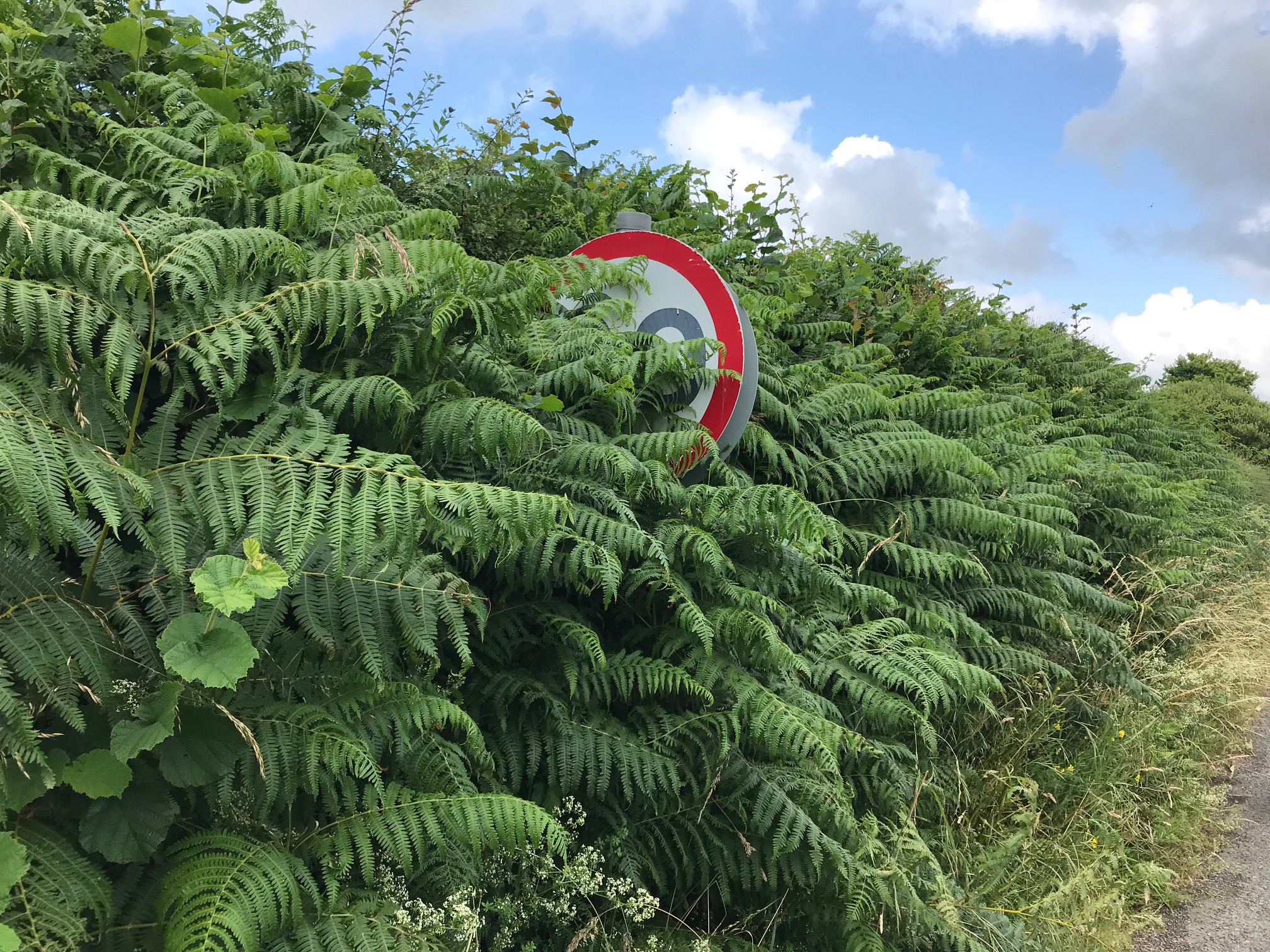
Irrelevant photo: From the Department of Useful Road Signs comes this beauty.

If you’ve engaged the god’s interest, you can now ask the god to act for you, and you’ll want to name your intended victim. But you won’t want to use the word victim. You’re the person who’s been wronged here. Remember that. All you’re seeking is–um, no, let’s not call it revenge. Let’s say you’re trying to set the world back into its natural order. 

If you don’t know the person’s name, you’ll want to identify them as best you can. One tablet that’s been found says, “whether man or woman, boy or girl, slave or free.” Another says, “Whether pagan or Christian,” which raises an interesting translation issue, since pagan didn’t start to mean non-Christian until the fourteenth century. 

Once you’ve got your target sketched in, you can talk about the crime, and curse tablets, for whatever reason, lean heavily toward theft. So name what was taken, and possibly the place where it was taken. 

Then you get to the important stuff: What are you offering the god in return? Because even gods have to make a living. One tablet that’s been found offered half the stolen money. Another offered a third. 

Once you’ve made your offer, it’s time to talk about what you want the god to do to your target. Most people asked for the thief to suffer so much that he or she would pay back what was stolen, and a lot of the suffering they requested involved health. One tablet asks for the target’s (as the article I found this in puts it) “bodily functions to cease from working” Another asks that the thief “not eat, drink, sleep, sit, lie, defecate, or urinate.” 

But if you like, you can stop fooling around and ask that they just go ahead and die. It’s your curse tablet. Most of us don’t believe in this stuff anymore, so you don’t need to act responsibly.

Of course, if the thief returns your property to the temple, all this horrible stuff stops and you give the temple whatever you promised the god. Because gods need intermediaries, and temples are good at that.

Not everyone who wrote a curse tablet wanted a happy outcome, though. One tablet said the thief would have to sell 8.6 liters (that would’ve been a modius) of “cloud and smoke” to break the curse. Which isn’t easy in any age. 

A warning: As a general rule, if you’ve asked for the thief to die you won’t get your property back.


Once you’ve written your curse, what do you do with it?

First, you’ll want to either roll your curse up or fold it so that only the god can read it. Or archeologists from later centuries–they seem to manage. Which may demonstrate that they’re gods. 

You can also pierce your curse with nails. I’m not sure what that demonstrates, but it’s a nice bit of drama.

Then you can leave your curse at a temple or in a spring or river, or you can bury with some dead person who’ll be happy to deliver it, since they’re headed off to lands where, presumably, the gods have registered their mailing addresses.

Okay, burying tablets with the dead was rare in Britain but it wasn’t uncommon in the Mediterranean. Still, if you really, really want to do it that way, there is a precedent.

You can also bury it in a house or a shop. Or if you want your enemy’s chariot to wreck during a race, you can bury it in the amphitheater. Or since we’re using the present tense here, you can bury it at a busy intersection.


What do we learn from curse tablets?

We learn that a lot of stuff got stolen, and that a lot of it was stolen from the public baths. The sample may be skewed, though, by a collection of tablets that were found in Bath. That’s a British city with a hot spring where the Romans built–yes, you guessed it–baths. The local god was a combination of the Roman Minerva and the pre-Roman Sulis, and the spring became a popular place to leave curse tablets.

The Bath tablets leave me thinking that in an age before lockers were invented, people lost a lot of belongings at the baths. 

Admit it: You’d wondered about that, didn’t you? Here’s a place where everyone shucks off their clothes and jumps in the water. And what happens to those clothes while no one’s inside them? Does anyone look after them?

And while we’re wondering, didn’t the victims of those thefts feel a bit naked walking home without them?

But it wasn’t just clothes that got stolen. It was also  jewelry, gemstones, money, and household goods. 

Who brings household goods to the baths? I don’t know. Maybe Sulis’s sacred spring had become known as a place to deal with theft in general, not just theft from the baths. 

We also learn about the languages that were spoken in Roman Britain, because although some of the tablets were written by specialists many were scrawled by ordinary people, using whatever language or mix of languages they spoke, because the Roman conquest didn’t wipe out Britain’s Celtic languages, it just added some new ones: Latin, predictably, but also Greek and the assorted languages of other Roman provinces. From the continent came Germanic and Celtic languages (there were multiples of both); from the Mediterranean came Semitic languages (anyone ever heard of Palmyrene?). 

These all left their traces on curse tablets.

The Bath tablets date from the second to fourth centuries, and most were in British Latin, showing the places where it diverged from Latin Latin–the words it had incorporated from other languages, the places where the grammar and spellings had wandered off in new directions. 

Two tablets that have been found used Latin letters to write in a Celtic language, possibly Brythonic, the language of one of the two Celtic groups that settled in Britain. Brythonic’s believed to have been an unwritten language–except, presumably, for these lone curse tablets. Another tablet used the Greek alphabet to write in Latin, possibly because Greek added a bit of extra magic to the words. 

If you really want a bit of magic spin, though, you can write your tablet back to front, as some people did. It’s no trouble for a god to read that, but it does make the archeologists work for their pay.

The tablets also show that it wasn’t just priests, scribes, and the upper classes who wrote Latin. Or who wrote at all, although a few tablets have been found with scratches that imitate writing–presumably made by people who couldn’t write but spoke the curse as they made the marks


Cursive

The scripts that people used on the tablets varied, but most were written in–yup–cursive, an everyday script used for documents and letters, which is–to simplify a bit– the ancestor of modern European handwriting. The words were rarely separated, although breaks between them were sometimes marked with points–and sometimes weren’t. 

Punctuation wasn’t a major issue for either gods or scribes.

To my disappointment, the word cursive has nothing to do with the word curse. It’s from the Latin word for to run: The letters in cursive handwriting run together. The origin of the word curse is uncertain. It’s late Old English, and there’s no similar word in Germanic, Romance, or Celtic languages.