
As you may have read when the UK experienced a series of racist and anti-immigrant riots earlier this month, Elon Musk predicted that civil war was inevitable in Britain.
Relax, kids. Bad stuff did happen, but a civil war it ain’t, and whatever else Musk is, he’s not a political sage.
What did happen?
Bad stuff, genuinely. It all started when with a knife attack on a dance class in which three young kids were killed and eight people were injured. The attacker was arrested, and a social media campaign claimed he was a Muslim immigrant. He was neither. He was the Welsh-born son of Somali Christian immigrants.
If anyone knows what his motivation was, they haven’t gone public with it. The best guess going is that he’s crazy, and craziness is an equal opportunity employer, but good luck convincing someone of that if they’ve put their bet on immigrants being the cause of all the country’s problems. Social media blamed an immigrant with a vaguely Muslim sounding (and incorrect) name, so folks got fired up. It was all the fault of immigrants and of Islam. The government was withholding the truth. Somebody had to do something!
The first something they did was riot in the town where the stabbings had taken place, attacking a completely unrelated mosque, burning a police van, and fighting the police–and they had so much fun there that they, or versions of them in other towns, went on to riot in other cities, attempting to burn down buildings housing refugees while people were inside. They also attacked mosques, minority-owned businesses, cars, Muslim gravestones, police, libraries, reporters, photographers, camera crews, individuals who weren’t white, and whatever else was available, including trash cans.
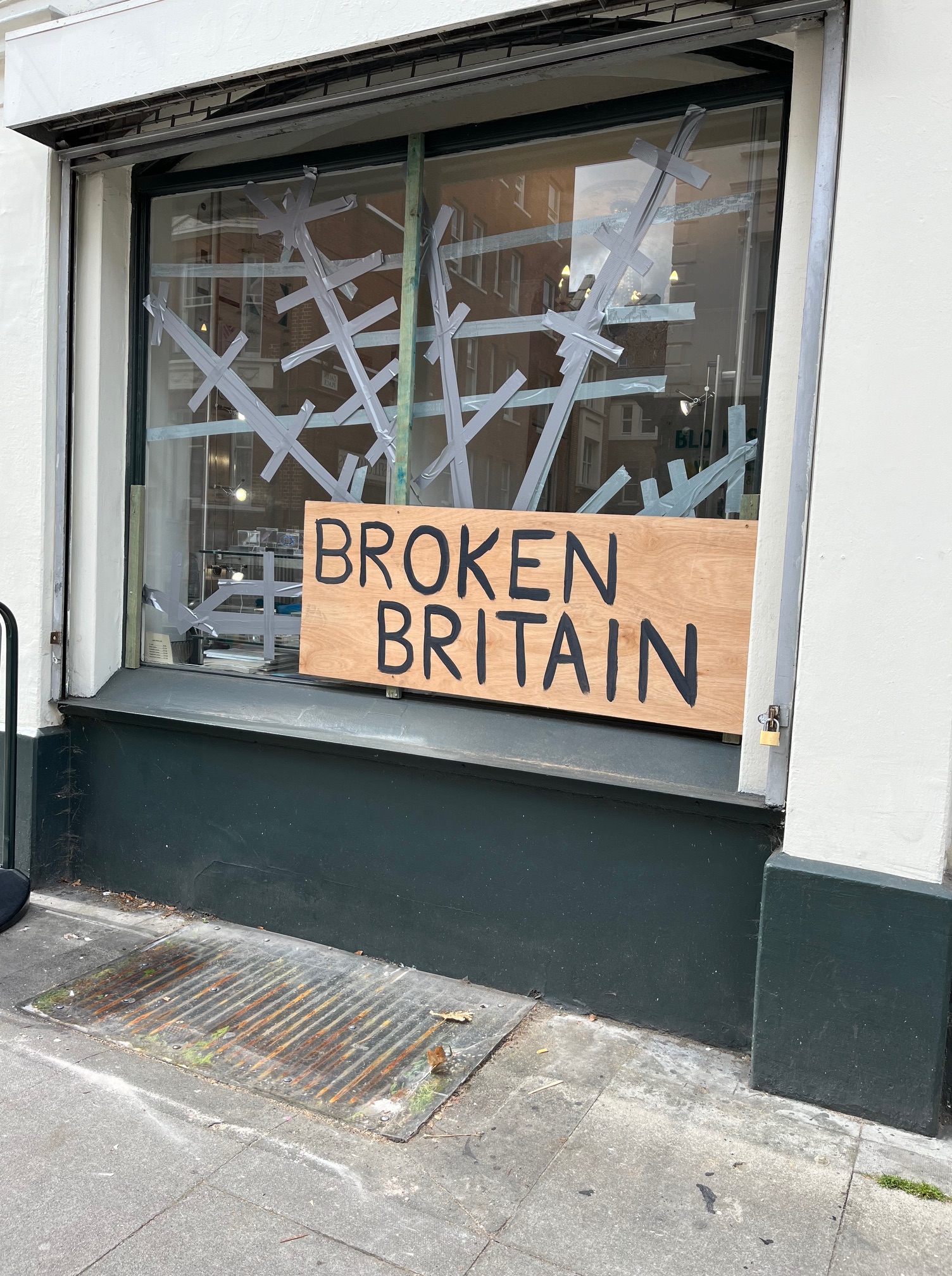
I saw this broken window and sign in London shortly after the riots ended. I tried to go in and ask what they meant (with my still-American accent, no one’s surprised if I seem clueless), but they were closed. The slogan appeared when David Cameron, the first in a string of Conservative Prime ministers, claimed he was going to fix Broken Britain. We could argue about whether it was, in fact, broken, but he and the Conservative prime ministers who followed him have beyond doubt left it shattered. So I’m genuinely not sure what the thinking is behind this particular sign.
In places, the rioters came with helmets and metal bars, wearing balaclavas, and generally ready for to wreak havoc. An article in Foreign Policy reports rioters yelling, “Go home,” at anyone with brown skin, or more generally, “We want our country back.”
The riots have gotten most of the publicity, but they’ve gone along with a fivefold increase of threats to Muslims–death threats; rape threats; generalized hate messages–and a threefold increase in outright hate crimes against Muslims. (I’m focusing on those because statistics are available, not because threats and attacks are only against Muslims.) Predictably, many Muslims and people of color report not feeling safe in public–which was, of course, the point. An anti-racism activist, Nazir Afzal, said, “This feels targeted against people who are black and brown. I can’t have a conversation with any person of color at the moment without finishing with: ‘Keep safe.’ ”
What’s the background?
The riots make no sense until you look at the background: we have entire dump trucks filled with politicians happy to fuel anti-immigrant sentiment. In fact, they’ve built their careers on it. They’re from both the Conservative Party and, to its right, the new Reform UK. I’ll give you just a few of examples or I’ll get too depressed to go on tapping the keyboard:
- Robert Jenrick, who’s in the running to lead the Conservative Party, called for the immediate arrest of anyone who shouts “Alluhu Akbar” at a protest. Betting sites give him the best chance to win. So does the Telegraph.
- The former home secretary Priti Patel got a lot of press for accusing “lefty lawyers” of keeping the government from cracking down on immigration. More recently, she’s accused the Labour government of “two-tier policing,” in which police are harder of whites than Blacks.
Yeah, I know, but if you lot at the back of the room can stop laughing, please, we’ll go on.
- A Conservative police and crime commissioner in Hampshire said the rioters were only “upholding British values.”
Et cetera. They’ve shifted the conversation around immigration so far to the right that the Labour Party is afraid to say, Hey, this country needs immigrants. They contribute to its economy and culture, even though it’s true and would resonate with a substantial number of voters.
Who took part in the riots?
Some participants were–as the papers put it cautiously–linked to the now-defunct English Defense League, which held that Muslims couldn’t be truly English. Some were Nazis, complete with swastika tattoos and straight-arm salutes. Others may have been football hooligans–a category of troublemaker I’d never heard of before I moved to the UK. They’re basically guys who like football and like a fight, so wouldn’t it be efficient to combine the two? I’ve been told–and it does seem to be true–that the British will organize a club for just about anything, and this is an example: they organize themselves to go out and get in a fight with people who support an opposing team.
So here was the prospect of a fight. Whee. Let’s go join in.
Are football hooligans inherently racist? A government site says no, they reflect the communities they come from, so some are and some aren’t.
Not all the rioters were there because they’re racists or hate immigrants, though, and I find that oddly reassuring. They wandered by, saw a riot, and were angry enough that rioting seemed like a great idea, so they joined in. Or saw looting going on and wanted some stuff. As one participant put it, “People just like rioting.”
Listen, fourteen years of Conservative governments have shattered not just the country but a lot of people’s lives. Let’s not be surprised if they’re angry. That wasn’t the cause of the riots, but it does seem to have been part of the picture.
Social media is another part of the picture, and was used in two ways: first to stir people up in general and second to let people know about specific riots. So although the articles I’ve read talk about the British far right as fragmented and can’t pinpoint any organizations responsible for the riots, it does sound like some non-organizations were effective in calling their non-members together.
According to a former head of MI6’s Russia desk, Russia was involved in instigating the riots. How accurate that is I don’t know. He’s a former-head, not a current one. Tuck the thought in your pocket as a possibility, not a fact.
Counter-demonstrations
The day after the first riot, in Southport, neighbors from multiple backgrounds came out to clean up, to rebuild and raise money to rebuild the mosque that had been attacked, and to show solidarity. Any number of them were quoted as saying that the rioters weren’t from around there.
There’s your first shred of hope for the day.
In Liverpool, an imam prepared for an expected riot by stocking up on burgers, chips (that’s British for french fries; you’re welcome), and cold drinks. About thirty people showed up ready to riot and were met by a couple of hundred who were there to protect the mosque–again, from many backgrounds. The imam crossed over to the thirty, handing out food, drinks, and when possible, hugs. Some people refused to talk with him, but with some he managed a dialogue.
There’s your second shred of hope for the day.
The rioting lasted about a week and seems to have been stopped by a combination of arrests, with threats of heavy sentences, and large anti-racist counter-actions. There’s your third shred of hope.
The anti-racist demonstrations really took off after it became known that a list of organizations supporting refugees had been circulated. The organizations on list either were or were believed to be targets for the next set of riots. Many of them were lawyers, and given Suella Braverman’s campaign against “lefty lawyers,” it wasn’t not irrational to think they’d be a target.
Thousands of people showed up in multiple cities to protect them.
Your fourth shred of hope is this: On Twitter, someone called RS Archer (@archer_rs) wrote, “I’m a lurking member of some far right discussion forums and they are VERY unhappy. They lament the lack of public support and recognise the fear generated by the high number of arrests and swift convictions. Also a lot of anger toward Farage [the most visible politician in Reform UK] who is seen as abandoning them.”
Who is Archer? No idea. Does he know what he’s talking about? I can’t say. It’s a shred. I won’t tell you it’s more than that, but I’m not above being glad of what it might tell us.
But with or without that fourth shred, sorry, Elon, we don’t have a civil war today and my reading is that we’re not on the edge of one either. We do have some ugly stuff happening, and we do have a problem, but I think we need to discuss the definition of civil war. Once we work that out, we can talk about what it takes to start one.
Or not. I don’t believe we have the ingredients in stock, but even so I don’t want to hand you a blueprint.
 Notes from the U.K.