British bonding rituals: the weather

We had a string of sunny, frosty mornings in late November and early December—the kind of morning where we all greet each other by saying either how beautiful or how cold it is.

British law mandates that whichever statement you hear, you agree with it. Or if possible, amplify it.

When we first moved here, fools that we were, we’d sometimes play the Minnesota macho card. The front of the card is a scene of snow piled up past a car’s roof and the back is a list of wind-chill factors and absolute temperatures in International Falls, Minnesota, which (ignoring Alaska, where it gets colder) calls itself the icebox of the nation.

Relevant photo: These flower in the winter. That's how cold it gets. I'm pretty sure they're viburnam.

Relevant photo (it does happen sometimes): These flower in the winter. That’s how cold it gets. I’m pretty sure they’re viburnum.

International Falls is right across the Rainy River from Fort Frances, Ontario, and I’ve never been there. I lived in Minneapolis, which is 294.2 miles away. Pay attention to that .2, because it won’t come up again. Most of those miles run north/south, so weatherwise (and in many other ways) living in Minneapolis is not the same as living in International Falls. According to the great googlemaster, they’re a four hour and thirty-eight minute drive apart. If you don’t stop for coffee and pie. Or a hot beef sandwich.

Is anything more American than a hot beef sandwich?

But just because I’ve never been in International Falls, is that any reason not to claim its weather as my own? We shared a state. Mi temperature es su temperature, as people who know almost no Spanish occasionally say apropos of not very damn much, leaving me wondering what I’m supposed to say back, although they’re never talking about temperatures, they’re talking about casas.

When I explain where I used to live (because no one knows where Minnesota is, even when they think it’s rude to admit it), I usually say it’s in the middle of the U.S., right up on the Canadian border, and as I hear myself talk I think what a liar I am, although what I’m saying is both true and not true. Minnesota is on the Canadian border. Unfortunately, that’s not the same as me being on the Canadian border, although when that wind blew down off the Canadian prairies it felt like I was.

From this distance, though, 294 miles doesn’t seem like much. Minneapolis got cold enough to frost my eyelashes if I drove the warm air upwards by covering my nose and mouth with a scarf, which I usually did. (People who object to the niqab, take note, please.) The first time that happened, I had no idea why my lashes were clinging to each other when I blinked, and once I figured it out I was afraid they’d freeze together and I’d never see again.

That story’s an example of what Minnesota macho is not. Minnesota macho insists that in temperatures like those there’s no reason to wear a hat. Or gloves. Or to wear a jacket. Minnesota macho says it’s beautiful out, let’s go walk five miles because weather like this makes us who we are.

Weather like that did make me who I was: I was a failure as a Minnesotan. In January, I was just a small heap of clothes struggling to get back indoors as fast as I could. The only glimpse of human being you saw under all that cloth was my eyes with their frosted lashes.

When we first moved to Cornwall, though, it was hard not to turn ourselves into later-day Paul Bunyans.

“Cold?” we’d say. “In Minnesota, it’s like this in June.”

“Minnesota only has two seasons,” we’d say. “Winter followed by a week of bad sledding.”

“It got so cold,” we’d say, “that on a clear day the moisture would condense out and freeze so the air sparkled.”

That last statement is true. It was beautiful, in a horrifying sort of way.

J.’s still so traumatized by our bluster that she prefaces any complaint about the cold by saying, “I know you two are Minnesotans, but—.”

It’s a wonder she still talks to us.

Eventually we learned: Shut up about Minnesota. People are cold. Hearing that it’s colder in a state they never heard of before they met us won’t make them any warmer. And we were being invited to participate in the essential British bonding ritual, which is complaining about the weather. We should have been thrilled. What could be a more authentically British experience?

On Dec. 3, the Guardian wrote about weather alerts and “severe cold weather.” How bad was it expected to get? Why, below freezing.

So I’m going to play by the rules here and swear it’s been terrible. In fact, it got so cold the other day that I took my gloves out of my pockets. Then I put them on my hands.

All you Minnesotans, stop laughing.
Do the British really talk about the weather?

Quick answer: Yes. Right now, the village is talking about the weather because it’s spring. Or summer. Or almost summer.

Is this different than what happens in the winter? It’s not. We always talk about the weather. Because we’re—.

Well, no, we’re not all British, but even those of us who aren’t live in Britain, and it doesn’t take long to learn that the way to make a bit of quick human contact it to talk about the weather. And we’re social beings. We need contact. So we talk about the weather.

What do we say? Well, saying a nice day’s nice is acceptable, but moaning’s got more punch. Because no matter how much the people I know glory in a beautiful day, underneath it all they live on a wet island and it would be unpatriotic to forget that. They believe in cloud, in rain, in damp. Anything else just flits across the windshield of life and is gone. Whatever replaces it will be water-based.

Besides, moaning allows for jokes, even if they’ve all been made before. A beautiful day? Happiness? Where’s the laugh there?

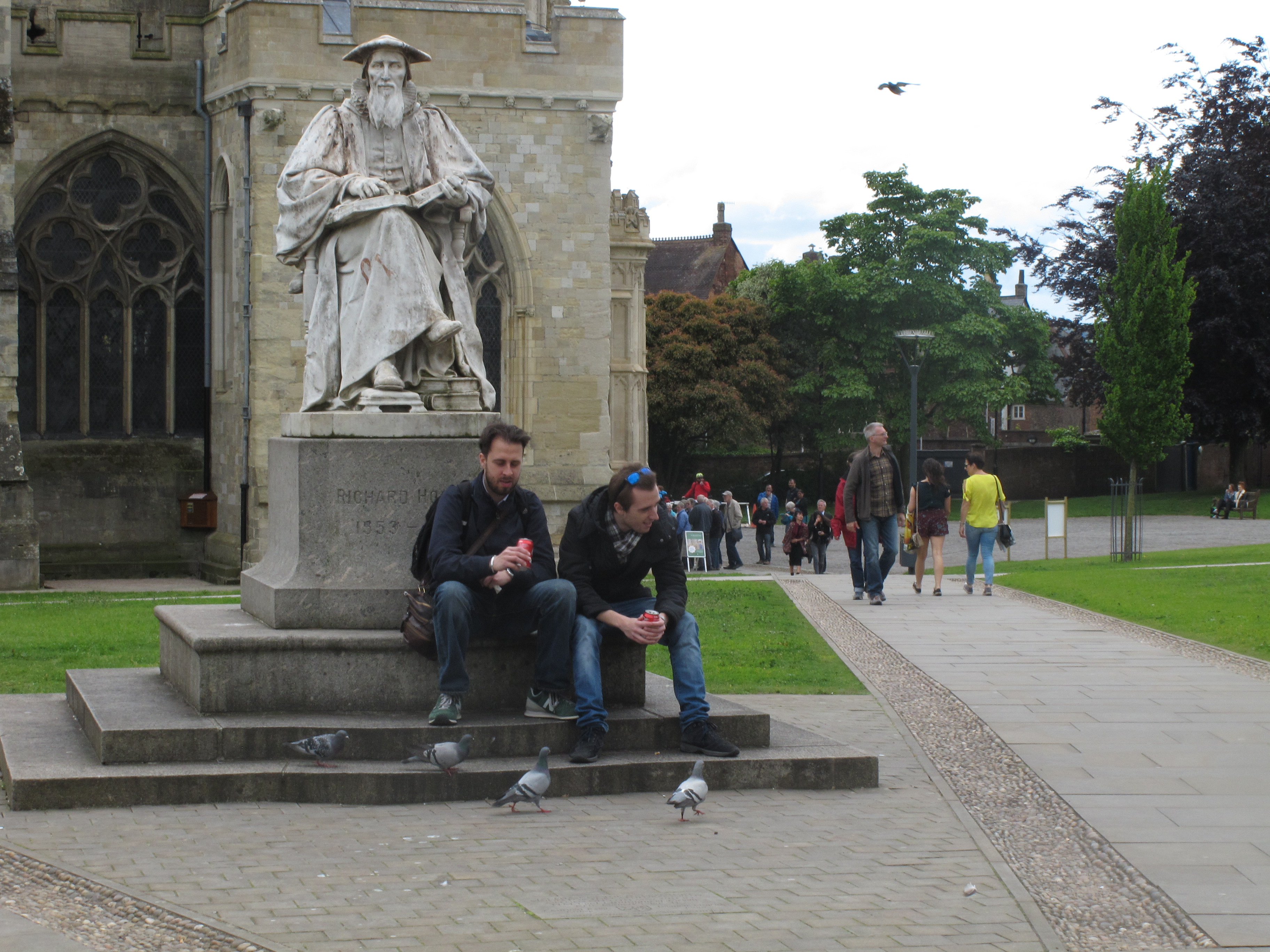
A rare relevant photo: people sitting outside Exeter Cathedral, in front of a statue of someone whose first name is Richard.

A rare relevant photo: people sitting outside on the Exeter Cathedral close, in front of a statue of someone whose first name is Richard. Oh, okay, it’s Richard Hooker (1554 – 1600). He was a priest. If he swings that foot, he’s going to kick someone.

According to Kate Fox, whose book Watching the English I haven’t quoted in entirely too long, moaning is an English (and by extension, and I hope I’m not wrong here, British) passion. She admits that the English aren’t the only people who moan but describes a form that she believes is uniquely English: “a sort of grumpy and apathetic stoicism; complaining…in a resigned manner, without any real expectation that things could be improved.”

And the weather’s perfect for that. We could complain about the government but we could—and surely we eventually will—dump the current one and complaining about it might nudge us toward action. But the weather? What can we do about that? Moan. Laugh. Put on a raincoat.

As Fox understands the way the English talk about the weather, people aren’t really talking about the weather when they’re talking about the weather. What they’re doing is talking. Finding a way to make contact. The weather’s an accepted channel but only borderline relevant to what’s really happening.

So moaning about the weather brings together two national passions. Or quirks. Or—well, I believe the technical term is whatever.

How does that work in practice?

The other day, G. and I saw each other on the road early in the morning. I was walking the dogs. She was walking herself. We traded a few words about how beautiful the day was, and what a gorgeous part of the day the early morning is. We were both happy, or at least we gave a damn good impression of it.

Before long, we were trading updates on our aches, our pains, the various ways we’re less able than we once were, and she mentioned the percentage of over-50s in Britain who have osteoarthritis. It might have been 70% or 85%. In fact, it might have been people over 60, not 50. But it involved numbers, that much I’m sure of, and they were ear-catching ones, even if they didn’t catch well enough to stay with me.

Don’t you just love how much you learn here?

Her point was—and I’m paraphrasing wildly, because she didn’t go all pseudo-poetic about it—that the damp draws arthritis out of human bones the way the sun draws sprouts out of seeds. So Britain breeds arthritis. We exchanged a few more bits of ache-and-pain news and went on our way fortified by the knowledge that we’re doomed. We were oddly cheery about it, and I suspect that’s a British thing as well.

Then I drove to Exeter, where I had some errands to run before I turned around and drove home without passing Go or dropping in on the friends Wild Thing and I usually see when we’re there. And I noticed something: This damp island is a place where people sit outside a good chunk of the year, and look forward to it. It’s a place where a sizable chunk of the population thinks of the outdoors as one of the places they live their lives, not just a place they hustle through between work, home, and grocery shopping.

To someone who spent forty years in Minnesota, that means the climate’s kind. Yes, it’s wet, but it’s not trying to kill you all winter. And while we’re at it, it’s not thinking about whether to give you heat stroke during a good part of the summer. I exaggerate very slightly, and only about the summer. The winter? It can kill you and if seasons had emotions it would be happy to. Leaving the house during a Minnesota winter is like suiting up to step out of the space station. I used to think I’d be a completely different person if I could just grab a jacket and walk out the door.

Here In Cornwall, even in the winter, people will sit outside. Not as many of them as in summer and not as often, but on a dry day it’s possible and people do it. One of the cafes in the village sets out a stack of blankets for people to wrap up in, and even if we look like patients at a pre-antibiotic TB sanitarium, we soak up some sun—or at least some not-rain—and feel better for it.

And still, the nation’s core belief is that the climate’s miserable. And bad for us.

I get swept into that, even though I don’t really believe it. Because at the same time I sort of do. We’re social creatures. I’ve been captured by the thinking around me. But for someone who’s officially miserable about the weather, I’m surprisingly happy. I’ve turned out to be the same person I was in Minnesota, but in some non-weight-related way I’m a lighter version of her.