
Orkney isn’t the first place that comes to mind if you’re looking for the center of Britain. It’s small, it’s an island, and it’s way the hell up north in a country whose political and cultural center is way the hell down south. What’s more, it’s sitting in the middle of a lot of water, which is what islands like to do, and the currents around it are fierce. But in Neolithic times, it was a center–maybe the center. It originated a type of pottery called grooved ware that spread across Britain and was the must-have thing of the late stone age. It built the first henges–those stone rings with ditches around them that dot the British landscape–and they also spread south. And yes, they did that before Stonehenge.
The Neolithic
Who were the people behind all that? They arrived, who knows why, from mainland Scotland, bringing their domesticated animals, their grain, and their knowledge of how to farm. Like any early farmers, they would’ve supplemented their diet with whatever they could gather, hunt, or fish. They replaced (or possibly absorbed; I don’t know) a small population of hunter-gatherers who’d reached the Orkneys first, and they set up a society successful enough to last through 60 or 70 generations and to build monuments that are still impressive today.
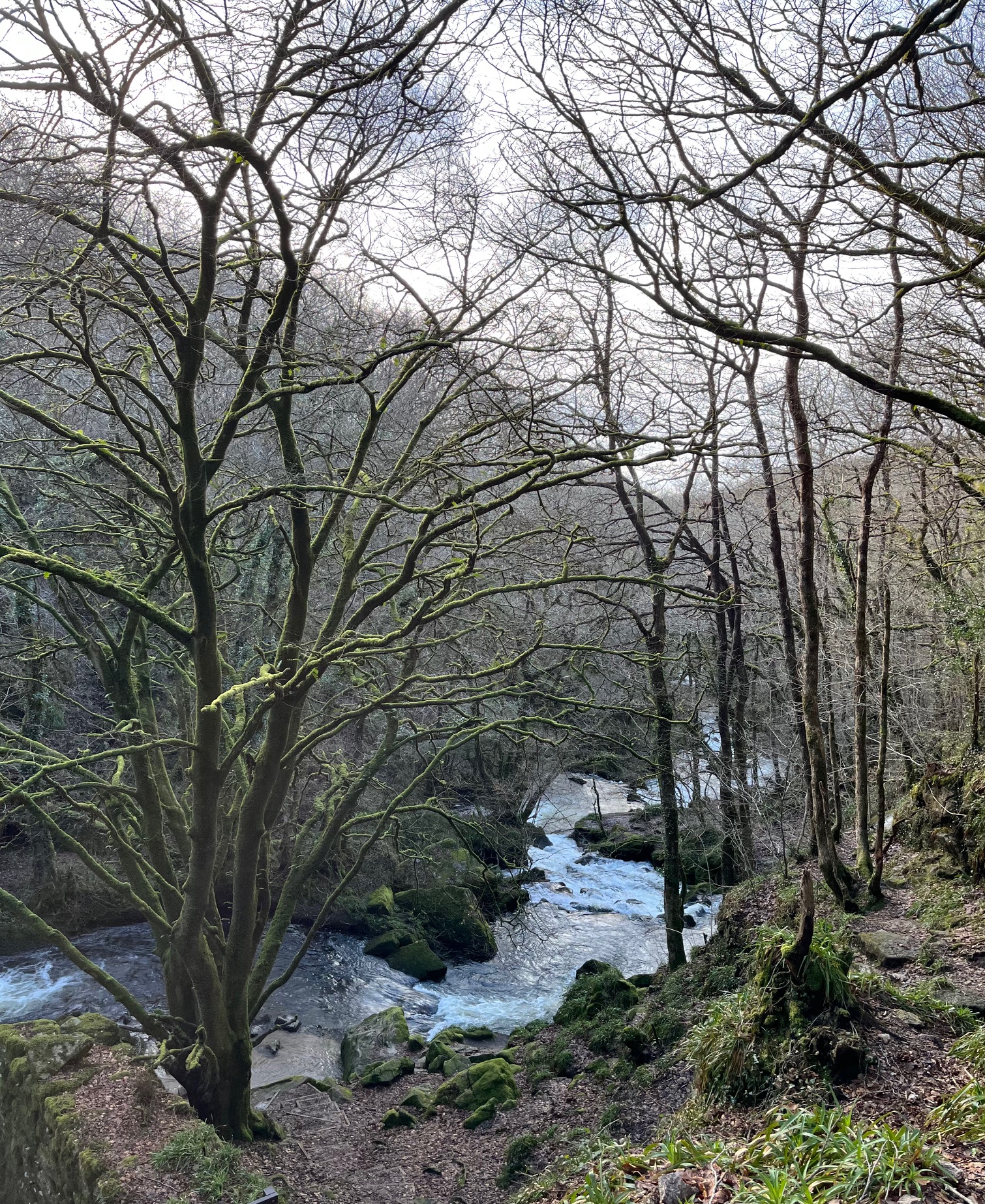
Deceptive photo: This isn’t from Orkney. It’s from Cornwall–the opposite end of the country. Sorry. I’d rather cheat than steal other people’s photos.
Their lives wouldn’t have been easy. Most people who survived childhood died in their 30s and few lived to be 50, but somehow or other this relatively small group of people found time to build massive henges and tombs as well as make that elegant pottery.
Initially they lived in isolated farmsteads but grew into a tribal society, possibly with an elite ruling class, but that implies the possibility that they might’ve lived without one. Until we hear something definite, it’s your choice. Personally, I’ve had it with ruling elites and I’m going for an egalitarian structure.
We know a lot of this because for the past 20 years archeologists have been excavating the Ness of Brodgar, an Orkney site that was used by those 60 to 70 generations of late Stone Age residents that I mentioned a paragraph or three back. Or if it makes them sound more modern, Neolithic residents. Now the archeologists are about to rebury everything they dug up so painstakingly, and eventually I’ll get around to explaining that, but first, how long does it take to get through 60 or 70 generations?
About as long as it took to get from the Norman Invasion of England to last Monday afternoon. So offhand I’d say they were more reliable than we are today.
The Ness
The Ness of Brodgar–that bit that’s been explored–covers six acres and only the top level has been excavated. It may be 5 meters deep in places, with newer structures on top of older ones. Tempting as it must be to find out what’s underneath, the only way to do it would be to destroy the top layer and the archeologists have held back. By covering it up, they’ll leave it to later generations of archeologists who, with luck, will have the tools to explore it without wrecking what’s on top.
There’s another reason to cover it up: the kind of stone it was built with erodes with long exposure to air.
In the layer they have excavated they’ve found dozens of buildings, including temples, outbuildings, and kitchens, all linked by paved paths and surrounded by a wall. It’s built on a narrow bridge of land, so you wouldn’t have been able to go around it. You either went in or you turned back.
Some of the stones, although not whole walls, were painted.
Did I mention that it rubs elbows with two impressive stone circles, the Ring of Brodgar and the Stones of Stenness? Impressive as they are, though, archeologists talk about them as peripheral. The temple complex–the Ness itself–was the most important piece of work. Or as one archeologist put it, “By comparison, everything else in the area looks like a shanty town.”
Archeologist Colin Richards describes it this way: “The walls were dead straight. Little slivers of stones had even been slipped between the main slabs to keep the facing perfect. This quality of workmanship would not be seen again on Orkney for thousands of years.”
Fans of the Ness say it rivals Hadrian’s Wall and Sutton Hoo for for both size and sophistication. Archaeologist Nick Card warns us never to “underestimate our Neolithic ancestors and what they were capable of.”
The Ness doesn’t seem to have been a settlement. It was a gathering place–a ceremonial center–for people from across the Orkneys.
How come Orkney just turned into a plural? It’s made up of some 70 islands. About 20 of them are inhabited these days. So we’re talking about a group of scattered people who would have come to the Ness to exchange ideas and objects, to hold rituals and ceremonies (no one has a clue what their belief system was), and to celebrate. Or as one article put it, to party.
And what happened next?
A lot of stuff, but since this is prehistory we don’t know most of it. Around 2,300 BCE, some thousand years after building began, the place was abandoned, apparently after a big feast–more than 600 cattle were slaughtered–and the Ness hung out a Closed sign.
Did a new religion take the old one’s place? Did power shift, drawing everyone’s attention to some other location? Can I think of a third possibility to round out the rhythm of the paragraph? Dunno, dunno, and no.
By the late Iron Age, the Orkneys had become part of the Pictish kingdom, and by the close of the Pictish era Celtic Christian missionaries began to show up. Then the Vikings came and, as WikiWhosia has it, “The nature of this transition is controversial, and theories range from peaceful integration to enslavement and genocide.” Which is one hell of a range.
Whatever happened, Norwegians–or Vikings if that’s a more familiar way to think of them–settled in the Orkneys and farmed and pretty much took over. Christianity packed its bags and left. Harald Hårfagre–Harald Fairhair–annexed both the Orkneys and Shetland, making them an earldom. We’re going to dance through this lightly and get out fast, but we can probably learn a lot about the culture from the names of a couple of rulers: Thorfinn Skull-splitter; Eric Bloodaxe.
See why we’re leaving?
According to the Orkneyinga Saga, the islands became Christian in 995, when Olaf Tryggvasson summoned the earl, Sigurd the Stout, and said, “I order you and all your subjects to be baptised. If you refuse, I’ll have you killed on the spot and I swear I will ravage every island with fire and steel.”
So Sigurd said, “Yeah, what the hell, I always wanted a bit of water sloshed on my head. What do we eat when we’re Christians?” and that was that. Or to tell the story a different way, details about the islands’ conversion to Christianity are elusive.
Fast forward to the fifteenth century, when the king of Norway, Denmark, and Sweden (we’ll call him King I) used Orkney as a guarantee that he’d pay his daughter’s dowry when she married the king of Scotland (that’s King II). So far, so good, but despite being the king of three countries and a whole raft of islands, King I was broke and he didn’t pay, so presto change-o, King II got the Orkneys, which became Scottish.
That’s feudalism for you. The rich play chess, using the land and its people as game pieces.
You see what I mean about ruling elites?
The shift brought an influx of Scottish settlers and the islands are Scottish to this day, but have retained a lot of Scandinavian influence.
 Notes from the U.K.