
Kew Royal Botanic Gardens is celebrating the queerness of nature this month–“the diversity and beauty of plants and fungi,” as they put it, especially those that “challenge traditional expectations.”
They’re messing with us, right?
Well, no. Not unless we’re the sort of people who accuse the natural world of political correctness when it doesn’t meet our expectations. Included in the Queer Nature festival are:
The Ruizia mauritiana, which grows male flowers when it’s hot and female ones when it’s cool
Citrus trees, which can switch between asexual and sexual reproduction.
Avocado trees, which flower twice, the first flowers being functionally female and the second, functionally male.
And fungi, which have worked out thousands of ways to reproduce.
Thousands? Apparently. What else do you have to think about if you’re a fungus?
You might want to see the exhibit soon, before someone decides it’s unnatural and shuts it down.
*
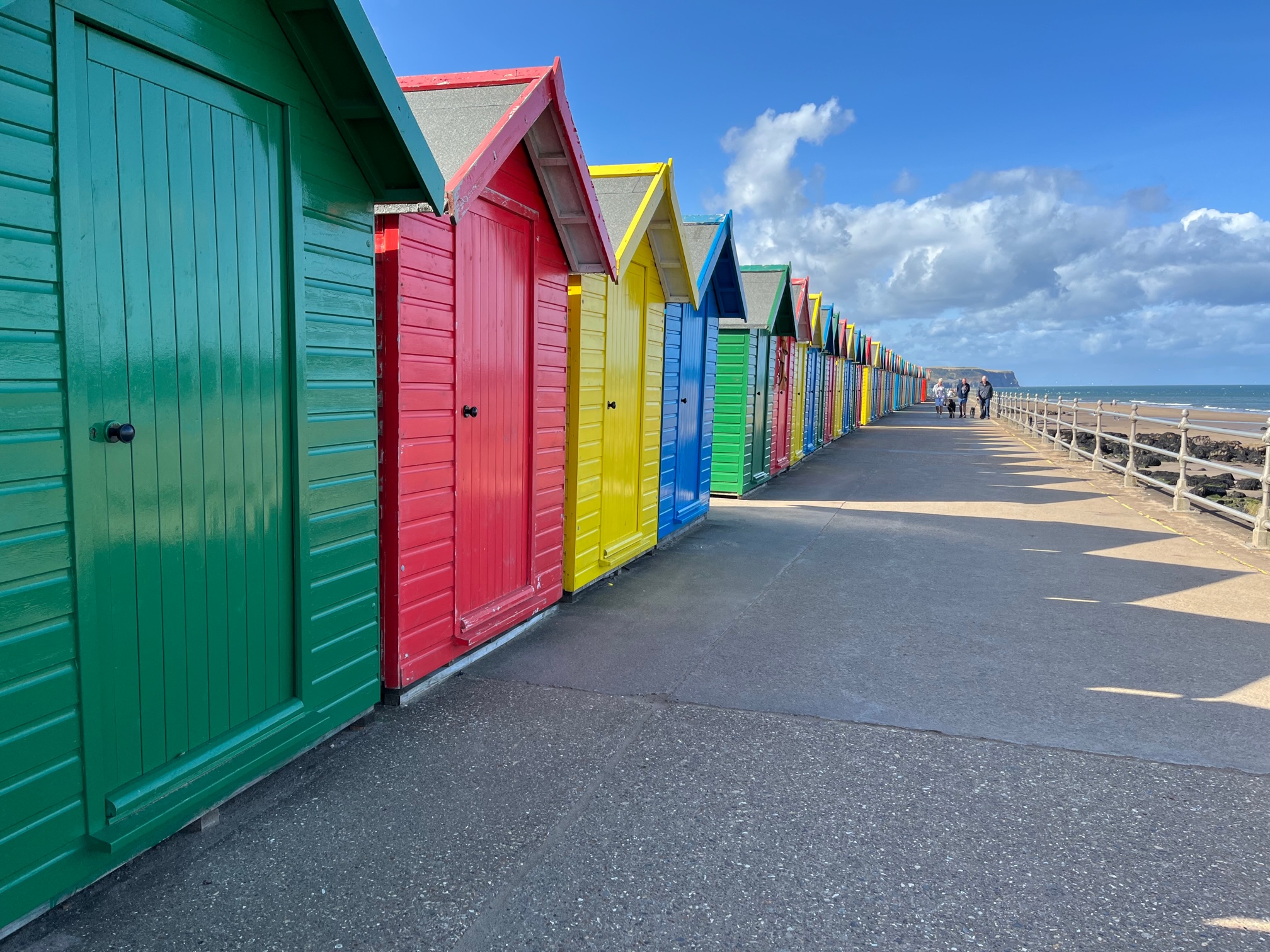
Irrelevant photos: Beach huts near Whitby. What are beach huts? They’re a British thing. A very British thing. If they make no sense to you someone other than me may have to explain them to you. But aren’t the colors wonderful?
Speaking of nature and the unnatural, someone cut down a much-loved sycamore that was growing along Hadrian’s Wall, in Northumberland, in a spot that was named after it: Sycamore Gap. The tree was some 300 years old.
It’s not clear yet who cut it down or why, but when someone planted a sycamore sapling a few yards away from the stump, “to restore people’s faith in humanity bring a smile back to people’s faces, and just give them a bit of hope,” the National Trust, which owns the site, uprooted it. It’s a world heritage site, they said. It’s an ancient monument. You can’t just run around planting hope without permission from the proper authorities. It might mess with the archeology.
There may well be some solid reasoning behind this, but they don’t seem to have communicated it yet.
They’ll plant the sapling someplace else.
However. It turns out that sycamores can be coppiced–cut down so that shoots regrow from the stump. So this one may regrow, although it’ll look different. And semi-relevantly, sycamores aren’t a native three. They were brought to the country some 500 years ago. Or else they were brought by the Romans some 2,000 years ago. Take your choice.
Correcting history
A former MP is–or may be–threatening to sue the University of Cambridge because a historian associated with the university named her as a descendant of the people who enslaved his ancestors. One article says she “threatened . . . legal action.” Another article says she “appears to threaten legal action.”
So we don’t have any agreement on how solid the threat is, but either way she complains of being singled out, since other living relatives went unmentioned. She accuses the university of not protecting her privacy.
She does make clear that she finds slavery abhorrent, so we have to give her credit for being forward-thinking.
The work of the historian, Malik Al Nasir, documents the business empire that linked plantation slavery to shipping, banking, insurance, railways, distilleries, and the sugar trade. It’s been described as ground-breaking.
Correcting the interview list
Almost 20 years ago, someone went for a job interview at the BBC and ended up on the air–not being interviewed for the job but as an IT expert who the interviewer asked about a legal dispute between Apple records and Apple computers.
How’d that happen? The applicant, Guy Goma, was in one waiting room and the expert, Guy Kewney, was in another. When someone walked into the wrong waiting room and asked for Guy–well, Guy responded. And panicked his way through what must have been the weirdest job interview of this life.
The clip seems to be immortal–it has 5 million views on YouTube alone–and Goma’s gone public to say he should be getting some royalties. I haven’t seen a comment from the BBC, but a new trailer for a BBC show, Have I Got News for You, shows him being mistaken for not one but three panelists as well as the host.
Did he get the job? I don’t think so and I can’t help imagining that someone said, “Listen, if he couldn’t even be bothered to show up for the interview, forget it.”
Correcting a death notice
A woman in Missouri applied for financial aid to help with an internship program and discovered that she was dead, at least officially. The financial aid office told her to withdraw immediately–either from the program or the request for aid, it’s not clear which, but if you’re dead I’m not sure it matters.
The problem involved her social security number, so the woman, now known as Madeline-Michelle Carthen, called the Social Security Administration, which agreed that she seemed to be alive and told her to visit a social security office with some convincing form of i.d. She did, and she got a letter acknowledging that she was, in fact, alive, but over the next 17 years she was turned down for a mortgage, lost jobs, had her car repossessed, and lost her right to vote, all on the grounds that she was dead.
She eventually changed her name and applied for a new social security number, but since it links to the old one, she’s still more or less dead.
About 10,000 living people in the US are listed as dead each year. May you never be one of them.
Meanwhile in Australia . . .
. . . a journalist thought it would be a good idea to test the country’s limits on what people can name their babies. Registrars are supposed to reject any name that’s offensive or not in the public interest, so the boringly named Kirsten Drysdale named her baby Methamphetamine Rules and waited to see what would happen.
Nothing happened. Nobody noticed anything strange about it and the name was registered.
“We were just trying to answer a question for our viewers for our new show . . . which was just around the rules about what you can and can’t call your baby,” she said (semi-coherently, but under the circumstances, who can blame her?).
She and her husband will change–or else have already changed–the baby’s name, but the original will still appear on his birth certificate. Forever.
 Notes from the U.K.