Serfdom, freedom, and misogyny in the Middle Ages

Today’s excursion into English history takes us to a moment in the Middle Ages when misogyny, common law, and feudalism– Well, cars hadn’t been invented yet, so let’s say they had a cart crash. High speeds hadn’t been invented either, so they all came out intact if slightly battered.

We’ll start with the law part.


Common law

English common law dates back to the Middle Ages and if you’re a fan of convoluted systems I can’t recommend it highly enough. Basically, this is a system of law that’s based not on what I think of as law–you know, a set of written rules that you transgress at your peril–but on what courts have decided in the past. It can rely on a written law if it’s in the mood, but precedent is the driving force.   

The system gives judges a shitload of power in shaping the law, and I’m naive to think common law’s outside of my experience (although I still think it is), because the system’s in use today in an assortment of countries, including the US and UK, the two countries I’ve lived in. 

Shows you what I know.
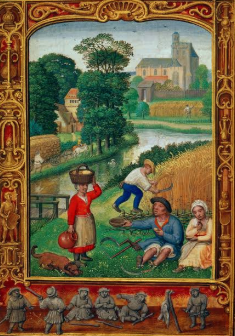
A rare relevant photo: medieval rural life–somewhere.


Other systems of law in the Middle Ages

Just to confuse things, in the Middle Ages English common law coexisted with other legal systems. Church courts applied canon law, urban and rural courts applied local customary law, Chancery and maritime courts applied Roman law. 

The royal courts were for the most serious stuff and were run by a professional (in other words, paid) judge. Starting in the 13th century, those judges traveled to each county two or three times a year and held county assizes. 

County sheriffs held a court in each hundred. 

A hundred? It was an administrative/political division, smaller than a county but bigger than a pie. Starting in the 14th century, justices of the peace took the role over from the sheriffs. They were drawn from the local nobility and gentry, and they weren’t paid for the job but I’d bet a small pie that they got power and prestige from it. 

In towns, borough courts played a similar role.

After all that, we get to manor courts. These were run by the lord of the manor or the village. They dealt with petty crimes–debt, theft, fighting. The accused would more than likely have been the lord’s own villeins.

What’s a villein? That’s medieval-speak for a serf. Sort of, and it sounds nicer, though, doesn’t it? 

The sources I’ve found in a quick search contradict each other about what the difference is between a serf and a villein. One says villeins, like serfs, were tied to the land–not slaves but not free to leave either. Another says villeins were free to leave but generally couldn’t afford to. Both sources are more or less bite-size but the issue’s off to one side of the point I’m trying to make, so let’s use a word that dodges the whole issue: naif

If you consult Lord Google, he’ll inform you that it’s also spelled neif, but I’ll stick with the more familiar spelling. It’s the root of our word naive, and you can trace it back to Old French, where it meant “native inhabitant; simpleton, natural fool.” Or to the Middle Ages, when it meant someone who was born a serf. 

But we were talking about courts. Church courts could try lay people for things like adultery, homosexuality, gambling, or not showing up at church–you know, the stuff that really mattered. Priests acted as the judges and unlike the other courts they had no juries.

If you’re  feeling hemmed in and starting to hyperventilate, I’d say you understand the situation fairly well. Most people probably got through their lives without appearing before any of those courts, but it can leave the modern reader feeling, um, judged. 


Common law and serfdom

With all the throat-clearing out of the way, let’s move closer to that collision I promised. A whole lot of legal time and energy gets devoted, both then and now, to disputes over property, and under feudalism the most valuable properties would’ve been land and the naifs who were trapped on it.

This brings us to the blog Legal History Miscellany, and to a post, “All Bastards Are Free.” Understand, please, that the author, Sara M. Butler, isn’t talking here about people she doesn’t like. She’s using the language of the era. Being born inside or outside of marriage mattered. She saw a passing reference to the bastard children of villeins being born free, wondered if that could possibly be true, and off she went down a fascinating rabbit hole. 

As it turns out, the answer to whether bastard children were born free is both yes and no, and that’s due to common law’s annoying habit of changing without having to file a written notice in triplicate. For information, Butler turned to legal treatises, which are as close as you can get to codified law at this stage. 

In the 12th and early 13th centuries, the child of an unmarried, unfree woman was a naif, even if the child’s father was free. 

What if the parents were married? Worrying over that seems to have kept a good number of lawyers occupied, and they went into intricate detail over it.The result? If both parents were unfree, the child was unfree, whether the parents were married or not. If the man was free and the woman not? The child was unfree. If the mother was free and the father wasn’t? Guess what! The child still wasn’t free. In fact, if that free man married the unfree woman, he lost his freedom.

Go a little further into the 13th century, though, and the rules loosen up a bit: the child follows the status of the mother, so if the mother is free, the child is free.

By the end of the 13th century, opinion was branching out in different directions, as it will when judges are essentially making the law. One treatise held that “One who is begotten of a free man but born of a bondwoman out of wedlock is a serf.” Another held that either parent could pass freedom down to their child. A third held that the father was the determining factor: the child of a free man married to a naif would be free; the child of an unfree man married to a free woman wouldn’t be. 

What happened, then, when the jurors didn’t know who the father was and therefore didn’t know if he was free, unfree, or fur-bearing? According to this line of argument, the child “belongs to the lord of the manor, for his condition is determined by that of his mother, by whomsoever he may be begotten, freeman or serf.”

One of those tracts holds that when “jurors do not in truth know whether [a person] is a villein or a free man, judgement must be in favour of freedom.” Another says that the “blood of a man” should not be tried “by means of women,” which means–

Okay, I’m not entirely sure what it means. It sounds like a woman’s status shouldn’t determine a man’s. I mean, come on, it was humiliating enough that a man had to be born of a woman, but why take it further than that?

What Butler says is, “I would argue that it is in these two statements, when taken together, that we see the glimmer of the origins of the common law rule that all bastards are free. Here’s the problem: the only person who can definitively prove that a bastard child’s father is free is the mother: she knows who she slept with and when. Granted, it surely comes as no surprise to anyone who studies the Middle Ages that by the late thirteenth century authorities were not keen to rely on a woman’s word alone, especially if it meant that a man might lose his freedom, or that an elite man would lose the profits associated with a villein and his entire line.

“Did justices decide to declare all bastards free because they didn’t want to have to rely on the word of a woman?” 

The implied answer is yes.

As one judge put it in 1279, “No woman should be received in proof except in a marriage case.“


Who actually went to court over this?

As long as all this child-bearing stayed on the manor, I doubt there would’ve been much cause to go to court over anyone’s status. Everyone knew everyone and everyone’s nose was undoubtedly in everyone else’s business–and the lord of the manor was the judge anyway, with the locality’s wealthier citizens acting as jury, so the manor court wouldn’t be a smart place to sue for your or your child’s freedom. But if a naif hightailed it to a town, hoping to establish a new life as a free person, and a lord appeared to reclaim him or her, it was up to the lord to prove his right to the person by establishing that he or she came from a line of naifs. 

If the case Butler cites was typical, proving that was harder than it sounds. In 1280, William of Cressy tried to reclaim William son of Siward by producing a collection of (entirely male) relatives to prove that William S. came from a line of unfree men, but either William S. or his lawyer managed to undermine William C.’s claims about their status, one by one. 

Not only were the courts leaning against women, they seem to have been leaning more toward freedom than unfreedom. As one judge wrote, “Free law is more predisposed to save and maintain a man in his free estate than to condemn him or lead him into servitude and so, since you say that he is your villein and he says he is free, the law acts and we ought rather to act to save him and support him in his free estate than to maintain you in this to bring him back and reduce him to servitude, for it is clear that he is free until you have proved him the reverse by his blood.”

In another case, from 1326, Thomas son of Thomas the Elder tried to claim Richard Lachebere, using three unfree relatives as proof. Richard argued that they didn’t share the same blood because “he was a bastard and thus free.” The judge ruled that because Richard was a bastard, “he had estranged himself from every blood, so that he could not be proven a villein by any blood.” 

Or as Butler puts it, “Rather than rely on the word of a woman, it was simply easier to presume freedom.”

I do wonder, though, whether town courts were more inclined toward freedom since they sat outside the manorial system.

What does freedom of the city mean?

Not long after Prince Andrew gave up on huffing and puffing until he blew down Virginia Giuffre’s house–in other words, after he settled her lawsuit out of court–the city of York rescinded an honor it had given him back when he looked a bit less sleazy than he does today: the freedom of the city.

This is significant because, um, why?

Well, it’s not, really. Or it is, but only if you take British traditions seriously, which I have some trouble doing but I’m sure Andy doesn’t. No one could run around dressed in those uniforms if they didn’t take it all seriously. 

Still, in the avalanche of bad publicity that’s fallen on him lately, York’s contribution is barely a pebble. But since it’s an intriguing pebble, let’s talk about what this freedom of the city business is.

Irrelevant photo: This was taken during either Storm Dudley or Eunice, although I’m damned if I remember which one. My partner swore they sounded like an aunt and uncle from Oklahoma–ones no one looked forward to seeing. All that white stuff? That’s foam. We had enough wind to whip the ocean into a meringue.

Starting at the beginning

Freedom of the city dates back to the middle ages, when lords were lords and serfs weren’t free and any sensible person would’ve told you this was the natural order of things. 

All that non-freedom is what made the freedom of the city matter.

According to a “purported law” of William the Conqueror’s–he’s the guy, remember, who won England as his very own plaything in 1066–“If serfs reside without challenge for a year and a day in our cities, or in our walled towns, or in our castles, from that day they will effectively be free men and forever free from their bonds of servitude.”

For a law that’s no more than purported, it seems to have had an impressive impact. It was repeated in various ways by various cities and rulers. Henry II gave Lincoln a charter saying, “Should anyone reside in my city of Lincoln for a year and a day without being claimed by any claimant, and he is contributing towards the customary dues of the city, and the citizens can prove (by the customary legal process of the city) that a claimant was present in England but made no claim upon him, thereafter he may remain in my city of Lincoln, undisturbed as before, as my citizen, without legal challenge.”

For claimant, you can substitute lord–someone with a feudal right to claim this person as, effectively, his property.

Elsewhere, you’ll find specific statements about a villein (that’s what you and I would call a serf) being freed of villeinage if he lives “undisturbed for a year and a day in any privileged town, to the point that he is accepted into its community (that is, gild) he is thereby freed from villeinage.”

Gild? That’s what we’d call a guild. Hold onto that word, because we’ll come back to it.


Consulting the grownups about this

Notice that bit about privileged towns. This year-and-a-day stuff didn’t work in just any town. You couldn’t hide out for the required time in your local market town and hope to be free. The magic only worked if the spell was written into the town’s charter. 

But not every town or city was welcoming to fugitive serfs.

Do I have details about that? I do not. The best I can tell you is that historians aren’t in universal agreement over how common it was for villeins to free themselves this way, or how welcoming or unwelcoming towns were. And since historians are the grownups in this discussion, we’ll leave this for them to work out while we go upstairs and do whatever they told us not to.

It’s worth knowing that free men didn’t live only in cities. They also lived in the countryside, working the land more or less as serfs did. The difference was that they rented their land, didn’t owe the lord any service in kind, and were free to leave, although they couldn’t necessarily afford to. You could be free and as poor as the neighboring serf–or poorer. 

Nothing’s ever simple, is it?


Two footnotes 

  1. Becoming a free man didn’t make you a freeman. That was a different category and we’ll get to it in a minute. What being a free man did do was make you not-a-serf, which was a major change in status,even if it wasn’t the solution to all your problems. 
  2. Almost everything I’ve found talks about free men. Only the Guild of Freemen of the City of London website acknowledges references to women having been guild members. Given the English language’s counterproductive tradition of sometimes insisting that men means both men and women and the rest of the time insisting that men means only men, figuring out what we’re talking about here isn’t easy, but the year-and-a-day thing does seem to have applied to women. As far as I can tell.


Guilds, freemen, and free men

It’s not just the men and women who are hard to tell apart. Several websites get woozy about the difference between free men and freemen. So when the city of Birmingham, by way of example, explains what freemen means, it’s hard to know if it applies to both free men and freemen.

Don’t you just love the English language?

What does the Brimingham website say? “The medieval term ‘freeman’ meant someone . . . who had the right to earn money and own their own land. People who were protected by the charter (rules) of their town or city were often ‘free’, hence the term ‘Freedom of the City.’ ”

Are you confused yet? 

Good. Then you’re following the discussion. You could live in a city and be free, but not be a freeman, and therefore (at least as time went by) not someone who had the freedom of the city. To become a freeman of a city or town, you had to be accepted by one of its guilds, and they limited their membership. If too many people have the right to practice as, say, goldsmiths, prices will drop.

The medieval guilds were powerful organizations, made up of merchants or craftspeople (who weren’t always men). They had a monopoly on their corner of the economy and regulated trade, standards,  apprenticeships, and prices. Each one protected its interests, and they often controlled city or town governments.  

If you couldn’t become a member–and unless you had connections, you probably couldn’t–you might well be free and a man, but you were stuck working as a laborer. You weren’t a freeman of the city.


More about freemen

The Portsmouth City Council website skips over free men and goes straight for freemen:The institution of freemen or burgesses dates from the early beginnings of municipal corporations in the twelfth and thirteenth centuries. Freemen or burgesses enjoyed considerable political privileges, being entitled to elect the officers of the corporation and its representatives in Parliament, although they were not necessarily resident in the borough of which they were burgesses or freemen.”

In this context, the corporation was the city government.

“In choosing freemen or burgesses, boroughs found it convenient to admit men of national importance who might be able to secure greater economic or political privileges for the area. Prominent local landowners with interests in a borough would reward their supporters by securing their admission as freemen or burgesses–between the sixteenth and early nineteenth centuries a very high proportion of the known burgesses in Portsmouth were not resident in the borough.”

In other words, freemen were a select group of a city’s residents (or, just to confuse the picture, non-residents). They were people with power and money. That held until 1835, when the Municipal Corporations Act established city councils. After that, they might very well still have held power, but they had to exercise it differently.


Can we confuse the issue a bit more?

Of course we can. Let’s go to Texas, where a couple of Freedom of the City certificates are sitting in the Ransom Center, which led the center to write about them.

One certificate was issued in London in 1776 to Michael Dancer at the end of his apprenticeship. It was big–2 feet by 5 inches–and came with a tube so Mick could roll it up and carry it around with him. The Ransom Center swears that people would have carried these the way we might carry a passport or driver’s license today, to prove identity and citizenship. 

I offer you a grain of salt to go with that explanation. They might well have needed the document for one thing and another–only people who’d been granted freedom of the city could exercise a trade within London’t city limits, and that held true until 1835–but I’d guess it was too important to cart around the streets every day like a driver’s license. 

The Ransom Center tells us that along with a freedom of the city certificate, London also presented its new members with “a book titled Rules for the Conduct of Life, which was intended to guide them in their life as freemen. While providing many basic laws and recommended codes of conduct, the book also outlined several interesting freedoms available only to freemen.  For example, the book notes freemen have the right to herd sheep over the London Bridge, go about the city with a drawn sword, and—if convicted of a capital offense—to be hung with a silken rope. Other ascribed privileges are said to include the right to be married in St. Paul’s cathedral, to be buried in the city, and to be drunk and disorderly without fear of arrest.”

I’m not exercised about where I get buried–I hope to be past caring by then–but that silken rope might make freedom of the city worth pursuing. 


What does being a freeman of the city get you today?

Not much. Let’s limit ourselves to London: You can’t drive sheep across London Bridge anymore. Capital punishment’s been abolished, so if you want to be hung with a silken rope you’ll have to make your own arrangements. I’m not sure what the law is on drawn swords, but I‘d recommend doing some research before you try it. Folks get twitchy about swords these days, no matter what certificate you’re carrying.

That makes the freedom of the city something you can put on your resume, if you have one, but that’s about it. It’s just a bit of English tradition that you’re welcome to take seriously if you can.

Life at the bottom of the heap in medieval England

Let’s visit the England of the middle ages. 

Why should we do that? Because making the occasional visit to the past is good for us. Finish your spinach and we’ll be ready to go. 

Medieval England was shamelessly hierarchical and society was generally thought of as being divided into three parts. We’ll start at the top, since they would have: The clergy were in charge of people’s spiritual wellbeing. This probably meant telling them all the ways and reasons they could end up in hell, but I don’t have a source for that, I’m just guessing. The clergy also prayed, which was considered a contribution to society.

Irrelevant photo: a rose

The warriors–for which you can read the aristocracy, upper and lower–fought when they were called on. Or at least they were expected to. If you rummage around in all the loose bits of history that no one bothered to file, you’ll find times when they were called on and said, “Sorry, I’m washing my hair right now.” That belongs in a different tale, but it explains why “at least they were expected to” snuck in at the top of the paragraph. 

Finally, at the bottom of society, the peasants, the laborers, and the and-so-forths kept everyone fed and housed to and and-so-forth’d, and they did whatever the other two groups told them to, because who were they to ask questions or have ideas of their own? 

And these divisions were sanctified by religion, which permeated every aspect of life. They would have been almost as self-evident as the knowledge that if you drop things they fall.

Hang onto the almost from that last sentence. This is a two-post visit and we’ll need it when we get to next week’s section.

In English Society in the Later Middle Ages, Maurice Keen—. 

But I need to interrupt myself here so I can apologize. We’ll be short on links today; I’m working largely from books. You remember books? They’re what came before pixels. 

Keen quotes the fifteenth-century Order of Chivalry, which said, “To the knight it sufficeth not that he be given the best arms and the best beast, but also that he be given seignory,” which Keen translates as lordship over lesser men. 

That includes women, of course. Look inside any medieval man and you’ll notice flocks of tiny, unacknowledged, and unquestioning women, cooking the food and washing someone else’s dirty linen. Not to mention sewing, spinning, planting, winnowing, weeding, brewing the ale, and looking after the chickens and cows. And if the family was high enough up on the social scale, embroidering.

Funny how they could do all that and still not be noticeable. I’m delighted that in our happy time we’ve left injustice, hierarchy, and inequality in the past. 

Giving us a wider glimpse of society, Master Ralph Acton wrote, “When God could have made all men strong, wise and rich, he was unwilling to do so. . . . He willed these men to be strong and healthy, wise or rich, that they might save their own souls by helping others through love of them: those others he willed to be weak or foolish or in want, that they might save their souls by enduring hardship in patience. Hence God says, the poor ye shall always have with you.”

Who was Master Ralph Acton? Possibly a fourteenth-century scribe. Also possibly somebody who didn’t exist, in which case we don’t know who wrote that. But the writings themselves do exist, and for our purposes that’s good enough. They reminded the reader that society’s divisions were created by god, so all its inequalities were for the best. 

Occasionally somebody would notice that the three-part division was a little rough and would work out a more detailed picture. The twelfth-century John of Salisbury structured society as a human body. The priesthood was the soul, the king was the head, the warriors were the hands, the laborers and craftspeople were the feet.

And the people who collected taxes? They were the intestines. 

Did he notice the implications of that? Your guess is as good as mine, and mine is that he did. Throughout history, tax collectors haven’t managed to collect much love.

John’s system included a few more body parts, but by now we have enough.

In the countryside, most people were villeins–peasants bound to the lord. And now that we’ve introduced them, to hell with the hierarchy, they’re the people we’re going to spend our time with. In 1290, they made up 60% of the rural population–or to be more accurate, of the rural population living on arable land. They weren’t just bonded to a lord, they were also bound to the land itself. Some definitions draw a line between a serf and a villein. Others count them as the same thing. Let’s not split hairs. We’re using the terms interchangeably here.

And by we, of course, I mean I

Villein, for all you word hounds out there, is the origin of the modern word villain. Not because the villeins were evil but because they were thought of (not by themselves, of course, but by the people who counted themselves as their betters) as uncouth in “mind and manners.” From there, it’s a short distance to being no good at all–a complete villain. 

The key to villeinage was the land. If the lord sold the land, the villeins went with it. But from about 1200 on, he (and lords had a habit of being he’s, although they could also be churches, monasteries, convents, or the very occasional she)–. Let’s start that over: After roughly 1200, he couldn’t just pick them up and sell them separately from the land. The kind of slavery that saw people bought and sold outright was common in Anglo-Saxon England–that’s before 1066, when the Normans stomped in and conquered the place–but became less common afterward. You can mark the shift as starting when William the Conqueror (the big, bad Head Norman himself) imposed a ban on selling slaves to other countries. 

It’s not clear why the shift took place. Morality might have driven it, but it wouldn’t have hurt that serfdom accomplished pretty much the same thing as slavery. And riding herd on villeins might have been easier than riding herd on slaves. 

So villeins weren’t free, but they weren’t exactly slaves either.

At the heart of the feudal system was the manor, which was run by the lord. Each manor had its own rules governing the relationship between lord and villein, and some were harsher than others. The tenants knew the rules as well as the lords did, since although the rules favored the lords heavily, they kept him from having complete, arbitrary control over their lives, leaving him only partial, semi-arbitrary control. 

Now let’s toss in another source, A Brief History of Life in the Middle Ages, by Martyn Whittock. 

The manor was made up of (1) desmesne land, which was farmed for the lord’s benefit; (2) land farmed by villeins, who paid for it by, among other things, farming the demesne; (3) land farmed by free tenants, who paid their rent in cash; and (4) common land, used by tenants in carefully defined ways. 

Villeins owed the lord a set amount of service, and the lord had the right to decide what services he wanted from them during that time. On one estate in the twelfth century, villeins owed five days a week. They might also owe a portion of their crops and animals, and they might owe cash on top of that. 

Villeins couldn’t marry or sell their property without the lord’s permission. They might owe tallages (unpredictable amounts of money that the lord could claim), wood silver (a fee for access to the lord’s woods), boon work (extra services at plowing and harvest times, just when the tenant’s own land needed the most work but who cared about that?), and heriot (the family’s best animal being owed to the lord when the tenant died). They might have to grind their grain at the lord’s mill, at the lord’s price. They might have to pay a fine for having taken part in some forbidden sexual activity–and any imaginative sexual activity was forbidden, along with a lot of activities that didn’t take much imagination. (The link there is to an earlier post on the subject.)

Surprise, surprise, this particular fine fell on women more often than on men. Suddenly they were noticeable.

The list goes on, but you get the picture. 

Villeins could and often did pay a cash rent as a substitute for service. Basically, they were buying back their time. But that didn’t make them free. They were still villeins.

Most serfs could also make wills and buy and sell land if they paid for the privilege. They could be evicted, but until the enclosure movement came along that was rare. (Again, the link’s to an earlier post. The enclosure movement wanders in about halfway down.) The tendency was for tenancies to be passed from one generation to the next–for a fee. If you think of anything a villein might want to do as involving the lord’s permission and a fee, you won’t go far wrong. 

I said serfs couldn’t leave the land. I should have said they couldn’t leave it legally. If they ran away and managed to live in a town for a year and a day, they became free. It’s an odd loophole in the system, and I don’t know its origin. But if they were caught and returned, they were subject to the lord’s justice. There are records of serfs bound in chains to keep them from taking off again. 

The lord ran the manor court, which had the right to impose physical punishments or fines for any act that broke the rules of the manor. And, conveniently enough, any fines the court imposed went to the lord.

Yes, of course the manor courts were impartial and justice was served. I hate it when you get cynical.

Now let’s complicate the picture. Free tenants lived among villeins, in the same villages. Keen paints a picture of village life in which two hierarchies intertwined and people’s social status depended not just on whether they were free or bonded but also on their prosperity. And the two didn’t necessarily line up neatly. A free cottager could be desperately poor. A villein could be prosperous, although most weren’t. It all depended on how much land a person had. A small minority might have upwards of thirty acres. The poorest free cottagers might have no more than a garden and depend on working for others to keep themselves and their families fed.

Telling a free man (which may also mean a woman; I’m not sure) from one who wasn’t free was a complicated business, and it came up in court cases, since only free men could use the royal courts. Villeins were stuck in the (utterly impartial) manor courts. It also came up because people looked for all possible loopholes to so they could be ruled free.

And here you need a warning about health and safety. Or truth in advertising. Or something along those lines. I’m compressing a long time period into a short space. When you compress time, sometimes you get wine, sometimes you get spontaneous combustion, and sometimes you get inaccuracies. So keep in mind that the royal courts weren’t in existence for the whole medieval period, and that even once they sprouted out of the damp ground of medieval politics, they didn’t sit there unchanged until the country rang a huge bell and the medieval period ended. Like any mushroom or bit of government, the courts grew and changed. As did the conditions of rural life.

Now go have a glass of wine and try not to set anything on fire.

To establish whether a person was free, the courts looked at all the things a villein might owe his lord. Did he have a pay a fee to give his daughter in marriage? Did he have to show up a fixed number of days to work for the lord with no clue what work he was going to be doing? Did he pay tallage? If the answer was yes, a serf he was and a serf he remained.

An assortment of people challenged their status as bondsmen, but what they were challenging was their individual status, not the system of bondage itself. Still, when a fair number of individuals pop up and say, “I don’t belong in this category,” you can take that as a sign that the system’s beginning to crack: The old categories don’t fit the realities of life.

Which is probably a good place to tell you that next week we’ll watch the system sprout a big honkin’ crack. In other words, we’ll look at the Peasants’ Revolt of 1381. 

I do love a good revolt.

*

Anyone missing Brexit news should check out the Brexit Blog. It’s clearly written and to the point.